


Your Guide to Cohen and Cohen Full Line Office Interiors


You’re likely here because you’ve been handed a deceptively simple brief: furnish an office. Then the language starts. “Systems furniture.” “Procurement.” “Decommissioning.” “Full line office interiors.” If you’re a business owner, facilities lead, architect, or trade professional, that phrase can sound reassuring and vague at the same time.
That confusion is normal. In commercial furniture, the words often arrive before the clarity. One vendor talks about breadth of inventory. Another talks about planning. Another promises a turnkey result, but means only delivery and installation. A discerning client shouldn’t have to decode an industry dialect before making a sound decision.
Think of this as the conversation you’d have with a family-friend architect over coffee. Calm, precise, and honest about what each term really means. If you’re trying to understand cohen and cohen full line office interiors, the useful starting point is not the catalogue. It’s the buying journey itself, and why some firms solve for availability while others solve for atmosphere, identity, and the complete room concept.
Understanding Your Office Furnishing Journey
A typical furnishing project doesn’t begin with desks. It begins with pressure.
Perhaps your firm has signed a new lease. Perhaps a client has asked you, as their designer, to rework a workplace on a tight timeline. Perhaps you’re inheriting a tired office with mismatched chairs, overbuilt storage, and a boardroom that feels more apologetic than authoritative. At that moment, it's common to start searching broadly and encounter terms that sound extensive but don’t yet feel tangible.
One of those terms is full line office interiors. It suggests a supplier who can cover many needs under one roof. That can be helpful. It can also flatten important distinctions between sourcing furniture, shaping experience, and creating an environment people want to return to.
For many teams, the office conversation now includes far more than furniture. It touches maintenance, lifecycle planning, and operational continuity. If you’re managing a larger property or mixed-use portfolio, a practical companion read on commercial building maintenance helps frame how furnishings sit within the wider responsibility of keeping a workplace functional and presentable.
There’s also a personal side to the process that people rarely admit. Buyers worry about making an expensive mistake that everyone sees every day. Designers worry about specifying something that solves the spreadsheet but weakens the brand. Leadership teams worry about spending on the wrong things.
A well-furnished office isn’t just purchased. It’s edited, coordinated, and lived with.
That’s why it helps to understand how the decision unfolds, from broad research to final placement. If you want a clear primer on that path, this guide to understanding the furniture buying journey from first research to final decision is useful because it mirrors the questions clients ask, rather than the categories vendors prefer to sell.
Where clients usually get stuck
Most confusion falls into three areas:
- Scope confusion. Buyers don’t know whether a company sells products only, or also handles planning, installation, and exit logistics.
- Quality confusion. “New and used” can mean smart value, or it can mean a warehouse of leftovers. The distinction is curation.
- Design confusion. People often assume function and beauty are separate decisions. In good projects, they’re one decision.
Once you understand those distinctions, the phrase “full line” becomes much easier to assess.
What Are Full Line Office Interiors
At its simplest, full line office interiors refers to a commercial furnishing model that offers a broad range of workplace products and related services from a single provider. Rather than buying desks from one source, task chairs from another, filing from a third, and installation from a fourth, a client can work with one company that covers much of the project.
That model appeals to buyers who value efficiency, access, and flexibility. It often includes both new furniture and used furniture, plus planning and support services. In practical terms, the phrase signals breadth.

The Cohen and Cohen example
A concrete example helps. According to its own company information, Cohen & Cohen Full Line Office Interiors has operated as a new and used furniture showroom in Canada’s capital region for over 50 years, and that dual focus on recycled and custom pieces has helped position it as a longstanding provider in Ottawa’s office interiors market. The same source notes that businesses often seek to reduce costs by 50-70% with used furniture compared to new purchases.
That tells you a great deal about the model. Cohen and cohen full line office interiors is not merely about style. It is about access to a wide furnishing mix, including value-driven options for clients who need to move quickly, furnish responsibly, or avoid full replacement costs.
What the phrase usually includes
When a commercial firm describes itself as “full line,” it generally points to a combination like this:
| Offering area | What it usually means for the client |
|---|---|
| New furniture | Current commercial lines for workstations, meeting spaces, reception, and executive areas |
| Used furniture | Pre-owned inventory suited to budget-sensitive projects or phased upgrades |
| Custom options | Selected lines, finishes, or configurations adjusted to suit the project |
| Project support | Planning, sourcing, installation, and often reconfiguration help |
This is why the phrase matters. It doesn’t describe one aesthetic. It describes a service structure.
Why buyers choose this model
A full-line provider is often attractive when your priority is coverage. You may need reception seating, benching, private office casegoods, storage, and conference furniture at once. You may also want a single point of accountability rather than a patchwork of vendors.
Practical rule: If your brief begins with “We need to furnish the whole place,” a full-line supplier is often the first commercial category worth evaluating.
Still, breadth is not the same as refinement. A supplier can offer many pieces without composing a room with any real point of view. That’s the subtle difference discerning clients begin to notice, especially when the office needs to express culture, confidence, and permanence rather than simple occupancy.
Exploring the Core Product Categories
Once you know what “full line” means, the next step is learning how to read the inventory itself. A credible commercial provider should cover the major categories well, but each category solves a different workplace problem. If you don’t separate them in your mind, it’s easy to overbuy in one area and underinvest in another.

Desks and workstations
Desks are the architecture of daily work. In commercial settings, that includes individual desks, height-adjustable tables, benching systems, and private office configurations.
What matters most is not only size, but how the workstation supports the rhythm of the team. An accounting office may need more fixed storage and surface depth. A creative studio may prefer lighter, reconfigurable layouts. In either case, the desk should fit the work, not merely the floor plan.
Seating
Seating is where many projects reveal whether they’re thoughtful or merely assembled. Staff chairs, guest chairs, lounge seating, boardroom chairs, training room chairs, and reception pieces all perform differently.
If you’re comparing options, it helps to understand what makes a proper task chair different from a handsome but inadequate one. This overview of a modern office task chair is useful because it breaks down the functional anatomy buyers often overlook when they shop by silhouette alone.
Good seating doesn’t announce itself on day one. It proves itself after long meetings, repetitive tasks, and a month of real use.
Storage and filing
Storage is less glamorous, but it shapes whether a workplace feels calm or congested. In a full-line environment, you’ll usually see lateral files, mobile pedestals, credenzas, lockers, and modular shared storage.
The key question is whether storage is personal, departmental, or architectural. A pedestal under every desk creates one kind of office. A wall of coordinated storage that doubles as zoning creates another. Those are not interchangeable design moves.
Systems furniture and panels
This category tends to confuse first-time buyers because the term sounds technical. Systems furniture usually refers to modular workplace components such as panels, work surfaces, divider elements, and integrated configurations used to create repeatable work areas.
It’s practical in larger offices because it can adapt over time. If your team expands, contracts, or changes departments, systems furniture can often be reconfigured more easily than fully fixed millwork.
Meeting and collaborative pieces
Conference tables, café tables, soft seating groupings, training tables, and touchdown surfaces all belong here. Their purpose isn’t only to give people a place to sit. They help define how a workplace gathers.
Here’s a useful way to assess them:
- Boardroom furniture should support authority, visibility, and technology integration.
- Informal meeting furniture should reduce friction. People should feel they can use it without ceremony.
- Training furniture should move easily and store efficiently.
- Touchdown furniture should welcome short stays without pretending to be a permanent workstation.
Acoustic and privacy elements
Many clients don’t ask about acoustics until they’ve lived with the problem. Then it becomes urgent. Acoustic panels, privacy screens, phone booths, and soft zoning elements help control distraction in open settings.
This isn’t only about noise reduction. It’s also about dignity. Employees need places to concentrate, speak privately, and reset between modes of work.
Finishes and surface language
A full-line supplier often presents finishes as a final detail. In reality, finishes tell the visual story of the workplace. Laminate, veneer, metal, upholstery, and panel textiles determine whether the office feels generic, institutional, warm, or design-forward.
| Category | What to look for |
|---|---|
| Desks | Scale, cable management, adaptability |
| Seating | Ergonomics, adjustability, upholstery durability |
| Storage | Access pattern, footprint, visual bulk |
| Systems | Reconfiguration potential, consistency across teams |
| Acoustics | Privacy support, visual integration |
| Finishes | Cohesion, wear performance, brand fit |
A true full-line provider should help you understand all of these categories, not just hand you a price list.
Key Services in a Full Line Offering
A full-line office interiors provider is about more than selling desks, seating, and storage. It is coordinating the chain of decisions that turns a floor plan into a working office.
That distinction matters. In commercial projects, furniture is only one layer. Someone still has to translate the plan into specifications, place the orders in the right sequence, coordinate trades and access times, install everything correctly, and stay involved when the space changes. Full-line service covers that operational side of the job.
Space planning and procurement
Space planning gives structure to business needs. It converts headcount, workflow, adjacencies, and circulation into a layout that can be furnished and used well. Procurement then carries that logic into ordering, making sure finishes, lead times, dimensions, and product families work together rather than colliding late in the process.
A single point of coordination can save time and reduce avoidable errors. Yet there is a meaningful difference between ordering an entire office from one source and shaping a workplace with design intent. For clients who want more than a room that fits, Critelli’s commercial design services bring a more curated process, one that treats the office as a complete environment rather than a collection of categories.
Installation and reconfiguration
Installation is a field operation, not a drop-off. It usually includes scheduling, receiving, assembly, placement, punch corrections, and site adjustment. In an active office, it may also require phased work so staff can keep working while the project is being completed around them.
Reconfiguration support is equally important. Offices change. Teams grow, contract, relocate, and reorganize. A provider that can revise panel systems, repurpose private office pieces, and reposition shared furniture helps the original investment last longer.
It works much like tailoring a well-made jacket. The value is not only in the material. The value is in being able to adjust the fit as the wearer changes.
Decommissioning and liquidation
Removal is often the first real task in a workplace project. Before new furniture arrives, someone has to assess what stays, what can be reused, what can be sold, and what must be taken out responsibly.
According to Cohen & Cohen’s service information, full-scope services like facility decommissioning are important; improper decommissioning can lead to 30% higher disposal costs and non-compliance with Ontario’s environmental regulations, whereas a professional approach ensures assets are liquidated efficiently, recovering value and reducing a company’s carbon footprint.
That point helps define what “full line office interiors” means in practice. The term suggests breadth of product, but the core value often sits in project handling before and after the furniture specification itself. Critelli builds on that idea with a more heritage-driven model, where service is not an add-on to inventory. It is part of a considered, high-touch approach to creating complete room concepts with staying power.
The old office does not disappear on its own. It has to be documented, dismantled, moved, and accounted for responsibly.
For clients managing a relocation, renovation, or consolidation, that service can matter just as much as the new pieces selected for the next space.
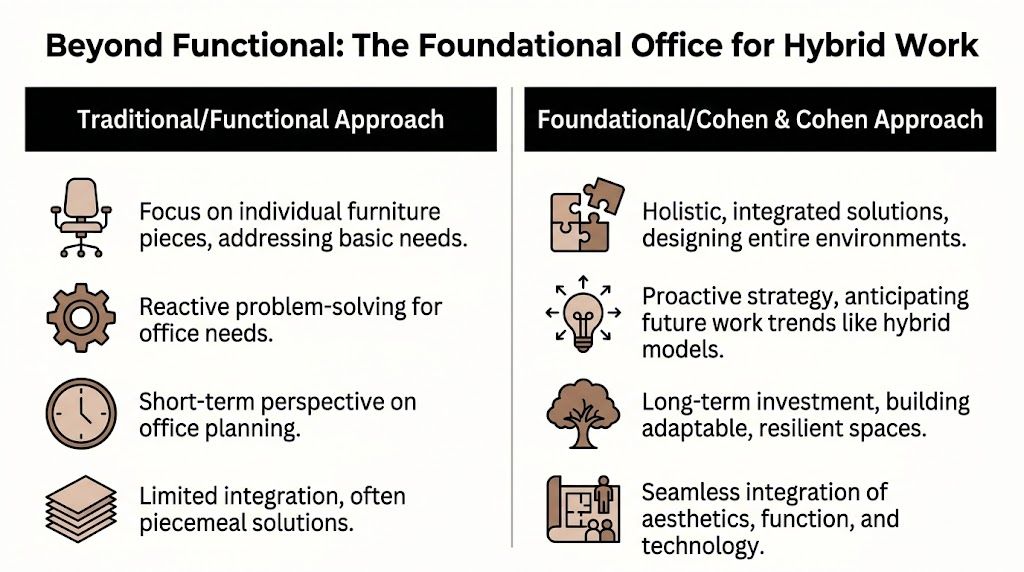
Elevating Your Space From Functional to Foundational
A functional office gives people a place to work. A foundational office gives them a reason to return, gather, and identify with the place. That distinction matters more now because the office is no longer competing with last decade’s expectations. It’s competing with choice.
Cohen & Cohen’s commercial interiors information notes that 28% of office workers in the Ottawa-Gatineau region are now in hybrid models, and that workplaces therefore demand flexible, modular furniture that goes beyond standard inventory and pushes businesses to rethink space for culture and collaboration, not just capacity, according to their commercial interior page. That’s an important shift.
Why inventory alone no longer solves the brief
When attendance patterns vary, square footage has to work harder. A room may need to host focused work in the morning, collaborative sessions at noon, and client-facing presentations by afternoon. That means the old “desk count first” mentality is often too blunt.
A broad supplier can provide modular pieces. That’s valuable. But modern commercial clients increasingly need something more exacting: a furnished environment that feels coherent, intentional, and brand-specific.
Here the contrast becomes subtle but meaningful. The utilitarian full-line approach solves coverage. A curated, design-forward approach solves composition.
The difference between selecting pieces and composing rooms
A thoughtful project benefits from thinking in complete room concepts. Instead of choosing a chair, then a table, then “something for the floor,” the designer begins with the atmosphere the room should hold. Quiet authority for an executive suite. Warmth and confidence for a client lounge. Flexible elegance for a collaborative studio.
That’s also where materiality matters. Rugs, for example, are too often treated as optional in commercial thinking. In refined interiors, they act as spatial anchors. The strongest designers understand rugs as Art for your Floor, not decorative afterthoughts. They establish the room’s cadence, absorb visual noise, and support a layered, design-led composition.
Designer’s Insight
Our designers suggest grounding a tailored seating group with a neutral hand-knotted wool rug, then introducing contrast through sculptural casegoods or a richly finished meeting table. The floor plane should quiet the room before the furniture starts speaking.
Heritage, identity, and the bespoke standard
Heritage-focused firms stand apart from purely utilitarian suppliers. A broad commercial showroom can furnish a space capably. A bespoke studio tends to ask a different question: what should this room say about the people who use it?
That approach often leads to fewer, better decisions. More considered upholstery. More intentional layering. Greater sensitivity to how one zone relates to another. It also favours heirloom quality, timeless craftsmanship, and a curated selection over a warehouse mentality.
For trade clients in Southern Ontario, especially those working across the Greater Niagara, Hamilton, and Toronto markets, that difference is often the difference between an office that functions and one that endures. The former fills a floor plate. The latter supports culture, reputation, and client experience.
The Importance of White-Glove Service and Legacy
Design can be excellent on paper and disappointing in reality if the final execution is careless. This is why service quality matters so much in premium interiors. The last step is not a minor logistical detail. It’s part of the design experience itself.

What white-glove service actually means
In furniture, white-glove service means more than dropping cartons at reception. It means receiving, inspecting, assembling, placing, adjusting, and leaving the site orderly and ready for use. In a commercial setting, that level of care protects both the product and the project schedule.
It also protects the design intent. A beautifully selected room can lose its balance if pieces are placed carelessly, rugs sit out of register, or final adjustments are skipped. Professional furniture assembly services near me are relevant here because they point to the operational side of what clients often assume happens automatically.
Why legacy still matters
Longevity in this field isn’t only a charming detail. It signals process discipline, vendor knowledge, and the judgement that comes from seeing many kinds of projects through. Heritage also reassures clients that the company understands continuity, not just transactions.
A family-run business founded in 1914 carries a different kind of authority than a short-cycle seller assembled around trend and convenience. That century-old continuity suggests care, memory, and standards passed down rather than improvised. It aligns naturally with clients who value artisanal quality, careful editing, and a room that feels settled rather than merely finished.
Some firms move furniture. Others steward an entire transition from showroom to final placement.
That distinction becomes especially meaningful when the office must feel polished on day one, not halfway complete while teams chase installers, fix placement errors, and manage packaging debris themselves.
Begin Your Bespoke Office Design Journey
By now, the distinction should feel clearer. Cohen and cohen full line office interiors describes a broad commercial model. It can be practical, efficient, and cost-conscious, particularly when a client needs access to both new and used furnishings with related services under one roof.
But the most memorable workplaces are rarely the product of breadth alone. They come from judgement. They come from coordinated materials, measured restraint, and the confidence to think of furniture as part of a larger interior story. For trade professionals and business owners, that’s the pivot from buying inventory to shaping experience.
If you’re refining your own brief, it can help to revisit broader office design principles and compare them against what your workplace is seeking to achieve. Then bring those priorities into a more individualized specification process, especially if you’re considering custom or design-led solutions. This guide on getting started with custom order is a sensible next read for clients who want more control over finish, scale, and final composition.
The office no longer needs to be merely efficient. It can be elegant, adaptable, and expressive. It can support hybrid rhythms without surrendering character. It can feel curated rather than assembled.
For clients across Southern Ontario, including the Greater Niagara, Hamilton, and Toronto markets, that’s a worthwhile standard to hold.
Experience the craftsmanship in person at Critelli Furniture and discover a heritage approach to interiors shaped by timeless craftsmanship, curated selection, and white-glove care. Book your complimentary design consultation today, or visit the Rug Market to find your room's foundation.