
Mid Century Modern Couches: A Definitive Buyer’s Guide


A familiar moment plays out in our showroom every season. A couple has finished the walls, chosen the lighting, and lived with a temporary sofa far longer than intended. The room is almost right, but not settled. They want one piece that can hold the whole space together without feeling trendy or overworked.
That’s often where mid century modern couches enter the conversation.
The right one does something few furnishings can do. It brings discipline to a room without making it cold. It feels structured, but still welcoming at the end of a long day. In heritage homes across St. Catharines, newer builds in Greater Niagara, and design-conscious residences stretching toward Hamilton and Toronto, that balance matters. You want a sofa with presence, not bulk. Character, not gimmick.
At a family firm founded in 1914, we’ve seen how often buyers confuse the look of mid-century design with the substance of it. A sleek profile is easy to imitate. Lasting comfort, proper joinery, good proportions, and material choices suited to Southern Ontario living are not. That distinction is what turns a stylish purchase into an heirloom-quality investment.
A mid-century sofa shouldn’t be chosen in isolation. It has to answer the room, the architecture, the way you sit, and the way your household lives. In a complete room concept, the couch becomes the anchor. The rug establishes the foundation. Lighting sets the mood. Delivery and placement matter just as much as the initial selection, because a piece this important has to arrive and settle beautifully.
An Introduction to Timeless Living
A homeowner walks into the room and sees the problem immediately. The existing sofa is too deep for conversation, too bulky for the windows, and too anonymous to justify the floor space it claims. The coffee table floats. The chairs feel unrelated. Nothing is technically wrong, yet nothing feels resolved.
That’s the sort of room a mid-century modern couch can correct.
The appeal isn’t only visual. A well-made MCM sofa gives a room structure. It creates legible lines, keeps the floor plane open, and introduces a sense of intention that many newer, overstuffed silhouettes are unable to offer. In older Southern Ontario homes especially, where room dimensions and doorway clearances aren’t always generous, that restraint becomes more than a style preference. It becomes practical design.
When clients come to us for a sofa of this kind, they’re rarely asking for “retro.” They’re asking for permanence. They want a piece that looks considered now and still feels right years from now. They want timeless craftsmanship, visible wood, clean upholstery, and proportions that respect both daily life and the architecture around them.
A good sofa doesn’t just fill the centre of the room. It teaches the rest of the room how to behave.
That’s why the conversation has to go deeper than colour and silhouette. You need to know what authentic construction looks like, which materials hold up, how scale affects comfort, and when bespoke work is the smarter path. In a heritage-minded firm, those are ordinary questions. They’re also the questions that protect your investment.
The Enduring Allure of Mid-Century Design
Mid-century design still resonates because it effectively solved problems. It favoured simplicity over ornament, clarity over excess, and function over decoration that served no purpose. That philosophy still feels current because the desire for calm, usable, and visually coherent homes persists.
Why the language of MCM still works
The hallmarks are easy to recognise once you know what to look for. Clean horizontal lines. Gentle curves rather than heavy carving. A raised profile that lets the room breathe. Wood used as a design feature rather than hidden under upholstery. Every detail is meant to do something.
Those choices weren’t accidental. The style embraced a form follows function approach, which is why authentic pieces rarely feel fussy. If an arm is slim, it preserves visual space. If the back is lower, it protects sightlines. If the legs are tapered, they reduce visual weight and keep the silhouette light.
For buyers trying to separate timeless design from imitation, that’s the test. Ask whether the shape looks disciplined because it was thoughtfully resolved, or whether it looks spare because corners were cut.
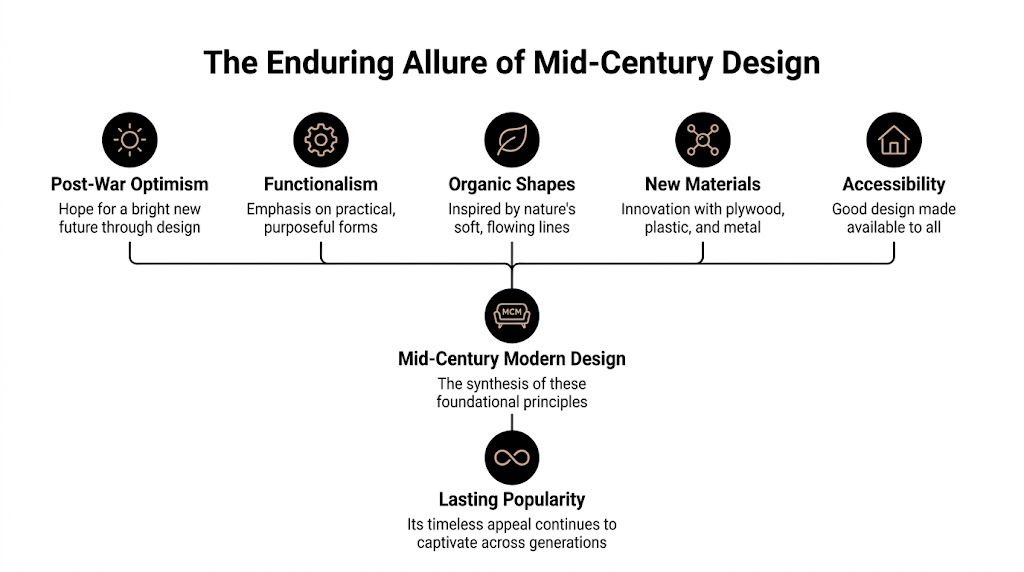
If you’d like to see how these principles translate into actual furnishings, this collection of mid-century furniture in Toronto offers a useful visual reference for scale, profile, and material direction.
The details that make it recognisable
A true MCM sofa tends to share a small family of visual cues:
- Raised stance with visible space below the frame, which keeps the room lighter.
- Minimal ornamentation so the silhouette carries the design.
- Mixed material expression, often pairing warm wood with fitted upholstery.
- Geometric discipline softened by organic curves at the arm, back, or corner.
The result is versatile. A mid-century couch can live comfortably with contemporary art, traditional millwork, sculptural lighting, or a quieter Japandi palette. It doesn’t demand a museum set. It asks for balance.
Designer’s Insight
Three silhouettes matter most. Start by identifying whether you’re drawn to a straight-track sofa, a softly curved conversation sofa, or a sectional with a disciplined low profile. Most buyers respond strongly to one of these before they ever choose fabric.
That insight saves time. Clients often think they’re choosing colour first, when in reality they’re reacting to architecture. A straight-track sofa supports symmetry and order. A curved form softens boxy rooms and formal sightlines. A sectional serves households that want ease without surrendering visual refinement.
A lasting design language always gives more than one answer. That’s part of why mid century modern couches continue to earn their place. They don’t impose a script. They create a strong framework and let the room become personal.
Anatomy of an Heirloom Quality MCM Couch
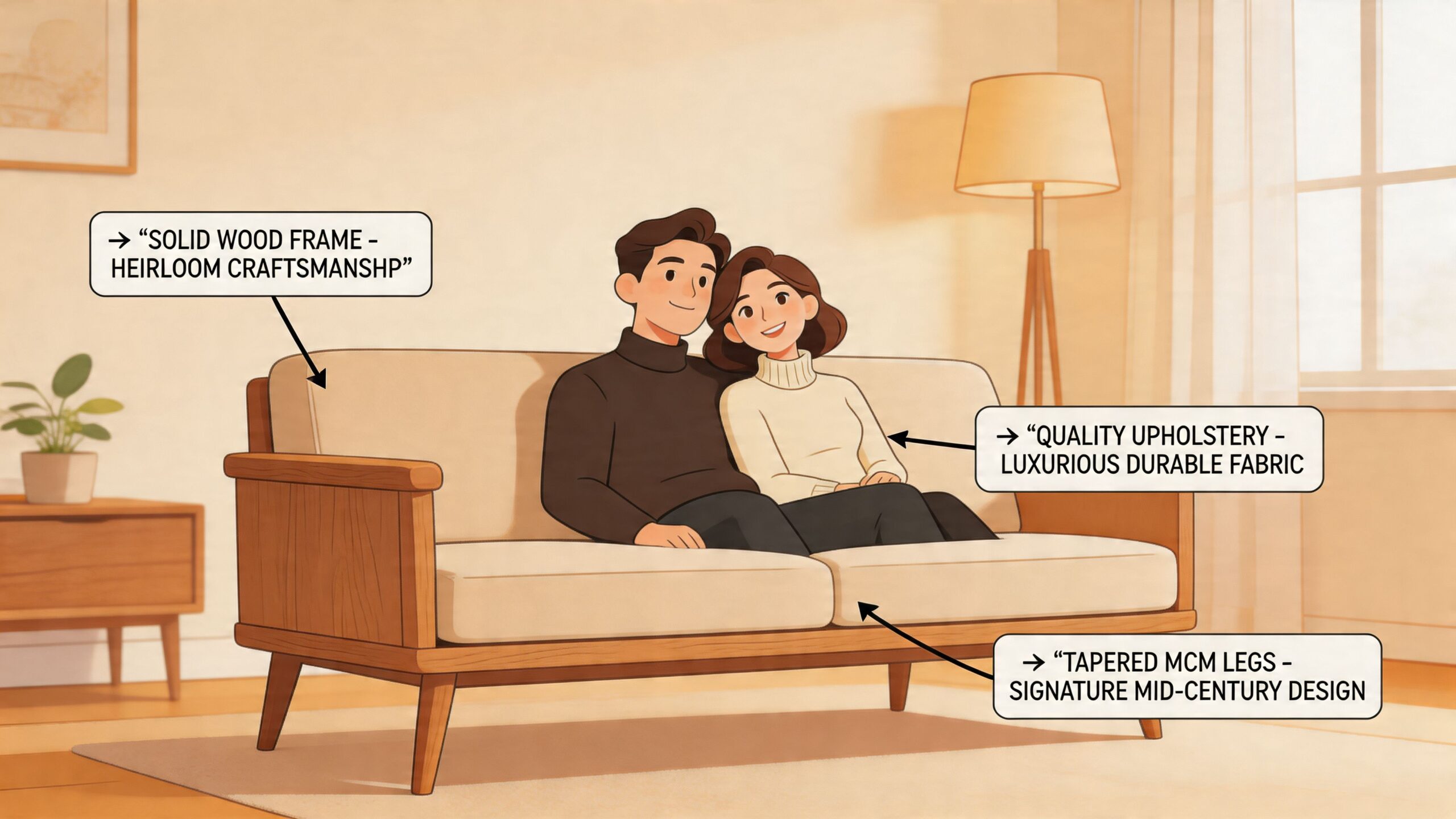
A handsome profile means very little if the construction beneath it is weak. With a serious sofa, the work starts where you can’t immediately see it. Frame, joinery, suspension, foam, upholstery tension, and finish quality determine whether the piece will still look composed after years of use.
Start with the frame
Authentic mid-century modern sofas use a specific frame architecture. They’re typically built from solid hardwoods such as walnut or oak, and they stand on raised, tapered legs of 7 to 10 inches. That raised stance isn’t merely aesthetic. It improves weight distribution across the frame. The same construction guidance notes that half-lap joints provide stronger frame integrity than dowel-only assemblies, reducing stress points that can lead to premature failure, as outlined in this mid-century modern sofa construction reference.
In practical terms, that means the sofa has a better chance of remaining square, steady, and quiet over time. No rocking. No twisting. No subtle loosening that turns a graceful piece into a maintenance issue.
Comfort isn’t separate from structure
The seat profile tells you a great deal about whether a couch was engineered properly. Authentic MCM sofas generally maintain a seat height of about 17 to 20 inches, paired with firmer cushioning. That lower, more structured sit creates a very different comfort experience from a deep, sink-in contemporary sofa.
That doesn’t mean less comfort. It means a different kind of support.
| Element | What works | What doesn’t |
|---|---|---|
| Seat feel | Structured support that keeps posture balanced | Overly soft fill that collapses the silhouette |
| Leg design | Tapered, raised legs that lighten the visual mass | Blocky bases that make the frame feel heavy |
| Joinery | Half-lap construction and reinforced frame points | Dowel-only assembly in a high-use household |
| Upholstery fit | Tight tailoring that holds the line of the piece | Loose, baggy fabric that sags quickly |
Upholstery is where many replicas fail
Material choice is never just about appearance. In mid-century design, upholstery has to support the shape. Tight-weave fabrics and full-grain leather suit the style because they hold a cleaner line than plush or loosely woven textiles. The profile remains crisp instead of softening into something shapeless.
Informed specification matters. Tight-weave linen or performance fabrics resist sagging better than looser constructions, while leather naturally resists moisture absorption and mildew formation. For buyers comparing fabric options, this guide to upholstery materials is a helpful starting point.
Designer’s Insight
Cushion density changes both the comfort and the longevity of the silhouette. A firmer, high-resilience core keeps the seat line cleaner over time, which is exactly what a mid-century sofa needs to remain elegant rather than tired.
That observation matters more than most buyers expect. A cushion that feels inviting in a showroom can become frustrating at home if it loses shape too quickly. Mid-century sofas rely on disciplined geometry. Once the seat crowns unevenly or the back pillows slump, the whole piece looks older than it is.
When evaluating any sofa, look at the underside, ask about frame wood, ask how the joints are made, ask what supports the seat, and ask how the upholstery will wear in your climate and household. Those are the questions that distinguish a styled set piece from a sofa with heirloom quality.
Choosing the Right Couch for Your Home
Selection gets easier once you stop asking, “Do I like this sofa?” and start asking, “Does this sofa solve my room?” The distinction is important. A beautiful couch can still be wrong if it interrupts circulation, blocks light, or asks too much of a modest room.
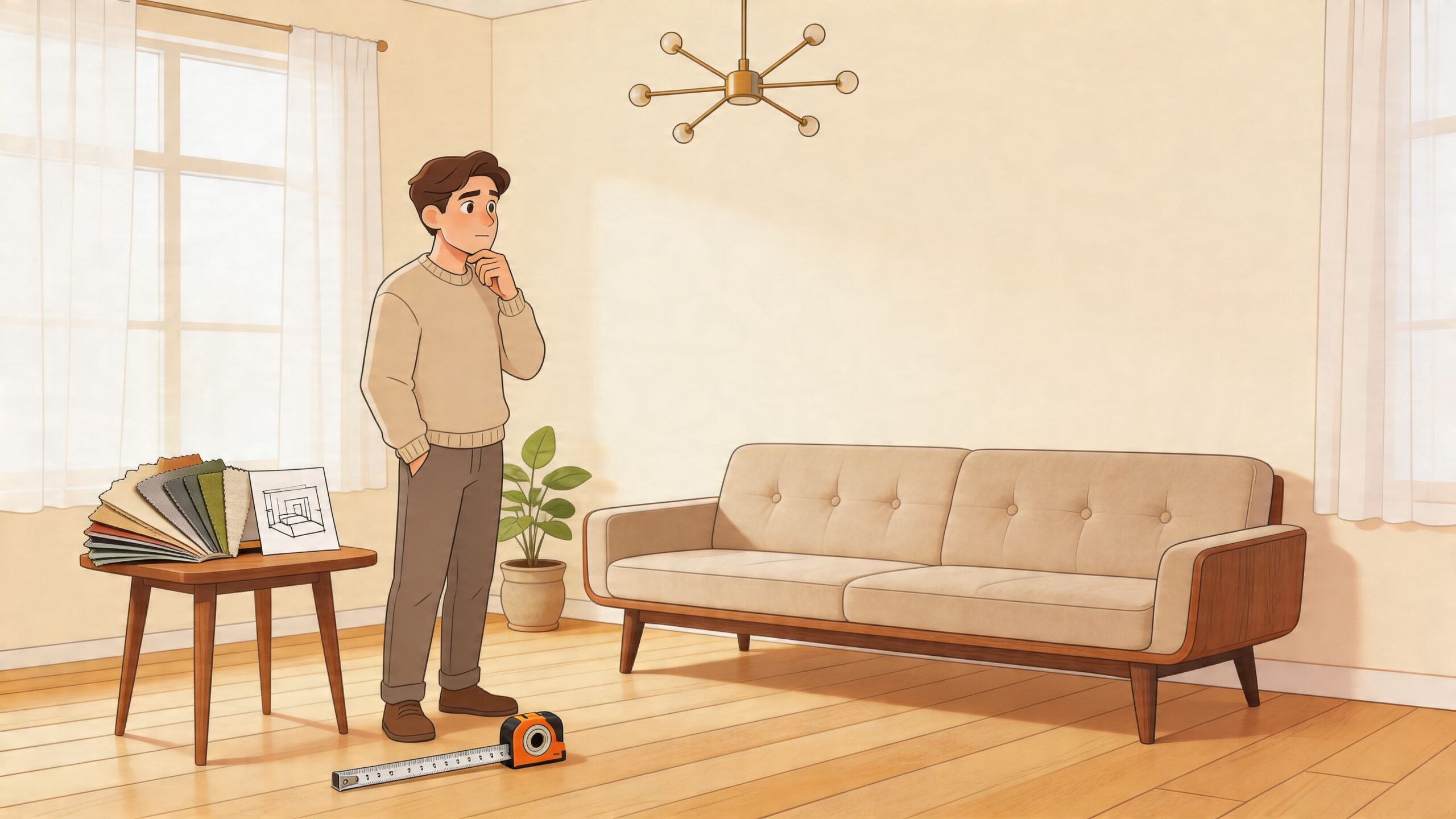
Measure the room you have, not the room you wish you had
Many heritage homes in St. Catharines and across Niagara have charm in abundance and generosity in all the wrong places. You may have lovely trim, deep baseboards, and excellent windows, then discover that the room narrows exactly where the main seating needs to sit. Doorways, stair turns, and radiators often shape the decision as much as style does.
Before discussing upholstery or wood tone, map these three things:
- Traffic path. Keep the route through the room clear and intuitive.
- Sightlines. Check what happens from the front hall, kitchen opening, or fireplace.
- Architectural interruptions. Note vents, low windows, trim, and door swings.
A sofa that respects those conditions will always feel more expensive than one that merely fills the available wall.
Ergonomics decide whether you’ll keep loving it
Seat depth, back height, and arm width all matter. A household that entertains often may prefer a slightly more upright seat that encourages conversation. A family room used for reading and long evenings may want more depth, but not so much that shorter sitters can’t use the back properly.
This is also where many online purchases disappoint. Photos don’t tell you whether your feet meet the floor comfortably or whether the back support lands in the right place.
Practical rule: Sit the way you actually live. Don’t test a sofa politely for thirty seconds in a showroom if you know you’ll spend evenings curled into one corner with a book or stretched across it on a Sunday afternoon.
When bespoke is the wiser route
Straight-line MCM sofas are easy to find. Curved and wedge-back sectionals are not. For Southern Ontario homeowners in pre-1980s homes, that gap is especially relevant. Searches from 2025 to 2026 found a 97% market gap between straight and curved models available new in Ontario, which helps explain why buyers with awkward rooms often have to look beyond standard retail offerings, according to this research on curved wedge-back sofa sectionals.
That scarcity is one reason custom work makes sense in older homes. If your room needs a softened corner, a narrower depth, a reworked arm, or a sectional that can make the turn into the house, bespoke specification isn’t indulgence. It’s problem-solving. Custom couches in Toronto and Southern Ontario are one route for buyers who need that level of fit and finish.
Designer’s Insight
A reliable rule of thumb is simple. If the sofa dominates the room before any other major piece is added, it’s too large. If it disappears once rugs, chairs, and tables arrive, it’s too small. The best proportion feels settled, not crowded and not tentative.
Clients often want one decisive answer, but good scale is relational. The room chooses with you. Ceiling height, rug size, window height, and companion seating all affect what the sofa should be. That’s why the smartest purchase isn’t always the one with the strongest first impression. It’s the one that still looks right after every other element is placed around it.
Styling Your Space Around the Couch
A mid-century sofa should never feel stranded in the middle of the room. It needs context. The most successful rooms treat the couch as the anchor of a wider composition, not as a standalone object dropped into place at the end.
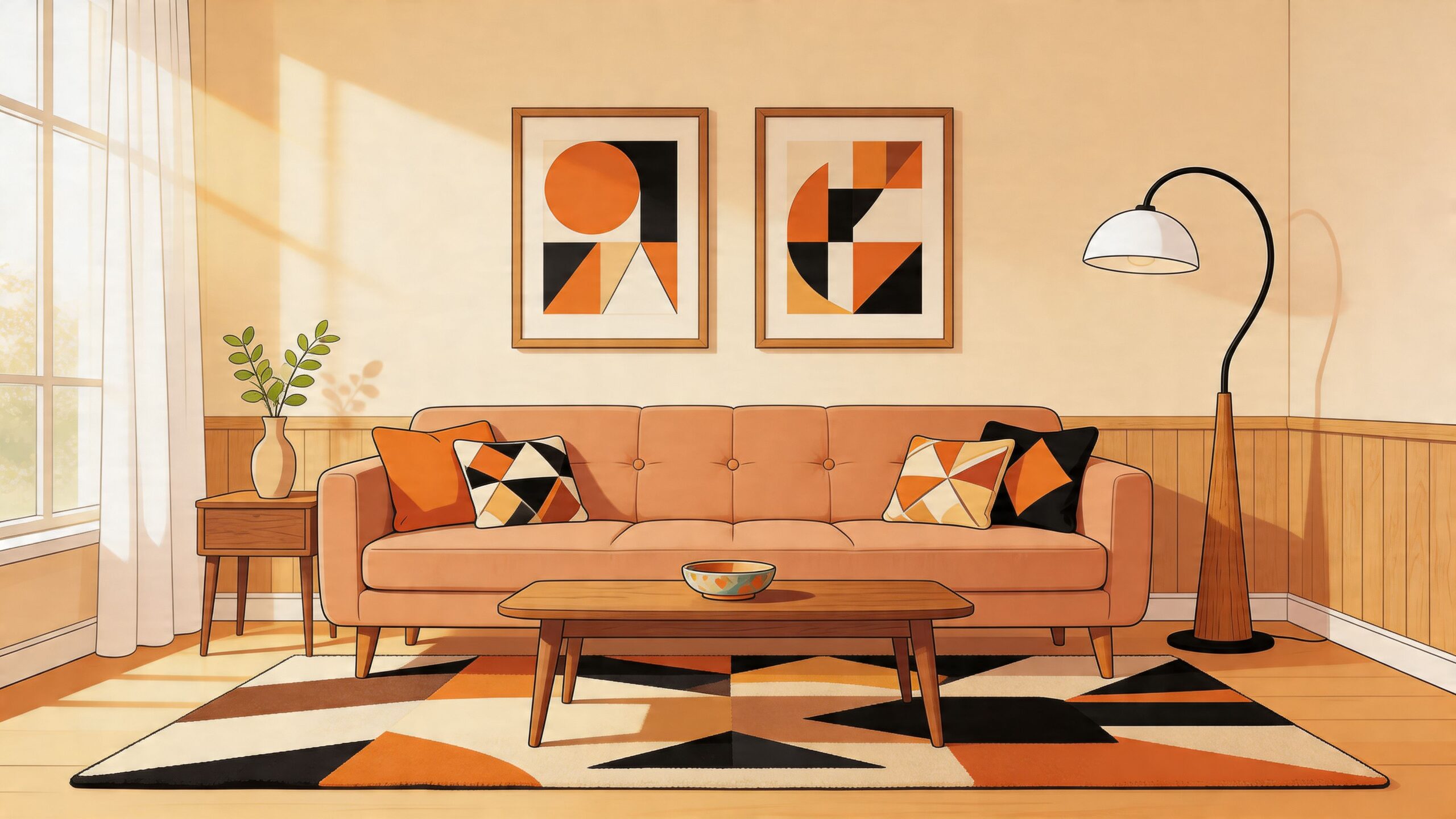
Begin with the floor
In design practice, the rug usually answers questions the sofa cannot. It defines the seating area, absorbs the visual weight of the upholstery, and establishes the palette that everything else can borrow from. This is why we often describe rugs as Art for your Floor. They don’t merely protect surfaces. They set the emotional register of the room.
A geometric or subtly textured rug can sharpen a mid-century silhouette beautifully. A hand-knotted wool piece adds depth and maturity. A room with a leather MCM sofa and no rug often feels unfinished, because the hard and smooth surfaces need something to counterbalance them.
For buyers working through scale, this area rug sizing guide helps resolve one of the most common mistakes in living room planning.
Keep the supporting pieces disciplined
The instinct to make everything “mid-century” usually creates a stage set. Better rooms mix periods and textures while respecting the sofa’s language.
A few reliable pairings work especially well:
- Lighting with sculptural form keeps the room lively without adding clutter.
- Wood or stone occasional tables echo the natural materiality of the sofa.
- A lounge chair with a different silhouette avoids the matched-suite look.
- Artwork with scale and restraint gives the sofa a backdrop, not competition.
The room should feel collected, not cast from a single era.
Designer’s Insight
Pair a rich leather MCM sofa with a neutral hand-knotted wool rug to create textural balance. The leather gives the room structure and polish. The rug softens the acoustics and brings warmth back underfoot.
That pairing works across a broad range of homes, from downtown condominiums to larger residences in Hamilton and the Greater Niagara region. If the room needs more softness, add linen drapery and a curved lamp. If it needs more edge, introduce darker wood and graphic art.
The strongest complete room concept doesn’t overstate the period. It takes the values of mid-century design, clarity, proportion, natural material, and functional beauty, then layers them into a room that feels current and lived in.
Maintaining Your Timeless Investment
A well-made sofa doesn’t ask for constant attention, but it does reward consistent care. Mid-century pieces are especially dependent on that discipline because their beauty is so tied to clean lines, visible wood, and well-kept upholstery. Neglect shows quickly.
Protecting the frame and wood details
Raised wood legs and exposed trim should be dusted gently and kept free of moisture buildup. In Southern Ontario, that matters more than many homeowners realise. For buyers in high-humidity climates like Niagara, where annual relative humidity averages 68% to 75%, material choice becomes especially important. Imported MCM replicas can show 40% faster fabric fading and 15% to 20% more wood warping than pieces made with suitable local hardwoods and climate-appropriate finishes, according to this mid-century modern sofa guide focused on buying considerations.
That’s why placement matters. Keep exposed wood away from direct heat sources and prolonged sun when possible. If the room receives strong afternoon light, use window treatments strategically rather than waiting for the finish to tell you there’s a problem.
Caring for leather and fabric properly
Leather and performance fabric require different routines, but both benefit from regular, gentle maintenance. Dust, body oils, and airborne residue settle gradually. If they’re left alone too long, cleaning becomes more aggressive than it needs to be.
A sound approach includes:
- Weekly light vacuuming with an upholstery attachment to remove grit from seams and under cushions.
- Prompt attention to spills using the manufacturer’s care guidance rather than improvised household mixtures.
- Rotation of loose cushions where construction allows, so wear stays even.
- Periodic professional care when the piece needs deeper cleaning than routine maintenance can provide.
For readers who want an example of what a specialist service looks like, this overview of professional upholstery cleaning services in Baltimore gives a useful sense of the standards and methods worth looking for when you hire locally.
If you own leather, this guide on caring for leather furniture is worth keeping on hand for routine maintenance.
Designer’s Insight
A simple natural wood refresher can be made with mild ingredients, but restraint matters more than the recipe. Use only a lightly dampened soft cloth, never a wet one, and always dry the surface immediately. The goal is to lift dust and residue, not saturate the finish.
Good maintenance is quiet work. It isn’t dramatic, and it doesn’t require a cabinet full of products. It requires attention before damage becomes visible. Done consistently, that’s what keeps a trim sofa looking composed year after year.
Your Buying Checklist and The Critelli Experience
A mid century modern couch usually looks convincing for the first five minutes in a showroom. The test comes later, when it has to fit through a narrow front hall in an older Niagara home, sit comfortably through a long winter evening, and hold its shape after years of daily use. That is why I ask clients to treat this purchase as a room decision, not a retail errand.
The right piece should suit your house in Southern Ontario, your habits, and the way your room will age over time. Dry winter air, strong summer sun, open-concept renovations, and compact heritage layouts all change what will perform well.
The checklist to bring with you
Arrive with facts, not guesses. That alone prevents many expensive errors.
- Bring exact room measurements. Include wall lengths, window locations, radiator placement, door swings, and any fixed elements that limit layout.
- Measure every access point. Front door width, stair clearance, ceiling height at landings, elevator dimensions, and tight turns all matter before you order.
- Be honest about how you sit. Reading, entertaining, television, afternoon naps, and family use call for different seat depths, back heights, and arm profiles.
- Ask how the frame is built. Hardwood species, joinery, and suspension affect lifespan more than styling language ever will.
- Ask how the upholstery will mature. Some leathers develop character. Some fabrics keep a crisp line. Some textured weaves show dust and pet hair more readily.
- Bring the rest of the room with you. Rug dimensions, flooring samples, paint references, millwork finishes, and photos from several angles help the selection feel grounded.
A notes app is enough. Accuracy matters more than presentation.
What to test in person
A photograph cannot tell you whether a sofa is comfortable at the end of a long day, or whether its proportions feel settled in a real room.
Use this in-showroom test:
| Check | What you’re looking for |
|---|---|
| Seat height | Feet rest naturally on the floor |
| Back support | Upright sitting feels relaxed, not stiff |
| Arm height | Comfortable for lounging and scaled to the frame |
| Cushion response | Support with good recovery after standing |
| Visual scale | Presence without bulk |
Sit upright first. Then lean back, shift to one side, use the arm, and stand up again. A well-made couch handles ordinary movement with composure. If you have to adjust your posture to make the sofa work, it is the wrong sofa.
Ask the same questions you would ask of cabinetry or millwork. What is it made of? How is it assembled? How will it look after ten years in a bright family room?
Why the buying process matters as much as the sofa
An heirloom purchase rarely succeeds in isolation. The sofa sets the scale for the rug, the rug affects how large the room feels, and both influence coffee tables, lighting, and circulation. I have seen handsome couches disappoint because no one accounted for the room around them.
That is where professional design service earns its keep. Clients get clearer proportions, fewer ordering mistakes, and a finished room that feels resolved rather than slowly corrected over several months.
Since 1914, Critelli Furniture has operated as a family-run firm in St. Catharines, serving clients across Niagara, Hamilton, and Toronto. For a Southern Ontario homeowner, that local experience matters. It means the buying process can account for older house footprints, condo access limits, busy family rooms, lake-effect light, and the practical wear patterns that come with four real seasons.
The experience after you choose
The order is only part of the job. Delivery, placement, inspection, and setup all affect how the piece arrives and how well it begins its life in your home. A properly handled delivery protects the sofa, your walls, your floors, and the confidence that you made the right choice.
Clients also find that the room often comes together only after the sofa is placed and the floor plan is confirmed. At that stage, final decisions about rugs, side tables, and lighting become much easier because the anchor piece is no longer theoretical.
For care after purchase, broad homeowner references can still be helpful. If you want a practical overview of spill response, fabric-safe methods, and routine upkeep, this ultimate guide to couch cleaning solutions is a useful starting point.
A strong buying experience leaves no loose ends. You know why the couch was selected, how it fits your home, what materials you are living with, and what kind of support you can expect after it arrives.
To experience the craftsmanship in person and discuss a complete room plan around an heirloom-quality mid century modern couch, visit Critelli Furniture.