


Cost of Upholstery Fabric: Price Ranges and Drivers

A yard of upholstery fabric can cost CAD 45 to CAD 100.90 before shipping and tax, according to the Canadian retail listings compared in the price ranges below. Fabric is only one part of the project budget: labour, freight and pattern waste add to the finished cost.
Price per yard is a starting point, not a measure of value. A lower-priced fabric may wear through sooner, while a more durable option can spread its cost across more years of use. Compare fabrics by cost relative to durability, then consider how their texture, care needs and cutting efficiency suit the sofa and the room.
For Southern Ontario homeowners, the goal is fabric that fits both daily use and the room's character. A considered choice balances appearance, practical care and expected wear, rather than focusing on yard price alone.
Upholstery Fabric Prices at a Glance
Canadian retail benchmarks span CAD 45 to CAD 100.90 per linear yard, with a solution-dyed acrylic example listed by WickerPark's Sunbrella fabric collection at the lower end. The following comparison brings together representative Canadian listings, rather than presenting a custom furniture or reupholstery quote.
Upholstery fabric price bands in Canada by type
Prices are per linear yard on 54-inch-wide cloth, before shipping and tax. Abrasion figures are Wyzenbeek double-rub ratings where listed.
| Fabric type | Price per linear yard (CAD) | Abrasion rating (double rubs) | Typical use |
|---|---|---|---|
| Solution-dyed acrylic, Sunbrella 54-inch | 45 | Not stated in the cited listing | Outdoor and sun-exposed seating |
| Bouclé, performance | 64.90 | More than 204,000 | Accent chairs and light-use sofas |
| Tapestry, heavy-duty | 77.90 | More than 45,000 | Traditional pieces with decorative weight |
| Cotton, polyester and acrylic woven | 77.90 | More than 150,000 | Family-room sofas and dining chairs |
| Crypton performance fabric | 100.90 | More than 100,000 | High-use seating that needs stain resistance |
These examples show why price and abrasion resistance aren't interchangeable. Decorative complexity can command a premium, while a comparatively economical performance textile may provide substantial resistance to seating friction. The suggested uses describe design applications, not restrictions imposed by the abrasion figures.
What a linear yard actually buys
A linear yard measures length along the roll, not a square yard of material. Width therefore matters: a narrower decorative cloth can require more purchased length to cover the same furniture, especially when the upholsterer must keep a motif centred.
Bolt pricing can create another misunderstanding. On Pins & Needles Quilting Co.’s explanation of how much a bolt costs provides useful background on buying cloth by the roll, but an upholstery estimate still needs the chosen fabric's usable width and required length.
Practical rule: Compare fabric allowances at the same width and with the same cutting requirements, not simply by the lowest ticket price.
The performance examples provide a useful starting band for family-use seating, but they don't establish a universal minimum budget. A household's cleaning habits, pets, sunlight and preferred texture should determine the specification.
For a new sofa, the living room sofa buying guide helps connect upholstery selection with frame, scale and comfort. A sensible shortlist contains fabrics within a comparable price band, followed by a review of abrasion performance before the final colour decision.
Recent Price Trends in Canadian Upholstery Categories
Statistics Canada reports that upholstered furniture prices fell 0.9% on an annual-average basis in 2025, while wooden furniture rose 2.6% and other furniture, including mattresses, rose 1.6% (Statistics Canada's summary of household furnishing prices). The same release records decreases of 1.6% for window coverings and 1.9% for bedding and other household textiles, following four consecutive years of annual increases for bedding and other household textiles (Statistics Canada's summary of household furnishing prices).
These figures track price movement across broad categories of household purchases. They provide context, but they do not give the price per metre or yard of a specific upholstery fabric.
What the trend means for a furniture decision
A lower upholstered-furniture index can help frame a comparison between replacing seating and recovering an existing piece. The price of a particular fabric or custom order still depends on its current quote and availability.
Rising wooden-furniture prices may make it useful to assess an existing frame before replacing it. The decision depends on the frame's joints, suspension, proportions and repair needs.
- For replacement furniture: Compare complete specifications, including upholstery grade, construction and delivery.
- For reupholstery: Have the frame and cushion interiors assessed before committing to cloth.
- For either route: Obtain a current written price for the exact fabric and quantity.
Annual averages describe a period, not a purchasing schedule. Check the supplier's current listing, stock and project-specific quote before ordering, especially if the chosen textile is available in a limited colourway or production run.
What Fibre, Weave and Finish Do to the Price
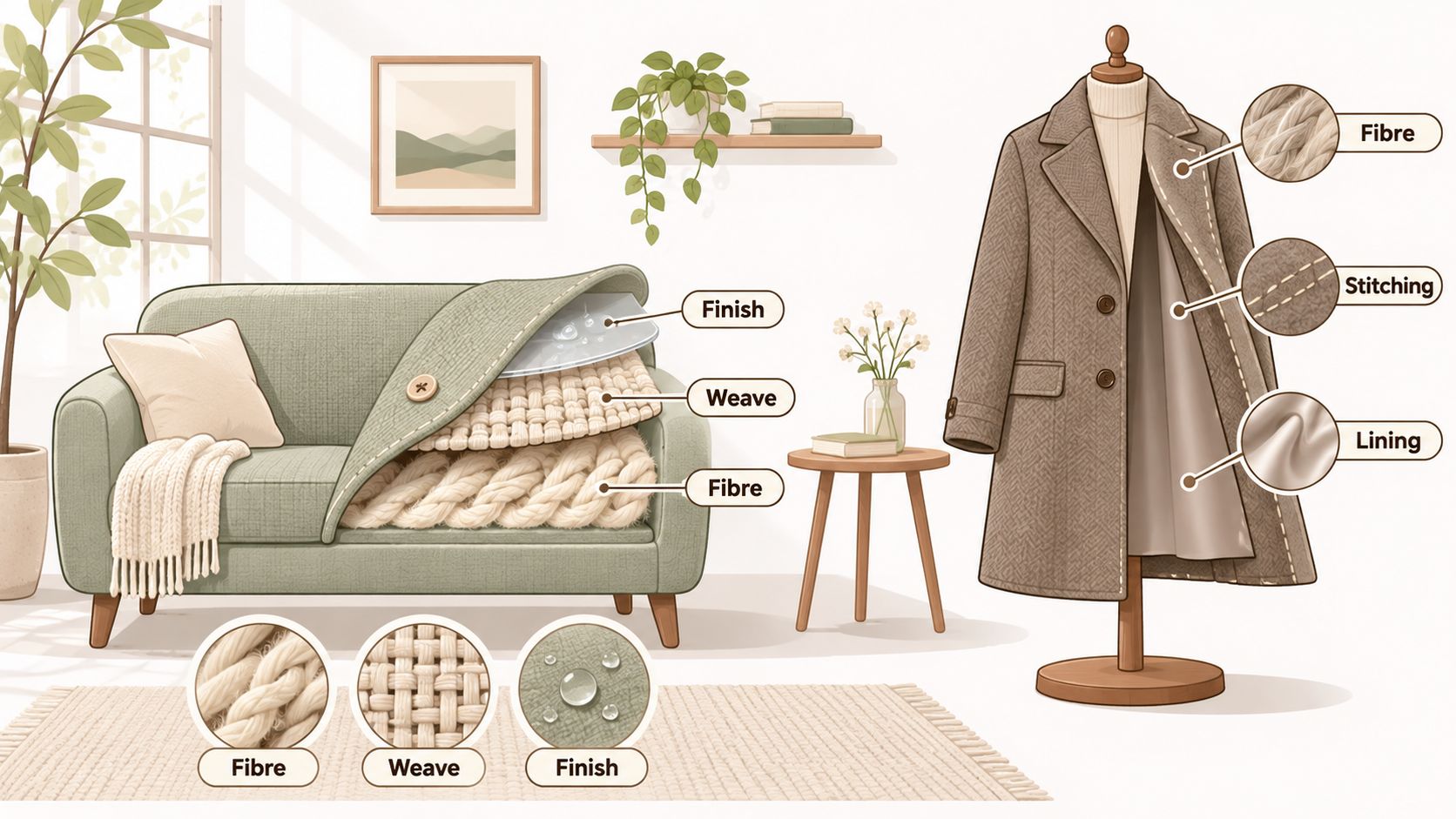
Upholstery is the outer skin of a sofa. Much like a well-made wool coat, its price reflects the material, the way it's assembled and the work required to make it suitable for everyday use.
The analogy is useful because an attractive surface tells only part of the story. The homeowner also needs to understand what sits behind the texture.
Fibre and construction work together
Fibre content affects handle, appearance and care. Cotton and linen can offer an appealing softness and natural character, while polyester and acrylic often appear in blends designed for demanding upholstery applications.
No fibre name guarantees durability. A loosely constructed synthetic fabric can be less suitable for a particular household than a carefully engineered natural-fibre blend, so composition should always be read alongside the finished textile's test results.
Construction introduces another layer of cost. A straightforward flat weave generally requires less elaborate production than looped bouclé or a complex woven pattern, while jacquard and tapestry designs may demand more involved manufacturing and careful placement during upholstery.
The guide to upholstery materials offers a useful foundation for distinguishing the feel of a material from its suitability for a particular seat.
Finishes and sourcing affect the allowance
Stain-resistant treatments, solution-dyed colour and specialist performance systems address different needs. A stain-resistant finish doesn't automatically establish sunlight resistance, and an outdoor-oriented fibre doesn't remove the need to review cleaning instructions.
Canada's textile supply also has a historical import dimension, documented in a federal textile-industry report. That history helps explain why exchange rates, freight, tariffs and access to specialized production belong in a fabric-price discussion, although the report's historical tariff figures shouldn't be treated as current rates.
Premium cloth may be imported, produced in limited quantities or distributed through a specialist collection. Its price can therefore reflect availability and design development as well as physical performance.
A clear quotation should identify:
- Fibre: The full blend, rather than a general description such as natural-look fabric.
- Construction: The weave, pile or loop structure and any directional cutting requirements.
- Finish: The specific performance treatment and its care conditions.
- Origin: Where the textile comes from, together with stock availability and any special-order conditions.
This makes the allowance easier to evaluate. A homeowner can then decide whether the premium purchases a desirable texture, easier maintenance, a distinctive pattern or a combination of those benefits.
Reading Abrasion Ratings for Long-Term Value
Wyzenbeek double rubs measure resistance to repeated friction, not how long a sofa will last. The figures below show how the listed fabrics compare in abrasion resistance relative to their price per linear yard.
Upper-bound cost per 10,000 double rubs
| Fabric | Price per linear yard (CAD) | Abrasion rating (double rubs) | Approximate upper-bound cost per 10,000 double rubs (CAD) |
|---|---|---|---|
| Bouclé, performance | 64.90 | More than 204,000 | 3.18 |
| Cotton, polyester and acrylic woven | 77.90 | More than 150,000 | 5.19 |
| Crypton performance fabric | 100.90 | More than 100,000 | 10.09 |
| Tapestry, heavy-duty | 77.90 | More than 45,000 | 17.31 |
Source: Canadian upholstery listings for performance bouclé, cotton-polyester-acrylic woven fabric, Crypton performance fabric and heavy-duty tapestry. Calculations divide each listed price by its stated abrasion threshold in units of 10,000. Because each rating exceeds the stated threshold, the results are approximate upper bounds, rounded for comparison.
How to read the ranking
The performance bouclé has the lowest abrasion-adjusted cost in this group, followed by the woven blend. The tapestry costs the same per yard as the blend, but its listed abrasion threshold is lower, so its cost per unit of tested resistance is higher.
The tapestry remains a sound choice for decorative seating, while Crypton may offer cleaning-related benefits that this calculation does not measure. Cost per 10,000 double rubs is a useful screening method, rather than a full lifecycle-cost model. It excludes replacement labour, stain removal, cushion condition and the chance that decorating preferences will change before the fabric wears out.
What friction testing leaves out
Pilling, seam slippage, lightfastness and cleanability need separate consideration. A fabric may resist rubbing yet develop surface pills, fade in strong sunlight or prove difficult to maintain.
For homes with animals, claw damage is another concern. Amseatec's guide to scratch resistant fabrics for pet owners discusses surface construction. Critelli Furniture's pet-friendly furniture options can help connect fabric choices with seating needs.
A high abrasion rating still calls for attention to the weave, cleaning code and household's everyday habits.
Critelli Furniture offers the Guardsman Gold Furniture Protection Plan, which covers damage and stains on fabric, leather or wood furniture. Review its coverage terms separately from the textile warranty, since protection plans and fabric performance address different concerns.
Before ordering:
- Set a use requirement: Ask the upholsterer to specify an appropriate minimum abrasion rating for the seat's workload.
- Compare like with like: Assess fabrics at the same usable width and within a similar performance class.
- Read the warranty: Check exclusions, approved cleaning methods and any conditions attached to performance claims.
Remnants, Reuse and Full-Width Options Compared
Measure an offcut against the actual cutting pattern before buying it. The usable dimensions must accommodate each piece, including the correct direction for any stripe, pile or large motif. Enough suitable cloth matters more than the lowest price per yard.
New, remnant and reuse options compared
| Option | Typical cost | Best use | Main risk |
|---|---|---|---|
| Full-width new fabric | CAD 45 to CAD 100.90 per linear yard | Visible seating, with a single dye lot and full pattern | Highest upfront cost |
| Coordinated remnants | Illustrative example: an individual remnant may cost about $15 to $50, depending on size | Cushions, back panels and other non-visible areas | Limited yardage and colour variation between dye lots |
| Reuse of existing upholstery | No new fabric purchase if the existing cover is retained; cleaning and repairs are extra | Sound frames with clean, odour-free covers | Hidden repair and cleaning work and uneven wear |
The remnant amount is an illustrative example, not a standard price for a set quantity. Compare value by usable area and condition, then consider how much of the upholstery each piece can cover. A low-cost offcut may be poor value if its shape leaves too much unusable cloth.
When a remnant is a sensible choice
Small, separate components are often the easiest fit. A cushion cover or discreet panel may work well, especially if coordinating textiles are part of the design.
Check visible surfaces carefully. In an open-plan room, a sofa's rear may be as prominent as its front, so a contrasting remnant should look intentional. Directional patterns can also limit the layout: a stripe, pile or large motif may need to face a particular way, leaving less room to arrange pieces efficiently.
- Shortage: The remnant may have enough total area but no uninterrupted section large enough for a seat.
- Dye-lot differences: Additional cloth may not match the original piece precisely.
- Unusable areas: Creases, fading, marks or damaged edges can reduce the cutting space.
Reuse should follow an inspection
An existing frame may be worth keeping even when its covers or cushion interiors need attention. Assess each separately for cleanliness, odour, resilience and uneven wear.
Canadian textile-reuse initiatives described by Memorial University's Gazette include cleaning, sorting and redirecting recovered textiles for uses such as upholstery stuffing or fibre recycling. This offers context on waste reduction, but recovered textiles are not automatically suitable as furniture covers.
Durability affects value over time. A less durable bargain may need earlier replacement and another round of upholstery labour, while a suitable performance fabric may warrant a higher initial allowance for a frame expected to remain in use.
Before buying, measure the visible and concealed areas, compare the remnant with the furniture's cutting pattern, and check its performance specification against the seat's intended use. These steps help protect the budget and the finished design.
How to Budget a Custom Upholstery Project
The fabric allowance is one line in the complete project budget. A clear estimate separates cloth from the skilled cutting, sewing and fitting that turn it into a finished piece.
For bespoke furniture, the selected textile should be confirmed against the frame's requirements before the order is placed. A generous chair, shaped arm or fully upholstered back can change the cutting layout even when the piece looks compact in a photograph.
Build the estimate in a practical order
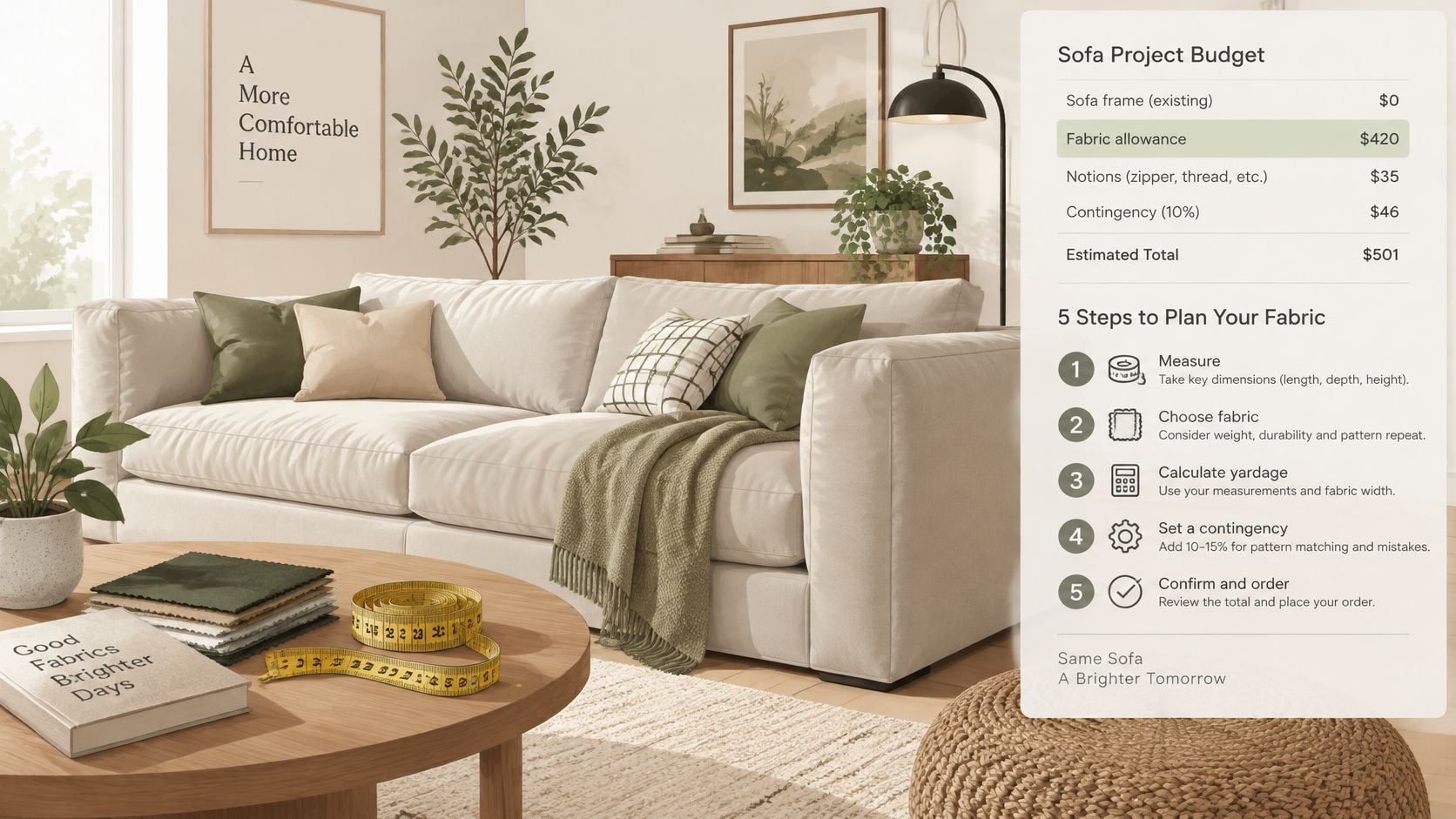
Confirm the required yardage. The upholsterer should calculate the cloth needed for the actual furniture form. A large sofa or deep chair generally needs more material than a compact occasional chair, but dimensions alone don't reveal every upholstered surface.
Multiply the approved yardage by the supplier's linear-yard price. In a hypothetical example, 14 yards at CAD 64.90 totals CAD 908.60 before extras. That is a fabric calculation, not a quotation for a completed sofa.
Allow for the cutting layout. Directional placement, pattern repeats and matching can increase the required quantity. The upholsterer should calculate this allowance rather than applying an arbitrary percentage without examining the design.
Add separate lines for cutting, sewing, foam, frame work, freight and tax. An older chair may need internal repairs even when its exterior looks presentable, so the estimate should identify what has been inspected and what remains provisional.
Reconcile the complete quotation. Fabric, labour and delivery should be distinguishable, allowing the homeowner to see which component drives the total and whether any work is excluded.
Designer's Insight: A bold patterned fabric paired with a neutral hand-knotted wool rug can balance the room's energy and keep the textile budget in proportion. The rug supplies a quiet foundation while the upholstery provides the focal point.
Confirm the order as carefully as the colour
The St. Catharines showroom information places fabric and finish selection within a broader design offering. A curated selection is most useful when samples are considered alongside the chosen frame, room dimensions and other finishes.
For homeowners considering custom couches for Toronto homes, the order should identify the fabric code, colourway, placement instructions and approved specification. Keeping those details together reduces ambiguity between selection and production.
Critelli Furniture offers financing, and delivery timeframes for custom-made furniture vary between brands; customers are asked to call for details. Financing should be considered against the complete purchase, while the delivery schedule should be confirmed for the specific brand and order.
A well-prepared budget doesn't merely prevent surprises. It shows where a change in textile, pattern or furniture form would make a meaningful difference without sacrificing the qualities that matter most.
Bring Your Fabric Choice Into the Whole Room
The best fabric is the one that suits the household's routines and the furniture's construction. Its value also depends on how well it fits the room's palette and use over time.
Critelli Furniture, based in St. Catharines, has served customers since 1914. Its design guidance includes selecting fabric and planning a complete room layout, helping connect upholstery choices with the rest of the space.
A complete room concept
An interior design mood board can bring upholstery, wood finishes, lighting and rug colours together before purchases are finalized. For example, a neutral sofa fabric can leave room for expressive artwork, while a patterned chair can add character to a restrained palette.
Critelli's Rug Market presents rugs as a starting point for a room's colours and character. Choosing a rug alongside upholstery can help clarify which fabrics complement the room rather than compete with it.
From selection to placement
Critelli Furniture offers design guidance and custom furniture orders made to meet customers' needs. Delivery timeframes for custom-made furniture vary by brand, so customers are asked to call for details. Furniture bought from the showroom floor is available for immediate delivery at the customer's convenience.
Critelli Furniture has a Low Price Guarantee. New customers who join its email list receive $100 off their first purchase of $1000 or more, and restrictions may apply. These offers are separate from the question of whether a fabric suits the furniture and household.
A considered choice brings fabric, furniture and room layout into alignment. Compare options by how they serve daily routines and how their durability supports the cost, not by price per yard alone.
From fabric selection to room planning, Critelli Furniture offers guidance for bringing the choices together. Room photographs, furniture dimensions and fabric preferences can help start a practical comparison.