
Recliners Chairs and Ottomans for Home Comfort


The sofa in the front room does three jobs at once and none of them well. Someone reads with their knees pulled up, someone else watches television with their feet on the coffee table, and the person who has been up since six is trying to stand from a cushion that sits lower than it did last year. The room is busy. Nobody in it is comfortable.
That gap is what one well-chosen seat fills. Not a matching set ordered in a single click, but a chair that changes angle for one body, with a place to put the feet that doesn't turn the floor into an obstacle course after dark. In Southern Ontario homes, where the living room has to absorb reading, television, recovery after a long shift and a visit from grandchildren, a single good chair earns its floor space in a way a larger sofa rarely does.
The choice runs in a fixed order. Style first, so the piece belongs in the room rather than fighting it. Body fit second, because a handsome chair that presses behind the knees is a chair nobody uses. Then the cover, the rug, and the walking routes that decide whether the seat is a pleasure or a hazard. Get those four right and the chair stays in the family. Get them wrong and it becomes a very expensive place to stack laundry.
Why a Chair and Ottoman Work as One
A Friday evening in a St. Catharines living room makes the case better than any catalogue. The sofa seats four for a conversation and none of them for a two-hour film. One person wants to read, one wants the hockey game, and the household's oldest member wants a seat that lets them rise without pushing off an arm. That's three jobs, and one seat can only do one of them well.
The three pieces people shop for answer differently:
- A recliner changes the angle of the back and the legs together, and most models carry a footrest that folds out from the chair.
- A chair stays upright or tilts only slightly, built for conversation, a coffee and a shorter sit.
- An ottoman or pouf is a separate leg rest you move where you want it, and some hide a blanket or a remote inside.
Matching them has little to do with a coordinated photograph and a lot to do with the height of the seat when the sitter's feet are down, the support under the calf, and the clear floor beside the piece. A deep lounge can feel generous at full recline and wrong the moment it returns upright, because the sitter slides forward and loses contact with the backrest.
The one decision all three share: who will sit in it, for how long, and where their feet will land. Everything else is finish.
That continuity is why seating here gets framed as heirloom quality rather than a seasonal purchase. Critelli Furniture's history runs back to 1914, when Joseph Critelli and his son Thomas opened the family's first store at the corner of Ormond and Albert Streets in Thorold, as Thorold Today reported on the 110-year milestone. The business later expanded into downtown St. Catharines and remains family-owned more than a century on, with fourth-generation owner Joe Critelli and fifth-generation owner Julia Critelli. A chair chosen against that timeline gets bought for a decade, not a season.
The order that follows is styles first, then body fit, then materials, then the room, then the daily routes that keep the seat safe.
Styles of Recliners Chairs and Ottomans
Start with the job, not the look. Most buyers arrive knowing they want "a recliner" and discover in the first ten minutes that four distinct pieces carry that name, each suited to a different evening.
Which recliner, chair or ottoman fits the job
| Piece | Best for | How it moves | Room condition |
|---|---|---|---|
| Manual recliner | Long reading and television | Lever recline and footrest | Wall clearance behind the back |
| Power recliner | Hands-free recline | Motorized back and footrest | Nearby outlet and a managed cable |
| Lift chair | Help rising from the seat | Seat rises and tilts forward | Clear floor in front for transfer |
| Swivel or glider | Conversation and nurseries | Swivel or glide base | Open arc that does not catch a rug |
| Accent chair | Shorter sits and a style note | Fixed seat or slight tilt | Scale close to sofa arm height |
| Matching ottoman | Leg support you can move | Separate padded rest | Not left across a walkway |
| Storage ottoman | Blankets and remotes | Hinged or lift-top seat | Closed height that meets the calf |
| Pouf | Informal, low footrest | Soft unstructured fill | Lower than a structured ottoman |
Nothing in that table is a ranking. A manual recliner isn't a lesser power recliner. It's the right answer in a room where the wall behind the chair leaves little to spare and the sitter's hands prefer a lever to a handset. A power model solves a different problem, and it needs an outlet within reach plus a cable route that doesn't cross a doorway.
What Changes Inside a Type
Frame construction and upholstery change the look and the lifespan inside a category without changing the job. An artisanal hardwood frame with proper joinery and hand-tied springs behaves differently over years of evenings than a stapled softwood shell, and bespoke upholstery lets one household choose a tight wool weave while another chooses a heavy grain leather. The mechanism, the seat height and the footprint stay the same.
The Footrest Decision
The built-in footrest is a hinged tray fixed to the chair. The ottoman is a separate table you can move when guests cross the room, which is exactly why it suits a living room that has to flex between a quiet read and eight people with plates.
Consider the closed height. A storage ottoman whose lid sits lower than the calf turns a functional footrest into a footstool that punishes anyone who uses it for an hour. A pouf is softer and lower again, pleasant as an informal rest and a poor substitute for medical-grade leg support.
Households with a dog or a cat that claims the new chair have one more variable to solve. A removable, machine-washable cover over the seat keeps the upholstery underneath intact through muddy paws and shed hair, and washable armchair covers for pets are worth checking before the chair is ordered rather than after the first accident.
Once a type is shortlisted, the next question isn't colour. It's whether the sitter's body matches the seat.
How Seat Fit Changes Comfort
A recliner is like a jacket. A good cut on the hanger can still pull at the shoulders, and a chair that photographs beautifully can still leave a sitter bracing all evening.
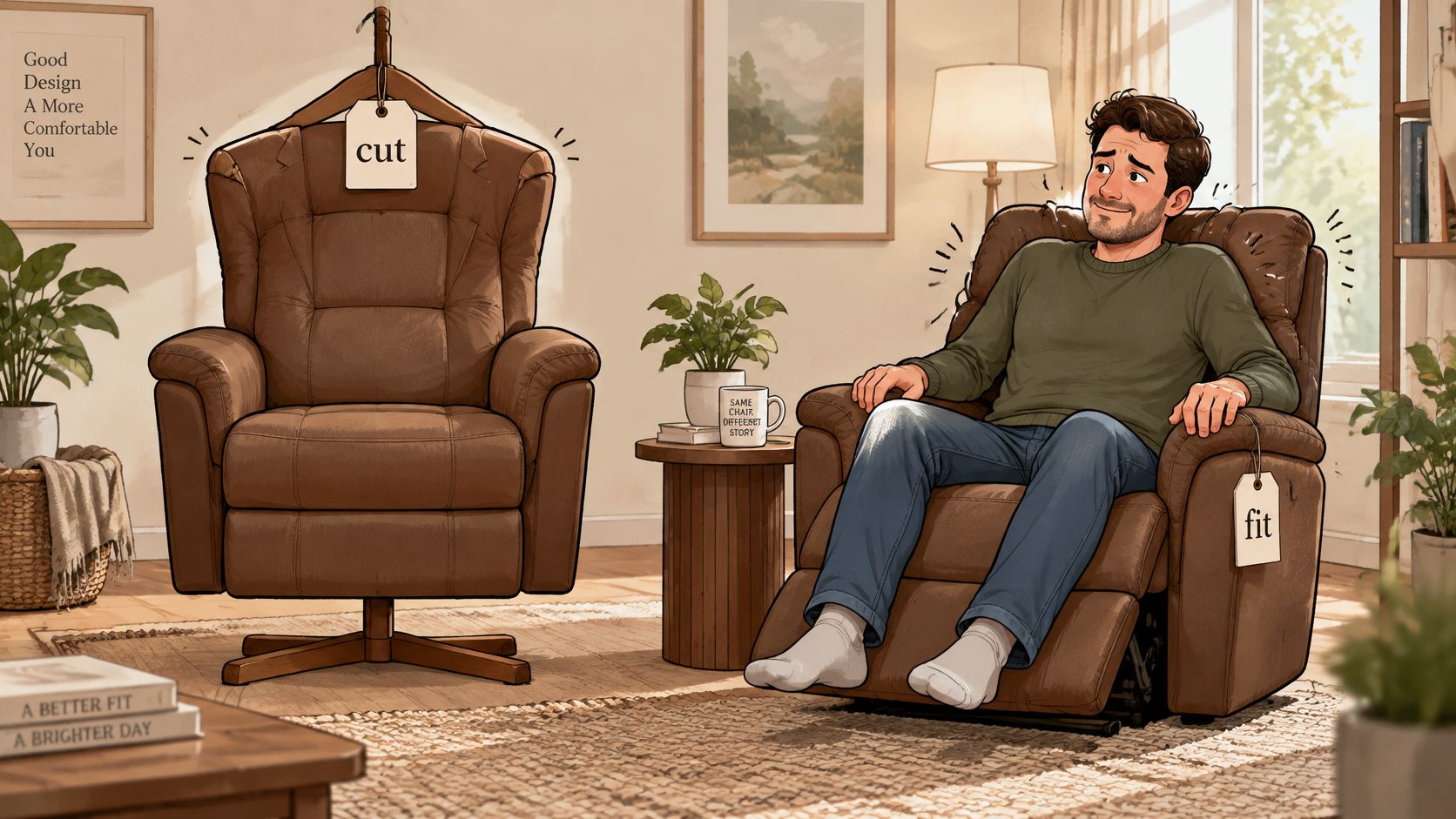
The Canadian Centre for Occupational Health and Safety treats seat height, seat depth, back support and body-size compatibility as the primary selection variables, and offers a starting estimate rather than a rule carved in stone: CCOHS chair-selection guidance puts seat height at roughly one-quarter of standing height, with seat depth set so the sitter's back reaches the backrest without pressure behind the knees. Those two numbers eliminate more bad choices than any swatch ever will.
The Upright Test Comes First
The trap is testing a recliner only in the position it was designed to show off. A deep seat that feels luxurious at full recline can be unsuitable upright, because the sitter slides forward and the lumbar area loses support exactly when it's carrying the most load. Sit upright first, feet down, and check whether the back is still in contact.
The same logic applies to the leg rest. An ottoman should carry the lower legs without locking the knees straight or jacking the hips into a sharp bend. A footrest that pushes the calves into overextension solves one problem and creates another.
Three checks on the showroom floor: knees clear of the seat edge, back in contact with the backrest, calves carried by the floor or the footrest.
Measuring in the Showroom
Measure seated popliteal height, the distance from the floor to the underside of the knee, and buttock-to-knee length before the visit. Then test both positions on the floor. Feet should reach the floor or the footrest when upright, the head should be supported if anyone in the house naps in the chair, and the controls should fall to the dominant hand without a reach across the body.
Seat-fit checks for recliners chairs and ottomans
| Check | Starting rule | What fails |
|---|---|---|
| Seat height | About one-quarter of standing height | Feet cannot reach the floor or the knees sit too high |
| Seat depth | Back meets the backrest with no pressure behind the knees | Sitter slides forward and loses lumbar contact when upright |
| Lower-leg support | Ottoman carries the calves without locking the knees or sharply flexing the hips | Knees forced straight or hips jacked into a sharp bend |
| Showroom measures | Seated popliteal height and buttock-to-knee length, tested upright and reclined | Choice made from a photo instead of a sit test |
| Shared household | Adjustable headrest, lumbar, recline and seat depth | One fixed size expected to fit every body |
CCOHS is direct that no single chair fits everyone, which is why adjustable headrests, lumbar support, recline mechanisms and seat-depth options carry so much weight in a Southern Ontario home where two or three people share the same seat. Where the frame offers a swivel base, take it. A chair that turns serves a conversation without anyone dragging it across the floor.
Before ordering, it helps to understand how seat depth is measured on a real frame, since published dimensions rarely state whether the figure includes the back cushion.
Leather Fabric and Fire Performance
Treat the cover as the skin of an heirloom and check it the way a specifier would, with three questions per swatch: how it feels, how daylight will show wear in three years, and what ordinary care it demands.
Upholstery choices for recliners chairs and ottomans
| Cover | Feel and look | How it ages | Everyday care |
|---|---|---|---|
| Full-grain leather | Natural grain, warm to the touch | Patina and honest marks | Wipe spills and condition on a schedule |
| Top-grain leather | Smoother, more even surface | Slower visible character | Wipe and condition; avoid harsh cleaners |
| Performance fabric | Tight weave in many colours | Resists stains and sun better than delicate cloth | Vacuum and spot-clean per the maker |
| Wool blend | Breathable, heritage texture | Can felt or shine if abused | Professional cleaning; keep out of prolonged wet |
| Performance velvet | Soft, design-forward pile | Light tracks and shade shifts | Rotate cushions and follow pile-safe cleaning |
Full-grain leather takes a patina and keeps the marks that come with a life, and it rewards a household that conditions it on schedule. Top-grain leather is smoother and more uniform, which suits a room where the chair is meant to sit beside a patterned rug.
Judge a Swatch in Daylight
Southern Ontario winter light is low, flat and unforgiving. It reveals nap direction on velvet and sheen on leather that a showroom's warm overhead lighting hides completely. Take a large sample home, leave it on the chair's intended spot for two days, and look at it at ten in the morning and again at eight at night. Velvet should be rotated so the pile doesn't shade unevenly across the seat.
Ask for the Paperwork
Marketing hangtags are not documentation. For an Ontario house or a multi-unit building, request the textile and foam paperwork with any bespoke order, because upholstered seating sits inside both comfort expectations and fire-performance requirements.
Canadian guidance identifies CAN/CGSB-4.2 No. 27.5 as the relevant textile test method and reports minimum flame-spread times of greater than 3.5 seconds for textiles without a raised fibre surface and greater than 4 seconds for certain raised-surface textiles, as set out in this Simon Fraser University chair-fit and upholstery study. That distinction matters most where a chair lands in a condominium common room, a lobby or another regulated space around Hamilton, the Greater Niagara region or Toronto.
Designer's Insight: pair a bold Hancock & Moore leather with a neutral hand-knotted wool rug. The seat stays the artisanal element and the floor keeps the room calm, so the chair reads as furniture rather than as a statement competing with everything around it.
Ask for upholstery, foam and installation documentation alongside the order confirmation. For a comparison of how the two families of cover behave over years rather than weeks, this guide to leather versus fabric upholstery walks through the trade-offs.
Building the Room Around the Seat
A seat is one instrument in a room, not the whole concert. The most common mistake is choosing the chair in isolation and then discovering that the sofa, the rug and the side tables were all playing in a different key.
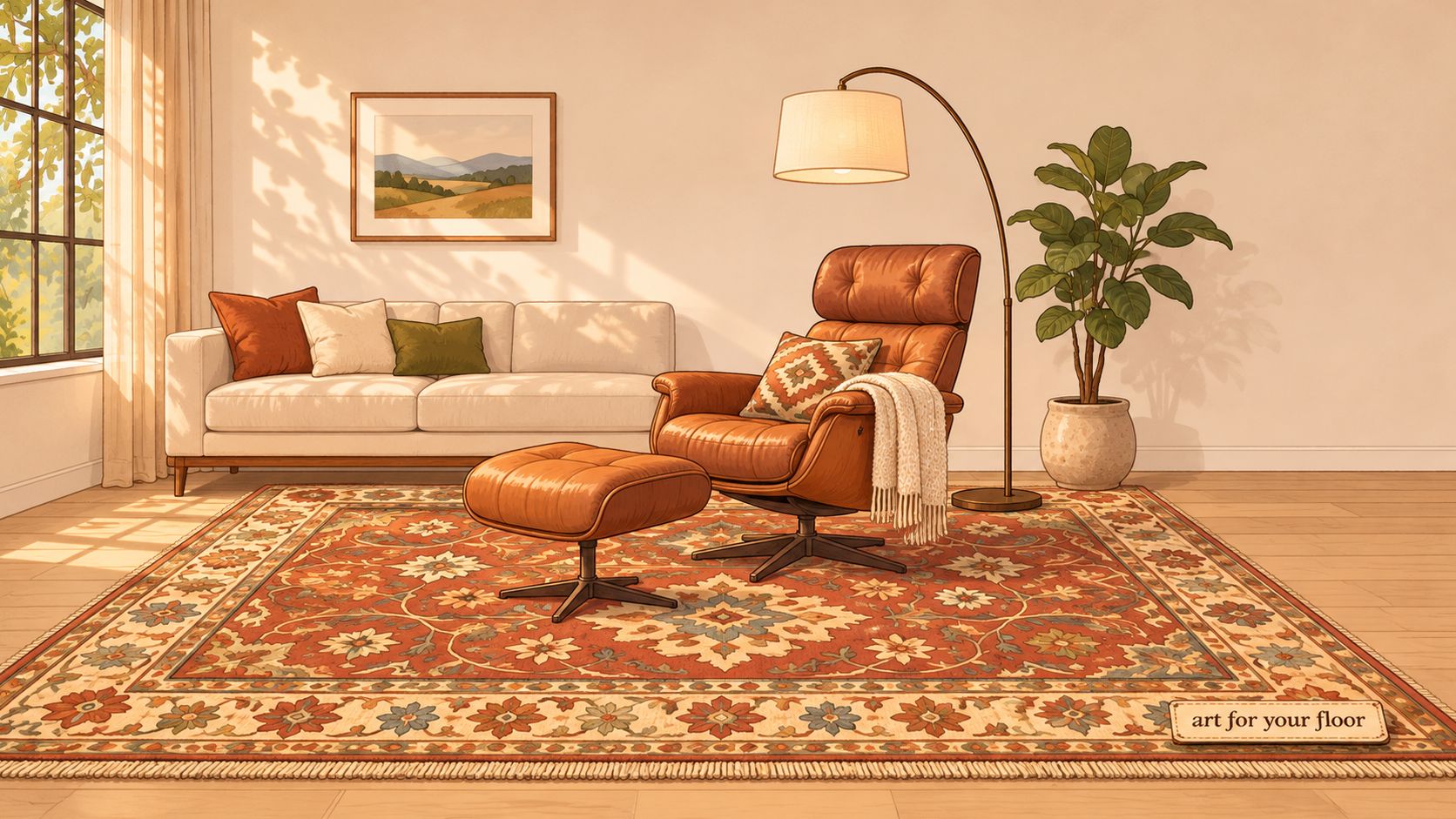
The rug comes first. At Critelli Furniture's Rug Market, hand-knotted, artisanal pieces are sourced from around the globe and described as art for your floor, with specialists helping clients set the foundation for a room's colour palette and character, whether the result is contemporary or traditional. That order makes practical sense. A busy rug with a strong pattern wants a quiet recliner in a solid, deep-toned leather. A neutral field wants a chair that carries the accent, and a complementary ottoman finishing it.
Two Rooms, Two Readings
In a traditional King Street living room, an ergonomic Stressless recliner and a matched ottoman sit on a muted wool rug, with Stickley wood nearby so the motion piece doesn't look stranded among still furniture. The chair is doing the work of comfort; the wood and the wool do the work of belonging.
In a brighter contemporary corner, the sort of reading Critelli Modern takes on at its St. Paul Street showroom, a lower lounge chair and a slim ottoman share a pale rug and leave walking space toward the window. Same problem, quieter answer.
Proportion and Distance
The ottoman should visually finish the chair, not rival the coffee table. Its near edge wants to tuck close enough that the sitter isn't stretching to reach it, and its width should stay inside the chair's footprint rather than spilling past the arms.
Curated selection is where the century of continuity shows. Critelli's move from general retail into fine furniture is documented, with Thomas Critelli's design interests steering the original business toward furniture by the 1930s and later generations building on global sourcing and long supplier relationships, including a six-decade association with Barrymore Furniture. That kind of continuity is a complete room concept in practice: space planning, a curated selection, and bespoke covers chosen against the architecture rather than against a catalogue page.
Winter light decides more than many expect, since it shows nap, sheen and tonal shifts that vanish under summer sun. Samples belong in the actual room.
A side table sized to the chair's arm height finishes the corner without crowding it; this guide to side tables for a Canadian living room covers the proportions. Then the question turns to whether the spot is safe to live with every day.
Placement That Keeps Daily Routes Clear
The safest recliner in the house is not automatically the one with the most motors. Power helps a person recline or rise, and it also adds buttons, a footrest that sweeps a hallway, and a seat height that may be wrong in either direction. More capability isn't the same as less risk.
The stakes are ordinary and high at once. British Columbia public-health guidance reports that half of falls resulting in hospital stays happen at home, and identifies furniture, cords, rugs, clutter and obstructed walking paths as preventable hazards, as summarized in this public-health guidance on healthy aging. Canadian federal fall-prevention guidance adds poor lighting, loose rugs, missing stair rails and absent bathroom grab bars to that list of environmental contributors.
A Room-by-Room Check
Run these before the chair is placed, not after:
- Route to the washroom: keep a clear, lit path from the chair, because the most common night-time trip is the one that matters most.
- Footrest and ottoman: never leave either extended across a main walkway, and move the ottoman aside before anyone transfers.
- Control lighting: a small lamp or a lit handset within reach for evening use, so nobody is hunting for a button in the dark.
- Charging cable: run it along a wall rather than under a rug edge, where it becomes a trip line.
- Standing test: confirm the sitter can rise without pulling on a light ottoman or an unstable side table.
- Walker and transfer: for a walker user, check that seat height and lift allow a forward transfer with the ottoman already moved.
Practical rule: when mobility is limited, an in-home assessment beats any ranking. Seat height, footrest clearance and the path to the bathroom are house-specific facts.
Placement is where delivery stops being logistics. A chair that lands in the planned spot, angled for the light and clear of the doorway, is a different purchase from one left wherever the carton fit. Good interior design space planning settles the position on paper before the piece arrives.
Durability belongs in this conversation too, because a chair that can be repaired and removed responsibly is safer for the household than one that gets shoved onto a porch.
What Happens to the Old Chair
Most buying guides stop at the new piece. The old one doesn't disappear. Neither does the carton, and neither do the worn components that made the replacement necessary.
Work in this order:
- Record before you shop. Note the current chair's maker, model and mechanism so a repair can be priced against a replacement rather than guessed at.
- Ask about service. Check whether the frame, motor or footrest can be serviced through the original maker.
- Separate packaging from furniture. Ask who takes the carton away on delivery day, and get the answer in writing.
- Plan the exit. For a chair beyond repair, book municipal bulky-item collection and ask what happens to that load.
That last question has a documented answer worth knowing. An Association of Municipalities of Ontario briefing estimates Canada disposes of about 672,000 tonnes of furniture waste annually, and population-adjusted, Ontario accounts for roughly 260,157 tonnes, while only about 88,453 tonnes is diverted, according to the AMO briefing on designated materials. The same briefing notes that bulky furniture collected by municipalities is often sent to landfill rather than reused.
In a Greater Niagara, Hamilton or Toronto household, heirloom quality means choosing a piece that can be maintained, then making the exit as deliberate as the showroom visit. Keeping model and mechanism details on file is the cheapest insurance a household can hold; the signs that a piece is finished are worth learning before the decision is forced. This guide to signs it's time to replace your furniture sets out when repair stops making sense.
Decide in the Showroom Not from a Photo
The whole choice collapses into one path. Pick the type from the style table. Confirm knee clearance, back contact and calf support with a real sit, upright first and then reclined. Match the cover to how the household lives, to the light in the room, and to the rug already on the floor. Everything else is finish.
That path is worth walking in person. Critelli Furniture's King Street Showroom in St. Catharines holds recliners from Stressless, Flexsteel, Palliser, American Leather, Hancock & Moore and IMG, alongside Ultra Comfort power lift chairs, within a living room range that also includes chairs, ottomans and poufs. Critelli Modern on St. Paul Street offers a more contemporary reading of the same problem. Where seat depth, leather or fabric has to be bespoke, custom orders run through Critelli Custom and Critelli Fine Custom Upholstery.
What to Test on the Floor
Bring three things to the visit: the seated measurements, a photograph of the room in daylight, and the tallest and shortest person who will use the chair. Sit in each shortlisted piece for ten minutes rather than ten seconds. Ask for the mechanism to be operated by the person who will use it daily, since a handset that suits one wrist doesn't suit every wrist.
Ask before you leave: which parts can be replaced in five years, and who performs that work in the Niagara region.
The Delivery Agreement
White-glove delivery is a defined service, not a compliment. Canadian logistics guidance describes it as room-of-choice placement, unpacking, assembly and packaging removal, with assembly included for eligible large pieces or added separately, as outlined in this guide to furniture assembly services. Put each of those items in the agreement for a Greater Niagara, Hamilton or Toronto delivery, because a recliner left in a foyer hasn't been delivered, only dropped.
Ontario consumer guidance adds a practical safeguard. Where goods or services are not delivered or begun within 30 days of the date stated in the agreement, or within 30 days of signing when no date is stated, cancellation may be available under applicable rules. That's the reason to have a date written down rather than agreed on the phone.
Financing turns a difficult decision into a calmer one, spreading an heirloom purchase instead of settling for a lesser fit. Then there's the floor beneath the chair. A visit to the Rug Market to find the room's foundation is the last design decision and often the one that makes the seat look as though it was always meant to be there.
Critelli Furniture has spent more than a century matching Southern Ontario households with seating they keep, from Stressless recliners and Ultra Comfort lift chairs to bespoke covers cut through Critelli Fine Custom Upholstery, and the design team plans the rug, the side table and the walking route around the chair rather than stopping at the chair itself. Book a complimentary design consultation at the King Street Showroom in St. Catharines or at Critelli Modern on St. Paul Street, and bring the room's measurements, its daylight and everyone who will sit in the seat. Visit Critelli Furniture to see the current collections and start the conversation.