


Custom Area Rugs with Borders: A Complete Guide for 2026


A bordered rug can rescue a room that feels unfinished in an instant. The sofa looks grounded, the seating group finally reads as a whole, and the eye has somewhere deliberate to rest instead of skimming past a floating rectangle on the floor. In a Southern Ontario home, especially where winter traffic, wet boots, and seasonal cleaning all shape how a room lives, the border is rarely decorative only. It is a structural decision that changes proportion, edge wear, and how the rug behaves once people start living on it.
Critelli's perspective is the one that matters here. With a family-run legacy since 1914, a Design Studio that approaches furniture as part of a complete room concept, and a Rug Market that treats rugs as Art for your Floor, the conversation starts with how the room functions, not with a swatch alone. That matters in Luxury furniture Niagara, across Interior design services St. Catharines, and for homes that pull from the Greater Niagara, Hamilton, and Toronto markets.
Why a Bordered Rug Changes the Whole Room
A designer walks into a living room and sees the same problem again and again. The sofa is substantial, the coffee table is fine, the floor is clean, and still the rug seems to hover without authority. The room doesn't feel wrong because of colour or pattern. It feels wrong because the floor has no frame.
The border gives the room an edge
A bordered rug works like a mat around a painting. It creates a visual perimeter, tells the eye where the composition begins and ends, and helps a seating group read as intentional rather than assembled by accident. That matters most in furnished rooms where a borderless rug can disappear under nearby upholstery or make the floor feel visually noisy.
In practice, the border can also steady a palette. A room with wood, upholstery, lamp bases, and art needs one quiet organising layer. A bordered rug does that job without shouting, which is why designer-led rooms so often use it as the foundation instead of the final flourish.
Practical rule: if the room already has strong furniture lines, the rug should organise them, not compete with them.
The other advantage is psychological as much as visual. A frame gives the centre field permission to feel calmer, and a calmer field lets the rest of the room look more polished. That is why custom area rugs with borders often feel more finished than borderless rugs in larger, fully styled spaces.
For readers arranging a seating area around the rug, the furniture relationship still matters more than the rug alone. The safest starting point is to think in relation to the sofa, chairs, and table, then refine the rug so the border reinforces the layout rather than fighting it. A useful living-room planning reference is the Critelli guide on how to arrange furniture in the living room.
Border Styles, Widths, and Corner Construction
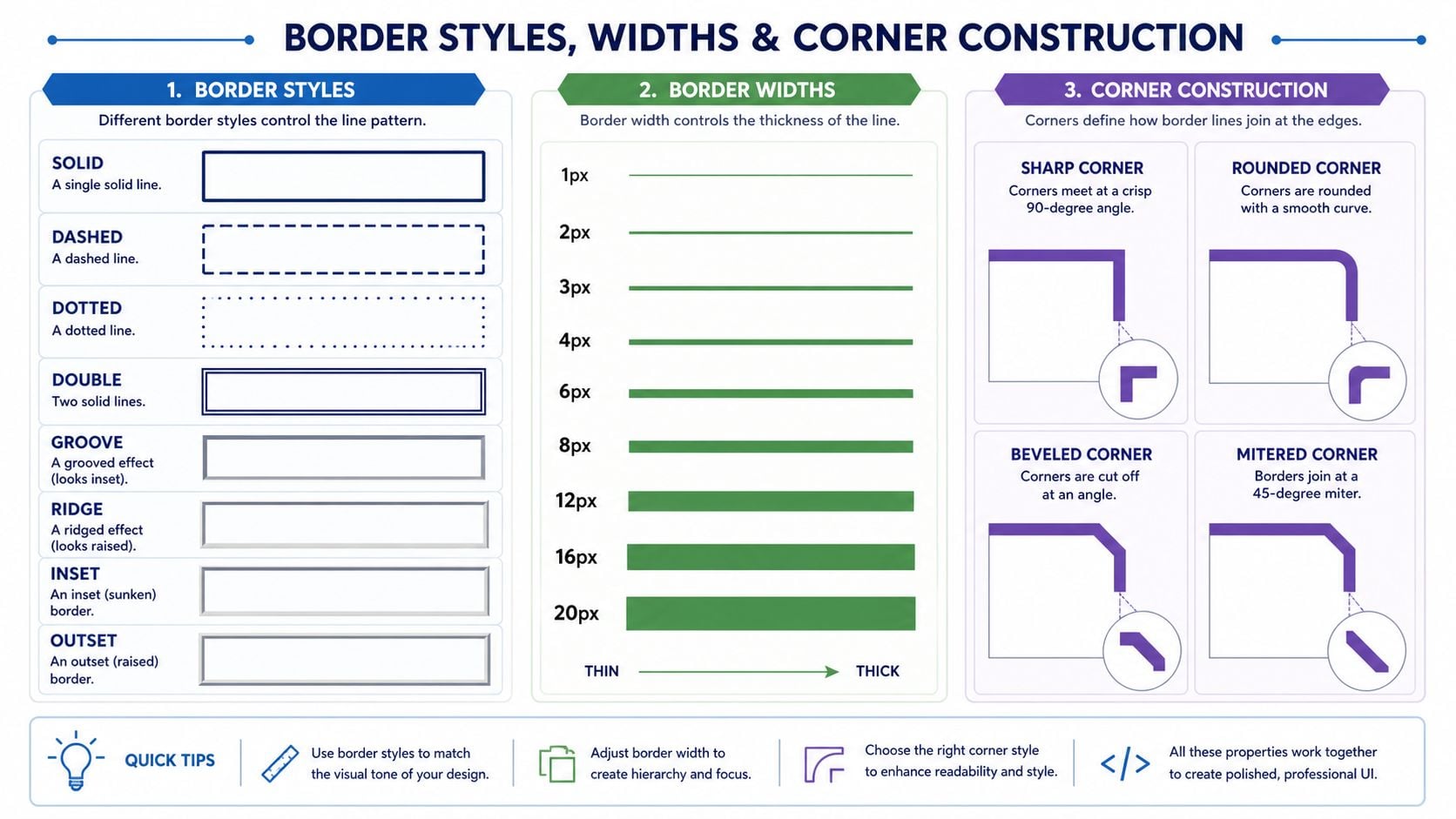
A bordered rug fails or succeeds on details that are easy to miss at sample stage. Width, corner treatment, and edge finish change how the rug sits in the room, how clearly the border reads under furniture, and how well the perimeter handles daily use. In Southern Ontario, those choices also have to hold up through muddy boots, dry heated air, and the seasonal back-and-forth that puts extra stress on the edges.
Width changes the visual weight
A narrow border, about 1/2 inch, reads like an architectural line and suits disciplined, contemporary rooms. A medium border, about 1.5 inches, gives the rug a clearer frame. A wide border, about 3 inches, starts to act like a fabric statement and becomes part of the rug's character rather than just its outline.
That visual width does not always change the rug's cut size. In custom work, the border can read larger on the face while the overall dimensions stay fixed, which gives installers more control over clearances and furniture placement. In tight rooms, that difference keeps the rug from crowding circulation or fighting the base of a sofa, cabinet, or chair leg.
Corners are not a small detail
Corner construction changes both the look and the wear pattern. Narrow borders usually require folded corners with visible stitching, while medium and wide borders can use either folded or mitered corners. Mitered corners give the cleanest, most architectural result, but folded corners are often the only workable choice when the border is narrow.
That is not just a style preference. Corners take stress from vacuuming, chair movement, and the little shifts that happen every time a rug is cleaned or rotated. If the room sees regular traffic, the corner choice should reflect that reality instead of chasing the neatest sample. A narrow border can look crisp, but it limits the construction options available to the maker.
For finish types, binding is a practical custom option, serging gives the edge a continuous yarn finish, and a custom carpet-fabricated border is the more precise answer when the whole rug needs to read as a designed object. Critelli Furniture's rug and carpet options are useful to review at this stage, because border decisions are easier to make when you are planning the room, not just the surface.
For a close look at how border widths, edge treatments, and corner types change the finished result, this diagram is a helpful reference.
Industry guidance on custom rug construction styles, including binding, serging, and custom carpet borders, is useful here, and advice from Rubber Ducky Rug Cleaning is worth reading before you approve a build. The practical point is simple. The border should be drawn for the room it will live in, not just for the sample board.
Materials and Construction Methods That Affect Longevity
The right border only matters if the rug beneath it can carry the detail well. Some constructions accept a border cleanly, some fight it, and some look beautiful at the sample stage but wear poorly once the room gets busy. That's why material choice has to be judged against traffic, winter grime, and how the edge will age over time.
Wool, blends, sisal, and synthetics behave differently
Hand-knotted wool has the most heirloom feel and usually supports a refined border with a strong, defined presence. It's the right answer when the room is meant to feel collected rather than temporary. Hand-tufted wool can deliver a similar look with a different production profile, though the edge treatment and overall durability need to be checked carefully.
Wool-silk blends bring sheen and softness, which can be beautiful in a formal room, but they're less forgiving in entry-adjacent spaces and busy family areas. Sisal and other natural plant fibres give great texture, though their borders often need more careful planning because not every finish is available on every weave. High-performance synthetics are practical in homes that need easier maintenance and better everyday tolerance under heavier use.
Industry guidance on custom rug construction styles, including binding, serging, and custom carpet borders, is useful here, and advice from Rubber Ducky Rug Cleaning gives a plain-language view of how those build choices affect a rug once it's on the floor. The key point is simple. Construction isn't a back-end detail, it determines what the border can do and how long it will keep its shape.
What fits real life in Southern Ontario
In a home that sees snow, salt, and frequent cleaning, a rug with a more durable edge treatment usually makes more sense than a fragile decorative finish. In a quieter formal room, the calculus shifts, and a more artisanal border can earn its keep through appearance alone. That's the tension behind Hand-knotted rugs Ontario buyers feel when they compare a showpiece against a family-room workhorse.
A good starting point is the Critelli guide on the best area rugs in Canada, which frames rug choice as a balance between texture, function, and room use. For a custom order, the construction has to support the border, not merely tolerate it.
Designer's Insight: choose the border after the construction is settled, not before. A beautiful border on the wrong weave becomes a compromise the moment the rug arrives.
Sizing, Proportion, and Placement in Real Rooms
Bordered rugs live or die on proportion. A rug can be cut to the right dimensions and still sit badly if the border reads too heavy for the room, too close to the walls, or too thin to hold the furniture together. Because the border changes the visual mass without changing the cut size, it has to be part of the sizing decision from the beginning, especially in Southern Ontario homes where the rug has to work through snow, salt, drying heat, and constant foot traffic across seasons.
Read the room before you read the swatch
Common custom sizes usually follow room use, not arbitrary dimensions. A practical area rug size guide will show the familiar rectangular range from 4' x 6' through 12' x 15', with rounds typically 6' or 8' in diameter, and broadloom cut to the exact shape and size the room needs. That flexibility helps, but it also means the measurements have to be disciplined from the start.
Furniture placement still drives the decision. In a seating group, the rug can sit with the front legs on, all legs on, or the whole arrangement fully anchored, but the border has to support the layout instead of fighting it. A wide border can make a room feel tighter if the field becomes too small, while a narrow border can disappear if the room already has strong perimeter lines from baseboards, millwork, or built-ins.
Irregular rooms need more than guesswork
Out-of-square walls, fireplaces, built-ins, and open transitions can make a simple rectangle wrong. Complex cut-outs often call for a full template, exact dimensions for each edge, and multiple measurements because walls are not always straight, and the error shows up fast once the rug is installed. That matters in Ontario homes where tight layouts and nonstandard room shapes are common, especially when circulation paths are already constrained.
A placement guide from Colorado Art Services makes the same practical point, measure from more than one point and account for skew instead of forcing a generic shape into an irregular room. For custom bordered rugs, the designer has to think about the frame the border creates, not only the number on the tape measure. A room that looks square at a glance may still need a slightly adjusted template so the border lands where the eye expects it to land.
The Custom Order Workflow From Brief to Delivery
Custom work should feel calm, not improvised. The best orders move in a clear sequence, because each decision affects the next one, and nothing slows a project faster than vague approvals. In a well-run process, the customer should know what's being fixed, what's still open, and what will affect timing.
The brief has to be specific
A strong rug brief starts with room dimensions and clearances from more than one point, furniture placement, seating or circulation pattern, fibre and pile height, border and finishing details approved in writing, and installation constraints. That's the part that keeps the finished rug from becoming a near miss. If the room has a fireplace, a doorway swing, or a built-in run, those details belong in the brief before production begins.
A complimentary design consultation and an in-home visit are especially useful when the room has mixed light, unusual architecture, or multiple traffic paths. That's where the team can see whether the border should feel subtle or architectural, and whether the rug needs to behave more like a visual anchor or a soft transition.
Production time follows construction complexity
Not every rug enters the calendar the same way. A broadloom-cut rug with a simple finish usually moves faster than a hand-knotted custom piece with a more elaborate border. Knot density, fibre selection, border complexity, and overall size all shape the timeline, which is why two rugs that look similar in a room can carry very different production requirements.
A sensible workflow is straightforward.
- Consultation first: confirm the room, the use case, and the finish direction.
- Measurement second: lock the exact size and border reveal.
- Sampling third: review fibre, colour, and finish against the actual room light.
- Approval in writing: no ambiguity on pile height, border, and edge treatment.
- Production and delivery: move from maker to home with a defined handoff.
Critelli also offers a custom-order path through its ordering process, which fits the way bespoke rug projects tend to unfold in practice. For buyers in Custom furniture Southern Ontario projects, that kind of sequence keeps the room concept coherent from the start.
Care, Cleaning, and Seasonal Maintenance
A bordered rug doesn't stay beautiful by accident. The edge, the pad, the vacuum pattern, and the seasonal cleaning routine all affect whether the rug still looks polished after a year of use. In Southern Ontario, that issue becomes more visible because winter grit and moisture don't ask for permission before entering the house.
The edge finish changes the maintenance routine
A serged edge handles everyday wear differently from a bound edge or a more custom carpet-fabricated border. Serging can be elegant, but the continuous yarn edge deserves gentler handling at the perimeter. Binding is usually more precise and can be easier to read visually, while custom-fabricated borders demand the same level of care you'd give any finished textile.
The fibre matters too. Wool tends to recover well and usually wears with dignity, while synthetics often offer more predictable cleaning behaviour. Sisal can be handsome and textural, but it doesn't reward careless cleaning. Wool-silk blends need the most restraint, especially where spills, sunlight, and friction are all in play.
Seasonal habits matter more than deep cleaning alone
For entryway rugs, the winter routine has to be stricter than for a living-room rug. Grit should be lifted before it works down into the pile, and the rug pad should be checked so the piece doesn't drift or curl at the corners. In a family home, stain resistance is not a slogan, it's a practical advantage that needs to match the fibre and the finish chosen at ordering.
A helpful routine check can look like this.
- Vacuum with care: avoid aggressive edge abrasion.
- Rotate periodically: distribute wear in areas that catch the most traffic.
- Inspect the border: watch for loosening, fray, or visible stress at the corners.
- Match cleaning to fibre: don't treat wool, sisal, and synthetics as interchangeable.
- Schedule professional cleaning: especially after seasonal soil load builds up.
For machine-safe maintenance guidance, J.G. Carpet Cleaning's advice on machines is a useful reminder that method matters as much as product. The larger lesson is that the rug's border should be chosen with cleaning in mind, not after the first spill.
Bringing It All Together in a Finished Room
A bordered rug earns its place when the room is fully assembled. A medium-width mitered border can frame a seating group without making the rug feel heavy, while the field colour can echo upholstery, artwork, or drapery in a way that feels intentional rather than overly matched. Once the rug is in place, lighting and the rug pad do the quiet work of finishing the composition, and both matter more than people expect.
A room concept that holds together
Start with a hand-knotted or carefully specified custom rug in a neutral field, then use the border to sharpen the perimeter. A pair of chairs can sit fully on the rug, the sofa can anchor the far edge, and the coffee table can land inside the frame so the whole group reads as one conversation. That approach works especially well in rooms where the architecture is handsome but not perfectly square, because the border gives the eye a clean line to follow.
Designer's Insight: a bordered rug pairs well with premium furniture pieces in wood, leather, and upholstery when the goal is to balance the room's energy instead of crowding it. The rug gives the furniture a stable base, and the furniture gives the rug scale and purpose. That is the logic behind a complete room concept, not a standalone purchase.
Critelli's white-glove delivery matters here because placement is part of the design, not an afterthought. The transition from showroom selection to finished room should feel smooth, especially when the rug is serving as the foundation for a broader furnishings plan in Hand-knotted rugs Ontario projects and design-forward homes near St. Catharines. In a Southern Ontario home, that kind of planning has to account for winter grit, spring mud, summer sun, and the way a rug border holds up around traffic and furniture legs through changing seasons.
The right bordered rug does three jobs at once. It clarifies proportion, protects the edge, and gives the room a calm centre. Experience the craftsmanship in person at our King Street Showroom. Book your complimentary design consultation today. Visit the Rug Market to find your room's foundation.
Critelli Furniture brings the rug conversation back to room planning, finish detail, and the way a floor covering lives in a home. For homeowners comparing border styles, fibre choices, and custom sizing, Critelli Furniture offers a design-led starting point with showroom guidance and white-glove service.