
How To Choose An Area Rug Size: Expert Guide

You’ve chosen the sofa. The chairs are in place. The lighting feels right. Yet the room still looks unsettled.
In most homes, that last bit of tension comes from the floor. A rug that is too small leaves furniture drifting. A rug that is too large for the wrong reason can flatten the architecture. The right size does something quieter and far more important. It makes the room feel resolved.
That is why knowing how to choose an area rug size matters more than many homeowners expect. In Southern Ontario homes, especially across St. Catharines, Greater Niagara, Hamilton, and Toronto, the answer is rarely a generic rule copied from an American showroom. Heritage bungalows, two-storey colonials, and renovated open-concept layouts each ask for a slightly different hand.
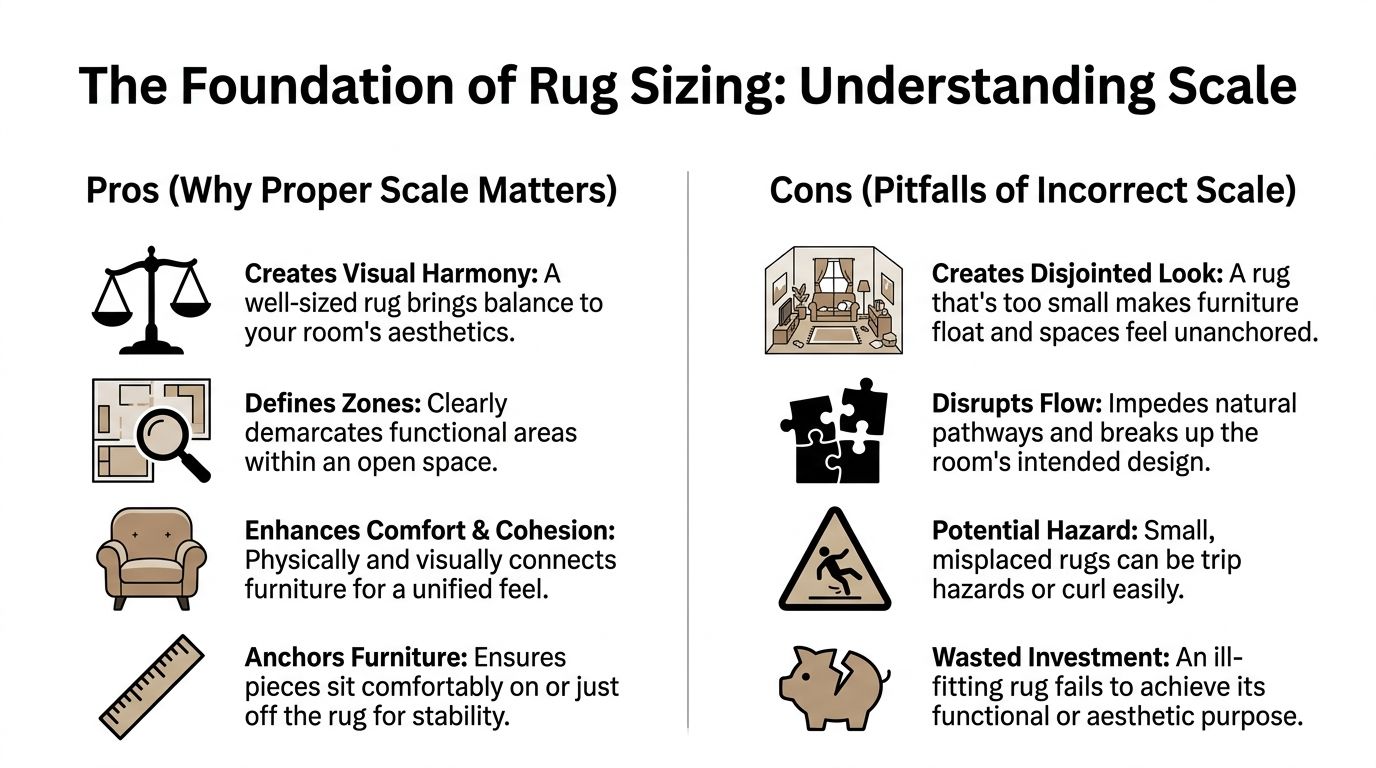
The Foundation of a Well-Designed Room
A well-furnished room can still feel cold if the rug does not support the architecture. That happens often when homeowners choose beautiful pieces one by one, but never stop to build a complete room concept.
At Critelli’s King Street showroom, rugs have long been treated as “Art for your Floor.” That perspective is not new for us. It reaches back to the company’s founding in 1914, when rooms were assembled with a curator’s eye rather than a catalogue approach.
A rug does more than add softness. It tells the furniture where to belong. It frames the conversation area in a living room, settles the bed in a bedroom, and gives proportion to a dining setting that might otherwise feel disconnected from the rest of the home.
In Southern Ontario, that matters even more because the homes themselves vary so much. A compact heritage living room in St. Catharines does not behave like a broad, renovated family room in a newer Niagara build. One needs careful anchoring. The other needs a rug large enough to prevent visual drift across an open plan.
When clients browse living room essentials, they often begin with upholstery, tables, or case goods. The more lasting decision is often underfoot. Rug scale determines whether those pieces read as a collection or as a room.
A correctly sized rug brings warmth, order, and visual calm. An undersized one creates exactly the opposite result. Even heirloom quality furniture can lose its presence if the foundation beneath it is not proportioned properly.
Designer’s note: The rug should support the furniture arrangement you have created, not the empty dimensions of the room.
Understanding Scale Before You Measure
The first common mistake is reaching for a tape measure too soon. Rug sizing begins with scale, not inches.
A rug should relate to the furniture grouping and to the movement around it. In a traditional parlour, that means creating a composed seating area. In an open-concept condo or renovated Niagara family room, it often means using the rug to define one clear zone within a larger envelope.
The three placement approaches that matter
There are three common ways to place a rug in a seating area.
All legs on the rug gives the most generous, customized look. It works beautifully in larger living rooms and open layouts where you want the furniture grouping to feel substantial and composed.
Front legs on the rug is the most versatile approach. It anchors the sofa and chairs without demanding an oversized piece. For many Southern Ontario homes, this is the practical sweet spot.
Floating in the middle is the arrangement to avoid. That is the classic small-rug problem. The rug sits under the coffee table only, while the seating remains detached around it.
Why scale matters in Southern Ontario homes
Southern Ontario homes bring two additional considerations. The first is architecture. Heritage rooms often have tighter footprints, deeper wood trim, and floors you want to show in a controlled way. Modern homes often need rugs that create distinct zones within larger, more open spaces.
The second is climate. Existing guides often miss how flooring behaves locally. With Niagara summer humidity averaging 70 to 80% and cold winters, undersized rugs can leave vintage hardwood exposed to wear and moisture shifts. Data from Critelli’s Rug Market notes a 62% success rate in preventing floor damage with custom oversized rugs that leave a planned 6 to 12 inch border rather than a generic wider gap, as described in this discussion of choosing the perfect rug size for every room.
That border matters. It protects flooring while still respecting the room’s edges.
A practical way to visualise size
Before buying, mark the proposed rug on the floor with painter’s tape. Walk the room. Sit in the chair. Open doors. Consider where feet land when someone stands.
If you want a quick visual reminder that proportion changes everything, the phrase how size matters captures the principle nicely. In design, scale is rarely decorative trivia. It changes how the whole room reads.
For homeowners who want dimensions before they visit the showroom, a measuring guide such as this furniture measurement resource helps clarify the room envelope before finer rug decisions are made.
Key takeaway: Choose the placement style first. Then measure for the rug that supports it.
Sizing a Rug for Your Living Room
The living room is where most rug mistakes happen. People measure the room, buy a rug that seems reasonable, and then wonder why the seating still feels adrift.
The right method starts with the furniture grouping. Not the walls.
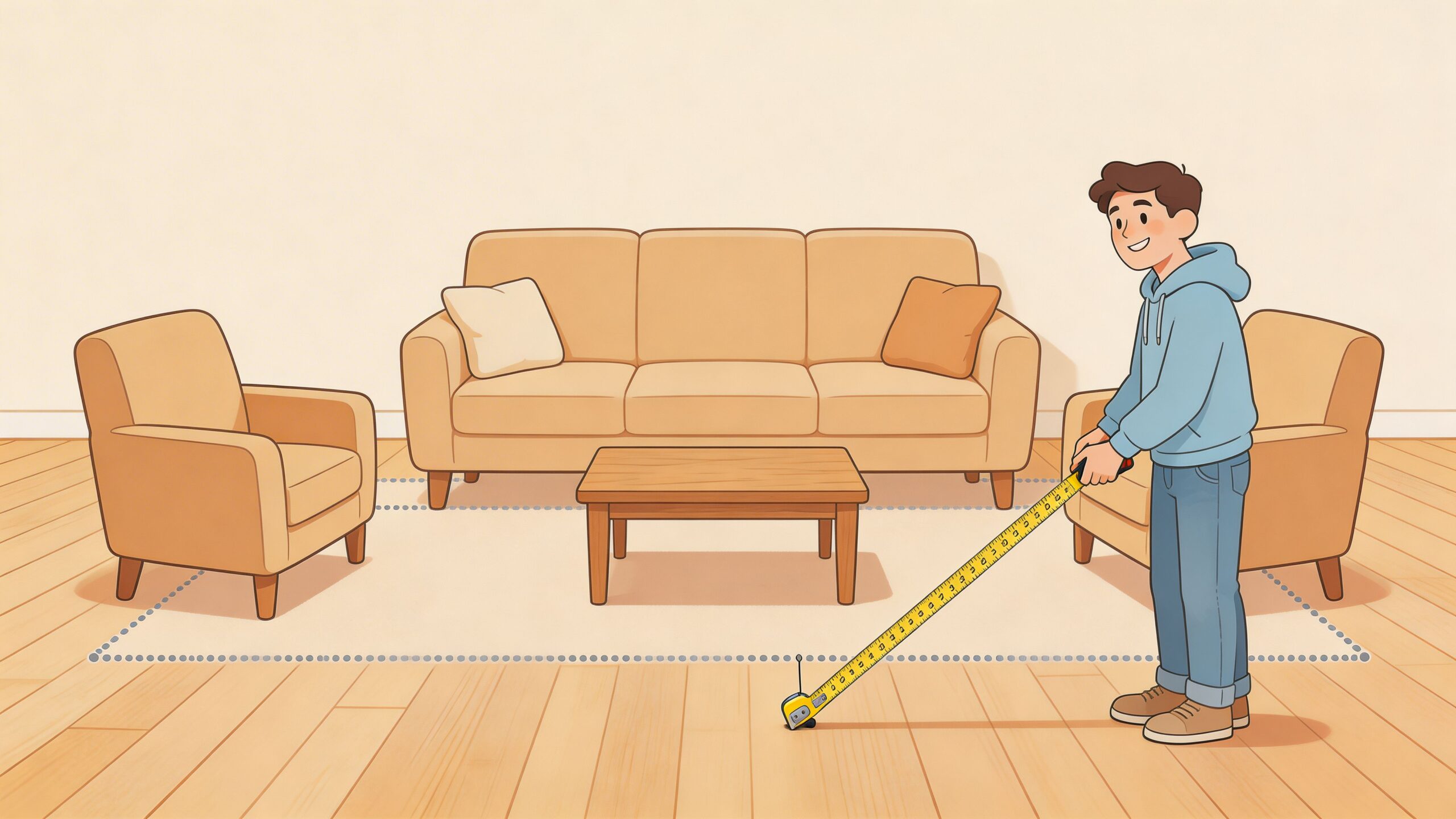
Start with the seating arrangement
Place the major pieces first. That might be a Stickley sectional, a sofa with two lounge chairs, or a more formal arrangement with a pair of accent chairs opposite a sofa.
Then measure the outer perimeter of that seating group, not including every spare inch of room beyond it. In Southern Ontario homes, the most dependable living room result usually comes from allowing the rug to sit beneath at least the front legs of all major seating.
For the majority of mid-sized living rooms in the Niagara Region, an 8' x 10' rug is the minimum size required to anchor the space properly, and 62% of homeowners undersize their living room rugs, creating a floating-island effect that can visually shrink a room by up to 25%. Critelli’s design consultants also report a 92% success rate when clients make a painter’s tape mockup before ordering, as noted in this guide on determining the size of a rug.
What works in real rooms
An 8' x 10' often suits the classic Southern Ontario living room with a standard sofa and two chairs.
A 9' x 12' usually reads better with a larger sectional, a deeper room, or an open-concept arrangement where the seating area needs stronger definition.
A smaller rug under only the coffee table almost always looks temporary, even when the rug itself is beautiful.
Standard living room rug sizes and uses
| Rug Size | Ideal Placement | Best For |
|---|---|---|
| 5' x 7' | Rarely suitable as the main living room rug | Small secondary seating areas |
| 6' x 9' | Limited use if the furniture barely engages the rug | Compact rooms with very light furniture footprints |
| 8' x 10' | Front legs of sofa and chairs on the rug | Most mid-sized Niagara living rooms |
| 9' x 12' | More complete furniture anchoring | Larger seating groups and sectionals |
A simple decision rule
If you are hesitating between two sizes, choose the larger one when the furniture arrangement can support it. A rug should look intentional, not apologetic.
This matters especially in open plans. The rug becomes the visual boundary for the conversation zone, much like millwork defines a wall in a more traditional house.
Designer’s Insight: A bold Hancock & Moore leather sofa often sits more gracefully on a neutral hand-knotted wool rug. The leather carries the weight and character. The rug steadies the room without competing for attention.
For homeowners refining layout and rug placement together, guides on how to arrange furniture in a living room are useful because furniture spacing and rug scale always work as a pair.
The common trade-off
The smaller rug usually feels financially safer in the moment. The larger rug almost always looks better once installed.
That is the trade-off. A living room rug is not merely a surface under a table. It is the visual platform for every upholstered piece around it.
Selecting Rugs for Dining Rooms and Bedrooms
Dining rooms and bedrooms ask a different question from living rooms. In each case, one major piece becomes the anchor.
For dining rooms, that anchor is the table and the movement of chairs. For bedrooms, it is the bed and the comfort of the floor around it.
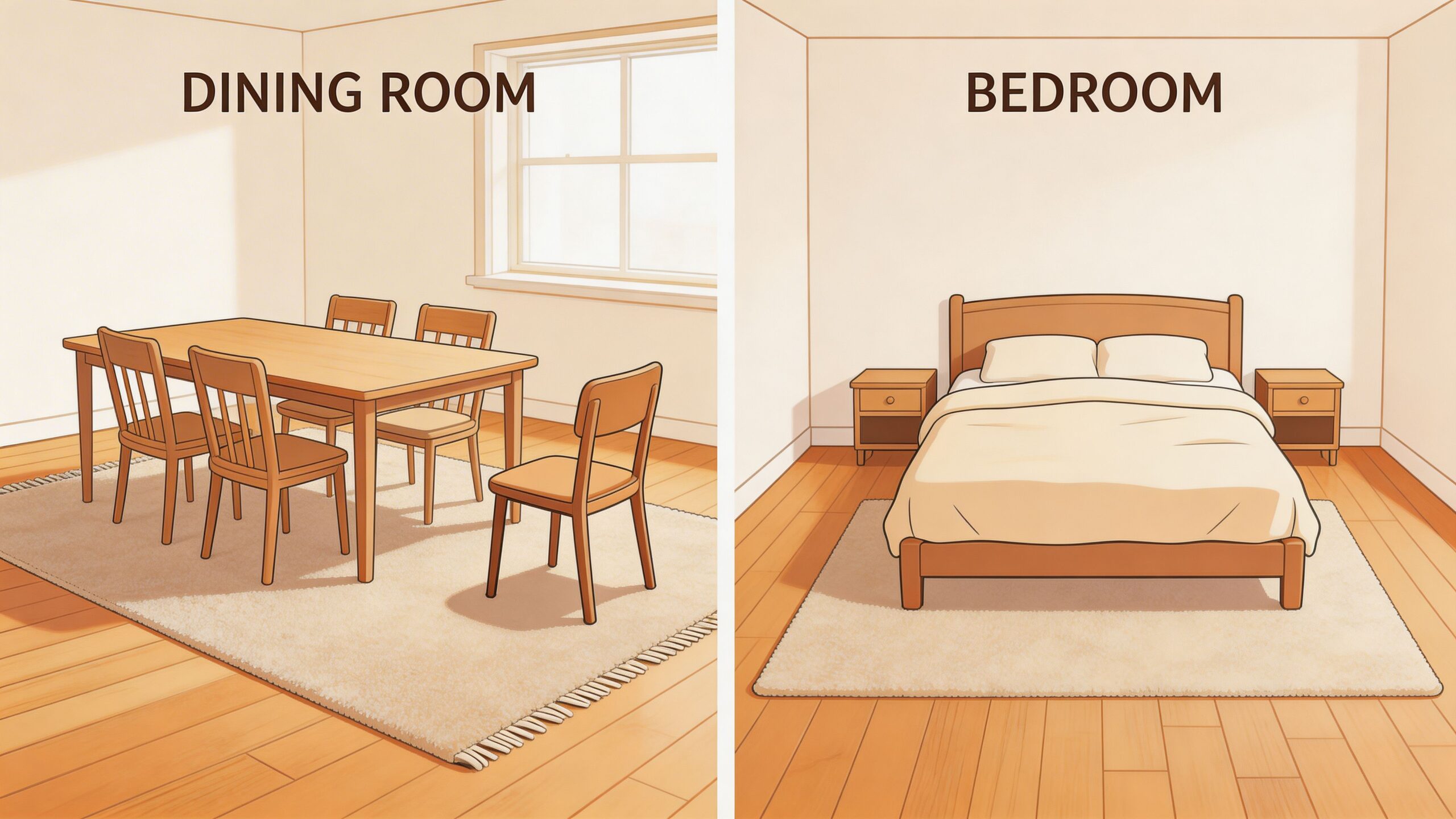
Dining room sizing depends on chair movement
Dining room rug sizing is not flexible in the way living room sizing can be. The rule is functional. The rug must extend far enough beyond the table that dining chairs remain on the rug when pulled out.
Use the table as the measurement centre. Then add enough clearance on all sides for seated use and everyday movement. If chair legs drop half on and half off the rug, the room feels awkward immediately.
That is why low-pile and flatweave constructions often perform best here. They allow chairs to slide more cleanly, and the room functions as well as it looks.
Bedroom sizing depends on the barefoot landing
Bedrooms are about comfort and proportion. The rug should be large enough to frame the bed and create a soft landing where people step.
For master bedrooms in Southern Ontario, a 9' x 12' rug is the gold standard. It allows the recommended 24 to 36 inch extension beyond the bed, creating a proper barefoot zone. A 2024 Ontario Real Estate Association survey found that properly sized bedroom rugs can increase a room’s perceived luxury by 45%, according to this rug size guide for your space.
That is one reason a too-small bedroom rug feels particularly disappointing. The bed may look heavy, but the room never feels generous.
Comparing the two rooms
| Room | What you measure from | What the rug must do |
|---|---|---|
| Dining room | Table footprint | Keep chairs on the rug when pulled out |
| Bedroom | Bed footprint | Provide visible framing and soft landing space |
What usually works best
In bedrooms with queen beds, many homeowners can achieve balanced placement with an 8' x 10'. In rooms with king beds or larger master suites, the 9' x 12' usually delivers the more complete result.
For bedrooms in older Southern Ontario homes, proportions matter even more. Sloped ceilings, narrower walkways, and original trim can make a room feel pinched if the rug stops too abruptly beneath the bed.
The same principle applies in dining rooms inside heritage homes. If the room is formal and enclosed, the rug should respect the room’s symmetry. If the room is part of a newer open layout, the rug should still contain the dining zone cleanly without drifting into adjacent circulation paths.
Practical tip: In both rooms, tape the outline before ordering. In dining rooms, pull every chair back. In bedrooms, stand where you naturally get in and out of bed.
Homeowners exploring artisanal and hand-knotted options can browse area carpets in Hamilton, Ontario to compare styles once the right size range is clear.
Common Rug Sizing Mistakes to Avoid
Most rug problems are not style problems. They are scale problems.
The rug may be the right colour, the right weave, even the right quality. If the size is wrong, the room still feels unresolved.
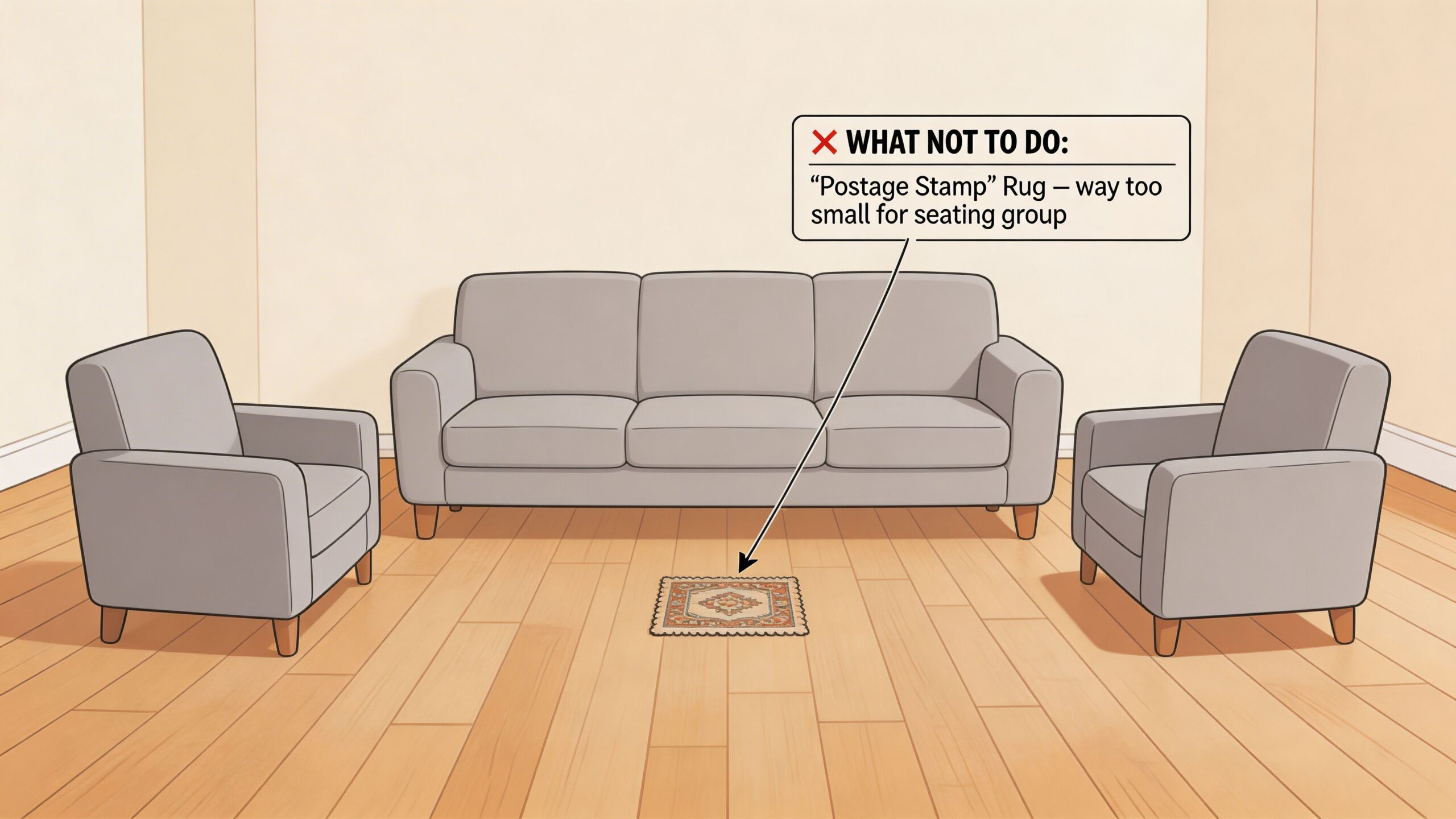
The small-rug trap
The most common mistake is buying a rug that is visibly too small for the furniture grouping. In the Niagara Region, the 8' x 10' area rug is the most versatile size for the majority of living rooms, yet 82% of sizing consultations are initiated to correct an undersized rug purchase, often a 5' x 7' or 6' x 9'. A correctly scaled rug also prevents the disjointed look reported in 40% of DIY installations, according to this article on how to choose area rug size.
That mistake usually starts with good intentions. A homeowner sees floor and assumes more visible floor means a better fit. In practice, the opposite often happens.
Other errors that change the result
- Measuring the room instead of the furniture group: Rug size should follow use and placement, not just wall dimensions.
- Ignoring pile height: A thick rug may look luxurious, but it can interfere with doors or make dining chairs cumbersome.
- Skipping the rug pad: Pads matter for grip, cushioning, and wear, especially on hardwood surfaces.
- Forgetting the architecture: Heritage homes and newer open-concept homes need different border treatments and visual balance.
What to do instead
A better process is slower but simpler.
First, finalise the furniture arrangement. Then mock up the rug footprint. Finally, check function: walking paths, chair movement, bedside landings, and door clearance.
For floor protection, especially under substantial furniture, practical guidance such as how to protect your floors from your furniture is worth reviewing alongside rug placement decisions.
Rule of thumb: If the rug looks like an accessory, it is probably too small. The rug should read as part of the room’s architecture.
Find Your Foundation at The Rug Market
A rug should never feel like an afterthought. It is the element that makes a room cohere.
That is especially true in Southern Ontario homes, where architecture ranges from heritage bungalows with vintage oak floors to broad, renovated interiors that need clear spatial definition. One rug size rule cannot cover every one of those conditions. A time-tested process works better. Start with the furniture placement. Respect the room’s use. Let the architecture guide the border.
This is also where homeowners benefit from seeing rugs in person. Colour, scale, pile, and edge treatment are easier to judge on the floor than on a screen. Hand-knotted and artisanal pieces in particular carry nuance that is hard to understand until they are unrolled in a room setting.
Within tapis, rugs, and carpets, clients can compare pieces as part of a complete room concept rather than as isolated purchases. That matters when a rug must relate to Stickley wood tones, the profile of a Stressless chair, or the character of bespoke upholstery.
The most successful rooms are rarely assembled by accident. They are curated. The rug establishes the foundation, the furnishings build on it, and white-glove placement ensures the final proportions feel considered when everything arrives in the home.
A design-forward room does not need more objects. It needs better relationships between the ones already chosen. Rug size is one of the clearest examples.
If you want a room that feels calm, grounded, and finished, start underfoot. That is where timeless craftsmanship begins to read as lived-in comfort rather than display.
Visit Critelli Furniture to explore heirloom quality furnishings, complimentary interior design support, and a curated Rug Market built around timeless craftsmanship. Experience the craftsmanship in person at our King Street Showroom, book your complimentary design consultation today, or visit the Rug Market to find your room's foundation.