


Ergonomic Sofa Couch Guide: How to Choose Well


A buyer can spend an afternoon searching for a sofa that looks generous and inviting, then discover at home that standing up requires a careful forward lean and both hands on the cushions. The problem usually isn't a lack of softness. It's a mismatch between the sofa and the body using it.
An ergonomic sofa couch should support several kinds of living, including reading, conversation, television, reclining, and occasional computer use. The right piece offers comfort without trapping the sitter in one collapsed position, and it should remain practical for every household member, including older adults, shorter users, people with arthritis, and anyone who needs more stability during transfers.
What Makes a Sofa Truly Ergonomic
A cloud-like sofa can feel wonderful during the first few minutes of a showroom visit. Once the sitter sinks fully into the cushions, however, the pelvis may slide forward, the lower back may lose contact with the backrest, and the arms may no longer provide useful support. A sofa that feels soft at first touch can become surprisingly difficult to leave.
Ergonomics means fit, support, and freedom to move, not just generous padding. Canadian seated-work guidance from the Canadian Centre for Occupational Health and Safety recommends an upright or slightly reclined posture, thighs approximately horizontal, feet fully supported, and a head and neck aligned with the torso. Those principles apply to residential seating because the body responds to a living-room sofa much as it responds to any other seat used for extended periods.
Comfort should remain active
Passive comfort comes from sinking into a surface. Active support helps the sitter maintain contact with the backrest, distribute weight across a broad area, and change position without fighting the furniture. The best ergonomic sofa couch for one household may feel too upright for another, because height, leg length, hip mobility, and preferred activities all affect the required fit.
An accessible sofa also needs to support the transition between sitting and standing. A stable armrest can help a person rise in a controlled way, while a cushion that collapses under the hips can make the same movement more demanding. CCOHS recommends lumbar support, a seat that doesn't compress the underside of the thighs, a seat depth that avoids pressure behind the knees, and a front edge that curves downward. These details separate considered design from furniture marketed only as plush.
Four questions guide the first inspection
A showroom evaluation should begin with four physical questions:
- Can the feet rest fully on the floor or a footrest?
- Does the lower back remain supported without sliding forward?
- Can the sitter recline, sit upright, and shift position easily?
- Can the arms assist movement without forcing the shoulders upward?
CSA Z412-17, cited by CCOHS, recommends alternating between sitting and standing and varying positions, including reclining, forward tilting, and semi-standing. A design-forward sofa therefore supports movement rather than encouraging one prolonged slump. A useful introduction to the wider furniture category appears in what ergonomic furniture means, but the final decision still belongs to the individual body and the room where the sofa will live.
The Four Dimensions That Define Fit
A sofa can look beautifully proportioned and still feel wrong after sustained use. Fit depends on the relationship between the seat, back, arms, and the sitter's own joints. Canadian accessibility guidance provides useful reference points, although a residential sofa should always be tested by the people who will use it.
Seat height affects transfer effort
The City of Toronto recommends loose seating with a seat height of 405 to 460 mm, approximately 16 to 18.1 inches, together with back support and armrests for seniors and people with limited stability. The range is a practical benchmark for a residential sofa, particularly where sit-to-stand effort matters. A lower seat can increase hip and knee flexion, while an overly high seat may prevent stable foot contact.
The measurement must be taken with the cushion compressed, not only from the empty floor model. A firm, non-collapsing cushion can preserve a more predictable knee angle. Armrests should be structurally stable enough to assist rising, rather than serving only as decorative borders. Seat depth measurement guidance can help a buyer distinguish the visible frame depth from the usable sitting depth.
Seat depth determines back contact
A deep seat often looks luxurious, but it can force a shorter sitter to slide forward until the feet reach the floor. That movement separates the lower back from the lumbar area and leaves the pelvis unsupported. CCOHS recommends avoiding pressure behind the knees and keeping the sitter's thighs supported without compressing them.
Ottawa's accessibility guidance gives a seat-depth reference of 330 to 510 mm, approximately 13 to 20.1 inches, for accessible seating. A sofa may fall outside that range and still suit a particular person, but the benchmark illustrates why a single deep configuration cannot serve every household equally well.
Back geometry should preserve contact
The backrest should support the lower back while allowing the spine to remain upright or slightly reclined. Ottawa guidance recommends back support extending at least 320 mm above the seat surface, a useful reference when comparing low-profile silhouettes with taller, more enveloping frames. The important test is contact. If the sitter must lean forward to see the room or television, the back geometry isn't doing enough work.
Arm position influences the shoulders
Ottawa guidance places at least one armrest 220 to 300 mm above the seat, or approximately 8.7 to 11.8 inches. Armrests that are too high lift the shoulders. Those that are too low may not assist a controlled rise. Their firmness matters as much as their height because a person with limited stability needs a reliable point of contact.
| Dimension | Target range | Why it matters |
|---|---|---|
| Seat height | 405 to 460 mm, Toronto benchmark | Supports stable feet and easier transfers |
| Seat depth | 330 to 510 mm, Ottawa benchmark | Reduces knee pressure and forward sliding |
| Back support | At least 320 mm above the seat surface, Ottawa benchmark | Promotes fuller back contact |
| Armrest height | 220 to 300 mm above the seat, Ottawa benchmark | Supports relaxed shoulders and sit-to-stand movement |
The four dimensions form one seating system. A sofa with a suitable height can still fail if its depth pushes the sitter away from the lumbar support. A supportive back can still feel inaccessible if the arms are unstable or the cushion compresses too far.
Cushion Firmness and Material Behaviour
Firmness isn't a single sensation, and it isn't adequately described by words such as “plush” or “supportive.” A cushion behaves differently at the first touch, under concentrated pressure from the sit bones, and after the sitter changes position. The useful question is whether the material keeps the pelvis and spine supported throughout those movements.
A down-wrapped cushion typically feels luxurious at contact. Its surface can conform beautifully to the body, but a very yielding construction may allow the pelvis to sink and rotate backward. When that happens, the sitter may lose the lower-back contact that made the sofa feel comfortable initially.
Three common cushion behaviours
High-resilience foam generally keeps the sitter more on top of the cushion. It returns more readily after pressure and can provide a stable base for upright reading or conversation. The desired result isn't hardness. It's controlled compression that lets the body settle without losing the neutral relationship between the pelvis, spine, and feet.
Pocketed-spring cores provide suspension beneath the upholstery. Their purpose is to distribute load through the seat rather than concentrate it at the tailbone or behind the knees. A spring-supported seat can feel buoyant, but the surface still needs enough structure to prevent excessive pelvic rotation.
Down-wrapped constructions offer softness and a relaxed, customized appearance. They may suit households that value informal lounging, provided the cushion can be plumped and the user can maintain back contact without sliding forward. The showroom test should include upright sitting, not only reclining.
Designer's Insight: A cushion should feel welcoming at first contact, then become quietly dependable beneath the pelvis. If the sitter must brace against the back cushion to keep the feet grounded, the softness is working against the body.
Material selection also involves household maintenance. Homes with pets may benefit from a review of top sofa fabrics for pet owners, particularly when texture, cleanability, and resistance to snagging influence long-term use. The best fabrics for sofas should be considered alongside cushion construction, because a technically supportive seat won't remain appealing if the upholstery is poorly matched to the household.
The whole household should test the sofa together. One person may prefer a softer surface, while another needs a firmer edge for transfers. Sitting side by side reveals whether the frame remains stable, whether the cushions migrate, and whether different body sizes can use the back support without one person sliding forward.
Reclining Mechanisms and Posture Variation
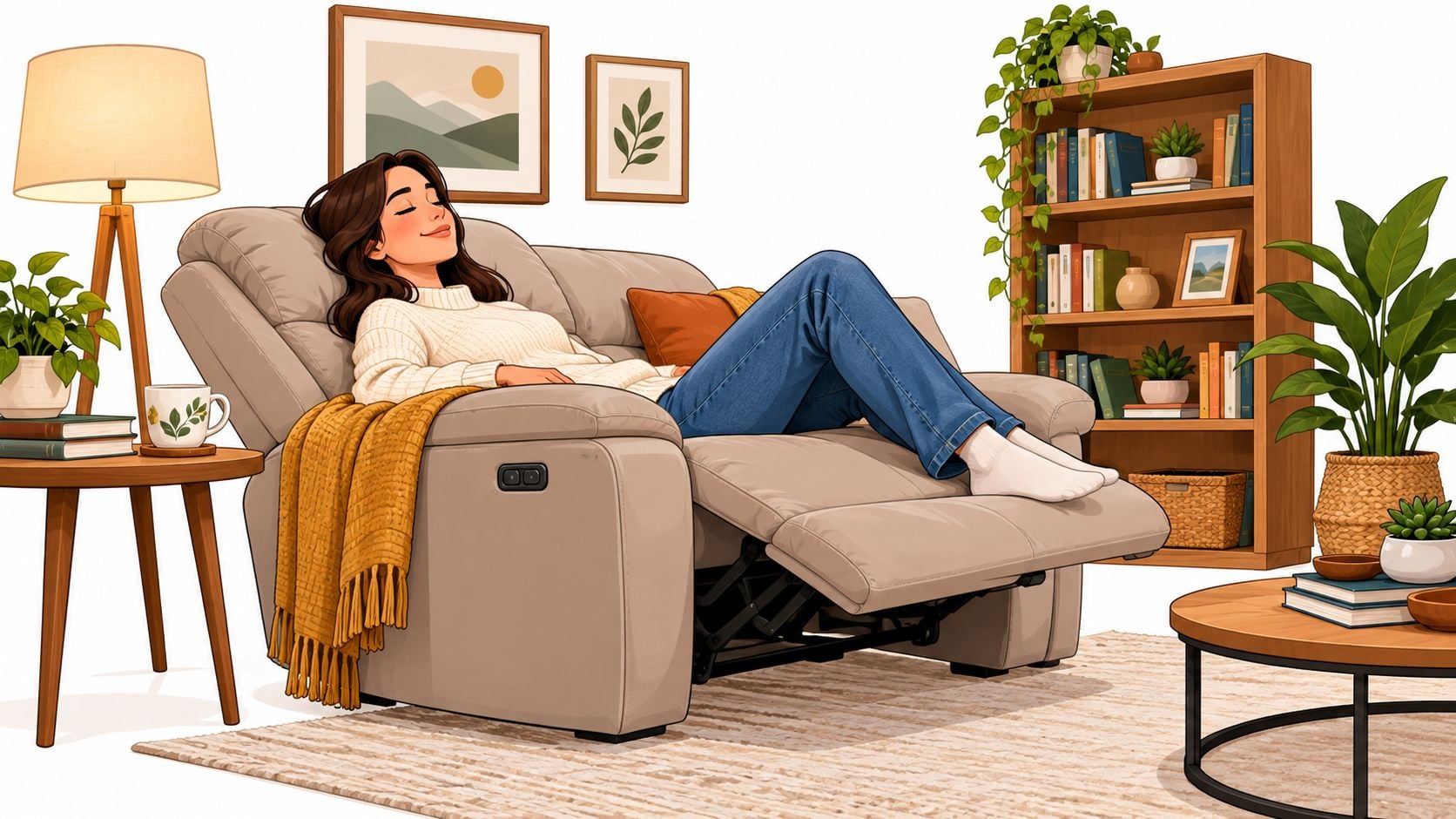
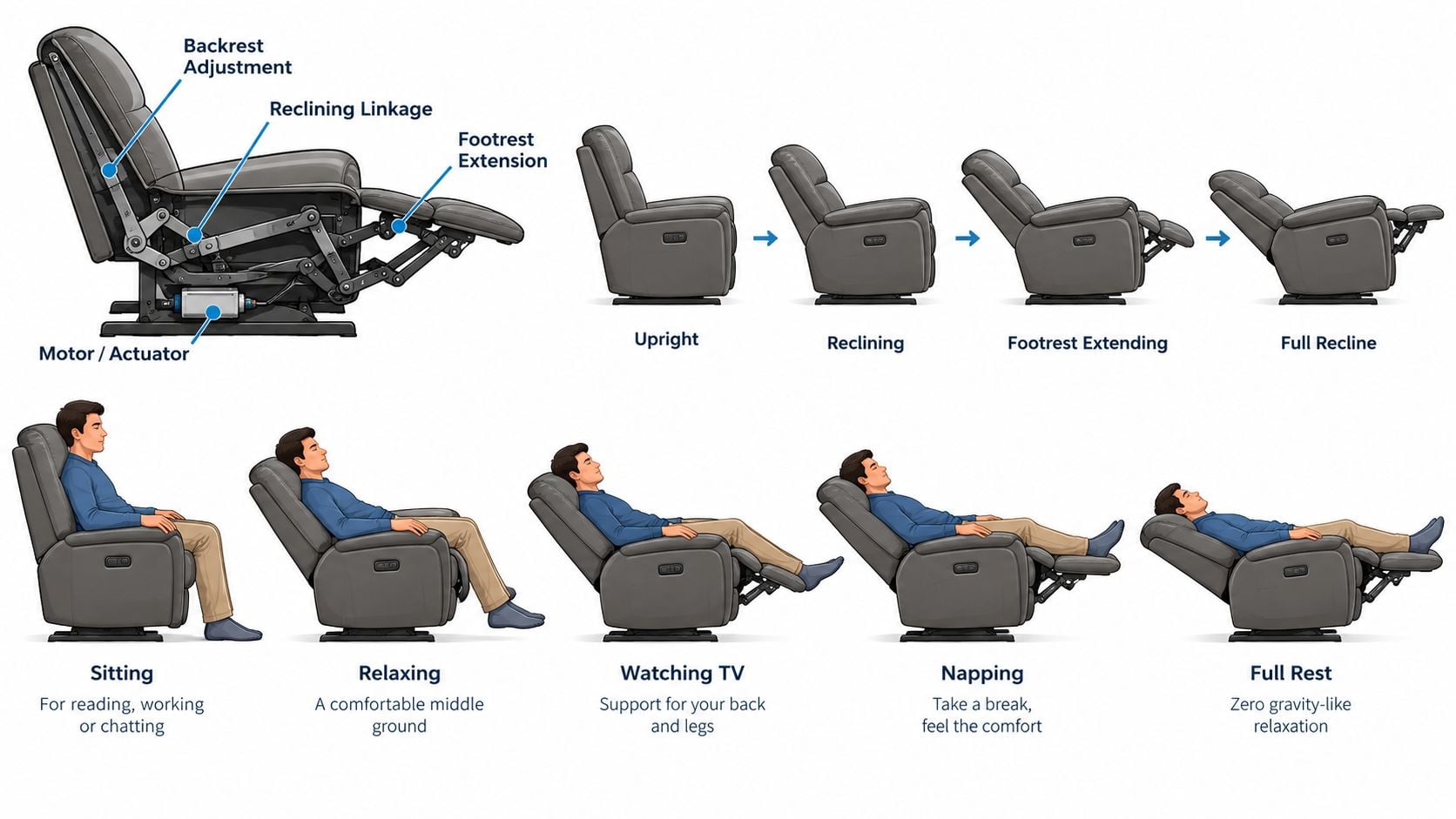
Reclining furniture earns its place through the movement it permits. Opening the angle between the hips and torso can shift some load away from the lower back, while a supported footrest can reduce pressure through the legs. The mechanism should help the sitter vary posture without creating a new problem, such as a head falling forward or the lumbar area losing contact.
Manual recline suits deliberate simplicity
A manual recliner may use a pull lever or a push-back action. It generally requires more upper-body effort and may provide selected stopping points rather than continuous adjustment. That arrangement can suit a person who reclines occasionally and prefers a design without a motor or electrical connection.
The key inspection is the movement itself. The user should be able to operate the mechanism without twisting the torso, overreaching, or losing stable foot placement. A manual design isn't automatically less ergonomic. It asks more of the person using it.
Power recline reduces operating effort
A powered mechanism moves through a wider range with controlled pressure from a switch. It can be valuable for people with limited core strength, those recovering from surgery, or anyone who changes position frequently. The controls should be easy to identify and operate, and the movement should stop smoothly rather than placing the body abruptly at the end of its travel.
A power recliner versus manual comparison is most useful when it focuses on household ability and routine rather than on a list of features. A battery backup may be worth discussing where a powered seat must return to an upright position during an outage, but the retailer should explain the specific system rather than assume every model operates the same way.
Headrests and lumbar controls complete the position
An adjustable headrest can help the neck remain aligned when the torso reclines. Adjustable lumbar support can preserve contact as the seat angle changes. Without those adjustments, the sitter may compensate by pushing the head forward or allowing the lower back to flatten against an unsupported gap.
The footrest should move in harmony with the seat. The surrounding clearance also deserves attention, especially in a compact room. Zero-wall or proximity designs can reduce the space required behind the sofa, but the exact clearance depends on the mechanism and installation. A showroom demonstration should show the fully open position, the upright position, and the path a person takes to approach the seat.
Why the Softest Sofa Is Not Always the Most Supportive
At the showroom, a sofa can feel inviting for a minute and still become tiring during a long evening. A heavily padded seat may let the pelvis roll backward, flattening the natural lower-back curve and encouraging the neck to reach forward. The sitter feels enveloped, while the body works to keep the head and torso oriented toward the room. Softness is therefore a material behaviour to assess, not a measure of support on its own.
Canadian occupational-health guidance links prolonged sitting with complaints such as back pain, muscle tenderness, aches, stiff necks, and numbness in the legs. It also connects sedentary time with broader health concerns, including metabolic syndrome, heart disease, and poor mental health, as described by CCOHS guidance on sitting at work. In a home, the furniture implication is practical. The sofa should make position changes and periodic standing easy rather than encourage uninterrupted collapse.
Comfort includes the way a person rises
The seat should retain enough structure to support several postures across the day. Test its compression directly. Press the seat 50 mm with a flat palm and hold for ten seconds. After releasing, watch how quickly the surface recovers. If it remains visibly depressed for more than a few seconds, the foam may continue changing shape during use, altering the sitter's hip position and knee angle as the cushion warms.
That behaviour matters in an inclusive household. A child, taller adult, older person, or someone with joint discomfort may each load the same cushion differently. A sofa that recovers predictably gives every sitter a more consistent starting position, while a seat that keeps settling can make relaxed sitting feel progressively less stable.
Practical rule: Ask, “Can this sitter remain supported, change position, and rise without a struggle?” The answer should hold after repeated sitting, not only during the first impression.
A softer model may still suit occasional lounging if its frame, seat height, depth, and back cushions fit the user. Assess softness as one behaviour within a complete seating system, then choose the sofa that supports the household's real routines rather than the most dramatic initial sensation.
Testing an Ergonomic Sofa in the Showroom
A showroom visit becomes more useful when the buyer replaces a quick impression with repeatable checks. The following sequence can be applied to any floor model, including a traditional sofa, a modular arrangement, or a reclining design.
Five checks reveal the working fit
Test the rise. Sit naturally, place both feet on the floor, and stand without using the arms if the sitter can do so safely. Notice whether the hips feel trapped, whether the knees are fully flexed, and whether the cushion rebounds quickly enough to support the movement.
Check lumbar contact. Sit back without forcing the shoulders into the cushion. A hand placed behind the lower back can reveal whether the upholstery fills the gap or leaves the spine unsupported. The lower back shouldn't need to work as a bridge between the seat and backrest.
Change posture. Shift from upright sitting to a relaxed position, then return to upright. Try the movement repeatedly rather than staying in the first comfortable pose. Pressure behind the knees, at the sit bones, or across the shoulder blades indicates that the sofa may be distributing weight poorly.
Invite a second sitter. A taller and shorter household member can test the same sofa together. Both people should be able to use the back support without one person sliding forward or losing stable foot contact.
Observe material recovery. Press the seat with a flat palm, release it, and watch how the surface responds. Slow recovery, visible hollows, or shifting upholstery may signal behaviour that will change the sitting experience over time.
A buyer should bring room measurements as well as body measurements. Furniture measuring guidance can help account for doorways, corners, stairwells, and the final placement area before a frame is selected.
Canadian benchmarks for the showroom floor
| Dimension | Recommended range | Why it matters | Accessibility note |
|---|---|---|---|
| Seat height | 405 to 460 mm | Supports stable foot contact and easier rising | Toronto benchmark for loose seating with back support and armrests |
| Seat depth | 330 to 510 mm | Helps avoid knee pressure and forward sliding | Ottawa accessibility benchmark |
| Back support | At least 320 mm above the seat surface | Encourages fuller contact through the back | Ottawa accessibility benchmark |
| Armrest height | 220 to 300 mm above the seat | Supports the arms and controlled transfers | Ottawa accessibility benchmark |
| Elbow angle | 90 to 120 degrees | Helps keep elbows near the body | CCOHS seated-posture guidance |
The table offers a starting point, not a substitute for testing. Cushion compression, footwear, body proportions, and mobility all change the final result. A family member who uses a walking aid or needs a clear transfer path should be included in the visit rather than represented by measurements alone.
Bringing Ergonomic Design into the Whole Room
A person may rise from the sofa comfortably, then meet a coffee table with their knees or a narrow route to the door. That scenario shows why an ergonomic sofa couch is part of a larger seating system. Seat height, recline clearance, lighting, table placement, and walking routes must work together. A sofa that fits one person's body can still create effort or uncertainty if the surrounding room restricts the approach.
Ontario's building-accessibility framework emphasises barrier-free paths of travel in applicable new construction and extensive renovations. It also states that 15% of suites in a multi-unit residential building must include basic accessibility features, including a barrier-free path and accessible doorways into key living spaces, as outlined in Ontario's building accessibility guidance. Residential furniture does not automatically follow public-space seating rules, yet the underlying idea remains useful. Clear circulation gives people more control during everyday sitting, standing, and movement.
Placement is part of the design
Map the room around the sofa before selecting its final configuration. Measure the transfer path as well as the sofa. Allow at least 900 mm of clear approach on the side the sitter uses to rise, and confirm that an open recliner does not block the route to the door. Check whether a mobility device can turn nearby, whether another chair narrows the passage, and whether a side table leaves enough space for an arm or walking aid.
Lighting also affects effort. A reading lamp should illuminate the seat without creating glare, while a television should sit at a sightline that does not encourage prolonged neck bending. Keep frequently used items within easy reach, but avoid placing tables where feet, walkers, or transfer movements may catch an edge. The floor should be stable and level. Health Canada warns that furniture can become unstable when it has a top-heavy design, rests on an uneven surface, or is assembled incorrectly. Modular units, movable consoles, and reclining sections deserve the same check.
Delivery is part of the room plan. The service should cover inspection, careful placement, assembly where required, packaging removal, and confirmation that the sofa sits level with the intended paths still open. Ontario consumer guidance treats many delayed in-store furniture purchases above $50 as future performance agreements when delivery is arranged later or payment is deferred. Written details should identify the supplier, goods, services, prices, shipping, payment terms, and delivery location, as explained in Ontario's safe store transaction guidance.
Delivery timing can affect the room setup as well. Ontario states that an ordered product must be delivered within 30 days of the promised delivery date, or the consumer may request a refund, subject to the guidance's conditions, including the consequence of keeping a late item, as described in consumer rights under Ontario's Consumer Protection Act.
Critelli Furniture, a Southern Ontario furniture destination founded in 1914, offers in-person consultations where buyers can compare frames, fabrics, reclining actions, and cushion behaviour while considering the surrounding room. Visit Critelli Furniture to discuss how the sofa, lighting, rugs, and circulation can work as one arrangement.
Designer's Insight: A neutral hand-knotted wool rug can visually organise the seating area while its size preserves a clear approach path. Keep the rug stable underfoot, especially where someone rises, turns, or uses a mobility aid.
Before ordering, mark the sofa footprint and its fully reclined position on the floor. Check door swings, heating vents, lamp locations, and the route used to bring the furniture inside. These room-level checks reveal conflicts that body measurements alone cannot show.