
Power Recliner vs Manual: Which Is Right for You?

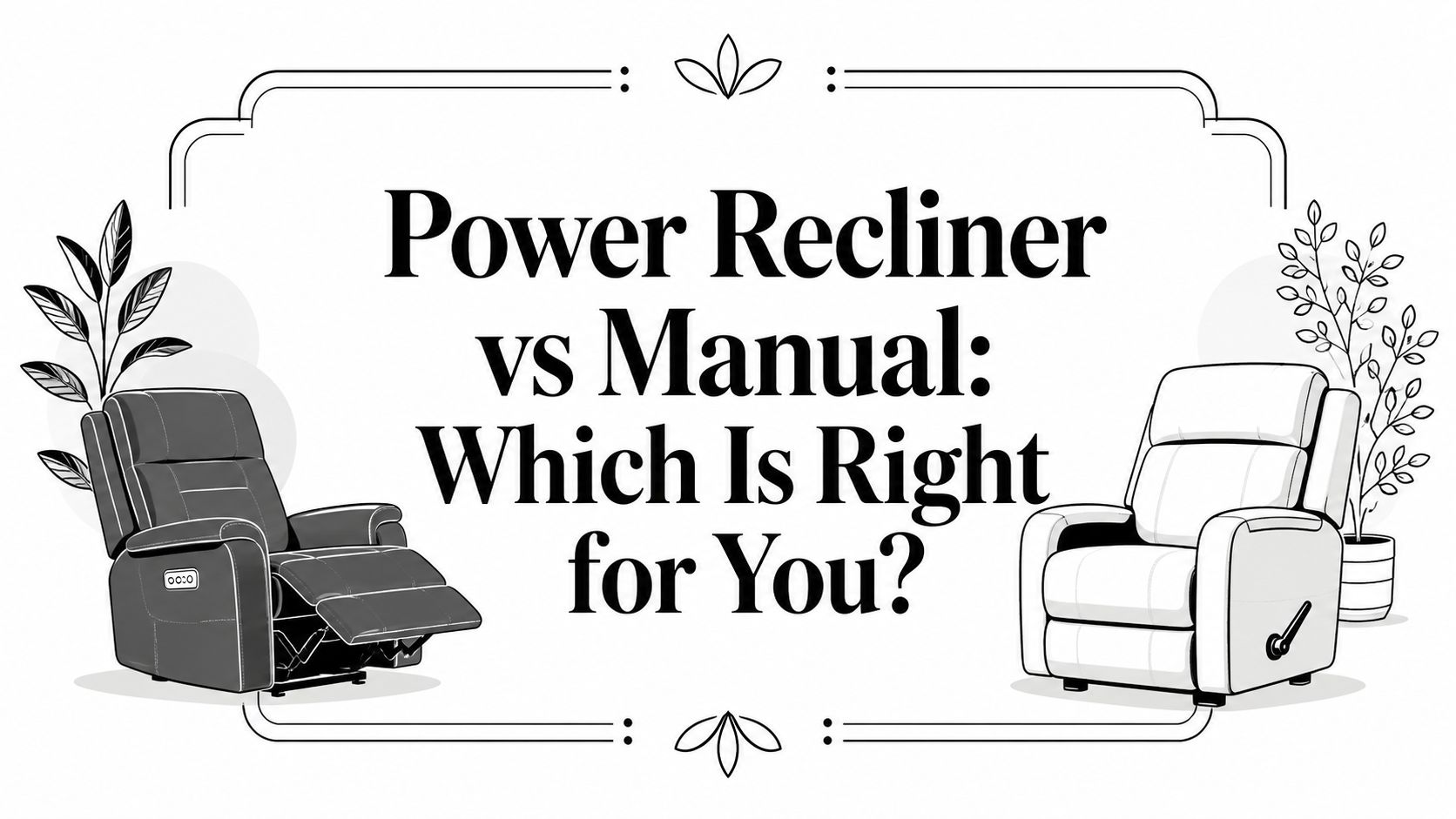
Evening usually decides this purchase.
A homeowner settles into the sitting room with a book, a film, or a final cup of tea, and the question arrives with surprising weight. Should the recliner disappear into the room and work with simple, mechanical ease, or should it offer precise, motorised comfort at the touch of a button? The right answer isn't about gadgets. It's about how the piece will support daily rituals, how it will sit within the architecture of the room, and whether it will still feel right years from now.
That's why the power recliner vs manual debate deserves more care than most buying guides give it. A recliner isn't just a seat. In a well-designed home, it becomes part of the family's domestic fabric, part of the evening routine, part of the room's visual rhythm. The strongest choices balance comfort, accessibility, placement, upholstery, and proportion.
The most trusted furniture houses understand that kind of longevity. Critelli Furniture was founded in 1914 by Joseph Critelli and his son Thomas H. Critelli in St. Catharines, Ontario, establishing a family-run legacy that has spanned over 110 years and three generations. That heritage matters because it shapes how a discerning client should evaluate a recliner. Not as a short-term convenience, but as an heirloom quality decision inside a complete room concept.
Table of Contents
- The Recliner Reimagined A Question of Lifestyle
- Understanding the Mechanics of Comfort
- A Detailed Comparison for the Discerning Homeowner
- Designer's Insight Integrating Your Recliner into a Room
- Ideal Scenarios Who is Each Recliner For
- Experience Timeless Craftsmanship Firsthand
- Frequently Asked Questions
The Recliner Reimagined A Question of Lifestyle
A well-chosen recliner reflects the household that lives with it. For one client, it's the chair used every night after work, upholstered in rich leather and placed near a reading lamp. For another, it's the seat that needs to support changing mobility, offer calm comfort, and still belong in a beautifully composed room.

The wrong way to shop is to ask which model has more features. The better question is which chair best suits the life unfolding around it. A manual recliner often appeals to the homeowner who wants artisanal simplicity, cleaner placement options, and a more traditional relationship with furniture. A power recliner suits the person who values effortless adjustment, customized support, and the kind of comfort that can be tuned rather than just opened and closed.
A chair that joins the family story
Furniture of consequence should never feel temporary. In finely designed homes, the recliner has to do more than function. It must age well, hold its silhouette, and contribute to the room's atmosphere whether it's fully occupied or standing on its own.
That's especially true for clients investing in Luxury furniture Niagara, Custom furniture Southern Ontario, or thoughtful Interior design services St. Catharines. They aren't looking for a novelty purchase. They're looking for proportion, materiality, and confidence.
A recliner earns its place when comfort and visual discipline arrive together.
The decision behind the decision
The power recliner vs manual question usually reveals a deeper preference. Some people want control without effort. Others want elegance through restraint. Neither instinct is wrong.
A well-designed home can accommodate either, but the recommendation should be clear. Choose power when precision, accessibility, or daily use takes priority. Choose manual when simplicity, placement freedom, and a less technical presence matter most. The best rooms don't chase trends. They select pieces that feel inevitable once placed.
Understanding the Mechanics of Comfort
The mechanism determines how the chair behaves every day. That behaviour affects comfort, appearance, maintenance expectations, and how intuitive the piece feels in use. Once the mechanism is understood, the decision becomes far easier.
How a manual recliner works
A manual recliner relies on body movement and a mechanical release. Depending on the design, the sitter may use a side lever or push back with weight to activate the footrest and reclining action. There's something appealingly direct about that. It feels grounded, tactile, and free of dependency on a nearby outlet.
Manual designs often suit homeowners who appreciate timeless craftsmanship and fewer integrated components. They also tend to be easier to place in spaces where flexibility matters, such as a sitting room that may be rearranged with the seasons.
A simple way to think about it is this:
- Manual equals decisive movement. The chair moves through set mechanical positions rather than fine increments.
- Manual equals fewer visible technical cues. There are no buttons to consider in the visual composition.
- Manual equals independence from power. The chair works wherever it's placed.
How a power recliner works
A power recliner replaces physical effort with motorised adjustment. The user presses a control, and the chair moves gradually into the preferred position. That slower, more bespoke precision is the central advantage. It allows the sitter to pause exactly where the body feels supported, instead of settling for the nearest preset angle.
Many buyers who are also exploring ways to personalize your lift chair options already understand the appeal of personalized movement. The same principle applies here. Comfort improves when adjustment feels measured rather than abrupt.
For readers comparing configurations, types of power reclining seating offers a useful overview of how different motorised formats can fit different rooms and routines.
Practical rule: If the chair will be used daily for reading, television, recovery, or extended lounging, power usually justifies itself through precision alone.
The engineering difference also changes the emotional tone of the chair. Manual feels classic and immediate. Power feels refined and controlled. In design terms, one speaks the language of mechanical tradition. The other speaks the language of customised comfort.
A Detailed Comparison for the Discerning Homeowner
The strongest furniture decisions come from trade-offs weighed objectively. Power recliners aren't automatically better. Manual recliners aren't automatically purer. Each serves a different brief.
Power vs Manual Recliner At a Glance
| Attribute | Power Recliner | Manual Recliner |
|---|---|---|
| Comfort adjustment | Precise, gradual positioning with touch-button control | More limited, position-based movement |
| Ease of use | Excellent for effortless reclining | Requires physical engagement |
| Visual character | Slightly more technical in nature | Often feels more classic and pared back |
| Placement | Usually needs planning around power access | Easier to place freely |
| Investment | Higher initial cost | Lower initial cost |
| Best for | Daily use, accessibility, personalised comfort | Simplicity, traditional feel, flexible layouts |
Where the investment difference matters
Cost should be discussed plainly. Power recliners retail for $200 to $800 more on average than comparable manual recliner models, a price gap driven by the added electric motors, wiring, and advanced components required for touch-button operation. For many households in Southern Ontario, including the Greater Niagara, Hamilton, and Toronto markets, that difference is meaningful but entirely reasonable when the chair will be used often.
The comparison is similar to other motorised home upgrades. A homeowner considering automated window treatments may recognise the same pattern in The Drapery Company's guide to motorized blinds. The premium is tied to convenience, control, and a more personalized experience.
For broader seating layouts, a power recliner couch can also help clarify whether the motorised function belongs in a single chair or a larger seating plan.
The real-world trade-offs
A concise evaluation helps.
- Choose power for precision: A power model lets the body settle into the exact angle it wants. That matters for long evenings, reading sessions, and anyone who dislikes the all-or-nothing feeling of traditional reclining positions.
- Choose manual for restraint: A manual recliner often feels less complicated, both visually and mechanically. In a room where understatement matters, that simplicity can be a virtue.
- Choose power for accessibility: If effortless operation is part of the brief, power is the clear recommendation.
- Choose manual for freer placement: In period homes, open-concept spaces, or rooms where furniture floats away from the wall, fewer technical requirements can make planning easier.
The best value doesn't come from the lower price. It comes from the chair that fits the household so well that replacement isn't discussed for years.
A discerning homeowner should also think beyond the chair itself. In the power recliner vs manual conversation, the correct answer often depends on the room's level of polish. In a fully styled interior, both can look exceptional. The difference is whether the room wants subtle tradition or design-forward control.
Designer's Insight Integrating Your Recliner into a Room
A recliner should never appear as the practical object that was tolerated for the sake of comfort. In a refined interior, it should look intentional from the doorway.
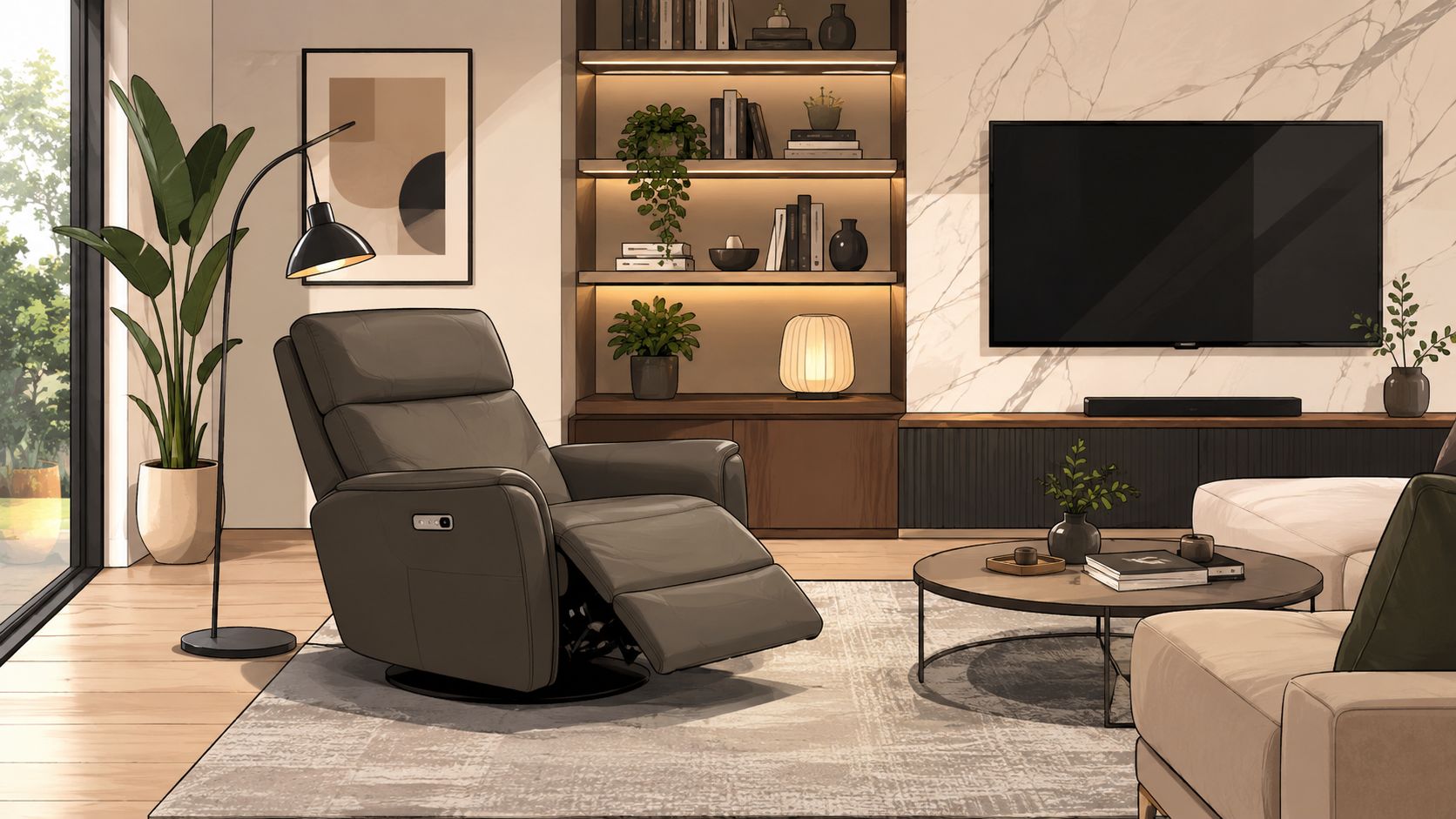
A recliner should anchor, not interrupt
The first consideration is scale. If the chair is too bulky, it stops the eye. If it's too slight, it looks apologetic. The strongest rooms use the recliner as one note within a broader composition that includes a sofa, occasional tables, lighting, and textiles.
Material matters just as much. Rich leather can make a recliner feel architectural and permanent. A tactile woven fabric can soften a contemporary scheme. In both cases, the upholstery should connect to something else in the room. A wood tone, a metal finish, a drapery fabric, or the undertone of the wall colour.
For clients arranging layered seating groups, how to arrange furniture in a living room is a practical starting point, especially when a recliner needs to balance conversation, television viewing, and circulation.
Designer's Insight
Pair a bold Hancock & Moore leather recliner with a neutral hand-knotted wool rug to steady the room's energy and keep the chair from feeling visually isolated.
That advice works because rugs do more than soften a floor. Critelli's Rug Market treats rugs as "art for your floor," featuring hand-knotted, artisanal masterpieces sourced globally that form the foundation of a room's colour palette and character. In serious interiors, the rug often solves the room before the final chair is even selected.
That's also why Hand-knotted rugs Ontario remains an important part of any complete room concept. The recliner shouldn't be chosen in isolation from the ground plane beneath it.
Clients who want long-term beauty should also think about maintenance from the beginning. Proper care helps restore your vibrant area rugs and protect the layered look that makes a recliner feel integrated rather than added later.
A bespoke room doesn't happen by accident. It comes from choosing each element with enough discipline that comfort and beauty stop competing.
Ideal Scenarios Who is Each Recliner For
Specific households make this decision easier than any specification sheet can.
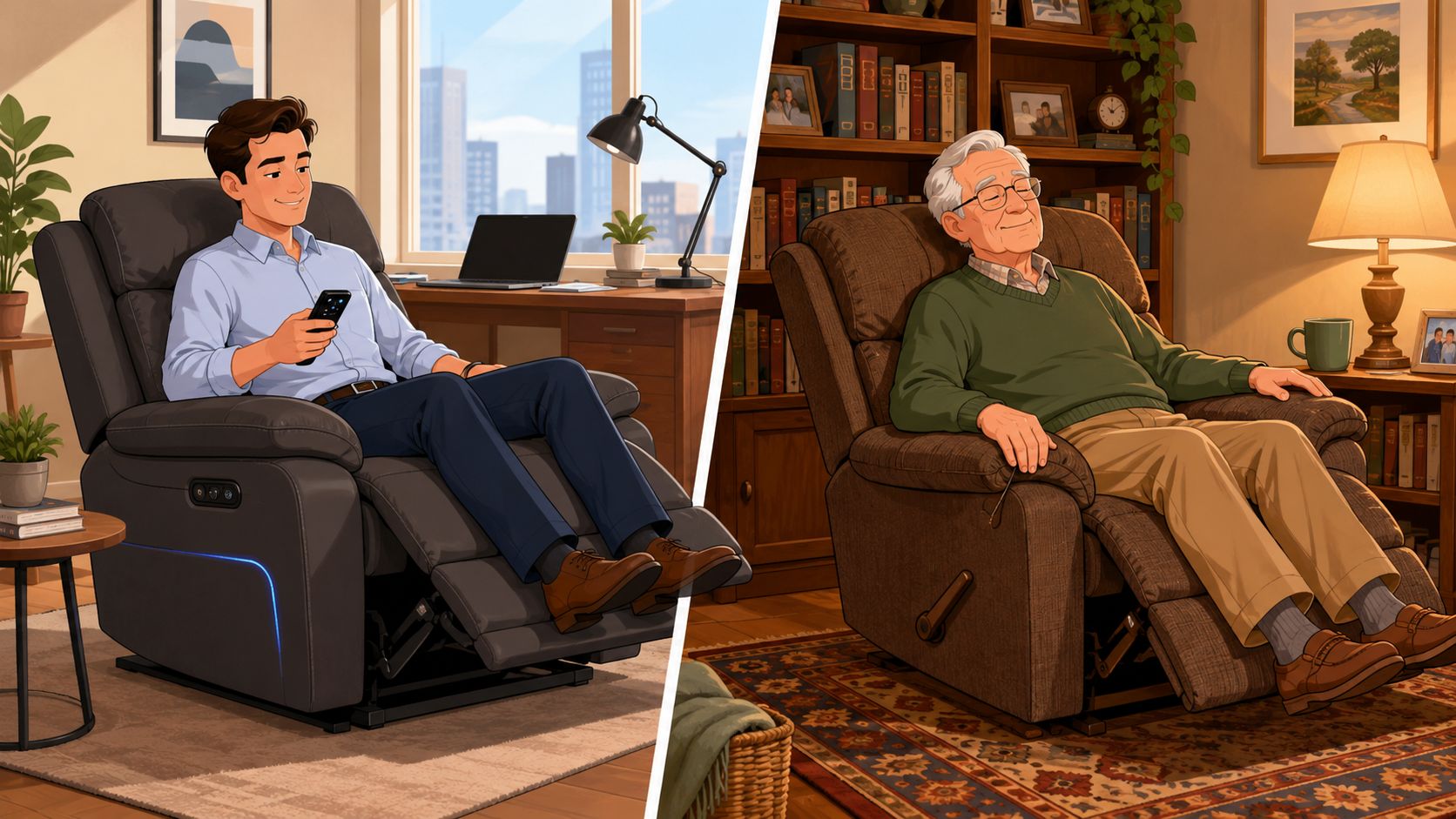
When power is the clear answer
A recovering client doesn't need a chair that asks for effort. Manual recliners require 30–50 lbs of force to engage, while power recliners operate with <5 lbs of button pressure, and that micro-adjustability helps prevent sudden joint stress during recovery. For anyone in a mobility-sensitive period, that isn't a luxury feature. It's the correct specification.
The same logic applies in a nursery. Parents often value a seat that moves unobtrusively and predictably, without the jolt that can come from a forceful mechanical shift. In that setting, a power recliner often feels calmer, more controlled, and easier to use when one arm is occupied.
Home cinema is another natural fit. The person who spends long evenings watching films or sport usually benefits from fine positioning and effortless adjustments. Small increments make a difference when hours are spent in the same chair.
For tighter layouts, a recliner for small spaces can help narrow the field without sacrificing comfort or silhouette.
When manual still makes excellent sense
A manual recliner suits the design purist who wants a quieter visual presence. In a room built around natural materials, curated upholstery, and minimal visible technology, manual operation often feels more at home.
It also suits clients who use the chair occasionally rather than constantly. If reclining is a pleasant extra rather than a daily necessity, the added investment in power may not improve life enough to matter.
Consider the manual route when these priorities lead:
- The room comes first: The homeowner wants the recliner to feel understated and visually integrated.
- The layout may change: Furniture is often moved or reoriented, and easy placement matters.
- The user prefers mechanical simplicity: There's comfort in a chair that does one thing cleanly and directly.
Some of the most elegant rooms choose manual not because power is undesirable, but because simplicity is the more disciplined design decision.
The power recliner vs manual choice becomes straightforward when household needs are clearly defined. Recovery, nursery use, and daily lounging favour power. Occasional use, minimalist styling, and placement freedom favour manual.
Experience Timeless Craftsmanship Firsthand
At a certain level of furniture, photographs stop being enough. Leather has to be touched. Seat depth has to be tested. The reclining motion has to be felt.
Two showrooms, two distinct moods
Critelli operates two distinct showrooms in Southern Ontario: Critelli Furniture on King Street for timeless, artisanal designs and Critelli Modern on St. Paul Street for design-forward, contemporary aesthetics, enabling a complete room concept. That distinction matters because the right recliner often depends on the language of the room around it.
One client may respond to classic lines, warm woods, and traditional upholstery. Another may want a cleaner silhouette with a more modern profile. Both deserve to sit in the chair, test the pitch of the back, assess the arm height, and decide whether the mechanism feels intuitive.
Why in-person testing still matters
A recliner is an embodied decision. The body recognises fit quickly. It notices whether the seat supports the thighs, whether the headrest lands correctly, and whether the movement feels smooth or distracting.
Delivery matters too. Once the right piece has been selected, the handoff into the home should feel smooth. White-glove delivery is essential for a polished transition, especially across the Greater Niagara, Hamilton, and Toronto markets where homeowners expect a room to feel composed from the start rather than half-finished after installation.
For clients considering Luxury furniture Niagara or Custom furniture Southern Ontario, the recommendation is simple. Test both mechanisms in person. Sit longer than expected. Evaluate the chair as part of a room, not as an isolated object. A good recliner feels comfortable in the showroom. The right one feels inevitable in the home.
Frequently Asked Questions
What happens if the power goes out
A power recliner depends on electricity for its motorised adjustments, so an outage can temporarily limit movement. That's one reason some buyers prefer manual in cottages, secondary rooms, or spaces where absolute independence is a priority. Buyers who value precision usually still choose power and plan accordingly.
Can a power recliner work in a room without obvious cords
Yes, but the room should be planned deliberately. Cord visibility can disrupt an otherwise composed interior, so placement, outlet access, and furniture orientation matter. In a design-forward room, that technical detail should be resolved before the chair is delivered, not after.
Is a manual recliner more durable
Not automatically. Durability depends on construction quality, upholstery, frame integrity, and how the chair is used. Manual mechanisms appeal to buyers who want fewer integrated components, while power models appeal to those who value comfort customisation enough to accept greater mechanical complexity.
Where does Stressless fit in
Stressless sits comfortably within this conversation because the brand is known for ergonomic thinking and refined comfort. For many discerning homeowners, that means the decision isn't just power recliner vs manual in the abstract. It's also about how a particular brand interprets posture, support, scale, and visual elegance.
A final practical checklist helps clarify the choice:
- Choose power if: daily comfort, accessibility, nursery use, or precise positioning are central.
- Choose manual if: visual restraint, flexible placement, and mechanical simplicity matter more.
- Pause before buying if: the room plan, rug, lighting, or surrounding upholstery hasn't been resolved.
- Test in person if: the chair will be used often enough to shape the rhythm of the room.
The correct recliner should feel resolved before it reclines. Its comfort matters, but so does its contribution to the home's character.
For homeowners seeking a recliner that balances comfort, timeless craftsmanship, and a complete room concept, Critelli Furniture offers the kind of curated selection and design guidance that rewards an in-person visit. Experience the craftsmanship in person at our King Street Showroom. Book your complimentary design consultation today. Visit the Rug Market to find your room's foundation.