CRITELLI'S SUMMER SALE | UP TO 70% OFF



Pressure Relief Mattress: Prevent Ulcers & Boost Comfort

A restless morning often starts quietly. A homeowner rises with a tender shoulder and a lower back that never quite settled overnight. In another home, an adult child checks on a parent who now spends long stretches in bed and worries less about comfort than about skin breakdown, circulation, and the strain of daily care.
That's where a pressure relief mattress becomes more than a bedroom upgrade. It can be a practical health support, a comfort tool, and, in the right setting, a meaningful safeguard. The confusion begins when medical language meets retail language. Many people hear “plush,” “supportive,” or “cooling” and assume those words mean the same thing as pressure redistribution. They don't.
A thoughtful mattress choice sits at the intersection of wellbeing, craftsmanship, and fit for the room itself. In Southern Ontario, homeowners often want both clinical reassurance and a design-forward bedroom that still feels composed and refined. Those readers often begin with a broader mattress buying guide before narrowing the field. A family-run legacy dating back to 1914 has also shaped expectations in this market, where people value timeless craftsmanship, bespoke guidance, and a complete room concept rather than a single isolated purchase.
Introduction to Pressure Relief Mattresses
A pressure relief mattress is designed to redistribute body weight so that the hips, shoulders, heels, and other prominent areas don't bear too much force for too long. That matters in clinical care, but it also matters in ordinary life. A side sleeper with joint pain and a bed-bound patient have different needs, yet both benefit when pressure is spread more evenly across the sleep surface.
The clearest way to understand it is to think about surfaces underfoot. Standing on a few small stones creates sharp discomfort in specific spots. Standing on a thick lawn spreads the load and feels gentler. A pressure relief mattress works in much the same way. It reduces concentrated stress points rather than merely feeling soft.
Practical rule: Softness alone isn't the goal. The right surface cushions pressure points while still keeping the body aligned.
This is also where many shoppers get turned around. A mattress can feel luxurious in a showroom for five minutes and still fail to support circulation, posture, or ease of movement over a full night. In higher-end bedrooms, the best choices often blend heirloom quality materials, curated comfort layers, and performance details that support day-to-day living without compromising the room's overall character.
Understanding What a Pressure Relief Mattress Does
Pressure relief starts with one simple task. The mattress has to let heavier parts of the body settle in enough to reduce concentrated force, while supporting lighter areas so the spine doesn't twist or sag.
How redistribution feels in real life
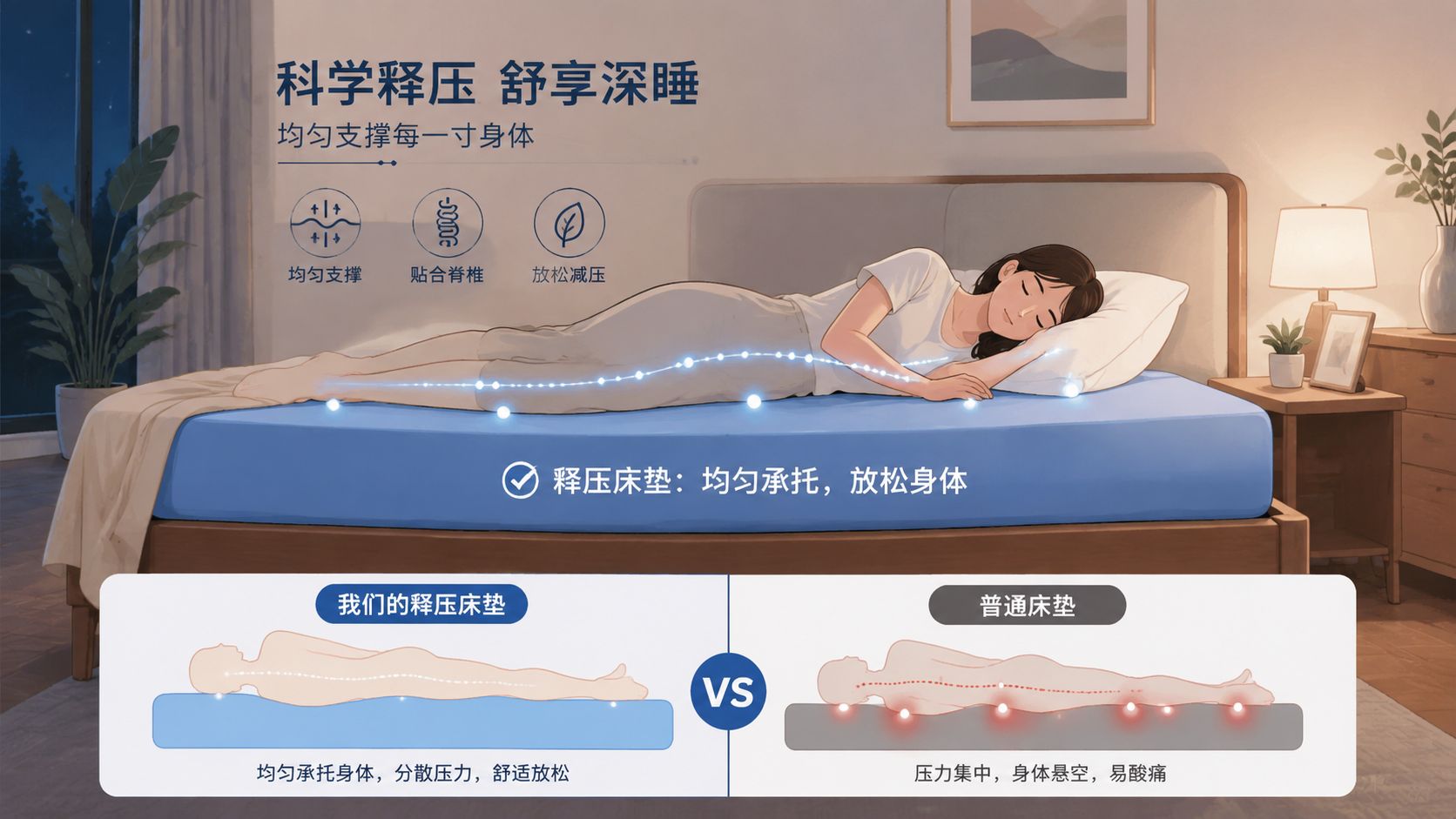
One helpful analogy is the difference between lying on pinpoints and gliding over a well-cushioned surface. A standard mattress that's too firm can push back sharply at the shoulders and hips. A well-made pressure relief mattress uses foam structure, air movement, or layered construction to spread that force over a broader area.
That spreading matters because blood flow occlusion begins at 32 mmHg, yet many consumer guides don't explain how to check whether a surface stays below that threshold at the hips and shoulders, as noted in this discussion of support versus pressure relief. In plain terms, too much concentrated pressure can interfere with healthy circulation.
A better mattress doesn't eliminate contact. It changes the pattern of contact. The body is held more evenly, so fewer areas carry too much load.
Why support and pressure relief aren't identical
Support keeps the body organised. Pressure relief softens the points that would otherwise feel compressed. Both have to work together.
A mattress with strong support but poor pressure distribution may leave a sleeper waking with numb arms or sore hips. A mattress with deep cushioning but weak structure may allow the pelvis to dip too far, creating morning stiffness. That's why body type matters, and why many shoppers benefit from comparing options through a more personalised lens such as which mattress is right for your body type.
A good pressure-relieving surface should feel calm, not dramatic. There shouldn't be obvious pushback under the joints or a sense of rolling into a hollow.
For caregivers, this science has another layer. A transfer in and out of bed should feel steady. For homeowners, the same principle becomes simpler. Less pressure at the shoulder and hip often means fewer overnight wake-ups and a smoother start to the day.
Benefits for Medical and Home Use
The medical case for pressure redistribution is unusually clear. In Ontario, pressure relief mattresses for emergency-admitted patients can prevent 5,500 cases of pressure ulcers annually, cutting incidence by 64% and saving hospitals an estimated $17 million each year, according to this Ontario cost-effectiveness analysis.
Why clinical results matter at home
Hospital evidence doesn't mean every homeowner needs a highly technical medical surface. It does show that pressure redistribution isn't decorative language. It has measurable consequences when a person is vulnerable, immobile, or healing.
At home, the benefits often show up differently:
- For older adults: gentler contact at the hips and shoulders can make prolonged rest more tolerable.
- For people with chronic back discomfort: medium-firm surfaces are often preferred over very firm ones for pain and sleep quality in the clinical literature cited in the Canadian review discussed later in this article.
- For households using adjustable bases: changing elevation can work hand in hand with pressure relief, especially for readers exploring how adjustable bases can help alleviate health concerns.
Who tends to benefit most
The strongest candidates usually fall into one of three groups. The first includes people with reduced mobility. The second includes sleepers who wake with recurring pressure-point pain. The third includes caregivers trying to make a bedroom safer and more restorative without turning it into a visibly clinical space.
That balance matters in design-led homes. A bedroom can still feel bespoke, calm, and beautifully resolved while accommodating serious comfort needs. The mattress becomes part of a complete room concept rather than a medical interruption dropped into an otherwise polished interior.
Comparing Mattress Technologies
Not every pressure-relieving surface works the same way. The materials change the feel, the upkeep, and the degree of clinical relevance.
Pressure Relief Mattress Technology Comparison
| Technology | Support Mechanism | Best For | Approximate Cost |
|---|---|---|---|
| Memory foam | Contours closely around pressure points and absorbs force | Sleepers who want close body-conforming comfort | Varies by materials and construction |
| Latex | Offers buoyant cushioning with quicker response | People who want pressure relief without a slow-sinking feel | Varies by build and finish |
| Alternating air | Uses shifting air pressure across chambers | Higher-risk medical users and some caregiving settings | Typically premium, often with added equipment costs |
| Hybrid | Combines cushioning layers with an underlying support core | Homeowners who want a balance of pressure relief and structure | Varies widely by complexity |
Foam versus more complex systems
Canadian evidence gives high-specification foam an important place in the conversation. Subgroup analyses show higher-specification foam mattresses reduce ulcer risk by 60% versus standard hospital mattresses, supporting targeted use for high-risk patients, according to this Canadian assessment of mattresses for pressure ulcers.
That finding helps cut through a common assumption. More mechanical doesn't automatically mean more effective for every setting. Some shoppers hear “air” and assume it's the premium answer by default. In reality, foam can be clinically meaningful and more straightforward to live with.
How each category behaves in the bedroom
Memory foam often offers the deepest contouring sensation. Some people love that gently enveloped feel. Others find it harder to turn or reposition on dense foam surfaces.
Latex tends to feel more buoyant and responsive. It can appeal to sleepers who want comfort without the sensation of sinking in. Hybrid models often sit in the middle, combining a pressure-relieving top with a more supportive underlying structure.
Alternating air systems belong in a separate conversation. They may be appropriate when medical need is the primary driver, but they can introduce practical questions around noise, setup, and maintenance.
For many homeowners, the shortlist comes down to feel and function:
- Choose foam when pressure reduction is the priority and simplicity matters.
- Choose latex when ease of movement matters as much as cushioning.
- Choose hybrid when the room needs a more conventional luxury-mattress feel with balanced support.
- Choose alternating air when a clinician or care context points toward a more specialised surface.
A shopper who's also evaluating construction styles may find it useful to look at what defines a hybrid mattress, especially when trying to balance comfort with a more traditional bed profile.
The most elegant choice is often the one that solves the right problem with the least complication.
Key Features to Evaluate in Pressure Relief Mattresses
Materials tell only part of the story. The more important question is how the mattress performs under a real body, in a real room, over a full night.
Pressure mapping and zoned support
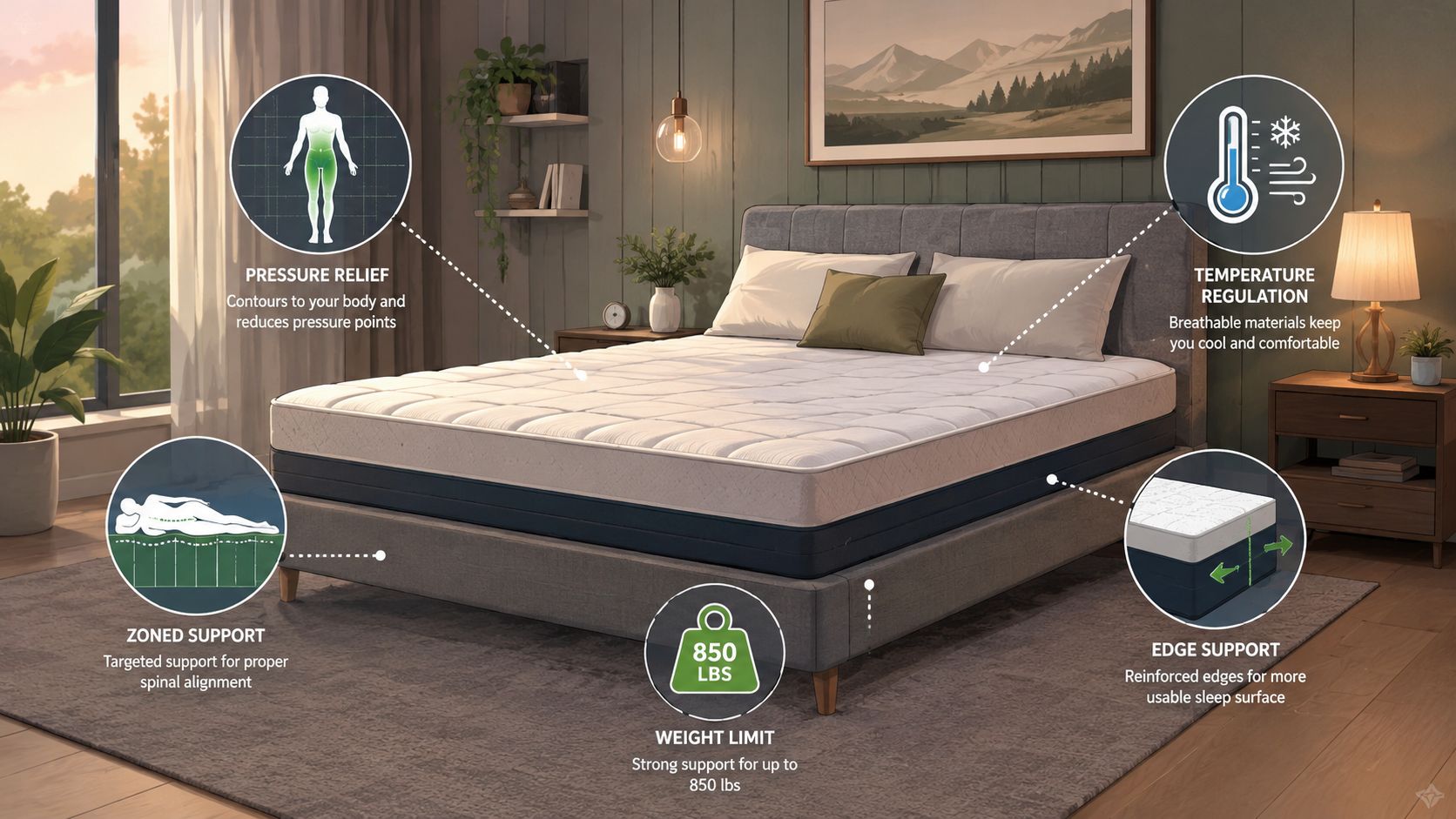
Pressure mapping sounds technical, but the idea is approachable. It asks where the body is carrying the most force. Hips and shoulders usually need more give. The waist and lower legs often need steadier lift.
A mattress with zoned support tries to answer that pattern. Instead of feeling identical from head to toe, it's built so certain sections compress differently. That can help the spine stay in a more neutral position while still easing pressure at the joints.
Temperature regulation and surface stability
Heat changes comfort quickly. A sleeper who overheats often shifts more, wakes more, and never settles fully into the mattress. Breathable construction, ventilated foams, and covers that release warmth can help the body remain at ease.
Edge support is less glamorous, but it matters. A strong perimeter helps a person sit at the side of the bed without the surface collapsing. For caregivers, that can make transfers feel steadier. For homeowners, it makes the bed easier to use day after day.
What to test in person
A careful evaluation usually includes these checks:
- Shoulder immersion: When lying on the side, the shoulder should settle in without feeling jammed upward.
- Hip balance: The pelvis shouldn't drop too far below the ribcage.
- Ease of turning: The sleeper should be able to reposition without strain.
- Perimeter steadiness: Sitting at the edge shouldn't feel precarious.
- Thermal comfort: After several minutes, the surface shouldn't start feeling stuffy.
Designer's Insight
In a design-forward bedroom, practical performance should still feel refined. A tailored upholstered bed, quiet bedding palette, and a hand-knotted rug as art for your floor can soften the visual presence of a more specialised mattress and keep the room cohesive.
Many shoppers stop at “firm” or “plush,” but that language is too broad. The better question is whether the surface manages pressure at the body's heaviest contact points while preserving posture, movement, and calm.
How to Choose Test and Maintain Your Mattress
A pressure relief mattress should be chosen with the same care given to fine upholstery. Comfort on day one matters, but so do durability, cleanability, and fit for the household's routines.
Questions worth asking in the showroom
A short list of practical questions often reveals more than a long product label:
- What body profile suits this model best? A mattress can be beautifully made and still be wrong for the sleeper using it.
- How easy is it to turn on? This matters for older adults and anyone with joint stiffness.
- What are the care requirements? Some covers are easier to manage than others.
- What does the warranty cover? Shoppers should look for plain language, not broad reassurance.
- Is this technology necessary for home use, or merely available? That distinction can prevent costly overbuying.
The cost question is especially important. Emerging reviews conclude uncertainty about whether active air systems outperform high-spec foam in home settings, warning most homeowners may not recoup the premium via additional clinical benefit, as discussed in this evidence review on support surfaces.
How to test beyond the first impression
A proper test takes time. Five minutes on the edge of a display model doesn't reveal much.
Shoppers usually benefit from checking these points during a trial period or an extended in-store test:
- Start in the usual sleep position: Side sleepers should judge the shoulder and hip first.
- Stay still long enough: Pressure discomfort often appears after several minutes, not instantly.
- Roll and sit up: Movement reveals whether the mattress is too engulfing or unstable.
- Notice the morning after: The actual measure is how the body feels after a full night, not during a showroom moment.
For the room itself, some households add sensory cues that support a restful routine. A linen refresh such as Loyaltie's gem infused mist can complement the atmosphere of a calm bedroom, though it doesn't replace the structural role of the mattress.
Maintenance that preserves performance
Like a fine leather sofa, a premium mattress performs better when it's cared for consistently. A neglected surface can lose the very qualities that made it comfortable in the first place.
A simple maintenance routine often includes:
- Rotation guidance: Follow the maker's instructions rather than guessing.
- Surface protection: Use a breathable protector when appropriate.
- Routine cleaning: Keep the cover and surrounding bed environment clean and dry.
- Foundation check: The support beneath the mattress should remain sound and level.
Households wanting a longer care roadmap can refer to mattress maintenance and cleaning tips to extend its lifespan. White-glove service also becomes valuable here, because proper placement from the start often prevents avoidable wear.
Buying Locally and Consulting Critelli Design Studio
For many Southern Ontario shoppers, the most useful part of the buying process is physical comparison. A mattress can look superb online and still miss the mark in person. Testing texture, edge stability, height, and ease of movement is far easier in a curated showroom setting.

A local design studio also reframes the purchase. Instead of treating the mattress as a single transaction, it becomes part of a complete room concept that includes bed scale, textiles, lighting, and floor covering. That's where interior design services in St. Catharines can offer real value, especially for homeowners furnishing principal suites, guest rooms, or care-conscious bedrooms with a bespoke eye.
In this part of Southern Ontario, the conversation naturally extends beyond sleep surfaces. A hand-knotted rug can serve as art for your floor, anchoring the palette and softening the room acoustically. Case goods, upholstered beds, and bedding can then be layered into a coherent, design-forward whole. That approach speaks directly to buyers searching for Luxury furniture Niagara, Custom furniture Southern Ontario, and Hand-knotted rugs Ontario without wanting a piecemeal result.
A heritage business founded in 1914 carries a different rhythm. It suggests family-run continuity, a curated selection rather than excess, and white-glove delivery that respects the home from showroom to final placement. For clients across the Greater Niagara, Hamilton, and Toronto markets, that meticulous handoff often matters as much as the mattress itself.
Conclusion
A pressure relief mattress serves two worlds at once. In clinical settings, it can play a meaningful role in prevention and protection. At home, it can ease pressure-point discomfort, support better alignment, and make rest feel more restorative without sacrificing a room's sense of calm and timeless craftsmanship.
The best decision usually comes down to fit, not hype. Shoppers should pay attention to pressure distribution, ease of movement, temperature regulation, edge stability, and whether a more complex system is necessary for home use. Trial periods, clear warranty language, and proper maintenance all matter. So does seeing the mattress in a fully styled environment rather than judging it as an isolated object.
In higher-end interiors, the most successful bedrooms don't separate wellness from design. They combine both. A thoughtful mattress, paired with bespoke furnishings, artisanal textiles, and a carefully grounded palette, becomes part of a room that supports the body and settles the mind.
Experience the craftsmanship in person at our King Street Showroom. Book your complimentary design consultation today.
Critelli Furniture brings together heirloom quality furnishings, a curated selection of premium sleep solutions, interior design services in St. Catharines, and white-glove delivery across the Greater Niagara, Hamilton, and Toronto markets. For homeowners seeking a design-forward bedroom with timeless craftsmanship, Critelli Furniture offers a refined path from first consultation to final placement. Visit the Rug Market to find your room's foundation.