
Choosing Heirloom End Tables Wood for Your Home in 2026

A great wooden end table is so much more than just a place to set down a lamp or a book. Think of it as a small but mighty piece of timeless craftsmanship, one that brings warmth and character into your home. The best ones have the potential to become cherished family heirlooms.
The Timeless Allure of Wooden End Tables
An end table is never an afterthought; it’s a key player in your room's overall design. Since our family founded Critelli Furniture back in 1914, we've helped generations of families across Southern Ontario choose pieces that do more than just fill a space—they tell a story. We don't just sell furniture; we help you make a thoughtful investment in your home's heritage.
The right end table can pull an entire seating area together. It connects the style of your sofa with the texture of your armchairs and even picks up on colours from the hand-knotted rug underfoot. It’s a quiet anchor piece that creates a sense of harmony and purpose in a room.
More Than Furniture—An Investment in Heritage
Choosing a solid wood end table is about appreciating the story behind the material and the hands that shaped it. It's about understanding how one well-chosen piece can elevate the whole feel of your living room, whether you're in Niagara, Hamilton, or the GTA. At Critelli, we want to help you build a legacy, one beautiful piece at a time.
This guide is designed to walk you through that selection process. We'll explore how to spot superior construction, choose the right wood for your lifestyle, and make your new table look right at home. It’s the same philosophy we use in our Design Studio every day. You can see how this same idea applies to other accent pieces in our guide to timeless living room style with sofa tables and consoles.
Designer’s Insight: Our designers often suggest using an end table to introduce a contrasting yet complementary wood tone to a room. For example, pairing a rich, dark walnut end table beside a sofa with lighter oak legs can create a sophisticated, layered look that feels collected over time rather than purchased all at once.
Thinking about your end table as part of a bigger picture is the first step toward creating a home that feels truly curated. It’s about finding a piece that will not only serve you well today but will also hold memories for years to come. We invite you to book your complimentary design consultation today to begin crafting a space that is uniquely yours.
Understanding the Language of Quality Wood
Choosing a true heirloom end table means learning to read the story written in the wood itself. Since our family began this journey in 1914, we've always believed that appreciating fine furniture starts with understanding the unique personality of each wood species. This knowledge helps you move beyond just matching colours to select a piece with genuine character and lasting value.
Think of a wooden end table as a living element within your home. The type of wood determines not only its durability but also its visual texture and how it will age. Each species offers a distinct aesthetic, much like a textile, contributing its own feel to a complete room concept.
The Character of Key Hardwoods
The most durable and revered end tables are almost always crafted from hardwoods. These slow-growing, deciduous trees produce dense, strong lumber that stands up to the rigours of daily life and can be finished beautifully.
- Oak (The Sturdy Classic): Known for its prominent, open grain pattern—often called "cathedrals"—oak gives off a sense of rustic warmth and traditional strength. It's exceptionally durable and resistant to dents, making it a fantastic choice for a busy family home. Because it's porous, it absorbs stains deeply, resulting in rich, textured colour.
- Maple (The Smooth Modernist): With a fine, tight, and subtle grain, maple presents a clean, uniform surface. Its pale, creamy colour provides a bright, contemporary feel, and its incredible density makes it one of the hardest woods available. Maple's smooth canvas is perfect for painted finishes or a clear coat that lets its natural purity shine through.
- Walnut (The Rich Aesthete): Celebrated for its deep, chocolatey hues and complex, swirling grain, walnut is the epitome of sophisticated elegance. It has a luxurious, smooth texture and a natural lustre that only deepens with age. While a bit softer than oak or maple, its commanding presence makes it a go-to for design-forward statement pieces.
- Cherry (The Graceful Chameleon): Cherry wood is prized for its warm, reddish-brown tones and smooth, closed-grain pattern. What makes cherry so special is how it ages; it darkens beautifully when exposed to light, developing a rich, burnished patina over time. This graceful evolution ensures a cherry end table just gets more distinguished with each passing year.
This infographic breaks down the core ideas that elevate a simple table into something more—connecting the concepts of heirloom quality, artisanal craftsmanship, and forward-thinking design.
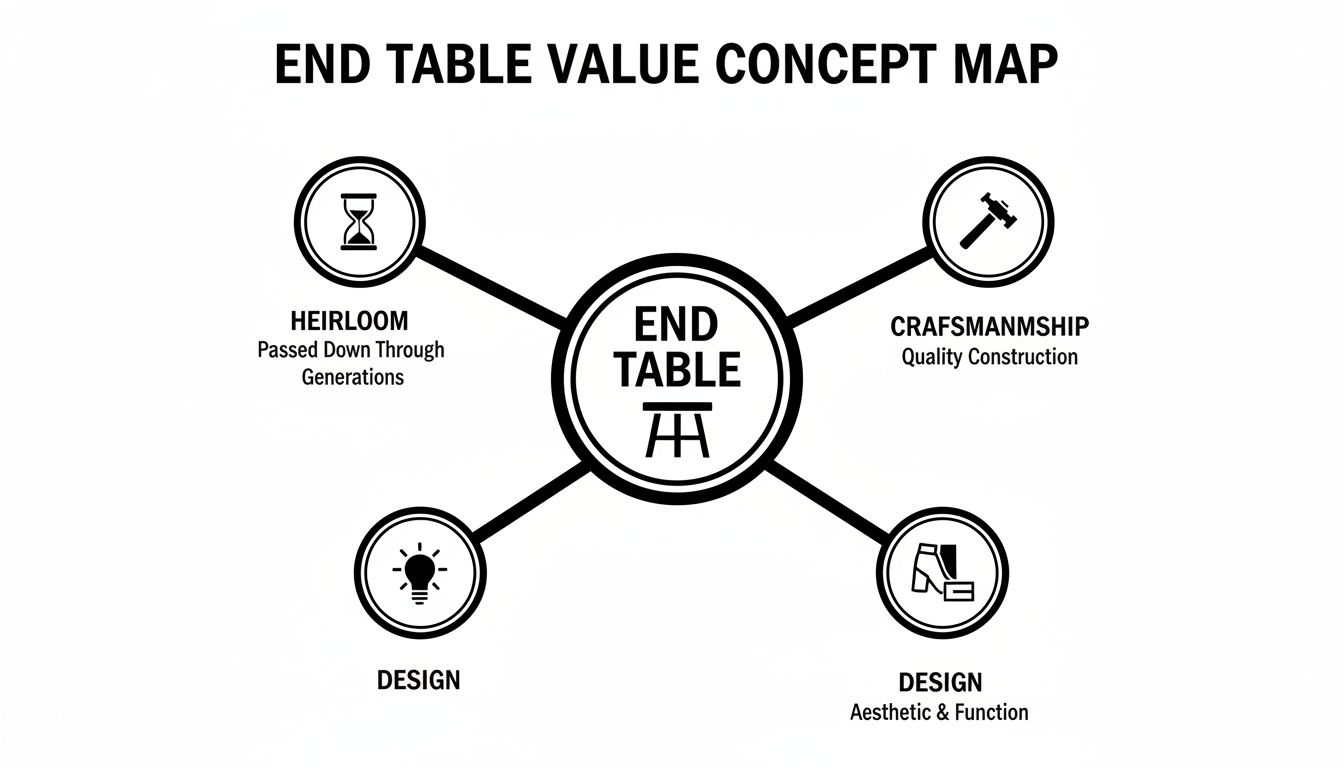
As you can see, a truly exceptional end table isn’t defined by just one feature. It’s about the synergy between timeless design, meticulous craftsmanship, and the potential to become an heirloom for the next generation.
Seeing Beyond the Surface
Understanding these woods empowers you to make a much more personal and informed choice. When you visit our King Street Showroom, you can look at a Stickley oak table and appreciate not just its form, but the inherent strength and history in its grain. You can run your hand over a Canadian-made maple piece and feel that dense, smooth surface that's so perfect for a modern space.
To dig deeper into how these materials contribute to a lifetime of use, you can learn more about choosing the right hardwood in our article.
Designer’s Insight: Our designers often suggest thinking of wood grain as a pattern. A bold, open grain like oak adds texture and visual weight, much like a patterned fabric. In contrast, a tight, smooth grain like maple acts as a solid colour, providing a calm, neutral foundation for the room.
This foundational knowledge transforms furniture shopping from a simple task into a curated experience. It allows you to find an artisanal piece that really resonates with your style and meets the demands of your life, ensuring it will be a cherished part of your home for generations. It’s the core philosophy that has guided our family business for over a century, serving discerning clients from Niagara to Hamilton and across the Greater Toronto Area.
The Art of Construction That Lasts Generations
There's more to a truly exceptional wooden end table than meets the eye. What separates a temporary piece from a future family heirloom is hidden in how it's built. Since our family began this journey back in 1914, we've always championed artisanal construction methods—the kind that ensure furniture can be passed down from one generation to the next.
The real strength of a solid wood end table comes down to its joinery. Think of it as the piece's skeleton. Mass-produced furniture often relies on screws, staples, and glue that can loosen and fail over time. True craftsmanship, on the other hand, uses the wood's own integrity to create powerful, lasting bonds. These joints are designed to breathe, expanding and contracting with the wood to ensure stability for decades, not just a few years.
Hallmarks of Heirloom Joinery
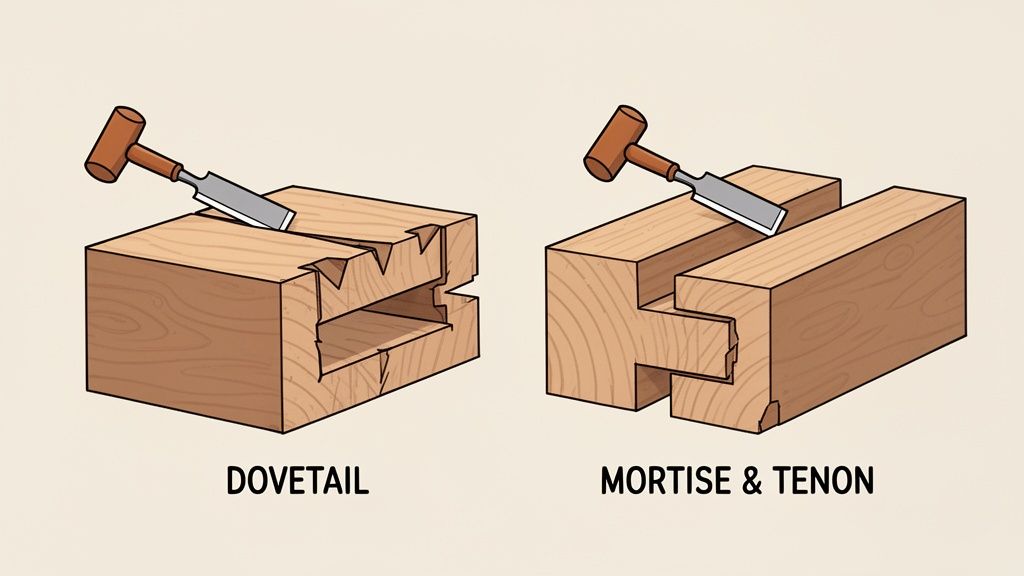
When you see a piece built with traditional joinery, you know it's made to last. Two of the most revered techniques are the dovetail and the mortise-and-tenon. These are true hallmarks of quality and a key reason we curate brands like Stickley, which has built its legacy on these very principles.
- Dovetail Joints: You can spot these instantly by their interlocking "pins" and "tails," most often found in drawer construction. This design creates an incredibly strong mechanical lock that is nearly impossible to pull apart, ensuring your end table’s drawers will operate smoothly for a lifetime.
- Mortise-and-Tenon Joints: This ancient and incredibly effective technique involves fitting a projecting piece of wood (the "tenon") into a corresponding slot (the "mortise"). It creates a powerful, right-angled joint that gives tables their core strength and stops them from wobbling.
When you invest in a piece with this level of construction, you’re really investing in a future antique. It's a cornerstone of the bespoke, custom furniture we help clients create in our Southern Ontario design studio.
Protecting the Beauty With the Right Finish
The finish on your wooden end table does more than just make it look good; it’s a crucial protective shield against moisture, scratches, and the realities of daily life. Choosing the right finish is always a balance between looks and practicality.
Designer’s Insight: Our designers often suggest letting the room’s function guide the finish. For a busy family room table that sees a lot of action, a durable lacquer offers priceless peace of mind. But for a quieter, more formal space, a hand-rubbed oil finish can create a richer, more tactile connection to the natural wood.
Each type of finish offers a different look and level of protection. To make the choice a little easier, we've put together a quick comparison of the most common options.
Comparing Common Wood Finishes for End Tables
This table breaks down the practical differences between popular finishes, helping you choose based on durability, maintenance, and the look you want to achieve.
| Finish Type | Appearance | Durability | Maintenance Level |
|---|---|---|---|
| Lacquer | Creates a clear, hard, and smooth surface that can range from matte to high-gloss. | High | Low |
| Oil | Penetrates the wood for a natural, close-to-the-grain feel and look. | Moderate | Moderate to High |
| Wax | Provides a soft, low-sheen lustre that sits on the surface. | Low | High |
Ultimately, a low-maintenance, high-durability finish like lacquer is often the most practical choice for a piece that will see daily use.
This artisanal approach to both construction and finishing is what turns a simple piece of furniture into a part of your family’s story. It's a philosophy we've upheld for over a century, delivering heirloom quality with our White-Glove service to homes from Niagara to Hamilton and across the Greater Toronto area. We invite you to experience the craftsmanship in person at our King Street Showroom to see and feel the difference for yourself.
Achieving Perfect Scale and Placement in Your Home
A beautifully crafted wooden end table only truly shines when it’s perfectly placed. Think of it this way: your end table is the supporting actor, and its job is to make your star sofa look its absolute best. It’s an essential part of a complete room concept—a philosophy we live by in our Design Studio.
Finding this harmony is all about understanding scale and proportion. For a piece to feel right, its dimensions have to work with the other furniture and the room itself. It's the secret to creating a balanced, inviting space. You can take a deeper dive into mastering scale and proportion in interior design to build a strong foundation for your vision.
The Rules of Height and Depth
The most common question our designers hear is, "How tall should my end table be?" Thankfully, there's a simple rule of thumb that makes a world of difference in creating a room that is both beautiful and functional.
Designer’s Insight: The top of your end table should be level with, or just slightly below, the arm of your sofa or chair. A difference of one to two inches is the sweet spot. This creates a graceful line for the eye and keeps a drink or the remote comfortably within reach.
This simple rule prevents the awkward look of a table that’s too high (which can feel top-heavy) or too low (which can feel disconnected from the seating). Similarly, try to match the depth of your end table to the depth of your sofa frame. Aligning them creates a clean, intentional line from front to back.
Balancing Surface Area and Visual Weight
The surface area you need is a blend of practicality and aesthetics. Think about what you'll actually put on the table. A lamp, a book, and a coaster demand more real estate than a simple spot for a cup of tea.
An oversized table next to a delicate sofa can look clumsy, while a tiny table can get lost beside a substantial sectional. This is where our curated selection of artisanal furniture shines, offering a wide range of sizes to suit any space, from a compact Toronto condo to a spacious Niagara-on-the-Lake home. The goal is to achieve balance, not just in size but in visual weight.
- Heavy Sofa: A large leather sofa with rolled arms has significant visual weight. Balance it with a solid, substantial wooden end table to match its presence.
- Light Sofa: A sofa with clean lines and thin legs has less visual weight. Pair it with a table that has a more open, airy design—perhaps with slender legs—to maintain that feeling of lightness.
Placing the Table in the Room
Once you have the right scale, placement is the final touch. Imagine your rug as the "Art for your Floor" that grounds the entire space. Your end table should sit comfortably on the rug, connecting it visually to the sofa and chairs.
This careful attention to placement is a service our designers provide during in-home consultations across the Greater Niagara and Hamilton areas. For those tackling it themselves, our guide on how to measure furniture offers practical steps to ensure everything fits perfectly. By considering these principles, you ensure every piece, from the largest sofa to the smallest end tables wood, works together to create a timeless, harmonious home.
Creating Your Bespoke End Table
While we take great pride in our curated selection, sometimes the perfect piece is one that exists only in your imagination. This is where the real magic happens. Going beyond our showroom floor, creating a bespoke wooden end table means you become the co-creator, ensuring every last detail is a perfect match for your home and your vision. That’s the entire philosophy behind our Critelli Design Studio—a collaborative space where we turn your ideas into heirloom-quality reality.
This journey doesn’t start with flipping through a catalogue; it starts with a conversation. Here in our Southern Ontario studio, we’ll explore a vast library of materials together. We'll help you touch and feel the perfect species of wood, select the ideal finish, and find hardware that completes the look. Whether you’ve fallen for the classic elegance of a piece by Stickley or have a completely new design in mind, our team is here to guide you, making custom furniture an accessible and enjoyable luxury.

From Concept to Creation
The bespoke process is really a partnership. We bring our century of expertise to the table, and you bring your unique vision. Our job is to translate your needs for function, scale, and style into a tangible design that fits right into your complete room concept, as if it were always meant to be there.
- Wood Selection: We’ll walk through the unique characters of oak, walnut, maple, and cherry again, helping you choose a wood that not only looks stunning but will hold up to your family’s lifestyle.
- Finish & Hardware: You’ll get to hand-pick from an extensive palette of stains, paints, and protective coats. Then, we’ll find the artisanal hardware to serve as the perfect finishing touch.
- Design Finalization: Our team creates detailed drawings for your approval. We won’t move forward until you’ve confirmed every dimension and detail is perfect. Only then do our master craftspeople begin their work.
This hands-on, personal approach is core to what we do at Critelli, a philosophy that has served clients from Niagara to Hamilton and Toronto for over a century. You can learn more about our custom order process to see exactly how we bring these one-of-a-kind pieces to life.
Designer’s Insight: We always encourage clients to bring in anything that inspires them—photos from a magazine, fabric swatches from their sofa, even a picture of their hand-knotted rug from The Rug Market. These elements help us understand the soul of your space, allowing us to design an end table that feels like it has always belonged right where you place it.
When you invest in a custom wooden end table from Critelli, you're also investing in a proud local industry. In Ontario's wood manufacturing sector, furniture businesses are leaders in getting the most sales value from every cubic metre of wood fibre. This incredible efficiency, driven by skilled Southern Ontario craftspeople turning logs into premium designs like those from Stickley, means you get maximum value and quality.
With 68% of sales remaining right here in Ontario, each bespoke piece carries a legacy of regional excellence and directly supports our local economy.
Your home deserves furniture that is as unique as the life you live in it. To start your own design journey and create a timeless piece of craftsmanship, we invite you to book your complimentary design consultation today.
White-Glove Delivery and Lifelong Care
The journey to finding that perfect, heirloom-quality wooden end table doesn’t end when you leave our King Street Showroom. At Critelli Furniture, we believe the final step—bringing the piece into your home—is just as important as the generations of craftsmanship that went into making it. Our family has understood this since 1914. True luxury is a seamless experience from start to finish, a promise we deliver on with our signature White-Glove Delivery service.
This isn’t your average drop-off. It's a careful, meticulous process our professional team handles from top to bottom. Before your new end table even begins its journey to you, it gets a final, thorough inspection to ensure it meets our exacting standards. When we arrive, we don't just leave a box on your porch. We carefully carry the piece into the room, handle any assembly needed, and place it exactly where you've imagined it. Our team makes sure your space is showroom-ready before they leave, serving discerning homeowners from Niagara to Hamilton and right across the Greater Toronto Area. You can get a better sense of how we manage this final, crucial step in our guide to furniture assembly services.
Protecting Your Investment for Decades to Come
An artisan-made wood end table is built to last a lifetime. With just a little attention, its character and beauty will only deepen over the years. Keeping its finish looking its best is much simpler than you might think, but it's the key to preserving its story and value.
- Routine Dusting: A quick wipe with a soft, dry microfiber cloth is all you need. This simple habit prevents fine scratches from building up over time.
- Spill Management: Accidents happen! When they do, blot them up immediately with a soft, absorbent cloth. Never wipe, as that can spread the liquid and push it deeper into the finish.
- Avoiding Damage: This is all about good habits. Always use coasters for drinks and place felt pads under lamps or decorative items. Try to keep your table out of direct, harsh sunlight to prevent the wood from fading, and steer clear of placing it right next to radiators or heat vents.
For the minor scuffs and marks that come from years of being a well-loved part of your home, a little maintenance can work wonders. For more significant wear or if you're looking to bring an older, cherished piece back to life, a guide on restoring scratched wood furniture can offer some fantastic professional tips and techniques.
Designer’s Insight: Our designers often suggest a simple "reconditioning" every six months. After a good dusting, apply a small amount of a high-quality furniture polish or wax—one that’s recommended for your table's specific wood finish. Buff it in gently with a clean, soft cloth. This small ritual restores the wood’s natural lustre and adds a fresh layer of protection.
This commitment to lasting quality is the final chapter of your furniture story, ensuring the piece you choose today becomes a treasured heirloom for your family for generations to come. We invite you to experience the craftsmanship in person at our King Street Showroom.
Frequently Asked Questions About Wooden End Tables
When you're looking to invest in a piece of furniture that could one day become a family heirloom, it’s only natural to have a few questions. As a family-run business since 1914, we’ve spent more than a century helping our clients in St. Catharines and across the Niagara Region feel confident in their choices.
This section tackles some of the most common questions we hear in our showroom, giving you the same straightforward advice our designers offer every day. We don't just see an end table; we see a key piece that completes your room.
What Is the Best Type of Wood for a Heavily Used End Table?
For a table that’s going to see a lot of action in a high-traffic area, we always point people toward dense hardwoods like oak or maple. They’re built for real life.
Oak is exceptionally durable, and its strong, visible grain is fantastic at hiding the minor scuffs and scratches of daily use. It's a classic choice for a busy family home for a reason.
Maple is another powerhouse, but it offers a finer, more subtle grain for a smoother, more modern look. We make sure to feature both in our collections from premier artisans like Stickley, so you know your table isn't just beautiful—it's built to last.
Can I Mix Different Wood Finishes in My Living Room?
Absolutely! In fact, mixing wood finishes is one of the secrets to a truly personal and well-designed room. It creates a space that feels thoughtfully collected over time, rather than something you bought all at once.
The trick is to make sure the different woods have something in common. Usually, this means sticking to a similar undertone—for example, pairing pieces that all have warm tones (like cherry and oak) or cool tones (like grey-washed maple and walnut).
Designer’s Insight: We usually suggest limiting yourself to two or three different wood finishes in a single room to keep things feeling harmonious, not chaotic. During a complimentary design consultation, we can help you find a new end table that beautifully complements the furniture you already own, creating a layered look that just works.
Choosing to buy from a local furniture curator like us also makes a real difference right here at home. Ontario's secondary wood manufacturing sector—which includes furniture like end tables—generated $5.3 billion in sales in a recent year. A stunning 68% of those sales happened within Ontario, meaning your purchase supports a thriving provincial economy that benefits communities from Niagara to Hamilton. You can read more about the impact of Ontario's wood industry.
How Do I Choose an End Table to Match My Hand-Knotted Rug?
We love this question. We always tell our clients to think of their rug as "art for the floor." Your end table, then, should be its perfect frame. The goal is always balance.
If your rug has a bold, busy pattern, you'll want an end table with clean lines and a simpler shape. This lets the rug be the star and prevents the two pieces from competing for attention.
On the other hand, if your rug is more about texture or has a single colour, you have the freedom to choose a table with more personality—perhaps something with sculptural details or a more dramatic wood grain. A great first step is to bring a photo of your rug from The Rug Market into our King Street Showroom. Our experts can help you find the perfect match right on the spot.
At Critelli Furniture, we are committed to helping you find pieces that tell your story.