
Dining Bench with Storage: Smart Seating for Modern Homes


A dining room starts to feel cramped in the same ordinary way every busy home does, a couple of stray chairs along the wall, placemats shoved into an overfull cabinet, and a table that looks useful but not quite settled. A dining bench with storage solves that tension in one move, because it gives the room a seat, a place to tuck away daily essentials, and a calmer visual line all at once. In Southern Ontario homes, where dining areas often have to work hard inside compact layouts, that kind of efficiency feels less like a trend and more like sensible design.
The strongest reason to choose one is not that it hides clutter. It's that it lets the dining space behave like part of a complete room concept, with the bench, table, rug, and lighting all working together instead of competing for attention. For families who want custom furniture Southern Ontario shoppers can live with every day, the right bench becomes part of the architecture of the room, not just another object in it. Critelli Furniture has long approached pieces this way, as part of a curated selection built for rooms that need both beauty and function.
Why a Dining Bench With Storage Changes Everything
A dining bench with storage changes the feel of a room because it removes several small irritations at once. The extra chair that never quite belongs somewhere, the stack of linen napkins in a cabinet, the serving pieces that only come out on holidays, all of that can disappear into one well-planned seat. In a family kitchen, that means the table area stops feeling like a catchall and starts feeling intentional.
The value shows up in smaller Ontario homes, where the dining area often has to share space with the kitchen or living zone. In those rooms, the question is not just whether storage exists, it is what kind of storage will still feel easy on a weekday morning, during homework time, or when guests stay for dinner. A bench that looks tidy but slows everyone down will not hold up to daily use. A bench that fits the room, the seating height, and the way the family moves through the space will.
Practical rule: if the room already feels crowded, the bench should simplify the edge of the table, not add another bulky silhouette.
That is where seat geometry matters. A bench with a comfortable seat depth and a shape that supports normal posture works better than one that maximizes enclosed volume. Families also need to decide how they want to reach the storage. Drawer access is faster for everyday items, while lift-up access usually gives more enclosed room for bulkier pieces. The trade-off is real, especially in compact urban homes where the bench gets opened often and by different people throughout the week.
For families comparing seating layouts, the smartest first question is whether the bench will support daily use or only occasional seating. A thoughtful plan for that layout belongs alongside other interior design services St. Catharines homeowners often use to make compact rooms more livable, including room flow, table placement, and rug size.
seating arrangement ideas are useful precisely because the bench works best when the whole dining zone is considered together.
Understanding the Three Main Storage Types
The storage mechanism is what determines whether a bench becomes easy everyday furniture or a piece that only looks convenient. Drawer-based storage, hinged flip-top lids, and open shelves each solve a different kind of household problem, and the right choice depends on what gets used most often. A family that reaches for placemats every day needs different access than a household storing spare candles and holiday linens.
Drawer-Based Storage
Drawers win on access. They let you pull out napkins, coasters, or serving utensils without lifting a seat cushion, which matters in homes where the bench is used constantly and by more than one person. For daily dining routines, that ease usually feels more graceful than a deep cavity hidden under a seat.
Hinged Flip-Top Lids
Flip-top storage gives the largest enclosed compartment, so it suits bulky items, seasonal decor, and less frequently used tableware. The trade-off is physical effort, because the seat itself has to open every time. In a busy household, that can be perfectly fine if the contents stay occasional, but it's less convenient when the bench stores things used several times a week.
Open Shelf Configurations
Open shelves are the least formal and the most casual. They keep things visible and within easy reach, which works well for baskets, board games, or frequently used linens. They don't hide as much, but they also avoid the lifted-seat routine that can feel awkward in tight spaces.

A useful way to judge the format is to ask whether the contents need daily access, occasional access, or visual openness. That question tends to settle the matter quickly, especially in smaller rooms where the storage format matters as much as the seat itself.
The idea of a dedicated storage zone is also reflected in crates for storage, where the focus is on keeping commonly used objects accessible without turning the dining room into a storage closet.
Materials and Construction That Stand the Test of Time
A storage bench works hard in two directions at once. It carries seated weight, and it opens and closes repeatedly, so the frame, joinery, hinges, and slides all need to stand up to real household use. That is why construction details matter more here than they do on a decorative seat.
A well-made bench also has to feel stable on day one and stay that way after years of family meals, backpacks, and quick cleanups. In smaller Ontario homes, that matters even more because the bench often ends up doing double duty at the table and in the circulation path around it.
What Holds Up, What Doesn't
Solid hardwood frames usually offer stronger long-term stability than lighter panel construction, especially when the bench will support shared family seating. If you are comparing material choices, a good place to start is solid wood furniture, because the same principles of grain strength, joinery, and everyday wear apply here. Reinforced joinery, well-fitted hardware, and soft-close hinges help the piece stay controlled rather than loose or noisy. The storage compartment is not a bonus feature in mechanical terms, it is another moving system that has to survive daily use.
The broader dining furniture market reflects that shift toward durability and better-built pieces. That does not mean every buyer needs a luxury bench, but it does show that many households are choosing furniture for the long haul.
A useful material comparison is simple:
| Material Type | Durability Level | Maintenance Needs | Best For |
|---|---|---|---|
| Solid hardwood | High | Regular dusting, occasional conditioning | Long-term family dining |
| Engineered wood with reinforced frame | Moderate | Careful cleaning, hardware checks | Lighter use or tighter budgets |
| Veneered mixed construction | Moderate to lower | Gentle cleaning, protection from moisture | Style-led rooms with lighter traffic |
The construction details matter most when the bench supports several people at once. A storage bench that looks handsome but flexes under load is not a design solution, it is a repair waiting to happen. In practice, the best-built pieces feel calm to use, close properly, and keep their shape without constant adjustment.
Choosing the Right Size for Your Dining Space
Sizing a dining bench with storage starts with the table, not the bench. The seat has to clear comfortably under the table edge, and the depth has to leave room for people to move around it without turning the room into a squeeze. In practice, the most successful layouts are the ones that feel easy every day, not just impressive in a showroom.
The most practical benchmark in the Canadian market is a seat height around 18 to 20 inches and a depth near 17 to 23 inches, because that range keeps the bench comfortable while leaving space for storage volume. A depth at the upper end usually means more room inside, but it also makes the bench feel heavier in compact dining areas. That is where daily usability matters more than extra volume.
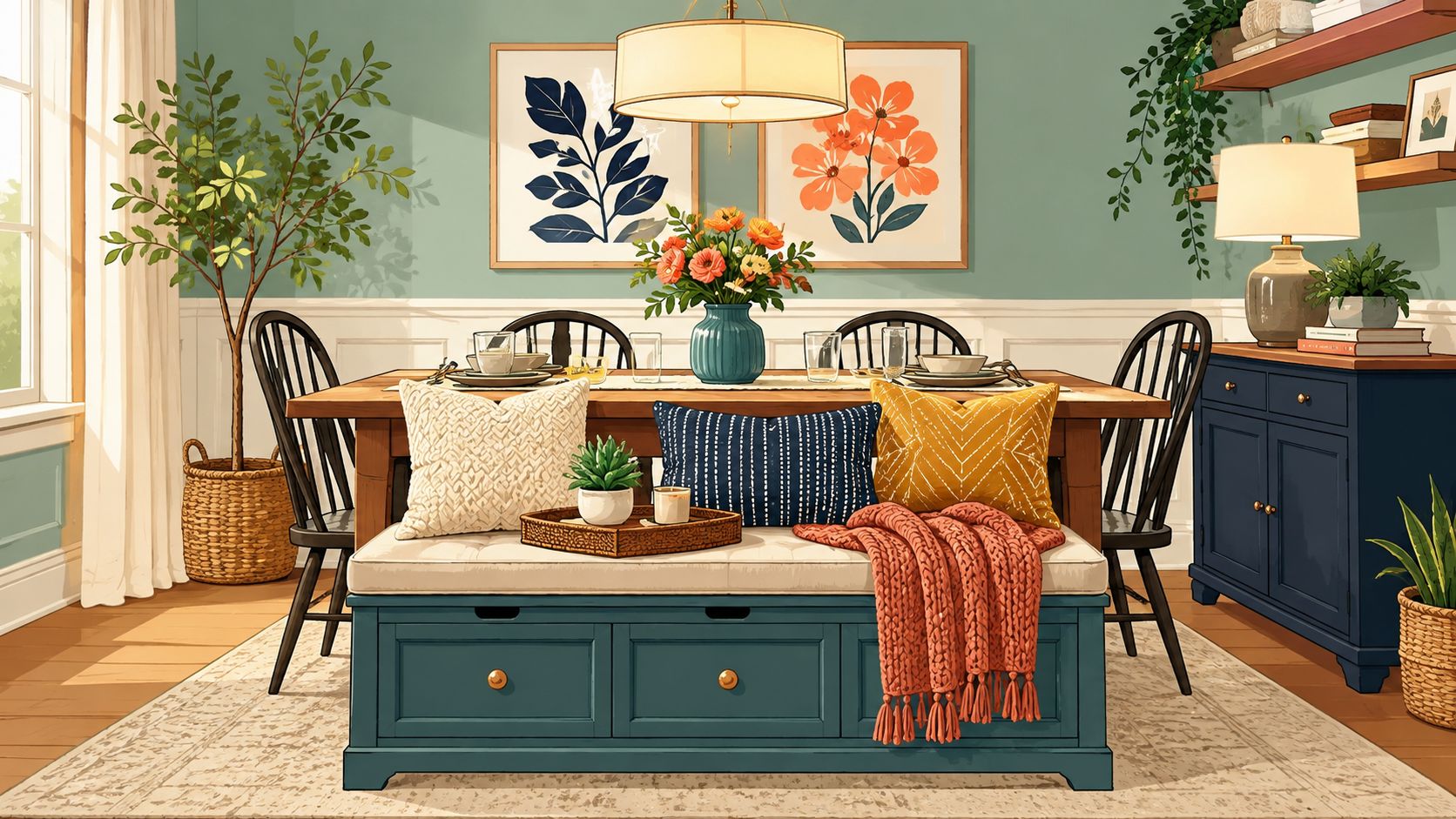
For households in smaller urban homes, the bench should be measured against the route people walk, not just the wall it sits against. The bench can be beautiful and still fail if it interrupts traffic between the kitchen, table, and adjacent living area.
| Table Size | Recommended Bench Length | Seating Capacity |
|---|---|---|
| Small round or compact table | Streamlined bench for one side or short wall | 2 to 3 diners |
| Medium dining table | Mid-length bench matched to the table edge | 3 diners |
| 6-foot dining table | Longer bench sized to the table proportion | 3 to 4 diners |
A planning pass through interior design space planning helps prevent the most common mistake, which is choosing a bench for storage first and for circulation second.
Styling Your Storage Bench as a Design Anchor
A storage bench does its best work when it looks like it belongs to the room's overall composition. That means treating it as a foundation piece, not as an afterthought tucked under the table. The bench, the rug, and the surrounding chairs should read as one curated selection, not a collection of unrelated purchases.
A strong room starts with balance. A bench with a bolder profile can be grounded by a quieter rug, while a cleaner-lined bench can sit comfortably beside more expressive chairs. That kind of restraint is one reason the phrase Art for your Floor fits so well in dining spaces, because the rug sets the mood before the furniture even starts speaking.
Designer's Insight: a stronger seating piece pairs best with a quieter floor treatment, because the eye needs one clear anchor, not two competing focal points.
Texture matters more than people expect. A woven seat, a rich wood grain, or an upholstered top all bring a different temperature to the room, and that detail can make the space feel considered rather than merely functional. In homes where the dining room is visible from the living area, that continuity matters a great deal.
For rooms built around a table-and-bench layout, dining table chair bench helps reinforce the idea that the bench should coordinate with the rest of the setting, not sit apart from it. A hand-knotted rugs Ontario search often lands in the same design conversation for exactly that reason, the floor and the seating need to work together.
Caring for Your Dining Bench Long Term
A well-made storage bench stays handsome when it's cared for in small, steady ways. Dust is the enemy of finishes, so a soft, dry cloth used weekly keeps the surface from collecting the grit that dulls wood over time. That simple habit preserves the clean look that makes the bench feel intentional in a dining room.
Hardware deserves attention too. Drawer slides and hinge mechanisms gather dust and lose smoothness if they're ignored, so they benefit from occasional cleaning and light lubrication when needed. If the bench has a flip-top mechanism, it should open easily without scraping, sticking, or shifting out of alignment.
Care by Surface Type
Wood frames like a dry dusting routine and periodic conditioning to help the grain stay rich. Upholstered surfaces do better with regular vacuuming using a soft brush attachment, plus immediate spot care when spills happen. For mixed-material benches, the goal is not to treat every surface the same way, but to protect each one according to how it's built.
Keep the mechanics clean before the finish starts to look tired.
Southern Ontario homes often deal with seasonal humidity changes, so wooden pieces benefit from consistent, gentle care rather than occasional deep cleaning. A storage bench that's maintained this way should keep its structure, its finish, and its ease of use for years without feeling overly delicate.
Making the Right Purchase Decision With Confidence
Choosing a dining bench with storage is easier when you can test the piece in person. The seat feel, the way the lid opens, the finish under natural light, and the weight of the frame all tell a more honest story than photos do. That matters in a room where the bench will be used daily, not displayed occasionally.
Critelli Furniture has been family-run since 1914, and that long perspective shows up in how pieces are selected and presented. The showroom approach works well for buyers who want to see how a bench behaves beside the rest of the dining room, especially when the decision needs to fit into a larger complete room concept rather than a single-purchase mindset.
For homeowners in the Greater Niagara, Hamilton, and Toronto markets, the most practical next step is simple. Test the mechanism, compare finishes, and look at how the bench sits against the table and rug before making the decision. A storage bench should solve a space problem and still feel refined enough to live with for years.
If you're planning a dining update, visit Critelli Furniture to explore seating that fits the way Southern Ontario homes work, with thoughtful guidance, coordinated room planning, and a showroom experience that makes the right choice much clearer.