
Sustainable Furniture Canada: Eco-Conscious Living Guide

Most advice about sustainable furniture Canada gets one thing wrong, it treats sustainability like a style label. A chair is not sustainable because it looks natural, costs more, or was made nearby. It is sustainable only when its materials, construction, repairability, and end-of-life path can stand up to scrutiny.
That matters in Southern Ontario, where discerning buyers want heirloom quality without the performance theatre. A locally made piece can still be wasteful if it can't be repaired or disassembled. A premium imported piece can still be a smart choice if it carries the right evidence, while a cheaper one can become expensive the moment it starts failing early.
Rethinking What Sustainable Furniture Really Means
The quickest way to miss the point is to assume expensive means sustainable. It doesn't. Price can reflect craftsmanship, brand positioning, or showroom presentation, but it does not prove a lower footprint, better materials, or longer service life.
Sustainability is a full-life test
Real sustainability asks more of a piece than a glossy label ever can. It starts with where the wood came from, how the frame was built, what the finish emits, whether the cushions can be renewed, and whether the piece can be repaired instead of replaced. That's why timeless craftsmanship matters so much. A well-made sofa or table that stays useful for years is usually a better environmental decision than a trend-driven purchase that is discarded early.
Practical rule: if a retailer can't explain how a piece will be repaired, renewed, or reused, the sustainability claim is still unproven.
Sustainable furniture Canada requires a more disciplined definition. Sustainability balances environmental, social, and economic outcomes, not just reclaimed wood or a low-toxin finish. A higher-end buyer in St. Catharines, Niagara, Hamilton, or Toronto should expect traceable information, not vague reassurance.
Local does not automatically mean low-impact
A “Made in Canada” tag is useful, but it isn't the finish line. Local production can support shorter supply chains and easier service, yet a locally made piece still fails the test if it can't be taken apart, refreshed, or repurposed. That's why heirloom quality should be treated as a sustainability metric, not just a luxury talking point.
For buyers who want a practical starting point, a solid-wood construction guide helps clarify what durable furniture should look like, feel like, and age into. Solid wood furniture guidance is useful precisely because it pushes the conversation toward structure, not slogans.
The Circular Economy and Canadian Furniture Design
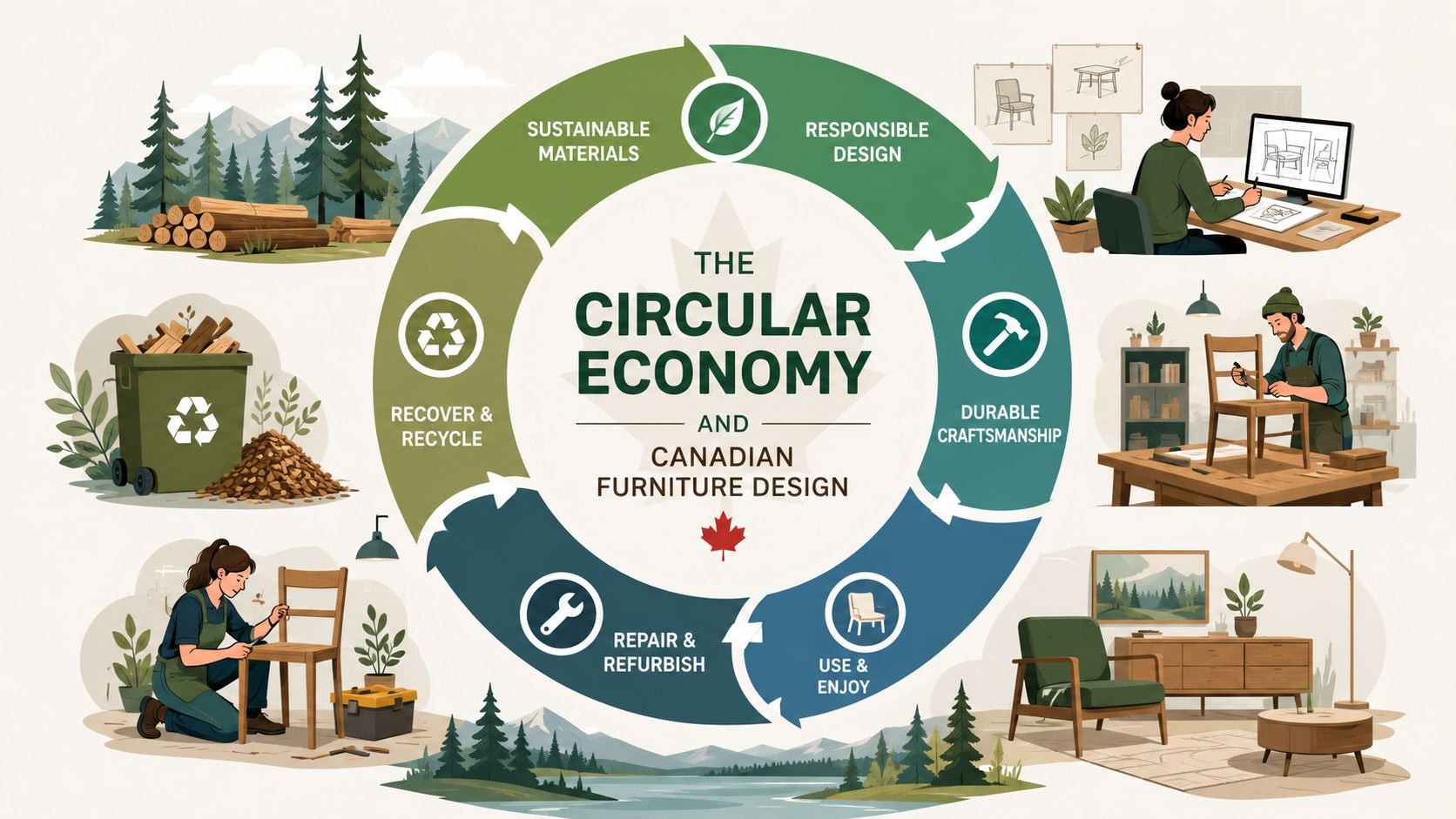
The circular economy is the cleanest framework for understanding sustainable furniture in Canada. It aims to eliminate waste and pollution, circulate products and materials, and create new products from recycled material. That's not abstract theory, it's a design brief for how furniture should be built, used, and recovered.
What circular design asks from a piece
A circular piece should do more than look good on delivery day. It should use materials that can be renewed, parts that can be replaced, and construction that doesn't fight repair. In Canadian guidance, that often means locally sourced materials, thoughtful disassembly, and a design that can be recycled or repurposed later.
The most useful mental shift is simple. Don't ask only, “Is this made well?” Ask, “Can this piece stay in use through multiple room changes, fabric updates, or ownership changes?” That question is where durability turns into sustainability.
Why Canadian makers are leaning into this
Independent Canadian furniture makers are competing on sustainability, innovation, and customized service, which is exactly where design-led buyers should pay attention. That combination matters because circularity rewards manufacturers that can support repair, refinishing, and thoughtful material choices over time.
For buyers who want a broader lens on business models, explore ITAD circular economy models offers a useful way to think about recovery, reuse, and asset extension. The principle translates directly to furniture. A piece that can be serviced, refreshed, or redirected has more value than one that ends up as waste the moment its first use changes.
The design implication for homeowners
Circular furniture isn't about sacrificing beauty. It's about specifying furniture that can survive real life. That means prioritising frames that can be repaired, finishes that can be maintained, and layouts that respect how a home actually evolves.
Certifications That Actually Matter for Canadian Buyers
Vague “eco-friendly” language is easy to print and hard to trust. Certifications force the conversation into evidence, and that's exactly where premium buyers should insist on it. In Canadian furniture procurement, certification-based specifications are replacing loose claims because they are more defensible, more comparable, and easier to verify.
What to ask for first
The most useful documents are the ones that prove something specific. Environmental Product Declarations (EPDs) show embodied-impact disclosure. BIFMA Level certification helps buyers assess product sustainability more structurally. UL GREENGUARD and SCS Indoor Advantage Gold address indoor-air quality, while FSC wood supports responsible forest sourcing. The University of Pennsylvania guidance also points buyers toward PVC-free construction, noting PVC is classified by the EPA as a known human carcinogen. For premium projects, that is not a minor detail, it is a material-health issue. Sustainable furniture purchasing guidance
A beautiful finish means little if the underlying materials can't be documented.
University of Waterloo's procurement guidance is especially practical because it pushes buyers toward Cradle to Cradle, Green Label Plus, and LEVEL, then adds circularity checks like recycled content, replaceable parts, limited packaging, and vendor take-back at end of life. That's the right standard for discerning buyers who don't want to rely on marketing language alone. The more complete the specification package, the easier it is to compare suppliers objectively. University of Waterloo furniture procurement guidance
Key Sustainable Furniture Certifications for Canadian Buyers
| Certification | What It Measures | Why It Matters |
|---|---|---|
| EPD | Lifecycle impact disclosure | Helps buyers compare embodied impact across products |
| FSC wood | Responsible forest sourcing | Supports traceable wood procurement |
| BIFMA Level | Product sustainability performance | Gives a structured, technical benchmark |
| UL GREENGUARD | Low emissions for indoor air | Useful for cleaner indoor environments |
| SCS Indoor Advantage Gold | Indoor-air quality performance | Helpful when low-VOC performance matters |
| Cradle to Cradle | Material health and circularity | Points buyers toward recoverable materials |
| Green Label Plus | Emissions related to flooring and furnishings | Relevant for indoor-air quality decisions |
For a bedroom project, a made-in-Canada option with documentable sourcing and serviceability belongs on the shortlist. Bedroom set made in Canada is relevant because it shifts the conversation from origin alone to what the piece is made of and how it will age.
Read claims like a procurement officer
A strong sustainability claim should be backed by chain-of-custody records, emissions testing, and disassembly or reuse pathways. That is also the standard to demand from any public-facing sustainability statement, which is why a clear policy for responsible product claims is worth reviewing before anyone accepts a premium green label at face value.
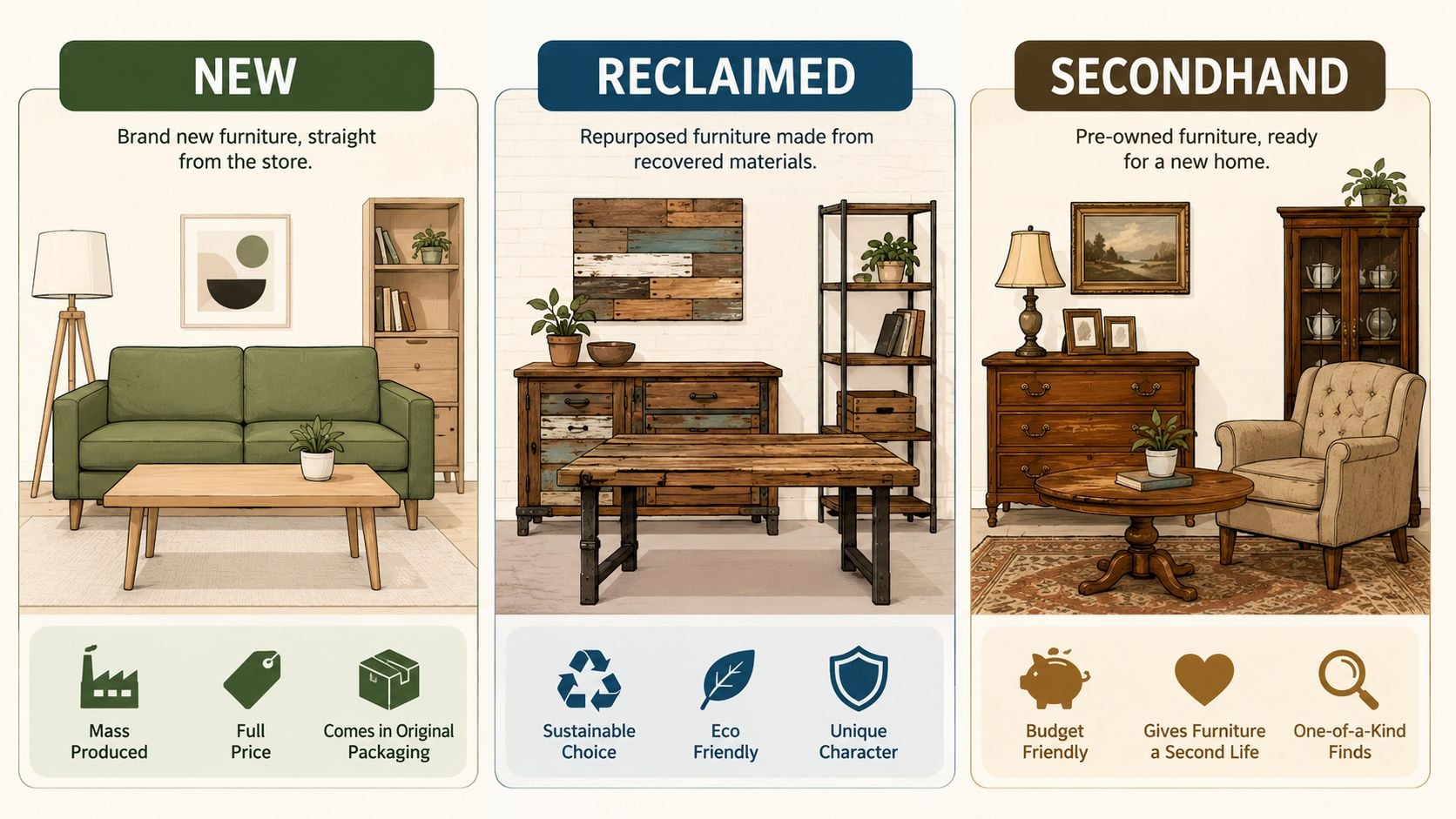
New vs Reclaimed vs Secondhand Furniture
The cleanest way to choose between new, reclaimed, and secondhand is to decide what matters most, design control, footprint, or immediacy. Each path has a place, but they don't serve the same client.
Secondhand has the strongest footprint case
A UBC life-cycle analysis found that buying second-hand furniture instead of new furniture can avoid 60% to 97% of emissions, depending on the item and reuse scenario. The report also notes avoided emissions of 85% to 97% for a reused Wayfair table and 60% to 95% for a reused IKEA table. That makes secondhand the most direct sustainability win when the condition and style are right. UBC furniture life-cycle analysis
Reclaimed brings character, but it needs discipline
Reclaimed furniture and reclaimed wood can deliver a bespoke look with genuine depth. The grain, wear, and patina often give a room the kind of quiet character that new pieces struggle to match. Still, reclaimed does not automatically mean better. If the piece is unstable, hard to service, or impossible to adapt to a new room, its sustainability story weakens fast.
New furniture still has a role
New furniture makes sense when the dimensions must be exact, the upholstery needs to suit a specific interior, or a long-term family use case demands reliability. In that context, custom furniture Southern Ontario buyers often choose new because the fit, finish, and serviceability are all aligned from the start. The important thing is to specify it well, not to assume new is wasteful by default.
Designer's Insight: the smartest rooms often mix one strong new anchor piece with a carefully sourced secondhand accent and a rug that pulls the palette together.
A disciplined buyer in Niagara or the Greater Toronto area should treat curated selection as a design strategy, not a compromise. The goal is not to buy old for the sake of it. The goal is to buy the piece that will still earn its place after the room changes around it.
A Practical Evaluation Checklist for Southern Ontario Shoppers
Good furniture shopping starts with hard questions. A retailer that can't answer them clearly is asking the buyer to rely on faith, and that is a poor way to spend premium money. Southern Ontario shoppers should ask the same questions whether they are furnishing a condo in Toronto, a family home in Hamilton, or a custom room in St. Catharines.
What to ask before buying
- Can the retailer document material origin? Ask for chain-of-custody details, especially on wood and upholstery components.
- Is there an EPD or emissions documentation? If not, the sustainability claim is still incomplete.
- Can the piece be repaired or disassembled? If the answer is vague, future service may be difficult.
- Which parts are replaceable? Cushions, legs, and hardware should not be treated as disposable.
- What happens at end of life? Donation, resale, refurbishment, or take-back should be discussed before purchase.
These questions matter because a higher price does not automatically mean a lower footprint. A locally made piece can still be poorly designed for repair or reuse, and that undermines the very value it was supposed to provide. The same logic applies to premium finishes. Beautiful is not the same as durable.
What documents deserve real attention
A serious buyer should request proof, not promises. The most useful documents are EPDs, certification records, and any information that shows how the piece can be maintained over time. Buyers working on a custom specification should also ask how fabric changes, finish touch-ups, and component replacement are handled after delivery.
For projects that require a more personalized process, best custom furniture makers is worth using as a benchmark for what a service-led furniture experience should include. It's not about collecting names. It's about comparing how seriously a retailer treats fit, finish, and long-term ownership.
One local option that fits the process
Critelli Furniture's design-led approach is useful here because it treats furniture as part of a complete room concept, not an isolated object. For clients across the Greater Niagara, Hamilton, and Toronto markets, that matters when the room needs to balance aesthetics, serviceability, and a coherent material story.
Maintenance Repair and End-of-Life Strategies
Sustainable furniture is not finished when it leaves the showroom. The true test comes years later, when the fabric dulls, the room changes, or the house gets reconfigured. That is where maintenance, repair, and responsible exit planning become part of the design brief.
Keep the good pieces in play
Routine care extends life more effectively than most owners realise. Leather needs conditioning, upholstery needs prompt attention to spills, and wood surfaces need protection from neglect, not just from obvious damage. How to care for leather furniture is a useful reminder that proper maintenance protects both appearance and value.
Repairs should happen early, not after the damage spreads. A loose joint, worn cushion, or tired finish is usually easier to address before it becomes structural. Reupholstery also deserves more respect than it gets. For high-quality frames, it can turn a dated piece into a long-term asset again.
End-of-life should be planned, not improvised
When the piece no longer belongs in the home, the next move should favour reuse first. In Southern Ontario, Furniture Bank shows that redistribution is part of the region's real sustainability infrastructure, not a theoretical ideal. Donation, resale, and refurbishment all keep value in circulation longer than landfill does.
For owners looking at private resale or online sale, empowering sellers of furniture online is a useful lens because it highlights how furniture can move into a second life rather than being discarded. The point is not just to sell, it's to extend use.
Design rule: a piece worth buying is usually a piece worth maintaining, and a piece worth maintaining is usually a piece worth re-homing later.
White-glove delivery also matters here. When a retailer handles placement carefully, the furniture is less likely to suffer damage at the start, and that protects the long-term lifespan of the piece. Sustainable ownership is easier when service is built into the experience.
Designer's Insight and Next Steps
The most elegant sustainable interiors are rarely built around “green” objects alone. They are built around a disciplined mix of structure, texture, and restraint. A walnut case piece with strong lines, a repairable leather seat, and hand-knotted rugs Ontario buyers choose as the visual base can produce a room that feels richer over time, not more cluttered.

A designer's point of view
Sustainable furniture should look intentional on day one and still feel right years later. That is where design-forward thinking matters. A room anchored by one substantial, serviceable piece, then softened with texture and pattern, usually ages better than a room filled with trend-driven purchases that compete for attention.
Critelli's century-old legacy, dating back to 1914, gives that philosophy real weight. A family-run showroom does not survive that long by chasing noise. It survives by understanding that refined homes need furniture with presence, not just novelty. The same thinking supports Custom furniture Southern Ontario clients who want a room to feel personal without becoming fragile.
For buyers who want the room to be more than a collection of objects, the Rug Market deserves special attention. Rugs function as art for your floor, and they often set the tone for the entire interior before the furniture even lands. That foundation matters in a sustainable scheme because strong visual planning reduces the urge to replace pieces later.
Collaborative design process is worth reviewing for homeowners and trade clients who want a room built with intention from the start. The right process makes sustainable decisions feel natural, not forced.
Experience the craftsmanship in person at our King Street Showroom. Book your complimentary design consultation today, especially if the goal is to pair sustainable furniture Canada priorities with timeless style, repairable construction, and a room that will still feel composed years from now. Visit Critelli Furniture to start with a curated selection, thoughtful guidance, and a white-glove transition from showroom to home.