


Modern Couch Recliner Guide for Design-Led Homes

A long day has ended, the lights are low, and the living room is ready for its quietest ritual. The homeowner wants to lean back, lift the feet, and settle into a film or a book, yet the usual recliner introduces a visual problem: it feels like an object added to the room rather than part of it. The best modern couch recliner solves both needs at once, offering genuine support while preserving the calm proportions of a carefully furnished interior.
In Southern Ontario, that balance matters. Younger professionals, families, and homeowners planning for longer-term comfort increasingly treat seating as a lifestyle investment rather than a disposable purchase. A reclining piece can be heirloom quality, design-forward, and practical, provided its mechanism, upholstery, scale, and placement receive the same consideration as any other important furnishing.
Redefining Comfort in the Contemporary Living Room
A sleek leather recliner sits beside a low timber table, facing the television without dominating it. Its arms are neatly finished, its base is visually quiet, and its headrest disappears into the silhouette when upright. Once extended, the chair becomes a personal retreat. When closed, it reads as a considered piece of furniture rather than a bulky machine.
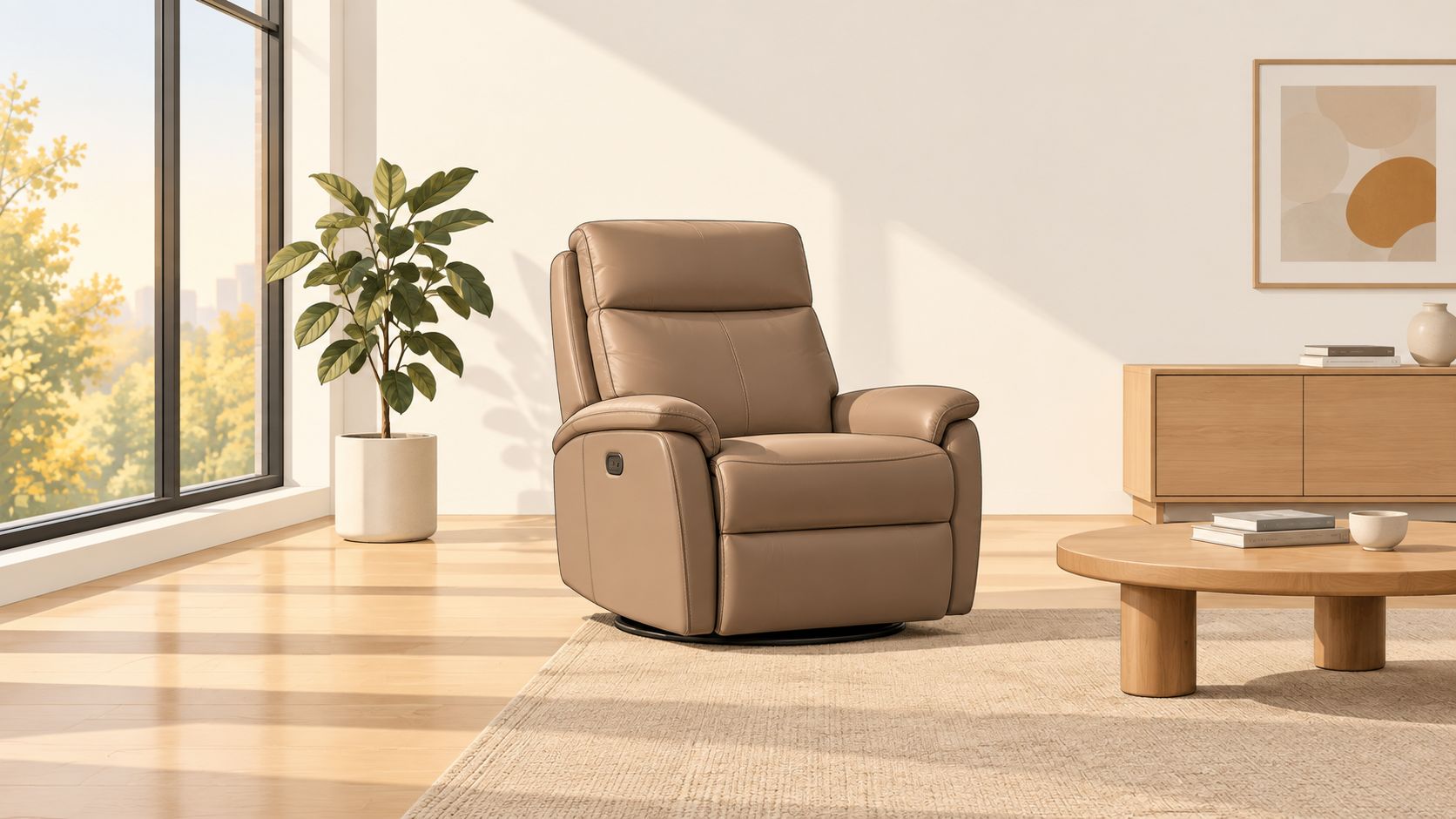
That transformation captures the evolution of the recliner. La-Z-Boy, one of the best-known modern recliner brands, traces its origin to 1927, when cousins Edward Knabusch and Edwin Shoemaker created the first recliner chair in Michigan. The company later grew into a global furniture business operating over 800 locations worldwide, making its history one of the clearest milestones in the development of modern couch recliners. Furniture.com's history of La-Z-Boy places the recliner within a longer story of upholstered seating, craftsmanship, and changing domestic habits.
From utilitarian object to tailored furniture
The older image of the recliner is familiar: oversized arms, visible handles, swollen cushions, and a silhouette that interrupts the room. Contemporary motion furniture takes a more architectural approach. Designers now consider the relationship between the frame, the seat pitch, the surrounding circulation, and the visual weight of the upholstery.
A good modern couch recliner should support the room in three positions:
- Upright: The closed form should look appropriate beside a sofa, console, or reading lamp.
- Relaxed: The partially reclined position should support reading, conversation, and casual lounging.
- Fully extended: The open position should feel generous without blocking essential paths through the room.
This is why the purchase belongs within a complete room concept. The chair must relate to the sofa's arm height, the rug's scale, the timber tones, and the quality of nearby lighting. A design-forward recliner can become the most comfortable seat in the home without becoming its loudest visual element. Guidance on what defines modern furniture design helps place motion furniture within that broader language of clean proportion, useful form, and restrained detail.
Colour plays an equally important role. A deep tobacco leather suits warm oak and aged brass, while a pale stone fabric sits naturally with bleached timber and plaster tones. For a home with coastal references, a resource on nautical colour palettes and decor can help refine navy, cream, sand, and weathered blue without turning the room into a theme.
Curator's principle: A recliner should look complete before it moves. The mechanism earns its place through comfort, but the silhouette earns its place through proportion.
The strongest choices combine timeless craftsmanship with discreet movement. Artisanal leather, carefully selected fabric, solid internal construction, and a mechanism that runs without noise all contribute to a sense of permanence. The result is not just a chair that reclines. It's a piece that supports the way a household lives.
The Engineering Behind Ergonomic Luxury
A homeowner can spend an hour admiring a recliner's leather, stitching, and sculptural profile, then discover its limits during the first long reading session. The difference lies beneath the upholstery. Comfort depends on the relationship between seat depth, back angle, lumbar support, footrest elevation, headrest movement, and the way the mechanism carries the body's weight.
A well-engineered modern couch recliner should support movement rather than lock the user into one pose. Canadian ergonomics guidance explains that no single posture suits extended sitting. The Canadian Centre for Occupational Health and Safety guidance on sitting recommends changing among sitting, semi-reclined, forward-tilted, and standing positions instead of remaining static for long periods. That principle belongs at the centre of any serious purchase.
Multi-posture support matters more than feature count
A fixed angle may feel pleasant for a few minutes, then create pressure around the lower back, hips, or backs of the knees. Guidance on what makes furniture ergonomic explains why multi-posture support matters more than a long feature list. The right mechanism gives the body several neutral positions and reduces the strain of holding one alignment for too long.
Test the chair in stages:
- Begin upright. The feet should rest naturally on the floor, while the pelvis remains supported rather than pushed forward.
- Move to a partial recline. The lumbar area should stay filled without a hard ridge pressing against the spine.
- Raise the footrest. The thighs should remain supported, and the knees should not feel excessively raised.
- Use the headrest. The neck should receive support without forcing the chin toward the chest.
- Return upright. The transition should feel controlled, with no abrupt movement through the pelvis or shoulders.
A refined motion chair earns its place through alignment, quiet operation, and durable construction. Power controls, charging ports, and multiple settings matter only when the frame and cushioning maintain support as the user changes position. Look for a mechanism that feels deliberate rather than mechanical, with movement that complements an heirloom-quality frame instead of distracting from it.
Assess the cushioning stack, not the showroom surface
The upholstery reveals only part of the construction. Beneath it, the cushioning stack determines whether the seat remains supportive or develops uncomfortable compression. Ask how the foam, fibre, springs, webbing, and barrier materials work together, and assess whether those layers are suited to the chair's intended use.
A seat that feels excessively soft can let the pelvis sink too far, increasing pressure around the lower back. A rigid seat may prevent the body from settling into a neutral position. The better response is resilient rather than merely plush. It should absorb weight, recover its shape, and support different body sizes without creating pressure points.
The headrest deserves the same scrutiny. A fixed cushion may support an upright position yet fail when the back reclines. An articulated headrest should meet the neck in both positions, particularly during reading or extended viewing. Its movement should look integrated into the silhouette, not added as a conspicuous technical feature.
Practical rule: The best mechanism encourages movement without making the user think about movement.
Manual and powered systems can both deliver excellent ergonomics. Manual operation offers simplicity and fewer electrical components. Power operation provides finer adjustment and can help anyone who finds a lever difficult to reach or operate. Choose according to the household's routines and physical needs, not the novelty of the control panel.
Ergonomic quality matters most when one chair serves several roles. Reading, resting, conversation, television, and occasional napping require different positions. A modern couch recliner should accommodate that range with quiet precision, durable materials, and a level of comfort worthy of its place in a carefully considered home.
Selecting the Perfect Silhouette and Mechanism
The right recliner begins with the room, not the feature list. A compact condominium near Toronto may need a wall-hugger silhouette that preserves circulation. A generous family room serving the Greater Niagara or Hamilton markets may accommodate a broad power recliner or a motion sectional with independent seats.
The following comparison offers a useful starting point. The listed spatial requirements are planning categories rather than universal measurements, because each manufacturer's mechanism opens differently.
Recliner mechanisms and spatial requirements
| Mechanism Type | Best For | Spatial Footprint |
|---|---|---|
| Manual recliner | Buyers who favour straightforward operation and minimal electrical complexity | Moderate rear and front clearance |
| Power recliner | Users who want gradual, precise positioning and discreet controls | Moderate clearance, with access to a power connection |
| Wall-hugger recliner | Condos, narrow rooms, and seating placed near a wall | Reduced rear clearance, with forward movement during recline |
| Power recliner with adjustable headrest and lumbar | Extended reading, viewing, and households with varied support needs | Moderate footprint with additional attention to headrest projection |
| Riser-style recliner | Users who benefit from supported transitions between sitting and standing | Larger visual and functional footprint, with clear space in front |
| Reclining sectional | Families seeking shared seating with individual zones | Substantial footprint, requiring careful circulation planning |
Match operation to everyday use
Manual recliners suit a quiet reading corner where the mechanism will be adjusted occasionally. Their control is direct and their visual language can be particularly clean. Power recliners are more appropriate when the chair will change position frequently or when precise, low-effort adjustment matters.
A wall-hugger is not automatically the best compact-room solution. Its rear clearance may be modest, but the extended footrest still requires a clear path in front. Painter's tape on the floor can define the closed and open footprints before delivery. This simple test reveals whether the chair will obstruct a doorway, crowd a coffee table, or interfere with a nearby sofa.
A riser-style recliner should be chosen for genuine usability rather than concealed need. It can help a household member move between sitting and standing, but it demands adequate space and a silhouette that works with the room's other pieces. The mechanism should be inspected in person, especially if several people will use the chair.
For a more detailed comparison of operation, control placement, and daily practicality, the guide to power recliners versus manual recliners offers a useful decision point.
The cleanest room often benefits from one generous motion piece, not a collection of competing functions.
The modern silhouette usually favours narrow arms, a controlled seat depth, and a low visual base. Traditional American craftsmanship may offer fuller cushioning, deeper seats, and a more enveloping profile. Neither approach is superior by itself. The correct choice is the one that respects the architecture and supports the people who use the room.
Integrating Motion Furniture into a Curated Space
A recliner becomes convincing when the surrounding room acknowledges its movement. The chair needs a generous rug, a reachable table, appropriate light, and enough open space for the footrest to operate without forcing the rest of the room into retreat.
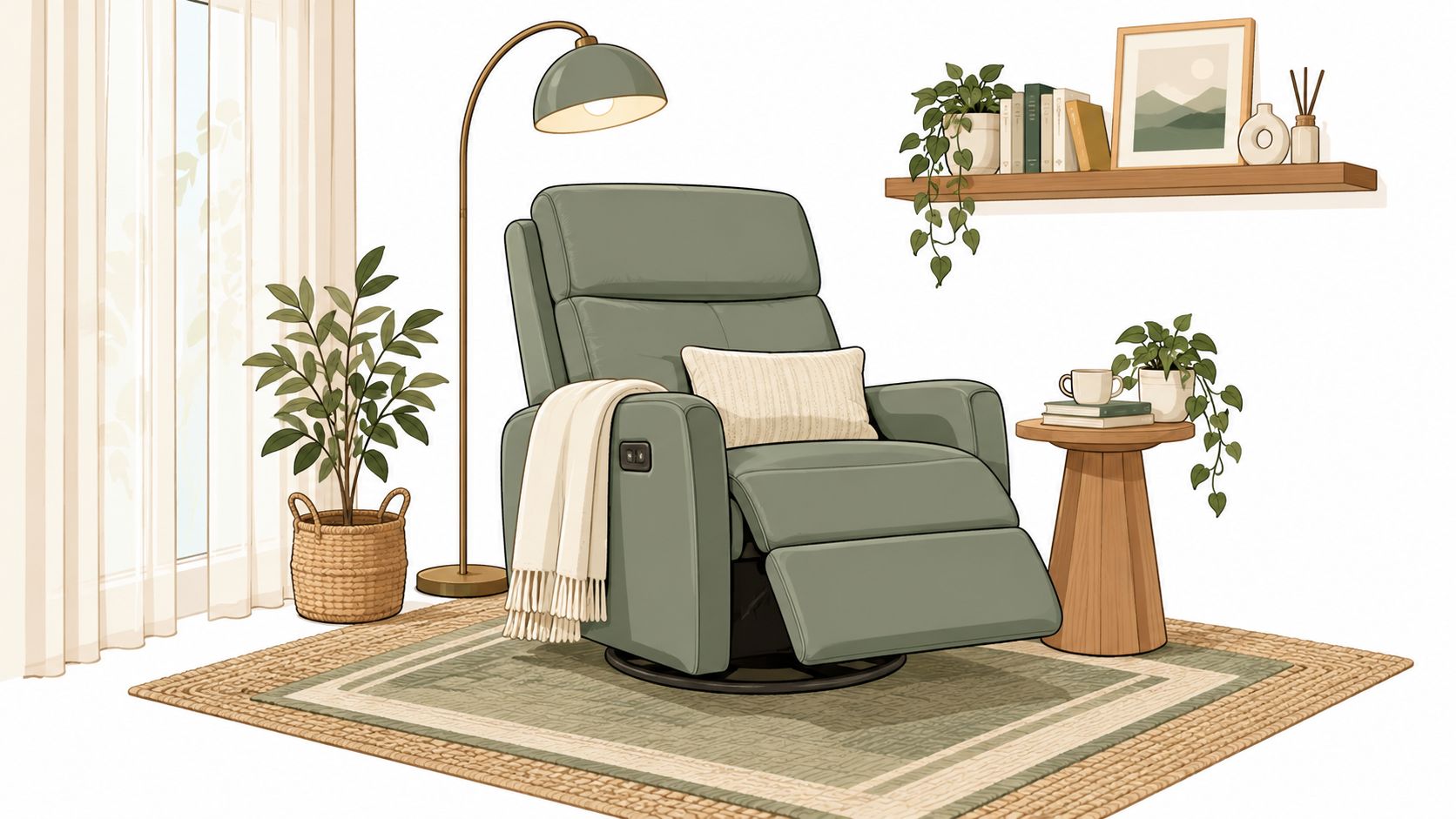
Start with the floor plan
The room should be measured in both the chair's upright and extended positions. The following sequence keeps the planning disciplined:
- Locate the primary view. Position the recliner toward the fireplace, garden view, television, or reading light that gives the seat its purpose.
- Protect circulation. Leave a comfortable route around the chair rather than placing the footrest across the main path.
- Place the table within reach. A small side table should hold a drink, glasses, and a book without requiring the user to twist.
- Layer the lighting. A floor or table lamp should illuminate the reading position without shining directly into the eyes.
- Coordinate materials. Repeat one element from the recliner elsewhere, such as leather tone, piping, timber, or a carefully selected accent colour.
The guide to arranging furniture in a living room provides a useful foundation for balancing conversation, circulation, and focal points. Motion furniture needs slightly more discipline than fixed seating because the open position changes the room's working geometry.
Let the rug establish the room
A rug is not an afterthought beneath a recliner. The Rug Market treats rugs as Art for Your Floor, and that description is particularly apt in a room where a single chair may become the visual anchor. A hand-knotted rug can soften the mechanical nature of a reclining base, connect the chair to the sofa, and establish the colour direction for the entire space.
For homeowners searching for Hand-knotted rugs Ontario, scale should be assessed before colour. A rug that ends immediately in front of the recliner makes the chair appear stranded. A larger design can gather the seating group into one composition, while a smaller rug may work in a dedicated reading corner with the front legs of the chair placed comfortably within its border.
Texture matters as well. A dense wool rug brings warmth to smooth leather. A finely patterned textile can add movement beneath a quiet fabric recliner. If the chair has a strong colour, the rug should provide equilibrium rather than repeat the shade too directly.
Use contrast with restraint
A sage or mineral fabric recliner can sit comfortably among walnut, aged bronze, and leafy green. A rich leather chair benefits from quieter walls and a rug with variation rather than a second dominant pattern. The room should feel layered, not matched.
Designer's Insight: A bold Hancock & Moore leather recliner pairs beautifully with a neutral hand-knotted wool rug. The rug calms the leather's visual energy while giving the chair a grounded, collected presence.
A complete room concept may include a reclining sofa, occasional chair, art, and textiles selected together. The recliner should have a relationship with each piece, but it shouldn't disappear. Its purpose is to offer a distinct posture and a distinct moment of comfort within the larger composition.
Ensuring Safety and Seamless Installation
A luxury recliner should be evaluated as an upholstered product and as a moving mechanism. Appearance doesn't reveal the full safety profile. In Canada, upholstered recliners sold for domestic use fall under Canadian upholstered-furniture safety and labelling rules, so buyers should look for products that identify compliance with the applicable standards for upholstered and soft-bodied furniture.
The upholstery system matters as much as the frame. The cushioning stack, cover fabric, and barrier layer work together to influence burn behaviour and smoke development. Canadian buying guidance recommends verifying certification documents and labels, particularly because foam density, barrier material, and textile composition remain hidden after the chair has been finished. Canadian recliner safety and construction guidance offers a useful checklist for examining those specifications.
Inspect the room before the furniture arrives
The delivery path deserves the same care as the selection process. A recliner may need to pass through a narrow entry, turn through a corridor, or travel in a building with lift restrictions. Condo rules, elevator bookings, floor protection, and access to the final room should be confirmed in advance.
In Ontario, in-home white-glove delivery commonly includes unpacking, assembly, placement in the chosen room, and debris removal. Delivery timing may require advance booking, an adult aged 18 or older to sign, and compliance with local condo or building rules, as outlined in Ontario furniture delivery guidance.
This service is more than a courtesy. Professional placement protects floors, walls, upholstery, and the mechanism itself. The team can check that the chair operates correctly, position it according to the room plan, and remove packaging that might otherwise remain in a hallway or garage.
Installation is part of the design
A family-run furniture house established in 1914 understands that the final placement shapes the customer's impression of the entire purchase. That heritage is meaningful only when it appears in practical care, from the first specification review to the final inspection.
Assembly should be handled by people familiar with the product's construction. A loose connection, poorly positioned foot, or pinched power cord can affect performance and create avoidable risk. Furniture assembly support can be reviewed through the professional furniture assembly service available to homeowners planning a more complete installation.
Installation standard: The chair should leave the delivery team positioned, tested, protected, and ready for use. A carton left at the door isn't a finished service.
White-glove delivery is particularly valuable across St. Catharines, the Greater Niagara area, Hamilton, and Toronto, where homes range from historic properties to high-rise condominiums. A design-led purchase should arrive with the same precision that shaped its selection.
Elevating Your Home with Expert Guidance
The best modern couch recliner is not defined by its motor count or control panel. It earns its place through a more demanding combination of multi-posture ergonomics, architectural proportion, material integrity, and spatial harmony.
A homeowner assessing a chair should first ask how the body will use it. The seat should support upright reading, partial recline, and full relaxation without pressure points. The mechanism should encourage adjustment rather than lock the user into one posture. The headrest and lumbar support should remain useful as the chair changes angle.
The second question concerns the room. A restrained wall-hugger may suit a compact city interior, while a generous power recliner can become the anchor of a larger family room. The chair's open footprint should be considered before the upholstery is chosen, and the final position should protect circulation, lighting, and conversation.
A complete room is the real investment
The recliner should then be connected to the wider scheme. A hand-knotted rug can establish the palette and ground the seating. A side table can introduce timber or stone. A lamp can turn the chair into a reading destination. Nearby art and accessories should reinforce the atmosphere without competing with the seat's movement.
Ontario's design culture provides a strong regional context for this approach. Specialized design services in Canada generated nearly $4.7 billion in 2024, with Ontario producing 51.3% of the national total, according to Canadian specialized design services reporting. The concentration reflects the importance of design guidance in the province, particularly for homeowners seeking coordinated furnishings rather than isolated purchases.
Interior design services in St. Catharines can be especially valuable when the recliner forms part of a larger renovation or when the room includes challenging architecture. Ontario accounted for 50.9% of Canadian specialized design services operating revenue in 2023, generating $2.3 billion, with interior design services representing 46.3% of sales, as reported in Ontario design services market data.
Choose pieces with a longer horizon
Luxury furniture should reward daily use and remain visually credible as the household changes. Wood, leather, wool, and carefully finished textiles can develop character over time when selected for the room and maintained properly. Canada's luxury furniture market generated USD 613.7 million in 2024 and is projected to reach USD 797.4 million by 2030, with wood identified as the largest material segment in 2024 in Canadian luxury furniture market reporting.
That market context supports a clear recommendation. A modern couch recliner should be bought as an enduring furnishing, not as a short-term technology purchase. The mechanism matters, but it should serve the upholstery, the room, and the household's patterns of living.
The most reliable next step is tactile. A showroom test reveals seat pitch, movement, texture, scale, and the difference between padded softness and true support. A complimentary design consultation can then connect those observations to the room's floor plan, rug, lighting, and surrounding furniture.
Experience the craftsmanship in person at our King Street Showroom, where a curated selection of modern seating, artisanal rugs, and complete room furnishings can be considered together. Book your complimentary design consultation today, then visit the Critelli Furniture showroom to find a modern couch recliner and room foundation suited to the way the home is lived in.