


Rug Pad Thickness Guide: How Thick Is Right?

The rug has arrived, the sofa is in place, and the room finally feels considered. Then the door brushes the pile, a dining chair rocks, or the rug shifts across the hardwood. The missing detail is often underneath: a pad chosen for softness rather than the room's actual conditions.
A useful rug pad thickness guide starts with the floor, the rug's construction and the clearance around it. The pad is the hidden foundation of the room, supporting an artisanal rug without making its edges feel raised or its surface unstable.
Recommended Rug Pad Thickness by Room
A rug pad sits between the rug and the floor. Most homes need one of three thicknesses, 1/8, 1/4 or 3/8 inch, with 1/8 to 1/4 inch covering most rooms.
| Room or situation | Recommended thickness | Metric equivalent | Key check |
|---|---|---|---|
| Entryways, hallways and stairs | 1/8 inch | About 3 mm | Low profile keeps door swings and edges clear |
| Living room with flat-weave or low-pile rug | 1/8 to 1/4 inch | About 3 to 6 mm | Use the thin end where door or furniture clearance is tight |
| Living or dining room with medium-pile wool | 1/4 inch | About 6 mm | Balances cushioning with edge visibility |
| Hand-knotted or heritage rug over hard floors | 1/4 inch | About 6 mm | Confirm the pad reaches the edges without folding |
| Thick or high-pile rug in a busy family room | 3/8 inch | About 9.5 mm | Test door bottoms and exposed edges before committing |
| Bedrooms and nurseries | 1/4 inch | About 6 mm | Choose a low-odour, low-emission material |
| Radiant heated floors | Manufacturer-approved maximum | Confirm the approved metric specification | Confirm maximum thickness with the floor or pad manufacturer |
These are starting recommendations, not automatic specifications. Read the table by situation rather than habit: the key check decides whether the proposed pad belongs in the room.
Entryways and hallways favour a discreet profile because an unobstructed walking route matters more than plushness. Stairs require additional care: a loose area-rug pad isn't a substitute for a securely installed runner system, and stair-specific installation guidance takes priority.
Let the room's use decide
Flat-weaves need support without an exaggerated lip around the perimeter. Medium-pile wool in a sitting or dining room benefits from moderate cushioning, but dining chairs still need to move cleanly across the surface. Selecting the right rug for beneath a dining table also means allowing enough rug area for chairs when pulled out.
A hand-knotted rug deserves a firm, even base, not a pillow beneath its knot structure. The family-room option is a conditional choice, reserved for a setting where the thicker assembly passes a physical clearance test.
Bedrooms and nurseries call for material scrutiny as well as comfort. Radiant heating remains the exception no general table can settle: the approved product specification governs.
Practical rule: When two situations fit, favour the thinner option where clearance is tight and the denser, more supportive option beneath heavy furniture. Greater thickness should solve a real problem, not simply feel more luxurious in a sample.
Why Thickness Balances Comfort, Safety and Clearance
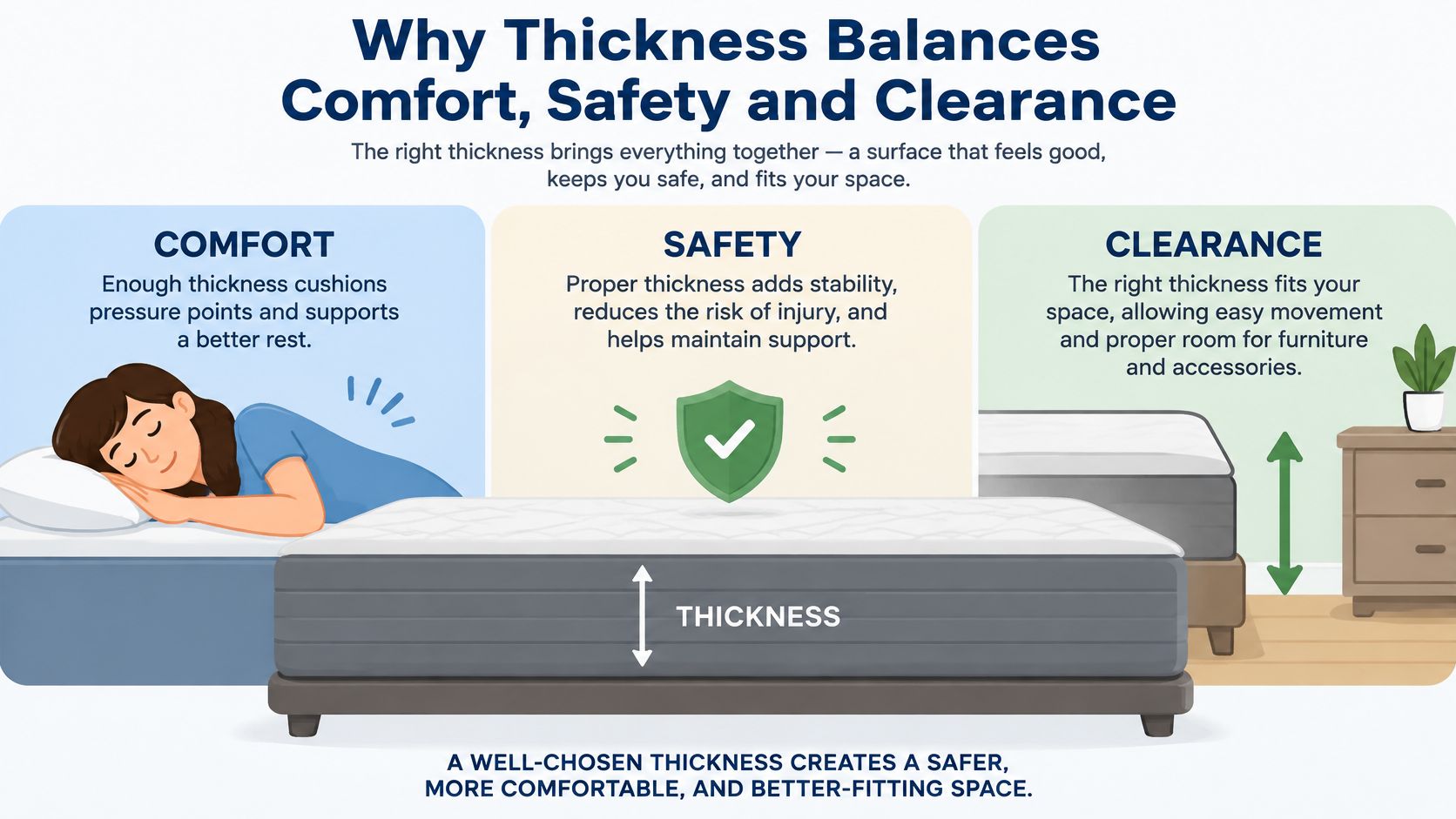
A rug pad is the hidden foundation of the room: it cushions the rug and helps it lie evenly, while its thickness affects door clearance and how securely furniture sits. Controlled support matters more than maximum softness.
The Canadian Conservation Institute's carpet and rug care guidance recommends underlays 1/8 to 1/4 inch thick, approximately 3 to 6 mm. The institute describes their role in cushioning uneven flooring, distributing furniture weight, reducing abrasion and extending a rug's service life.
Support should remain even
An even underlay helps address several everyday pressures:
- Uneven flooring: It cushions small irregularities, although it cannot repair a defective substrate.
- Furniture pressure: Dense padding spreads concentrated weight beneath sofa and chair legs.
- Underside abrasion: A suitable buffer reduces direct rubbing between rug and floor.
- Long-term care: Consistent support helps protect the rug's construction during everyday use.
The institute advises that padding reach the rug's edges without folding or overlapping. Doubled sections create ridges and concentrated stress, and a raised edge can catch a foot.
For hand-knotted and artisanal rugs, excess height can distort the rug's structure and complicate furniture or door clearance. Choose a restrained foundation that supports the rug without changing how it lies.
A substantial seating arrangement needs consistent support beneath the area the furniture covers. Thoughtful rug placement with a sectional establishes the composition; an even pad supports the rug beneath the seating.
At doorways and along circulation routes, a firm, low transition keeps movement easy. Choose the lowest thickness that provides the cushioning you want without leaving a raised edge. The rug should feel settled, not sit proud of the floor.
How Floor Surface Changes Your Pad Choice
A wool rug over sealed oak needs a different foundation from a rug on polished stone. Dense felt cushions the rug and distributes furniture weight; a grip backing helps keep it in place. Choose for the floor finish first, then set the thickness.
| Floor surface | Pad construction | Typical thickness | Watch for |
|---|---|---|---|
| Sealed hardwood | Dense or non-staining felt | 1/8 to 1/4 inch | Confirm the pad will not stain or mark the finish |
| Tile, stone or concrete | Rubber-backed or grip pad | 1/4 inch | Check grip and confirm the pad leaves no residue |
| Laminate or resilient vinyl | Low-profile felt or manufacturer-approved pad | Flooring-maker-approved low profile | Plasticizers can affect the finish |
| Existing low-pile carpet | Thin felt cushion approved for rug-over-carpet use | 1/8 inch | Avoid stacking pads and creating an unstable surface |
| Radiant heated floors | Low-profile, heat-compatible pad | Manufacturer-approved maximum | Confirm heat tolerance and assembly compatibility |
| Any floor under heavy furniture | Dense felt to spread loads | 1/4 inch | Test chair and recliner legs for stability |
Thickness alone does not indicate whether a pad will grip. Test the complete rug-and-pad combination on the actual floor, especially on polished stone or smooth tile.
Choose the backing deliberately
For a valuable hand-knotted rug, avoid foam rubber, vinyl, jute and recycled felt underlays. Choose a non-foam elastomer approved by the rug maker or a conservator, and confirm it is compatible with the floor finish.
Check the rug's backing for possible colour transfer before installation. A pad cannot prevent an incompatible backing from marking the floor.
For example, dense, compatible felt can support a wool rug over sealed oak beneath anchored living-room furniture. Test any unweighted section for movement. In an entrance hall with polished stone, prioritize grip because people approach the rug from several directions.
Test the complete combination
Walk across the installed rug, pull out dining chairs and operate recliners. Check for creeping, bunching and uneven support under furniture. Finger-pressing a pad will not reveal how it behaves underfoot.
If you are comparing floor finishes, this guide to wood-look laminate flooring in humid climates offers moisture-related context. The flooring manufacturer must still approve the pad. Protect the finish at furniture contact points with guidance on protecting floors from furniture.
Match the pad construction to the floor first. Then choose a profile that suits the room without relying on thickness to make the wrong material work.
Checking Materials, Odour and Emissions Before You Buy
You unroll a new pad in a closed bedroom and the room smells like a warehouse for two days. Treat that smell as a warning about the layer nobody sees. Binders, backings and adhesives decide what sits under the rug and what they release into the air. In a luxury room, buy the pad whose materials you can name, even when a thicker, softer option feels more expensive underfoot.
A 2025 National Research Council Canada investigation included underpad among 60 building-material samples and evaluated emissions of 90 volatile organic compounds, of which 47 had identified human-health implications. Those findings do not show that every rug pad creates a harmful exposure, or that every tested compound came from underpad.
Cut indoor sources by choosing lower-emission materials, then air the room properly. A thinner, dense pad with clear disclosure is the better buy when the thicker one hides its binders or keeps a smell after airing.
Ask for product-specific answers
Before you accept a pad for sealed hardwood or a nursery, get these answers in writing:
- Composition: Does the pad contain PVC, plasticizers, adhesives or undisclosed binders?
- Rubber type: Is the rubber natural or synthetic, and is it a foam or non-foam construction?
- Finish compatibility: Is the exact pad approved for the finished hardwood or resilient flooring in the room?
- Emissions documentation: Is testing available for the finished product, rather than only an individual ingredient?
- Care requirements: How should the pad be cleaned, dried and inspected?
Low odour is a useful first check, but documentation is what confirms low emissions. Trust the paperwork over the scent, especially where a bedroom or nursery stays closed overnight.
Plan for care before installation
Rug construction changes how you maintain the stack. Understanding hand-tufted area rugs separates their backing questions from those of hand-knotted pieces.
For a useful material-led cleaning reference, Eco Clean Solutions explains how to match cleaning methods to carpet types. Clean the rug and the pad according to each one's composition. They are not interchangeable textiles.
Pull the pad out of its packaging and air it in a ventilated space, following the care sheet. Install it only after that airing. A strong or lingering odour needs an answer from the maker, not a rug laid over it.
How to Measure and Size Your Pad
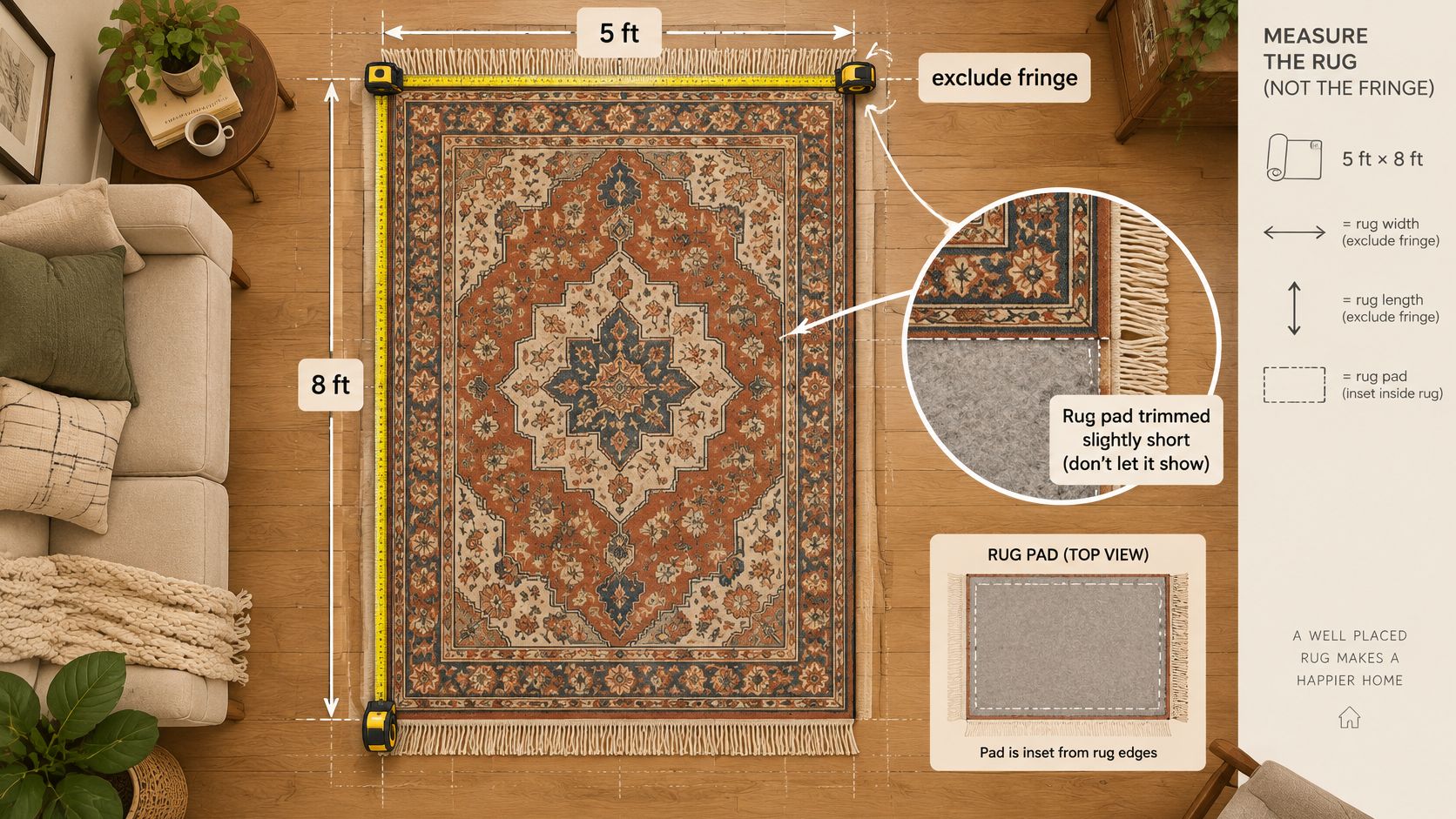
Consider a hypothetical 5 by 8 foot hand-knotted rug over oak in a living room. Its label gives the nominal size, but the actual woven dimensions and the door swing determine the final fit.
A tape measure, straightedge, pencil and sharp scissors suitable for the pad material are enough for most straightforward installations. Cut on a protected work surface, never directly on the finished floor.
Measure the assembly, not just the pad
Measure the rug's body. Record length and width at the widest points, excluding fringe. Handmade edges may not be perfectly square.
Allow a discreet inset. For a conventional contemporary installation, subtract about an inch at each side so the edge can taper. In this example, the resulting pad would be about 4 feet 10 inches by 7 feet 10 inches; valuable heritage rugs may require a conservator's closer-to-edge support specification instead.
Check the entire door swing. Place the proposed pad and rug together beneath the door's path. Measure the remaining gap at the tightest point, not merely beside the hinge.
Record combined height. Check doorways, thresholds and stair approaches with both layers in position. The federal model accessibility standard limits carpet-and-pad assemblies to 13 mm, approximately 1/2 inch, in its applicable settings; it doesn't automatically govern residential area rugs.
Inspect furniture contact points. Confirm that chair, sofa and recliner legs sit on consistent support, without a folded pad or a pad boundary beneath a leg.
Compare comfort against clearance. Select the proposed profile, then reject it if the measured assembly obstructs a doorway or creates an awkward transition.
Dry-fit before final trimming. Walk the normal route, move chairs and open doors fully. Look for lifted corners, ridges and rubbing.
Check placement before the final cut
The pad cannot correct a rug that is too small for the furniture arrangement. A living room rug size guide helps establish the footprint before trimming begins.
In the oak-floor example, a successful installation looks quiet and feels secure: the rug lies flat, its edge tapers, doors clear and no chair leg rocks.
Diagnosing Ridges, Slippage and Wear
A pad problem usually announces itself through movement, an uneven edge or a change beneath the rug. The symptom narrows the possibilities, but it shouldn't trigger an automatic purchase of thicker padding.
- Raised ridge along the edge: Check for folds, overlapping pieces or stacked pads. Remove the extra layer and correct the fit before considering replacement.
- Curling or lifted corners: Check whether the pad is undersized or lacks support, but also inspect the rug itself. Increasing thickness won't necessarily correct a curled rug.
- Sliding or bunching: The grip may be missing, worn or unsuitable for the surface. Use a grip-backed construction approved for both the rug and the floor.
- Door rubbing: The assembled height is excessive at that point. Trial a lower-profile pad across the affected rug rather than creating a stepped patch beneath it.
- Staining or a softened finish: Lift the rug, stop using the pad and contact the flooring manufacturer. Don't apply solvent or scrape away residue without finish-specific advice.
- Underside wear or debris: Inspect for a brittle, crumbling or shedding pad. Remove grit and replace degrading material before resetting the rug.
Separate wear from a poor fit
A busy walking route can expose a marginal installation quickly. Selecting the best rug for a high-traffic area addresses the visible surface, but the underlay still needs routine inspection.
The Canadian Conservation Institute recommends regular checks because padding can deteriorate or damage the rug over time. A practical household routine is to inspect it every few months and after spills.
Lift a corner, examine both contact surfaces, and reset the pad completely flat. Persistent movement or marking deserves investigation, not another layer.
Confirm Your Pad Choice Before You Buy
A rug can be the room's finishing touch, but its pad is the hidden foundation. Choose the thinnest pad that provides the needed support, suits the floor beneath it and clearly identifies its materials. The right choice keeps the rug stable without adding unnecessary height.
Before buying, check the assembled height against door clearance and nearby furniture. Consider how the rug fits the room's layout, too: Critelli Furniture's design guidance includes selecting fabric and planning a complete room layout.
Consider the room as a whole
Critelli's designers guide customers across their entire space, from architectural lighting to hand-knotted rugs. The In-Home Service develops a detailed “must-be-right” plan showing how textures, colours and configurations will look in the customer's actual environment.
The Rug Market describes rugs as “art for your floor.” When choosing a pad, consider how its thickness affects the rug's position in relation to the surrounding furnishings and the room's overall layout.
Bring your rug measurements, floor-finish details and doorway photographs to Critelli Furniture to discuss a foundation suited to the rug and the way the room is used.