

Best Rug for High Traffic Area: A Curator’s Brief


Snow lands on the mat, a retriever shakes at the threshold, and a child drops a backpack where the hall narrows into the living room. In that moment, the rug stops being decoration. It becomes the surface that either settles the room or starts to fail under pressure. For households across Southern Ontario, that is the true test of the best rug for high traffic area, and it is why the Rug Market matters as a room-building destination, not a place to grab a last-minute accessory.
A serious rug has to do two jobs at once. It must look composed enough to support a complete room concept, and it must stay flat, tidy, and serviceable when winter grit, paws, guests, and everyday movement keep coming through. The wrong answer is usually a soft, loose, pretty compromise that photographs well and ages badly. The right answer is a curated selection with the right construction, the right pad, and the right maintenance habits.
Critelli Furniture has spent generations treating rugs as art for your floor, the foundation that sets the tone for the rest of the room. In a home between Greater Niagara, Hamilton, and Toronto, where design expectations are high and daily wear is even higher, the decision deserves more than a fibre ranking. It deserves judgment.
The Foyer Moment That Defines the Problem
A foyer in February tells the truth quickly. Wet boots leave marks, the dog shakes off half the driveway, and a backpack lands with no ceremony while someone reaches for keys. A beautiful rug can still belong in that space, but only if it can hold its shape, keep its edges flat, and carry the room's first impression without turning fragile.
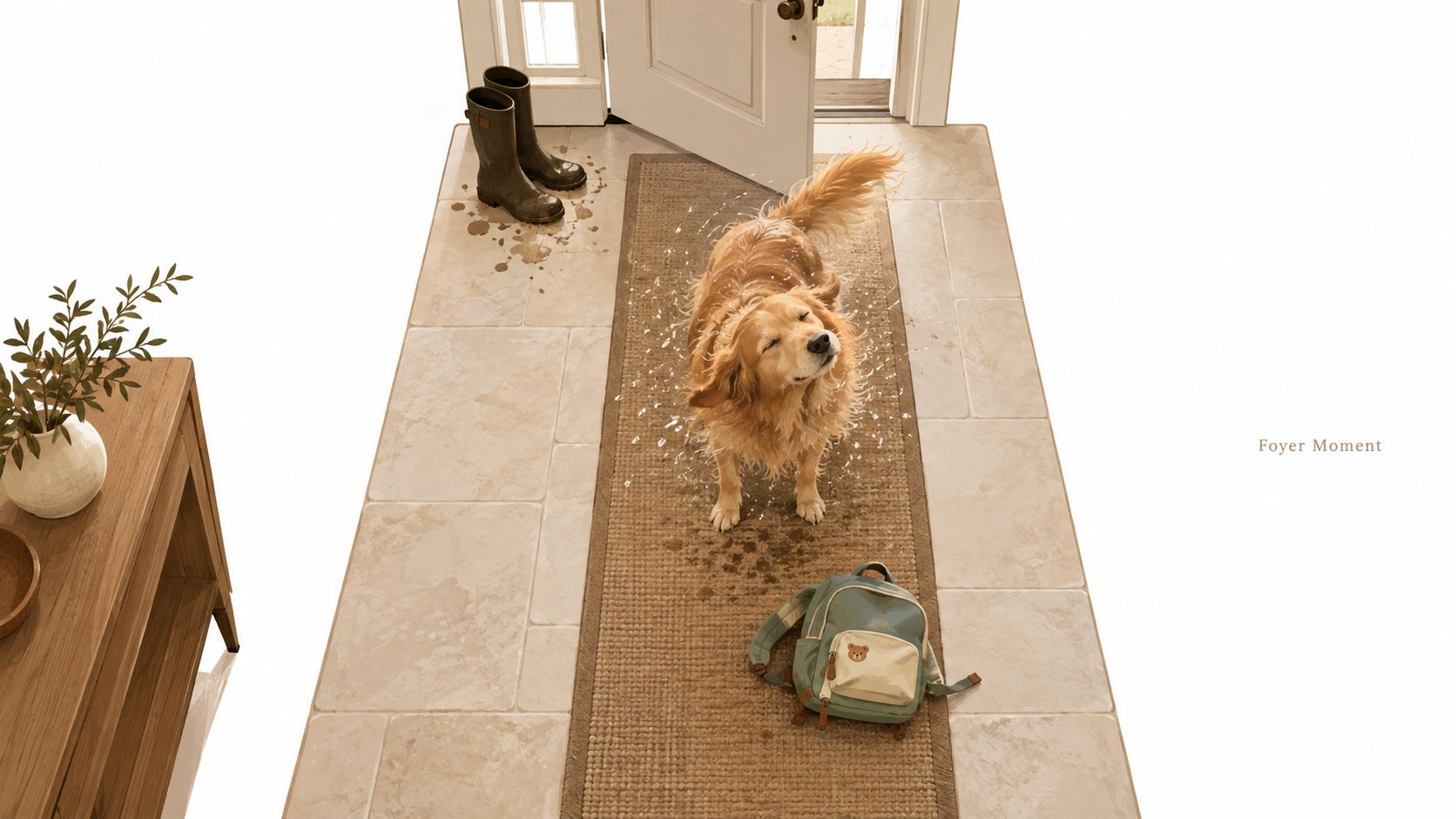
For a family moving between the garage, the front door, and the kitchen, the rug is part welcome mat, part buffer, part design anchor. That is why a design-forward choice has to survive more than a style test. It has to survive the rhythm of entry, pause, turn, and repeat.
A good runner or area rug in this zone should feel disciplined. Low profile. Stable. Easy to read at a glance. A loose edge or deep pile may look indulgent in a showroom, but in an active foyer it becomes a trip risk and a maintenance burden.
Practical rule: if the threshold gets wet, gritty, or crowded, the rug should behave like flooring first and ornament second.
For clients comparing a hallway runner with other scaled pieces, the difference is easier to grasp when the rug is seen as part of the room's circulation, not as an isolated object. A helpful reference is Critelli's rug runners overview, because the shape of the room matters as much as the weave.
The Four Variables That Actually Decide Durability
Fibre is only the starting point
Fibre matters, but it does not decide the whole story. Wool, nylon, and polypropylene each bring a different character to a room, yet the way the rug is built decides how that character holds up under pressure. A dense fibre in a weak construction can still fail early. A sensible fibre in a disciplined build can last with grace.
Pile and density do the real work
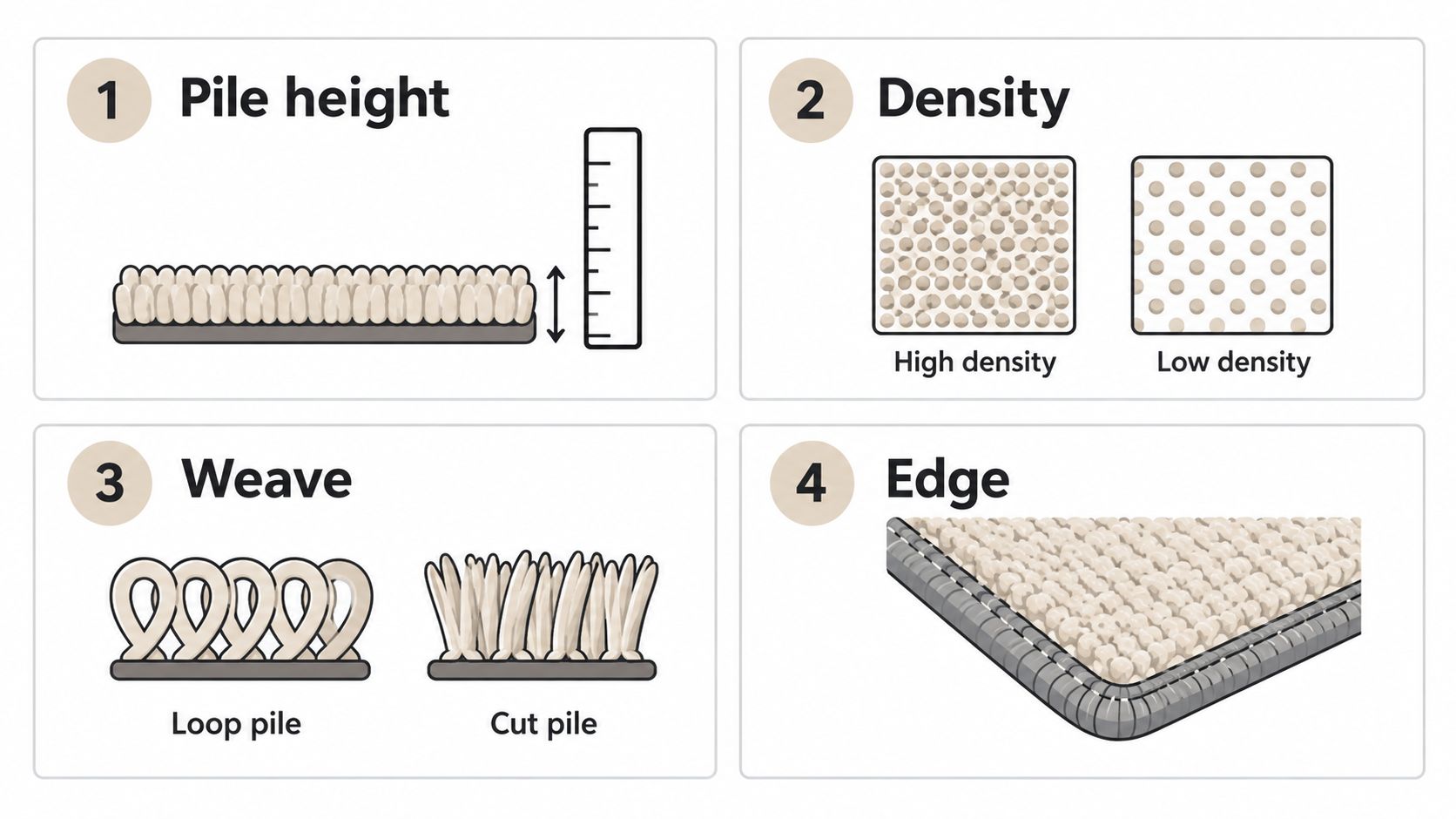
Pile height controls how much the surface stands above the floor. In a high-traffic route, a low, firm, level pile is the defensible choice, because feet, vacuum heads, and mobility aids meet less resistance. Density matters because tightly packed yarns resist crushing better than airy ones, which is why a compact surface often reads as more settled and polished.
Weave and edge finishing decide whether the rug keeps its shape
Loop structures usually handle traffic better than lofty cut pile because the surface stays more stable under repeated contact. Flatweaves are often excellent in halls and entries because they sit close to the floor and can look sharp without excess bulk. Edge binding matters too, because a properly finished edge is less likely to curl, fray, or lift where people step in and out.
A rug should be judged like architecture, by structure, not by the first colour that catches the eye.
Backing and pad complete the system
The rug and its underlay behave as one unit. The pad should fit properly, stay in place, and support the rug without adding unnecessary height. For a child's circulation zone, a dining passage, or a hallway beside a storage bench, the pad is not an accessory. It is part of the safety and wear system.
A useful mindset comes from seeing how people choose furniture for a children's corner. A compact, stable table set works because the proportions match the use. The same logic appears in this guide to kids' table and chairs sets, where form follows daily behaviour rather than showroom fantasy. That is the right way to think about rugs, too.
For a closer look at build quality, Critelli's hand-tufted rug guidance is useful for understanding where craftsmanship supports longevity and where it doesn't.
Wool, Nylon and Polypropylene Compared Honestly
Wool is the heirloom choice when the room needs warmth, depth, and a natural hand. Its fibres handle dry soil well, which is one reason wool can feel so dignified in a busy house. But wool still needs prompt blotting, careful cleaning, and rotation if the room sees regular traffic. In a family that wants timeless craftsmanship and accepts routine care, wool belongs.
Nylon is the practical workhorse. It recovers well after repeated compression, which is exactly what a hallway, entry, or busy family room asks of a rug. It gives a house a clear, orderly look and tends to suit homes that entertain often, because the surface is built for resilience more than romance.
Polypropylene makes sense when ease of cleaning and budget flexibility matter most. It can be sensible in active rooms and useful where spills are common, though it usually lacks the depth and ageing character of wool. Its strength is straightforward maintenance, not a rich textile presence.
The smartest households do not ask which fibre wins in the abstract. They ask which one matches the room, the mess, and the maintenance plan.
| Fibre | Resilience | Stain Behaviour | Hand & Character | Best Fit |
|---|---|---|---|---|
| Wool | Strong with proper care | Needs prompt blotting | Warm, tactile, artisanal | Living rooms, quieter family spaces |
| Nylon | Very dependable under repeated compression | Predictable and practical | Cleaner, more utilitarian feel | Hallways, entries, active family rooms |
| Polypropylene | Useful for everyday wear | Easy to clean in many settings | Simpler, lighter character | Casual high-use zones, spill-prone rooms |
For a broader material lens, That Blanket Co's fabric guide offers a similar logic for textiles in general, because the right fibre is always tied to how the object will be used.
Critelli's hand-knotted rug collection guide is also relevant here, since hand-knotted work can bring the visual gravity that a more polished room needs.
Designer's Insight: a hand-knotted wool rug can steady the quieter living zone, while a flatter runner at the entry handles the messier threshold. That layered approach feels more composed than forcing one rug to do everything.
How to Read Construction Like a Designer
Start with the label, then look at the floor
A rug label should answer practical questions before it sells a mood. Look for pile height, construction method, and edge finish, then check whether the rug stays visually level when it lies on the floor. If the edges lift or the surface looks soft in a way that suggests collapse, the piece is probably better suited to a low-use room.
Don't get fooled by face weight alone
Face weight sounds authoritative, but it can mislead. Total weight may include backing and other materials that don't tell the buyer much about usable surface fibre. A rug can feel substantial in hand and still perform poorly if the pile is airy or the edges are weak.
Know what repairability buys over time
A hand-knotted rug can often be repaired and refreshed over the long run, which is part of its appeal in an heirloom-minded house. A machine-made performance rug usually offers easier replacement and more predictable day-to-day behaviour. Neither is morally superior. Each serves a different relationship with time.
A prudent buyer brings a small checklist to the Rug Market:
- Stable edges: the finish should lie flat and stay flat.
- Low profile: the surface should support traffic, not resist it.
- Dense construction: the fibres should feel compact, not airy.
- Documented build: the rug should come with clear construction information.
- Proper pad fit: the underlay should suit the rug and the floor together.
Critelli's hand-woven rug page is useful for clients comparing construction styles, especially when the room needs artisanal character without sacrificing practical function.
Why Maintenance Discipline Beats Fibre Choice
A beautiful rug can still fail in a foyer if it is never rotated, cleaned poorly, or vacuumed with the wrong head. Embedded grit is the silent enemy. Foot traffic presses that grit into the fibres, and over time it works like fine sandpaper. That is why maintenance is not housekeeping in the background, it is part of the design decision.
Heirloom rugs need the right care. Beater bars can be too aggressive for delicate construction, and steam cleaning can be a bad fit when a rug needs a more customized approach. If a home has winter salt, pet hair, or frequent spills, the owner has to choose a rug that matches the household's actual habits, not the ideal version of them.
The most durable rug is the one its owner can care for correctly, consistently, and without improvisation.
HEPA vacuuming matters because it removes fine debris before it cuts fibres and clouds the surface. That is especially important in homes where rugs sit near exterior doors or under family traffic that never really stops. A low-pile rug cleaned well will outlast a more luxurious one that is neglected.
The same principle applies in a design studio: the object only performs as well as the system around it. A room that looks curated on day one can lose its clarity quickly if the textile at its centre is impossible to maintain.
A Room-by-Room Decision Framework
Entrances and foyers
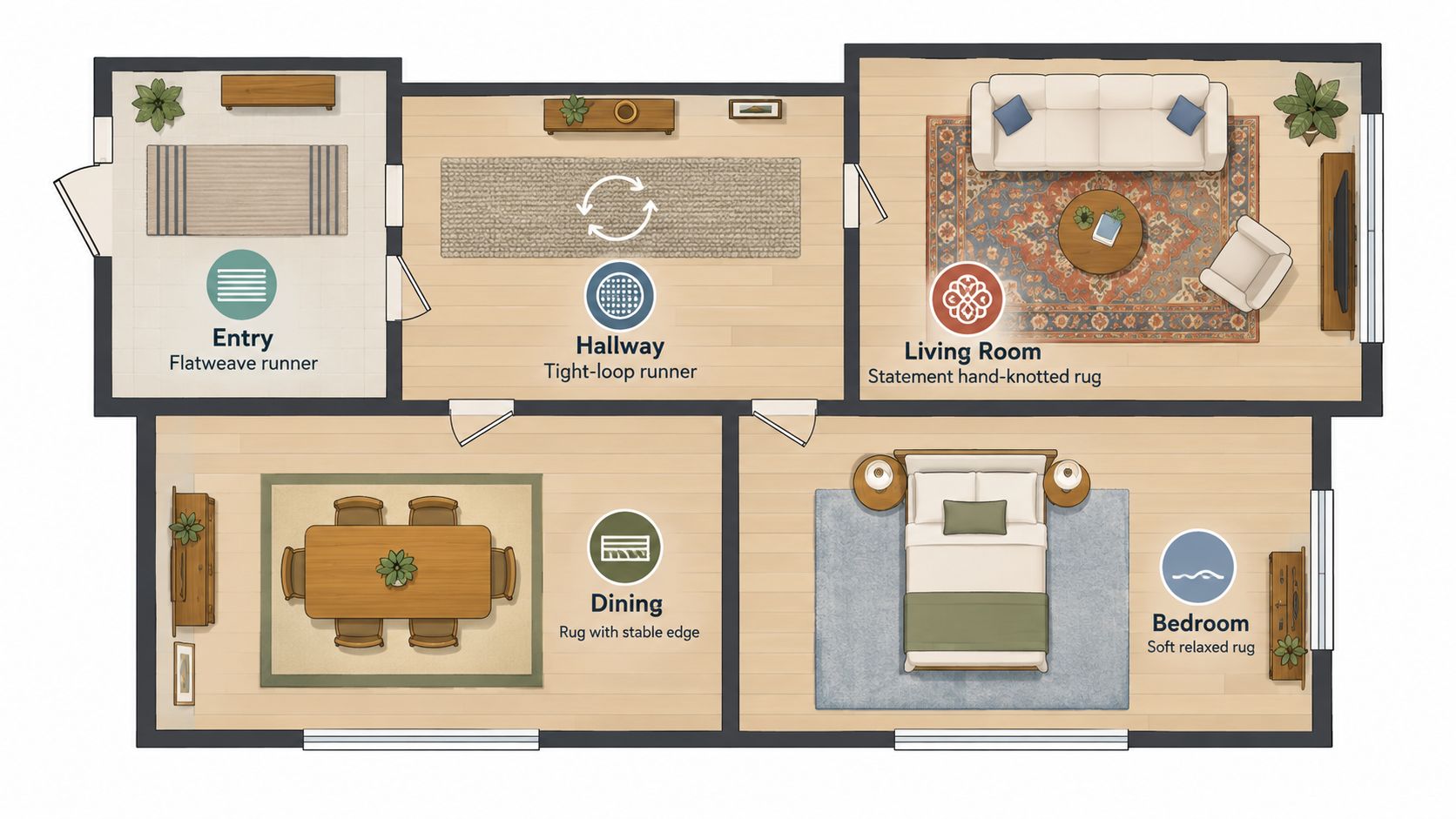
These spaces want the most disciplined construction in the house. A flatweave or tight loop pile in a forgiving pattern is usually the most sensible choice because it handles grit, turns, and quick movement with less visual drama. The rug should define the threshold, not fight it.
Hallways and stairs
These need a runner that can take repeated contact without curling at the edges. The surface should stay low enough to avoid catching doors or vacuum heads, and the pattern should disguise the wear that appears first in the path people use most. In long circulation routes, a rug that can be rotated becomes a real asset.
Living rooms
The room can afford more personality. A denser wool piece or a refined hand-knotted rug can bring depth, especially when paired with seating that is already doing visual heavy lifting. The pad matters here because it keeps the rug settled under daily shifting from guests, children, and furniture legs.
Dining areas
Dining rooms punish soft choices. Chairs pull back and push in constantly, so the rug needs stable edges and a pattern that keeps the surface looking composed even when crumbs, feet, and chair legs are active. Pale solids are a poor bet here. Visual variation helps a room stay elegant between cleanings.
Bedrooms and quieter studies
These rooms loosen the rules. A more expressive wool rug can bring warmth and a sense of completion without the same traffic pressure found at the front door. Even here, though, the construction should support daily use, not merely the first impression.
A planning conversation with Critelli's area rug placement guidance can help align rug dimensions with doors, vents, and circulation paths before anything is ordered.
The Care Calendar That Protects the Warranty
The right routine keeps a good rug from ageing prematurely. In high-traffic lanes, vacuuming should happen at least twice per week, and exterior entryways deserve the same attention because they collect the grit that wears fibres down fastest. A vacuum with HEPA filtration is the sensible choice for particle control, especially where indoor air quality matters.
Spills need immediate blotting, not aggressive scrubbing. Rubbing pushes liquid deeper and can distort the surface, while blotting gives the fibres a chance to release the spill cleanly. After any wet cleaning, the rug should dry promptly and stay away from persistent moisture.
A practical calendar keeps the rug honest:
- Twice weekly: vacuum the busiest paths with a suitable head.
- Monthly: inspect edges, corners, and high-contact zones.
- Quarterly: rotate movable rugs so wear distributes more evenly.
- Every 12 to 18 months: schedule professional cleaning, which aligns with the minimum interval noted in a Canadian carpet-care guide for many warranties (Canadian carpet-care maintenance intervals).
That cadence matters because improper equipment or delayed professional cleaning can affect both appearance and warranty coverage. It also keeps the rug aligned with the way a real house lives, which is the entire point. A piece that is cared for properly stays calm under pressure, and calm is what makes a room feel considered.
Choosing at the Rug Market
The buyer should bring room photos, doorway and vent measurements, and a frank account of how the household moves. That includes pets, winter grit, entertaining habits, and how often the rug will be rotated or cleaned. The question to ask in the room is simple, but decisive, can this rug be maintained beautifully in this home?
For clients balancing Luxury furniture Niagara, Interior design services St. Catharines, Custom furniture Southern Ontario, and Hand-knotted rugs Ontario, the answer should fit the room concept, not just the floor. A rug is the foundation under the seating, the colour palette, and the emotional tone of the space.
White-glove delivery matters here because a precise fit, proper placement, and full inspection are part of the finished result. In a well-planned home, the rug does not arrive as a loose object. It arrives as the last necessary piece of a complete room.
Critelli Furniture curates rugs as part of a full design conversation, not as an isolated purchase, with options that suit traffic, maintenance, and the architecture of the room. Visit Critelli Furniture to see how a thoughtful rug selection can anchor the home, then book a white-glove showroom visit to shape the room around it.