
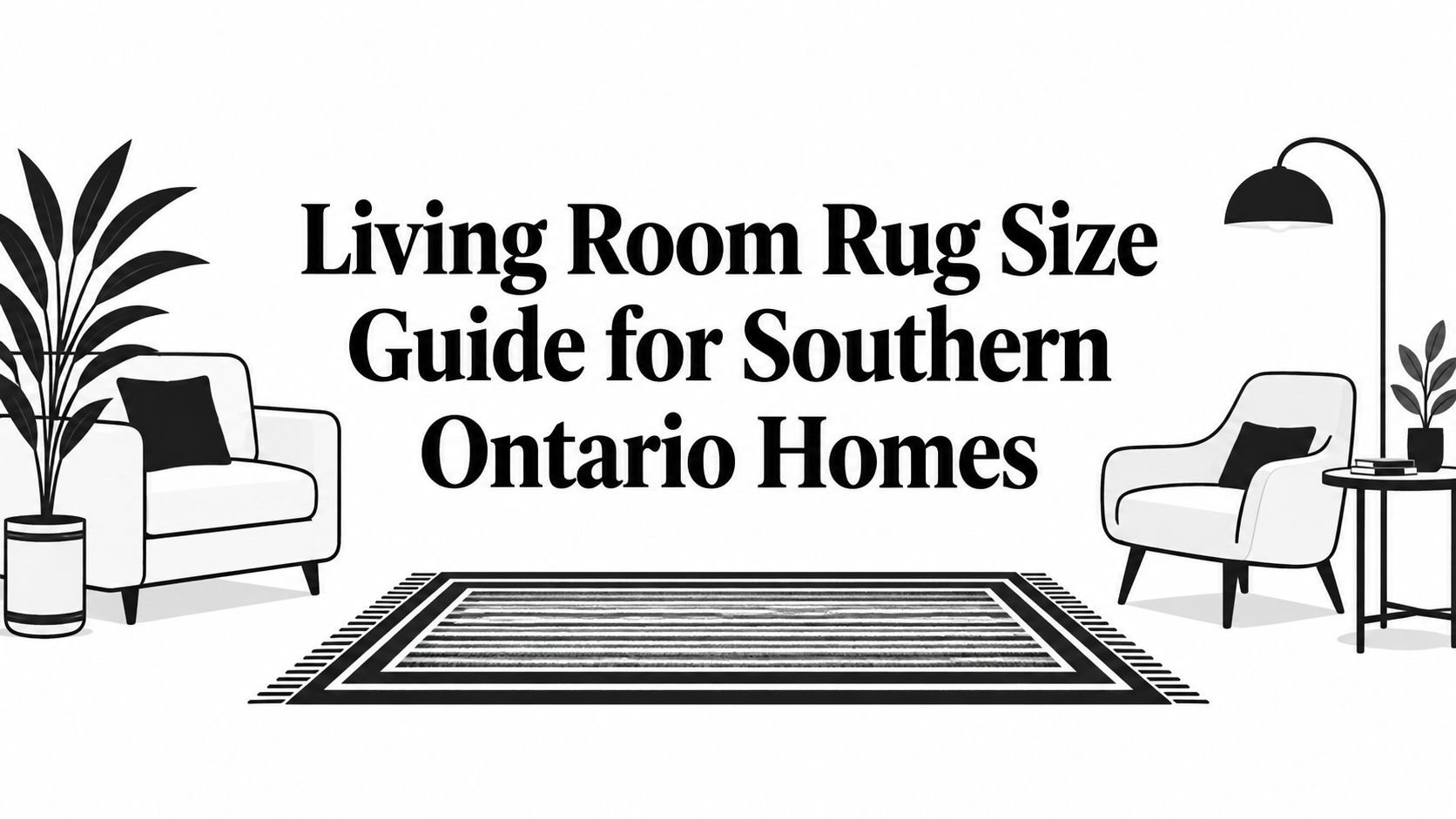
Living Room Rug Size Guide for Southern Ontario Homes

The sofa is in place, the coffee table has arrived, and yet the living room still feels strangely unfinished. Often, the culprit is a rug that sits beneath the coffee table like a small island, leaving the sofa and chairs visually disconnected. In Southern Ontario homes, where hardwood floors, fireplaces, built-ins, and open-plan layouts each influence proportion, rug size deserves architectural attention.
A well-chosen rug is art for your floor. It establishes the room's palette, gathers the seating into a coherent composition, and gives every subsequent decision, from upholstery to wall art, a firm point of reference. This living room rug size guide offers practical direction for homeowners across Greater Niagara, Hamilton, and Toronto, with a clear preference for generous proportions and furniture that feels intentionally anchored.
The Foundation of Exceptional Interior Design
A room furnished with beautiful pieces can still feel unsettled when the rug is undersized. A refined sofa may face two handsome chairs, but if the textile stops short of their front legs, each piece appears to occupy its own separate territory. The room loses the quiet authority that comes from visual connection.
The better approach begins with the rug. Its scale should establish the seating zone before the furniture is finalised, much as a drawing establishes the geometry of a room before construction begins. A rug's colour and pattern then guide the surrounding choices, helping a complete room concept feel curated rather than collected by accident.
Rugs as foundational art
The most successful rooms treat the rug as more than a soft surface. A hand-knotted design can introduce movement beneath a restrained furniture arrangement, while a quiet wool ground can give a richly upholstered room the calm it needs. The textile should support the room's energy without competing with its strongest architectural or decorative feature.
That principle extends beyond rugs. Homeowners considering how the walls will balance the floor may also appreciate this thoughtful guide to landscape wall art, particularly when a room needs a relationship between horizontal floor pattern and expansive wall imagery.
Curatorial principle: Choose the rug as the room's ground plane, then allow furniture, lighting, and art to respond to it.
Proportion before decoration
A larger rug often creates a more composed impression because it connects the sofa, chairs, and table into one conversation area. That connection matters in traditional Niagara residences as much as it does in contemporary Toronto condominiums. The room feels more generous when the floor treatment supports the furniture instead of interrupting it.
This is why heirloom quality and scale belong in the same conversation. An artisanal rug deserves enough visual territory to be appreciated, and the room deserves a foundation that won't make exceptional furniture feel cramped. The rug is not the finishing touch. It is the beginning of the design.
Measuring Your Space and Establishing Borders
Before selecting a pattern, measure the usable architectural footprint. The objective isn't to fill every inch of floor, but to define the seating area while preserving a deliberate frame of flooring around it.
A balanced living room commonly keeps 12 to 18 inches of visible floor between the rug edge and the surrounding walls, a rule reflected in Canadian sizing guidance from Crate & Barrel Canada's rug selection guide. Other Canadian advice allows a broader 18 to 24 inches of exposed floor, particularly where the room needs a stronger visual frame, as outlined in Home Depot Canada's area rug guidance.
A practical measuring sequence
Measure the room's usable length and width. Exclude areas blocked by permanent cabinetry or passageways that shouldn't belong to the seating zone.
Mark architectural interruptions. Note the hearth, fireplace projection, built-in millwork, vents, door swings, and any change in flooring. A rug can align with these features, but it shouldn't obstruct their function.
Map the furniture footprint. Measure the sofa, chairs, tables, and planned clearance between them. Furniture placement matters more than the room's total dimensions because the rug must anchor the grouping.
Reserve the perimeter border. Use the 12-to-18-inch rule as the starting point, then adjust where a hearth or built-in requires a more generous reveal.
Check circulation. Walk the principal routes through the room. A rug should define the sitting area without forcing household traffic across an awkward corner or narrow edge.
For homes with several seating arrangements, a floor plan can prevent expensive guesswork. Critelli's furniture measuring guide can help homeowners record dimensions before visiting a showroom or arranging an in-home consultation.
A rug should frame the room's architecture, not fight it. The visible floor border gives the textile authority and keeps the room from feeling swallowed.
Canadian sizing guidance also reflects the reality of mixed measurement systems. Common formats may appear in feet and inches or in centimetres, so shoppers should confirm the actual dimensions rather than relying on a familiar label alone.
Sizing Rules for Standard Seating Layouts
Three placement methods dominate living rooms, but they don't carry equal design weight.
All legs on the rug creates the most expansive, unified arrangement. It suits a generous room where the textile can extend beneath the sofa and chairs while retaining a visible border around the perimeter. The effect is formal, grounded, and particularly appropriate for a large seating group.
Front legs on the rug is the most versatile choice and the preferred standard for many living rooms. The sofa and chairs remain connected to the rug, while the back legs rest on the hardwood floor. This approach anchors the conversation area without concealing the craftsmanship of Southern Ontario flooring.
Coffee table only leaves the furniture floating around a small central textile. It can work in a compact setting, but it often produces the very disconnected effect that homeowners are trying to correct. For luxury furniture, this arrangement is usually too timid.
The practical benchmarks below reflect commonly cited Canadian recommendations for room scale and seating groups, including 5 × 8 feet, 8 × 10 feet, and 9 × 12 feet formats. Canadian guidance identifies 8 × 10 feet for medium living rooms and 9 × 12 feet for larger rooms or seating groups, as noted in Wayfair Canada's rug size guide.
Standard rug sizes and room proportions
| Rug Size | Ideal Room Dimensions | Best Seating Layout |
|---|---|---|
| 5 × 8 feet | Small living room or compact seating area | Coffee table and front portions of nearby seating |
| 8 × 10 feet | Medium or standard living room | Front legs of sofa and chairs on the rug |
| 9 × 12 feet | Larger living room or generous seating group | All legs on the rug, or a spacious front-legs-on arrangement |
The table is a starting framework, not a substitute for measuring the actual furniture. A deep sofa, broad armchairs, or an unusually long room may require the next available size. Homeowners comparing layouts can review Critelli's area rug placement guidance before committing to a final arrangement.
Designer's preference: If the choice is between a rug that barely catches the furniture and one that gives the seating group breathing room, the larger format nearly always creates the more polished room.
Brands such as Stickley and Hancock & Moore reward this considered approach. Their substantial forms need a textile with enough presence to unite the composition, not a small accent that disappears beneath the coffee table.
Navigating Sectional Sofas and Open-Concept Spaces
Sectionals change the calculation because their footprint extends in more than one direction. The rug should be at least as wide as the sectional's longest side, otherwise the sofa overwhelms the textile and the arrangement looks cut off. When the dimensions fall between standard formats, sizing up is the sounder decision.
A 9 × 12-foot rug often gives a larger seating group enough room to feel intentional, while a 10 × 14-foot format can establish a stronger zone in an expansive open-plan room. These larger formats are identified within Canadian sizing guidance for larger living rooms and open-concept spaces, including IKEA Canada's rug selection guide.
Let the rug create the room
Open-concept homes across suburban Niagara and the Toronto market often combine living, dining, and kitchen functions without full-height divisions. Furniture alone may not provide enough visual structure. A well-scaled rug gives the living area its own architectural boundary while preserving the openness of the plan.
The rug should run in the same general direction as the sectional's principal length. Its edges should sit clear of major traffic routes, and the seating should remain visually tied to its surface. A sectional that extends beyond the rug can still work, but the longest side should not appear to sit entirely outside the composition.
Avoiding the floating arrangement
A small rug under the centre of a sectional creates competing outlines. The sofa becomes one shape, the rug another, and the coffee table occupies an uncertain middle ground. A larger textile corrects this by placing the sectional, table, and occasional chairs within a single visual field.
Critelli's rug placement guide for sectionals offers a useful reference for evaluating the relationship between the rug's edges and the sofa's longest runs. The same principle applies when a room contains a chaise, a curved sectional, or a separate reading chair. The rug should clarify the hierarchy of the space.
In an open plan, a rug can also align with a fireplace, window wall, or ceiling beam. That alignment makes the zone feel designed into the architecture rather than placed loosely within it.
Prototyping Your Footprint Before Purchase
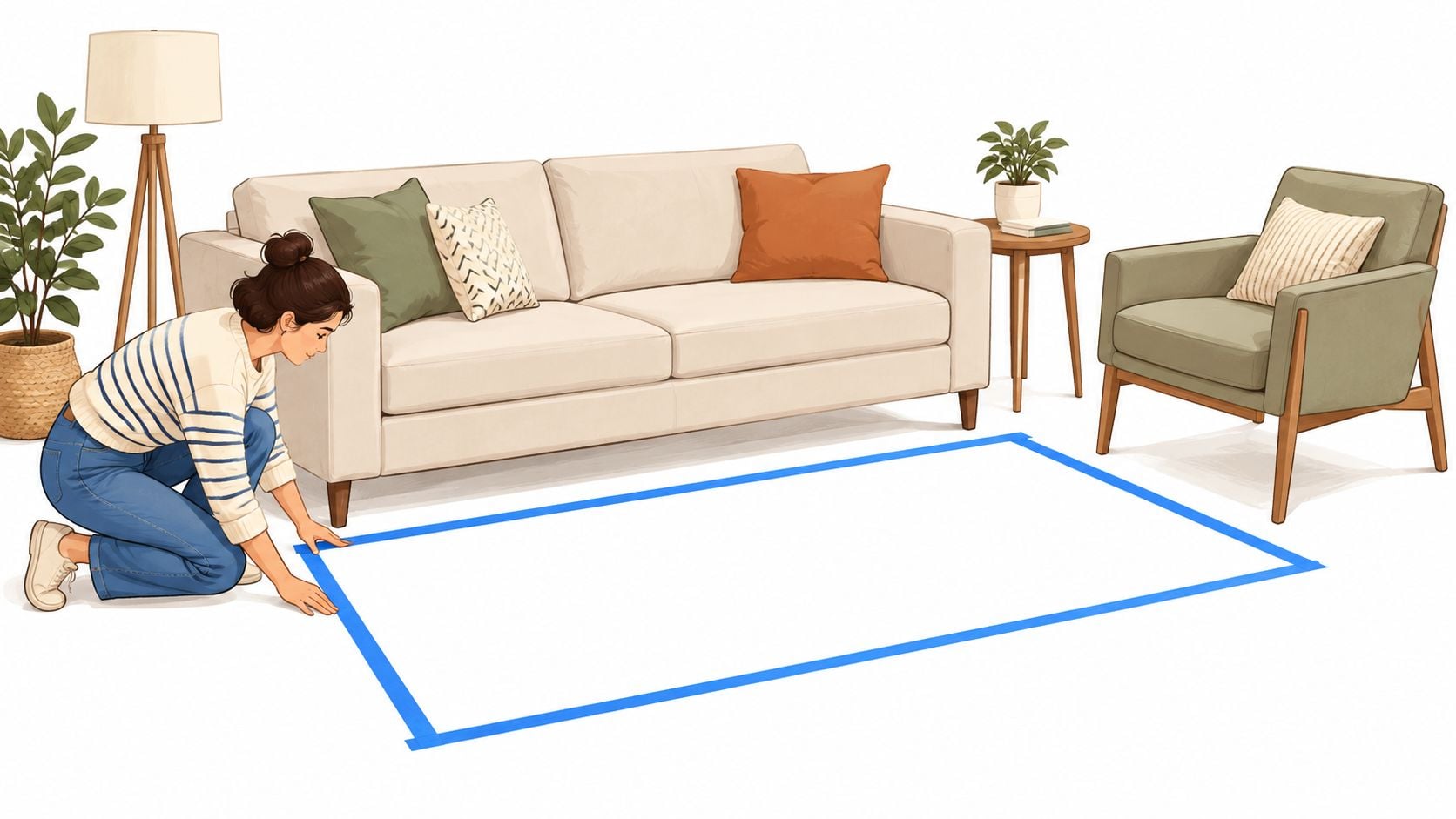
A paper plan can confirm measurements, but painter's tape reveals how the proposed rug will feel at full scale. Before choosing an artisanal, hand-knotted design, mark the perimeter directly on the floor and live with the outline during ordinary movement.
The most common technical mistake is undersizing. A Niagara-region source states that 62% of homeowners undersize their living room rugs, and that this can visually shrink a room by up to 25%. The same guidance recommends 8 × 10 feet as the minimum for most mid-sized living rooms, while also advising an 18-to-24-inch exposed-floor border and painter's-tape prototyping before purchase, as detailed by RSC's rug sizing guidance.

The tape test
- Clear the floor: Move small tables and accessories so the proposed boundary remains visible.
- Mark the corners: Measure the selected length and width, then place tape at each corner.
- Connect the perimeter: Run tape along the full outline, keeping the shape square and aligned with the principal seating direction.
- Replace the furniture: Return the sofa, chairs, and coffee table to their intended positions.
- Walk the room: Test the routes between the sofa, doorway, fireplace, and adjacent spaces.
A homeowner can also use folded newspaper to fill the interior temporarily. That makes the visual mass easier to judge, particularly when comparing an 8 × 10-foot footprint with a larger alternative.
The tape line should pass beneath the front legs of the sofa and chairs where that placement is intended. If the seating appears stranded outside the outline, the rug is too small. Critelli's rug size calculator can support the measurement process, but the physical test remains valuable because it captures circulation and proportion together.
Read the room at different times
Check the prototype in daylight and evening light. Observe it from the entry, from the principal chair, and from the sofa. A rug can appear generous from one viewpoint and timid from another, especially in rooms with a fireplace or a strong axis toward a window.
Curating Artisanal Rugs with White-Glove Care
Dimensions create the framework, but material and construction give the room its lasting character. A hand-knotted rug brings texture, variation, and a sense of permanence that suits a home furnished with heirloom-quality pieces. Its pattern may be traditional, richly expressive, or restrained enough to let an exceptional sofa take the lead.
The Critelli Rug Market treats rugs as art for your floor, with a curated selection intended to establish the foundation of a complete room concept. That perspective matters for homeowners seeking luxury furniture in Niagara, interior design services in St. Catharines, custom furniture across Southern Ontario, or hand-knotted rugs in Ontario. The right textile should relate to the room's architecture, upholstery, lighting, and daily life.
Designer's Insight
Pair a bold Hancock & Moore leather sofa with a neutral hand-knotted wool rug. The leather supplies depth and presence, while the quieter textile balances the room's energy without flattening its character.
Care should be considered before installation, not after a spill or seasonal change. Homeowners seeking practical maintenance information can consult Arelli Cleaning's carpet shampoo guide for general carpet-care context, then discuss the rug's specific fibre and construction with a qualified specialist.
From selection to placement
A rug's arrival should feel as considered as its selection. Critelli's white-glove furniture delivery service supports the transition from showroom to home, with professional handling, assembly, placement, and packaging removal forming part of a smooth installation experience.
Critelli Furniture's family-run story began in 1914, and its King Street Showroom serves homeowners from Greater Niagara while remaining accessible to clients in Hamilton and Toronto. The showroom experience allows the rug's scale, texture, and colour to be considered alongside furnishings from Stickley, Stressless, Magniflex, and other carefully selected collections.
The final choice should feel personal, not prescribed. A rug earns its place when it makes the room easier to inhabit, more coherent to look at, and more enduring in spirit.
Critelli Furniture brings together a Rug Market, complete room concepts, bespoke furniture guidance, and white-glove delivery for Southern Ontario homes. Experience the craftsmanship in person at the King Street Showroom, book your complimentary design consultation today, and visit Critelli Furniture to find your room's foundation.