
Best Rug for Under Dining Table: Timeless Guide

A dining room can look beautifully appointed, yet still feel unsettled. The table may be well proportioned, the chairs carefully chosen, and the lighting warm, but without the right rug beneath it, the arrangement often appears disconnected. Chairs catch at the edge, the table seems to float, and the room loses the sense of welcome that makes shared meals memorable.
The best rug for under a dining table is not chosen for colour alone. It must establish proportion, tolerate movement, suit the household's cleaning habits, and belong to the complete room concept. Treated as art for your floor, a dining rug becomes the foundation for furniture, light, texture, and hospitality.
The Foundation of Refined Dining Spaces
A dining room carries more emotional weight than its furniture plan suggests. It may host an ordinary weekday supper, a long Sunday lunch, or a formal gathering where guests linger long after the plates have been cleared. In each setting, the room needs a quiet structure that makes the table feel intentional rather than just placed in the centre.
That structure often begins underfoot. A well-selected rug creates a visual boundary around the dining setting, gives the table a sense of permanence, and softens the transition between the furniture and the surrounding floor. Pattern can introduce movement beneath a restrained table. A subdued field can give sculptural chairs and statement lighting room to breathe. The rug doesn't merely cover a surface. It establishes the room's character.
A room built around hospitality
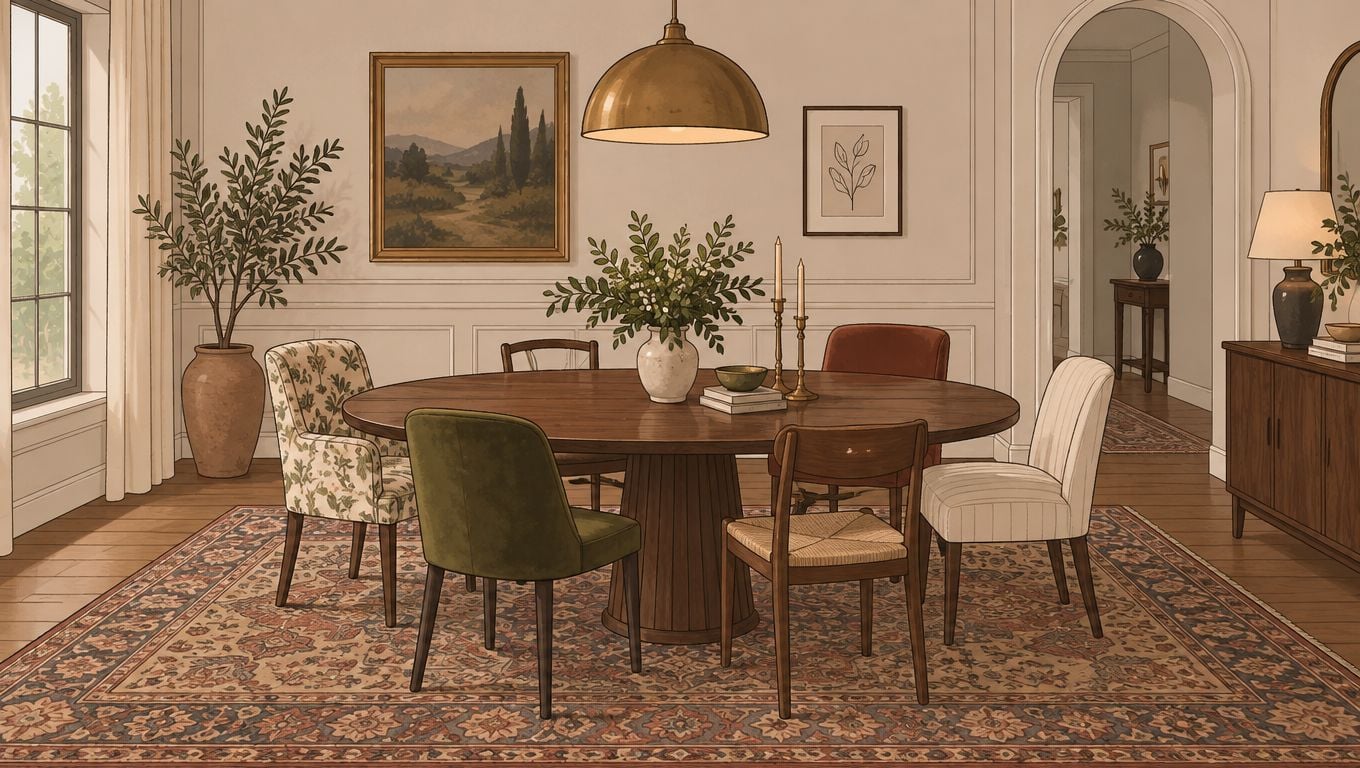
Consider a round oak table surrounded by chairs collected over time. Their finishes don't match exactly, but their proportions feel related. Above them, a restrained pendant light defines the centre of the room. Beneath them, an artisanal rug gathers the different materials into one composition. The rug's pattern gives the eye a place to rest, while its generous dimensions allow each chair to move naturally.
Without that foundation, the chairs might read as separate pieces. With it, the dining room feels curated, almost architectural. This is the distinction between decorating with a rug and designing around one.
The rug should also respond to the architecture. In a narrow dining area, a rectangular design can reinforce the room's length. In a more open plan, a square or generously proportioned rectangular rug can distinguish the dining zone without adding a physical partition. A round rug can work in the right setting, but matching the table shape isn't the only consideration. The seating footprint remains the priority.
Designer's Insight: A rug should frame the dining experience, not compete with the table setting. If the chairs and lighting are visually expressive, a softly patterned rug often creates the more sophisticated result.
Heirloom quality beneath everyday life
Critelli Furniture, family-run in Southern Ontario since its founding in 1914, approaches furnishings as part of a longer tradition of living well. That heritage is especially relevant to rugs. A dining rug is handled constantly, seen from multiple angles, and asked to support both daily routines and formal entertaining. A curated selection should therefore balance heirloom quality, tactile interest, and practical resilience.
The same principle applies to the rest of the room. A rug chosen in isolation may be attractive in a showroom, yet feel too pale beside the table's timber or too busy against upholstered chairs. A design studio considers the complete room concept, including wood tones, leather, fabric, wall colour, lighting, and circulation. Guidance on area rug placement can help homeowners assess how the rug relates to the furniture rather than judging it as a standalone object.
A design-forward dining room doesn't need to look formal. It needs to look resolved. The right rug gives the room that resolution, connecting heritage materials with contemporary life and making the table feel ready for both a simple meal and a generous evening of entertaining.
Determining the Perfect Rug Dimensions
A dining room can have a beautiful table, carefully chosen chairs, and a well-made rug, yet still feel awkward if the proportions are wrong. The first chair pulled back from the table reveals the problem: if its legs slip over the rug edge, the floor covering is too small for the way the room is used.
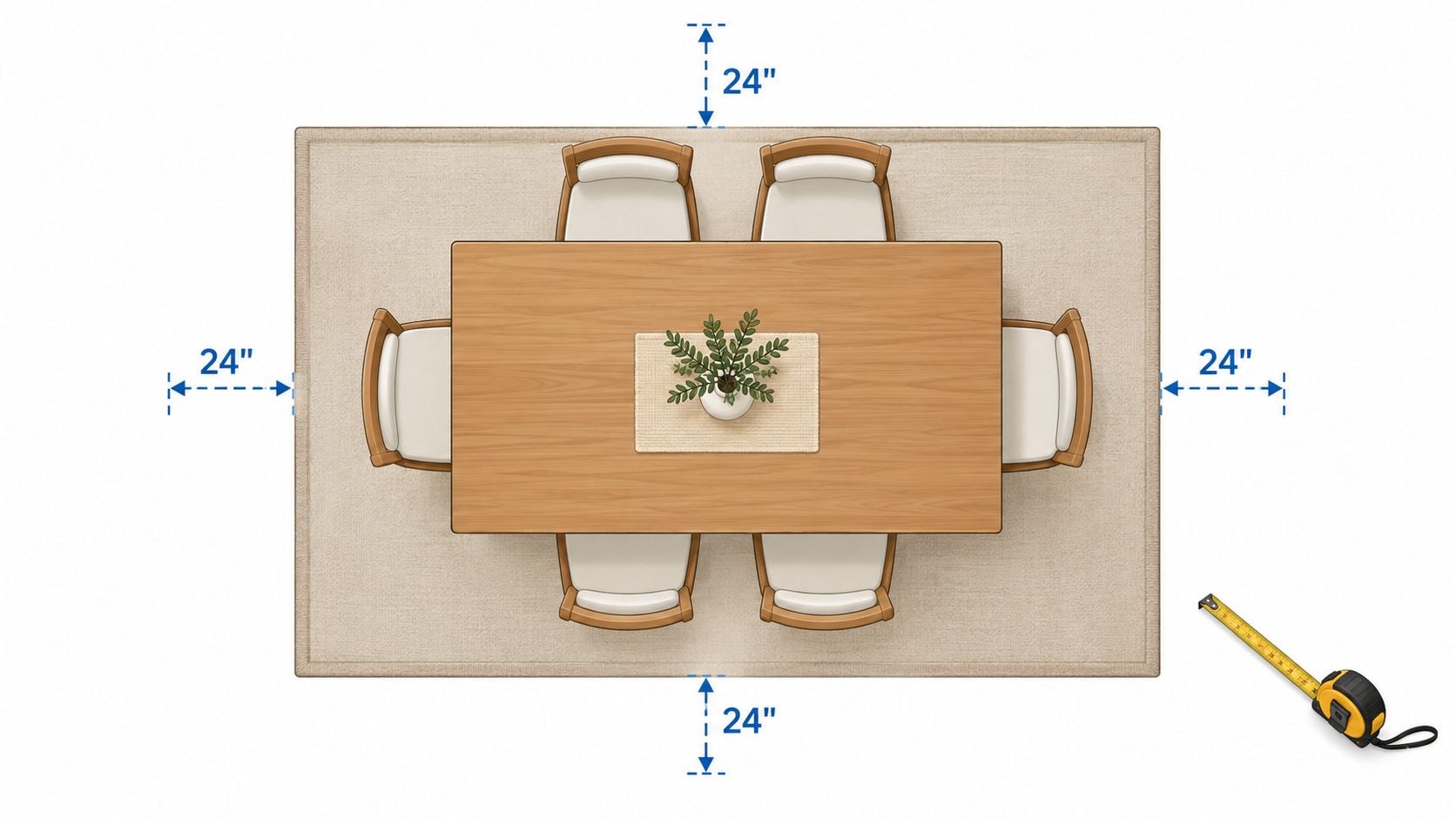
Sizing begins with the table, then extends to the full movement of every chair. Canadian guidance generally recommends allowing 24 to 36 inches beyond the table edges on every side, so chairs remain supported during meals. IKEA Canada's rug guidance expresses the same principle by recommending an addition of 60 to 80 cm to each side. Other Canadian guidance supports a 24 to 30 inch extension, depending on the table, chair depth, and available circulation.
Measure the table and the seating footprint
Begin with the table in its largest everyday configuration. If it has leaves, install them before measuring. A rug that suits the closed table can become too narrow when additional guests sit around the expanded version.
Use this process:
- Measure the tabletop. Record the length and width of a rectangular or oval table. For a round table, record its diameter.
- Add clearance on every side. Add at least 24 inches to each end and side. Where circulation allows, 36 inches creates a more forgiving frame.
- Test the pulled-out chair. Move each chair back as far as it would travel when someone sits down. The back legs should remain on the rug.
- Check doors and walkways. Confirm that the rug will not obstruct a nearby door, sideboard, heating register, or principal route through the room.
- Measure the extended table. If the table changes size for entertaining, use the expanded footprint as the final reference.
A table measuring 60 inches across needs at least a 72-inch rug to provide a compact 6-inch overall increase beyond the tabletop. That calculation does not account for chairs in use, so a larger square or rectangular rug usually functions better in a dining setting. Canadian recommendations favour measuring the complete chair footprint rather than relying on the tabletop alone. This prevents the common error of choosing a rug that looks adequate with the chairs tucked in but fails during an actual meal.
Let proportion guide the final choice
For a smaller dining set, an 8' x 10' rug is often a practical starting point. A larger table seating six to eight people generally benefits from a 9' x 12' rug. Home Depot Canada's area-rug guidance also recommends adding at least 48 inches in total to the table's length and width, preserving approximately 24 inches beyond each side.
A rectangular table for eight will often sit more naturally on a 9' x 12' rug than on a smaller format. The additional area gives chairs room to move and prevents the rug from reading as a narrow island beneath the tabletop. An 8' x 10' rug can suit a compact arrangement, provided its dimensions work with the table length, chair depth, and surrounding circulation.
Round tables offer more flexibility than many homeowners expect. The rug does not need to repeat the circular shape. A square or rectangular rug can provide a steadier seating area, particularly when the room includes a linear sideboard or a strong architectural axis. The table remains the focal point while the rug establishes a broader geometric field beneath it, functioning as art for the floor and helping set the room's proportions.
The textile on the table provides another useful planning reference. Homeowners comparing floor coverage with table coverage may find this guide to what size tablecloth do I need helpful when coordinating the dining setting.
The Critelli rug size calculator can support the initial measurement, but physical testing remains valuable. Mark the proposed dimensions with painter's tape or a paper outline, then walk around the shape and pull out every chair. This reveals circulation, balance, and visual proportion more accurately than a product image. It also shows whether the rug supports the complete room concept, rather than appearing like an isolated purchase.
Practical rule: If a chair catches on the rug edge during normal movement, the rug is undersized, regardless of how well it fits beneath the table when the chairs are pushed in.
Choosing Materials and Pile Heights for Longevity
A dining rug has to withstand the ordinary evidence of a well-used room: crumbs beneath the table, spilled drinks, chair legs shifting at every meal, sunlight across the fibres, and regular cleaning. The most decorative showroom piece may fail this test. In a Southern Ontario dining space, material and construction should support the complete room concept while giving the floor its own visual authority, almost like art for the floor.
Wool remains a dependable choice for family dining areas because it combines resilience with a naturally rich hand. It adds warmth beneath a timber table without making the room feel casual, and a well-made wool rug can develop character over time rather than just looking worn. Its surface also gives colour and pattern a nuanced depth that suits carefully composed interiors.
Sisal and other natural fibres create a more textural, organic expression. Their visible weave works well with timber, linen, rattan, and other natural finishes, but spills demand prompt attention because liquid and food particles can be more difficult to remove from a pronounced surface. Synthetic fibres offer a practical alternative where straightforward maintenance has priority. They generally provide consistent colour, accessible cleaning routines, and broad pattern variety, although they may lack the tactile variation associated with a hand-knotted wool design.
Pile height changes the way chairs behave
Pile is a functional decision, not just a question of softness. A plush or heavily textured rug may feel luxurious underfoot, yet dining chairs can drag, wobble, or catch as they move across it. Crumbs and fine particles also settle more readily into a deep surface, which makes routine cleaning less effective.
For most dining rooms, low-pile, flat-weave, and tightly constructed hand-knotted rugs provide the most useful balance. Chair legs move more easily across them, and there are fewer recesses where food debris can collect. A low profile also helps the rug remain stable beneath the table, particularly when the chairs already have substantial upholstery or expressive frames.
| Construction | Visual character | Dining-room consideration |
|---|---|---|
| Low-pile wool | Warm, refined, and adaptable | A strong choice for frequent use and layered material palettes |
| Flat-weave natural fibre | Organic and relaxed | Easy chair movement, but spills may require prompt attention |
| Synthetic low-pile | Consistent and practical | Useful where simple maintenance and pattern variety matter |
| High-pile or heavily textured | Plush and tactile | More difficult for chair movement and crumb removal |
General rug-care guidance recommends frequent cleaning in high-traffic areas and homes with pets. Regular washing can address some sources of household debris more effectively than vacuuming alone, so maintenance should influence the purchase from the beginning rather than being treated as an afterthought.
A washable rug may suit a household with young children, pets, or frequent entertaining, even when a more delicate design has greater decorative appeal. The right material is the one the household can maintain consistently. A beautiful rug that requires impractical care will not remain beautiful for long.
Texture should serve the room
Sisal can suit a relaxed Southern Ontario home, especially beside oak, walnut, linen, or rattan. Its visible weave gives the dining area an artisanal quality, but it needs careful consideration where food and liquid spills are common. Wool brings a softer, more forgiving visual presence. A tightly woven synthetic design can provide an easier-care option while still supporting pattern and colour within the room.
A hand-knotted rug brings timeless craftsmanship and subtle irregularity that machine-made surfaces often lack. It can become a quiet heirloom when its pattern remains compatible with changing furnishings. Select a construction with a controlled surface rather than excessive relief, so its character does not interfere with chair movement or daily cleaning.
Designer's Insight: A substantial leather dining chair pairs well with a neutral hand-knotted wool rug. The leather supplies depth and authority, while the rug settles the room's energy and keeps attention on material quality.
Floor protection also deserves a considered approach. Pads, protectors, and cleaning products serve different purposes, and the appropriate choice depends on the rug's construction and the floor beneath it. Homeowners can compare rug protector types before selecting a solution. For a more artisanal direction, hand-woven area rugs bring texture that can be assessed alongside pile height, maintenance requirements, and chair movement.
Styling Tips for a Cohesive Dining Room
A rug should make the table and chairs look as though they belong together. That doesn't mean every finish must match. It means the rug needs to establish a useful relationship between the room's largest forms, its architectural lines, and the smaller details on the table.
A dark timber table can take a lighter rug with quiet pattern, particularly where the walls and upholstery are also restrained. Pale upholstery may benefit from a rug with a deeper border or nuanced variation. If the rug carries a lively pattern, solid-coloured chairs often give it the necessary breathing room. If the rug is nearly plain, expressive chairs, table grain, or sculptural lighting can provide the visual interest.
Begin with the complete room concept
The rug should be selected with the furniture arrangement in mind, not added after every other decision has been made. A design studio looks at sightlines from the entry, the relationship between the dining area and adjacent rooms, and the way daylight changes the appearance of colour and texture.
This matters particularly in open-plan homes. A rug can define the dining zone while still relating to a nearby living area. Similar undertones, rather than identical colours, create continuity. A warm ivory in the rug may echo the upholstery, while a muted blue-grey thread can relate to cabinetry or artwork elsewhere in the home.
Critelli's guidance on choosing rug colour offers a useful framework for assessing undertones, contrast, and the mood created by different palettes. The most enduring selections usually include enough variation to disguise everyday marks without becoming visually restless.
Create texture without excess
Layering can add depth, but it needs discipline. A smaller decorative rug placed over a larger natural-fibre foundation may work in a broad room, particularly when the upper rug carries a meaningful pattern or heirloom quality. Under a dining table, however, layered edges must remain flat and secure so chair legs don't catch.
A single, well-sized rug is often the more elegant choice. It gives the table a clear setting and avoids adding unnecessary visual seams. Decorative restraint is especially important when the dining chairs are upholstered in a patterned fabric or the room includes a detailed chandelier.
The following principles keep the arrangement composed:
- Coordinate undertones: Warm timber generally sits comfortably with warm neutrals, muted terracotta, aged blue, and softened olive.
- Balance pattern: A complex rug benefits from quieter upholstery, while a plain rug can support a more expressive chair or drapery.
- Respect negative space: The rug should define the dining area without filling every visible inch of floor.
- Repeat one note: A colour found in the rug can appear subtly in artwork, ceramics, or window treatments.
- Keep the centre calm: A crowded tabletop can compete with a decorative rug, so accessories should be edited rather than accumulated.
Protect the design through regular care
Even a resilient rug needs an organised maintenance routine. Chairs should be lifted rather than dragged when the room is being rearranged. Spills should be addressed promptly according to the fibre and construction. Regular vacuuming helps prevent grit from working deeper into the weave, while professional cleaning can refresh the rug when household care is no longer sufficient.
Rotation can also help distribute wear, especially when the table is positioned in a room with strong daylight or a dominant circulation path. The rug shouldn't be rotated if its pattern or construction makes the change impractical, but many designs benefit from a considered adjustment over time.
A dining rug also needs to relate to the season and the way the room is used. A finely textured wool design can make winter gatherings feel intimate, while a flatter, lighter construction may suit a brighter breakfast area. The goal isn't to follow a passing trend. It's to choose a surface that continues to look considered after the room has hosted real life.
For homeowners extending the same design sensibility outdoors, guidance on how to create the perfect outdoor space can help maintain continuity between interior entertaining areas and exterior rooms.
Experience the Craftsmanship at Critelli
Selecting a dining rug becomes easier when the material, scale, and furniture are considered together. A homeowner may arrive with a table measurement and a preferred colour, yet discover that a different pile, border, or proportion creates a more convincing room. That kind of decision benefits from seeing the rug beside real timber, leather, upholstery, and light.
The King Street Showroom in St. Catharines gives homeowners an opportunity to assess those relationships in person. The selection can be considered as part of a complete room concept, with professional space planning, bespoke customization, and interior design services available for projects ranging from a single dining area to a broader home transformation.
The Rug Market treats rugs as art for your floor, rather than as incidental accessories. A hand-knotted design may establish the palette for the room, while a more practical low-pile construction may be better suited to a household with pets, children, or frequent entertaining. The appropriate choice depends on how the room must perform and the character it should express.
A considered journey from showroom to home
The final stage deserves the same care as the selection itself. Ontario white-glove furniture delivery commonly includes careful handling, indoor placement, assembly, and removal of packaging. Critelli's delivery service describes a process that includes transporting furnishings into the home, unwrapping and inspecting them, assembling them at the designated location, and clearing away debris.
That service is particularly valuable when a dining room includes a substantial table, delicate chairs, or a large rug that needs accurate placement. The transition from showroom to home should preserve the original design intention. Furniture should arrive safely, sit where the plan requires it, and work with the rug's proportions rather than forcing last-minute compromises.
Custom options can also resolve difficult rooms. A border, unusual colour balance, or specific size may make the difference between a rug that merely fits and one that feels made for the architecture. Homeowners exploring custom area rugs with borders can consider how edging changes the visual frame and supports the wider furniture plan.
Critelli serves homeowners across Greater Niagara, Hamilton, and Toronto, making the showroom a practical destination for those seeking luxury furniture in Niagara, interior design services in St. Catharines, custom furniture in Southern Ontario, and hand-knotted rugs in Ontario. The experience is intended for discerning households that value timeless craftsmanship, personal guidance, and a smooth route from selection to installation.
Critelli Furniture offers a curated selection of dining rugs and luxury furnishings, supported by design guidance, bespoke customization, and white-glove delivery across Southern Ontario. Visit Critelli Furniture to assess the right foundation for the dining room, then book a complimentary design consultation or experience the craftsmanship in person at the King Street Showroom.