


Sectional Sofas with Chaise: A Complete Buying Guide


The moment arrives when a living room needs more than another sofa. Perhaps the family gathers in one room for conversation and films, while one person wants to stretch out without claiming a separate chair. Perhaps the space looks finished on paper, yet the wrong chaise would block the entry, crowd the coffee table, or make delivery impossible. Choosing sectional sofas with chaise is therefore less about buying the largest seat available and more about deciding how the room should function for years.
A well-chosen chaise sectional can offer heirloom quality, generous seating, and relaxed comfort in one composed form. A poorly planned one becomes a permanent obstruction. The difference lies in proportion, construction, upholstery, orientation, and the complete room around it.
The most useful starting point is a design-led one. Critelli Furniture was founded by Joseph Critelli and his son Thomas in 1914 at the corner of Ormond Street and Albert Street in Thorold, and remains family-run under fourth-generation owner Joe Critelli and fifth-generation owner Julia Critelli, as documented by the Greater Niagara Chamber of Commerce history of the family business. That heritage supports a practical philosophy: furniture should be selected for the way people live, not for a showroom photograph alone.
Readers comparing seating arrangements may also benefit from this guide for South Jersey homeowners when considering how media furniture, viewing angles, and circulation work together. For a focused look at sectional planning, the sectionals buying guide belongs on the shortlist before any order is placed.
Why a Chaise Sectional Belongs in Your Living Room
A standard sofa asks people to sit upright or share a separate ottoman. A chaise sectional creates a more generous social space, with one continuous arrangement for conversation and an extended platform for reading, resting, or watching television. That difference changes the room's rhythm. People can gather together without giving up the option of individual comfort.
The strongest designs balance those two uses. The upright portion should support conversation and maintain a clear view across the room. The chaise should feel inviting without projecting so far that it cuts through the main route. In a compact apartment, that may mean a restrained chaise depth and a slim arm. In a broad open-plan room, a more substantial L-shape can define the living zone without requiring a wall.
A lifestyle investment rather than a default purchase
A sectional deserves the same scrutiny as a built-in architectural element because it establishes the room's primary orientation. It determines where the coffee table sits, how people enter the seating area, where lamps can stand, and how a rug must be positioned. That permanence makes timeless craftsmanship more valuable than a passing silhouette.
A Southern Ontario homeowner might use the chaise every evening, while guests gather on the upright seats during weekend visits. Another household may need a modular configuration that can adapt after a move. Both situations favour careful planning over impulse. The right choice feels effortless because the proportions, materials, and traffic pattern agree.
Designer's Insight: The most successful chaise sectional is rarely the room's only statement. It provides the architecture of comfort, while a rug, lighting, art, and occasional seating give the room character above and around it.
Critelli's perspective is particularly suited to buyers seeking luxury furniture in Niagara without separating furniture selection from the wider interior. A design-forward room considers the sectional, rug, tables, lighting, and wall colour as a single composition. That is how a practical sofa becomes part of an artisanal, enduring interior rather than a large object placed against a wall.
Understanding Chaise Configurations and Orientation
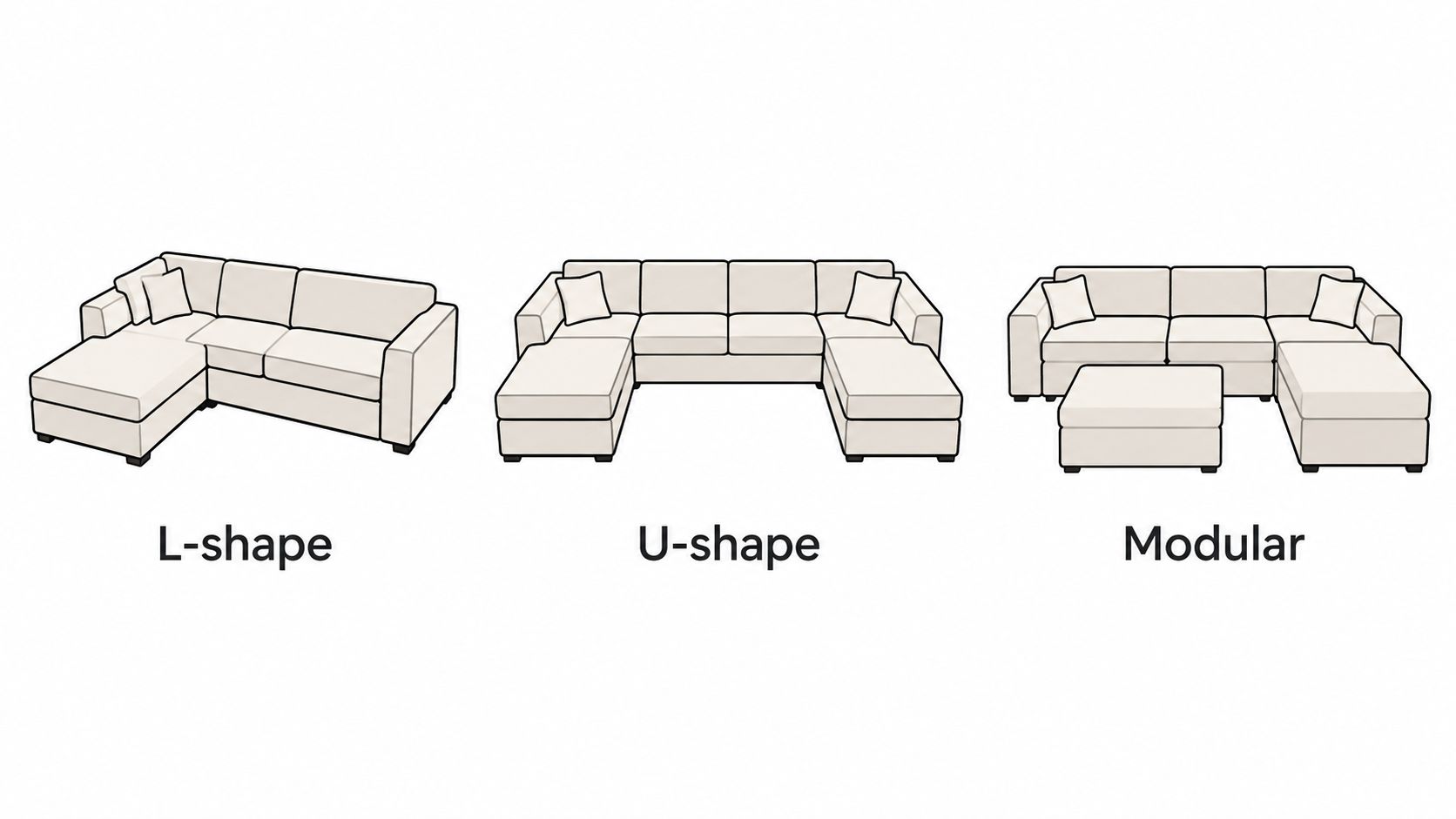
The configuration determines how the sectional occupies the room. An L-shaped arrangement combines an upright sofa with a chaise, making it the most versatile choice for many living areas. A U-shaped arrangement adds seating on both sides and creates a more enclosed conversational setting. A modular arrangement uses separate pieces that can be configured according to the room and, where the design permits, rearranged later.
Choosing the chaise side correctly
Left-facing and right-facing descriptions cause unnecessary confusion because retailers may label the pieces from a consistent showroom viewpoint. The safest method is simple: stand in front of the proposed sectional and face the seats. If the chaise extends to the left, it is left-facing. If it extends to the right, it is right-facing.
The room, not the seated viewer, should decide the orientation. Start at the entry used most often. Mark the route to adjoining rooms, doors that swing open, drawers that need access, and the space around the coffee table. If the main path runs along the sofa's right side, test the chaise on the left first. If the route runs along the left, test the chaise on the right.
Matching the shape to the room
An L-shape suits a room that needs an open end for circulation or a visual connection to an adjacent dining area. A U-shape can work in a dedicated family room, but it demands more care because the added return can restrict tables, walking paths, and access to the centre of the seating group. A useful reference for readers considering that deeper arrangement is this guide to a U-shaped sectional couch.
A reversible chaise reduces risk when the room may change, but reversibility must be confirmed in the actual specification. A modular sectional offers still more flexibility, though separate pieces require compatible connectors, arms, and dimensions. The phrase “modular” describes construction, not a guarantee that every possible layout will work.
Measuring Your Space and Delivery Path
A sectional can fit the floor plan and still fail before it reaches the room. The delivery route deserves equal status with the final footprint. In Southern Ontario, homeowners should measure the narrowest hallway, doorway, stair landing, elevator, and final entry point before choosing fabric, leather, or configuration.
The measurement sequence
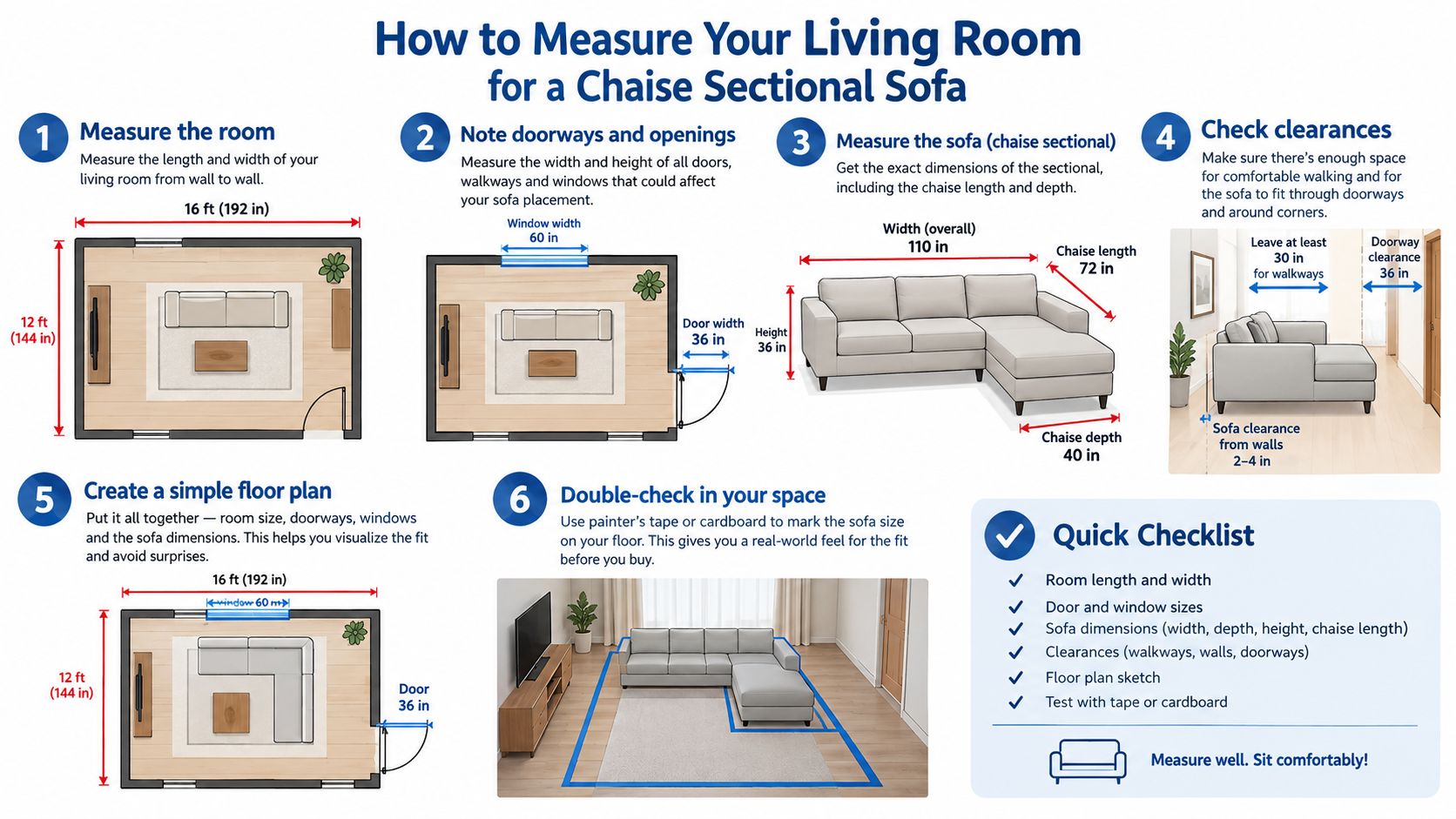
Begin with the room itself, including the full sofa width, the maximum chaise depth, arm projection, and any recliner movement. Then mark the primary path from the entrance to the seating area and onward to adjoining rooms. A chaise is a fixed obstruction along that route, not an abstract extension that can be ignored once the sofa width has been recorded.
Use these practical thresholds from Canadian housing accessibility guidance:
- Accessible route: Preserve a continuous path at least 915 mm wide, with hallways preferably 1,220 mm wide. The CMHC accessibility guidance provides the relevant planning framework.
- Interior doorway: Allow at least 810 mm of clear passage, with 860 mm preferable, especially when a large packaged module must be turned through the opening.
- Living-area paths: Current Canadian accessibility guidance identifies 1,200 mm interior paths and clear floor space of 820 by 1,390 mm for controls in living areas. These figures help establish a generous, usable room rather than a merely passable one.
- Furniture clearance: Keep approximately 18 inches between seating and a coffee table, and reserve at least 36 inches for a walkway, following the independent room-planning reference supplied for this topic.
The taped-floor test
Mark the sectional's complete outline with painter's tape, including the chaise projection. Add the coffee table, door swings, vents, outlets, and the route to nearby rooms. Walk the path while another person sits in the proposed chaise position. If the seated person's feet, the table, or the chaise forces a detour, the configuration is too large or poorly oriented.
Practical rule: Measure the packaged dimensions and every turn, not only the finished furniture dimensions. If a package exceeds the narrowest opening, specify a modular design or confirm that the chaise detaches.
The safest choice for a rental, condominium, or home with tight access may be a modular sectional with a reversible chaise. Delivery crews need room to rotate each module without scraping walls or trim. The furniture measuring guide can help organise the checklist before a showroom appointment.
Choosing Between Fabric and Leather Upholstery
Upholstery should reflect how the chaise will be used, not just how it looks under showroom lighting. The chaise receives prolonged, repeated contact, so its material must tolerate the household's habits. Children, pets, frequent entertaining, and quiet evening lounging each point toward a different balance of softness, cleanability, and visual formality.
A tightly woven performance fabric offers tactile warmth and broad colour flexibility. It can soften a room with pale walls, complement a patterned rug, and provide a more relaxed feel than a highly structured leather. Buyers should ask for the cleaning code, fabric composition, and abrasion information rather than relying on a broad label such as “family friendly”.
Leather for structure and patina
Top-grain leather gives a chaise sectional a refined presence and often suits rooms with natural wood, architectural lighting, or a hand-knotted rug. It can be wiped more readily than many textiles, but it still needs appropriate care and may show variation, creasing, and changes from use. Those changes are part of the material's character, provided the household appreciates a living surface rather than a permanently uniform one.
Fabric tends to offer more visual softness, while leather often provides stronger definition. Neither material automatically guarantees durability. The frame, suspension, cushion construction, maintenance routine, and intensity of use all matter.
Colour belongs to the room
A neutral sectional is not automatically the safest decision. A warm stone fabric can disappear beautifully into a pale room, while a deep leather can anchor a large space that needs visual weight. Colour should be judged beside the intended rug, wall tones, window light, and nearby timber finishes.
Custom upholstery requires documentation, particularly for imported or older-stock pieces. Buyers should ask for the manufacturer's California compliance statement when relevant, along with the barrier type, fabric composition, and care instructions. California AB 2998 prohibits the sale or distribution of upholstered furniture containing more than 1,000 ppm of specified flame-retardant chemicals, effective January 1, 2020, as discussed in the technical review of upholstered-furniture fire barriers. Compliance does not mean a sectional is chemical-free, and “natural” fabric does not explain the barrier construction.
For broader upholstery decisions, the sofa fabric guide offers a useful companion to the showroom conversation. A homeowner considering broader decorative changes may also find this discussion of vinyl wraps for furniture useful when coordinating surrounding pieces, though a chaise sectional itself should be specified for its intended long-term use.
Frame, Cushion, and Suspension Quality
Day-one softness says little about year-eight support. A chaise sectional should be assessed as a load-distribution and maintenance system, because the extended seat concentrates repeated, prolonged loading in one zone. The platform beneath that zone must remain stable when someone sits, reclines, or shifts position.
What to inspect beneath the upholstery
A rigid hardwood frame can provide strong structural support, while engineered components may also perform well when properly designed and joined. The important question is not the marketing phrase alone. Buyers should ask how the frame is joined, how the chaise platform is supported, and whether the manufacturer can service or replace cushions.
High-resilience foam generally provides a consistent, orderly sit. Down-wrapped cushions offer a softer, more enveloping feel but require more regular plumping and may develop a relaxed appearance. Either can be appropriate when matched to the household. The wrong choice is a cushion that feels impressive for a few minutes but cannot maintain the desired support under repeated use.
The ergonomic sofa guide can help buyers think beyond softness and assess posture, seat depth, and support as part of the decision.
A showroom checklist
A proper test should take more than a brief sit. The following checks reveal issues that photographs conceal:
- Test the chaise platform: Sit at the centre and near the transition point. Support should feel even, without a noticeable dip.
- Check the frame: Shift weight gently and listen for movement. Excessive flex or creaking deserves a direct question.
- Study the seams: Uneven tension, rippling, or strained joins may indicate poor alignment or a difficult transition between modules.
- Compare cushions: Sit in the sofa and chaise for several minutes. Both zones should feel related, even if the chaise is designed for deeper lounging.
- Ask about service: Confirm whether covers, cushions, connectors, or suspension components can be replaced or repaired.
For Canadian buyers, fire-safety documentation deserves specific attention because Canada historically lacked standard test methods for evaluating the fire performance of upholstered furniture, according to a National Research Council Canada publication. A retailer should provide the manufacturer's test method, cleaning code, cushion-core specification, fabric composition, and relevant compliance information.
Styling the Sectional as Part of a Complete Room
A chaise sectional should anchor a room, not consume it. The best interiors treat the sofa as one element in a complete room concept, with the rug establishing the visual territory beneath it and lighting, tables, art, and accent seating distributing attention around it.
Begin with the rug. A rug that is too small makes the sectional appear stranded, while a well-proportioned rug connects the seating and keeps the room visually settled. Critelli's Rug Market treats rugs as “Art for Your Floor”, a foundation for colour, texture, and character rather than a final accessory added after every major decision.
A considered styling sequence
- Place the rug first. Align the rug with the seating area and ensure the sofa's front feet can relate to it. A hand-knotted wool rug can temper the visual weight of a leather sectional and introduce artisanal texture without competing with the chaise.
- Set the coffee table second. Preserve the approximately 18-inch seating clearance and keep the table from pinching the main route. Rounded or softened edges can improve movement around a projecting chaise.
- Add light at different heights. A floor lamp near the upright sofa supports reading, while a lower table lamp or concealed source adds warmth without making the chaise feel visually heavy.
- Finish with supporting pieces. A swivel chair, compact side table, or custom-fitted ottoman can give guests a more direct conversational seat and prevent every person from facing the same direction.
A room feels curated when the sectional has companions, not when it is surrounded by matching pieces.
The showroom network operates from 126 King Street and 169 St. Paul Street in St. Catharines, with design-consultation services extending across the Greater Niagara, Hamilton, and Toronto markets, according to the Critelli design consultation information. That setting supports a more useful conversation about upholstery, rugs, finishes, and proportions than a sectional-only purchase.
Chaise sectional configurations at a glance
| Configuration | Room Shape | Best For | Watch For |
|---|---|---|---|
| L-shaped | Rectangular or open-plan rooms | A defined seating zone with an open end | Chaise projection across the main route |
| U-shaped | Dedicated family rooms | Larger gatherings and enclosed conversation | Restricted table access and circulation |
| Modular | Rooms that may change | Adaptability, staged delivery, and future moves | Connector compatibility and package dimensions |
| Reversible chaise | Flexible apartments and multipurpose rooms | Changing orientation without replacing the sofa | Confirming the mechanism and supported layouts |
Bringing Your Selection Home with Confidence
A chaise sectional is a substantial design investment, and the final experience depends on more than the order itself. White-glove delivery should include inspection, careful assembly, precise placement, and removal of packaging. That service protects walls, floors, upholstery, and the composition the design consultation created.
A delivery-path audit remains essential even when professional crews are involved. A useful stress-free sofa transport guide reinforces the practical principle that access, turns, protection, and handling should be planned before the furniture arrives. In a Southern Ontario home, the team should know about stair landings, elevators, narrow entries, delicate trim, floor transitions, and the exact wall where the sectional will sit.
Confidence comes from seeing the whole room
A consultation can reveal conflicts that a product page cannot. The designer may notice that the chaise blocks a door swing, that the rug needs a larger scale, that a leather finish competes with a nearby wood tone, or that a modular arrangement would serve a future move better. Here bespoke planning earns its value.
The family's regional timeline also matters. The business began in Thorold in 1914, opened a Niagara Falls location in 1936, and established a downtown St. Catharines store in 1939, later developing two family-run downtown stores and a distinct rug market, as recorded in the regional profile of Julia Critelli. That continuity gives Southern Ontario homeowners a tangible place to compare construction, fabrics, leather, rugs, and complete-room proportions.
Flexible financing can help a buyer preserve the intended design rather than compromise the frame, upholstery, or rug solely to reduce the immediate outlay. The better decision remains the one that respects the room's circulation and the household's daily habits.
Experience the craftsmanship in person at the King Street Showroom, where a curated selection of sectional sofas, rugs, and complementary furnishings can be considered as one complete room concept. Book a complimentary design consultation today, and visit Critelli Furniture to plan a chaise sectional with the right orientation, delivery path, upholstery, and foundation.