


Swivel Recliner Leather: How to Choose the Right One


Does a genuine leather label reveal whether a swivel recliner will suit a busy household, a sunny reading corner or a carefully planned living room? Not on its own. The finish, movement and room conditions often matter more than the label shoppers notice first.
A search for swivel recliner leather options should lead beyond colour swatches. The right decision connects everyday comfort with material care, rug placement and a delivery route that allows the chair to reach its intended corner without difficulty.
Swivel Recliner Sizes That Fit Your Room
Swivel recliner footprints and working rules
| Footprint | How to measure | Working rule |
|---|---|---|
| Width across the arms | Outer edge to outer edge with the chair upright | Confirm against the manufacturer's specification sheet |
| Depth when upright | Back of chair to front of footrest | Confirm against the manufacturer's specification sheet |
| Depth when fully reclined | Back of chair to front of footrest, fully reclined | Mark with painter's tape and check the room holds it |
| Swivel clearance | Full rotation of the chair on its base | In a hypothetical layout, test a clear circle at least the reclined depth plus 12 in, then verify the actual sweep |
| Walking space beside chair | Side clearance to nearest wall or furniture | In that hypothetical layout, start with 30 in (76 cm), then check comfortable passage and applicable access requirements |
These example clearances aren't universal product specifications or accessibility standards. A chair's pivot position, back shape and footrest geometry determine its actual turning envelope. The manufacturer's drawings take priority over a convenient planning allowance.
A recliner has an upright footprint, an extended footprint and a moving footprint. A chair that fits neatly beside a sofa while closed may strike a side table when turned or block a passage when reclined. Width alone won't answer the space question.
Map the movement before choosing the cover
A tape measure, painter's tape and the actual specification sheet make a useful planning kit. Mark the fully reclined outline on the floor, including the backrest's rearward movement. Then mark the turning arc around the base's pivot rather than assuming the chair rotates around its geometric centre.
Where an existing swivel chair is available, rotate it slowly and observe what its back and arms approach. That exercise demonstrates the problem, but it doesn't replace the proposed recliner's measurements. Lamps, curtain panels and low tables need consideration as well as walls.
Practical rule: A recliner fits only when its movement and the household's movement can happen without competing for the same space.
Include the route into the room
Measure the narrowest doorway, hallway turn, staircase and elevator opening on the delivery route. Note handrails, ceiling restrictions and doors that cannot open fully. Deep upholstered furniture can be awkward to manoeuvre, regardless of whether its cover is leather or fabric.
Confirm whether the manufacturer permits removal of the back or base for delivery. Those details should come from the product documentation, not an assumption based on another chair.
Before visiting the showroom, record the space's available width, fully reclined depth and clear turning circle. Keep delivery-route measurements beside them so an appealing silhouette doesn't distract from practical fit.
Leather Grades Compared for Daily Use
Leather grades for daily use
| Grade | What it is | Best use | Main drawback |
|---|---|---|---|
| Full-grain | Natural hide surface, not sanded | Recliner used every evening | Shows natural markings and develops patina |
| Top-grain | Typically corrected or sanded and finished for even colour | Daily-use recliner | Protective finishes can reduce breathability |
| Split | Lower layer of the hide, often sold as a softer, lower-cost option | Guest or occasional chair | Can wear faster and commonly carries a heavier coating |
| Bonded | Shredded leather fibre held with polyurethane | Lowest-price, light use | Can peel and flake under heavy use |
| Leather-look or PU | Synthetic cover in a uniform colour | Easy wipe-down finish | Vulnerable to cracking in sun and heat |
The table is a buying guide, not a guaranteed lifespan ranking. Hide quality, coating, seams and care can change the performance of any category. A premium-sounding name cannot compensate for an unsuitable finish.
Full-grain retains the natural surface, including variation that some buyers prize and others find distracting. It offers strong potential for lasting use, but calling every full-grain cover the most durable option oversimplifies the decision. An open finish may absorb marks that a protected leather resists.
Separate the hide from its finish
Top-grain is often presented as corrected leather with a more consistent appearance, although terminology differs between manufacturers. The useful distinction is the exact surface treatment: how much correction occurred, what coating was applied and what maintenance the maker permits.
Split leather can make sense for occasional seating, particularly when price and appearance matter more than intensive daily use. Bonded and synthetic covers should be evaluated as different constructions, not as equivalent versions of full-grain leather.
The guide to leather types for furniture offers useful vocabulary for comparing swatches and product descriptions.
Read disclosure without assuming a quality guarantee
According to the Competition Bureau's upholstered-furniture labelling guidance, leather isn't a textile fibre, so a 100% leather cover is exempt from textile fibre-content disclosure, while textile portions of mixed construction must be identified. An absent fibre label therefore doesn't establish leather quality.
Material descriptions should distinguish the seat, arms, outside back and side panels. Manufacturer identification, written panel specifications and care instructions belong with the sales documents for future warranty or service questions.
Buying caution: A lifetime durability claim needs supporting abrasion information, finish details and warranty terms. Canadian labelling guidance doesn't supply a universal leather-grade durability percentage.
For an every-evening recliner, full-grain or top-grain with a documented finish is a sensible starting point. Split leather is better approached as an occasional-use choice rather than an automatic substitute for a daily-use cover.
Matching a Leather Finish to Your Household
Genuine leather isn't automatically the easiest-care or healthiest choice. A heavily protected surface can resist staining but feel less breathable against bare skin. Aniline leather offers softness and visible character, while showing water, oil and dye transfer more readily.
Semi-aniline sits between those approaches, offering some protection while retaining natural variation. Its performance still depends on the actual finishing system, not solely the category name.
Health Canada's indoor-air-quality guidance identifies volatile organic compounds, including emissions associated with glues, varnishes, coatings and cleaning products, as indoor-air concerns and recommends low-emission choices and appropriate ventilation. The relevant questions extend beyond the hide to adhesives, cushions, frame finishes and care products.
Matching the finish to household conditions
| Household condition | Suitable finish | Care rhythm | Watch for |
|---|---|---|---|
| Pets or young children | Heavily coated or protected top-grain | Wipe spills immediately; inspect monthly and clean only as directed | Dye transfer and claw marks on unprotected hide |
| Direct sun or radiant heat | Protected top-grain; avoid unfinished aniline | Adjust placement; condition sparingly only if permitted | Fading and drying; cracking on leather-look covers |
| Basement or humidity swings | Finished top-grain with documented low-emission characteristics | Ventilate and manage moisture; inspect seams | Dampness, stiffness and emissions from adhesives |
| Frequent evening use | Full-grain or top-grain with a written finish specification | Dust weekly; use approved leather cleaner when needed | Changing patina and wear at arms and headrest |
Match the sample to real conditions
Request finishing specifications, care-product safety data sheets and any available emissions certification. Confirm whether assembly involves adhesives rather than assuming that an assembled chair has no emissions.
Colour also needs a home-based check. The guidance on avoiding colour mismatch when ordering online is useful when comparing a sample with flooring, upholstery and evening lighting.
With showroom permission and the manufacturer's approval, a barely damp white cloth can be rubbed gently on an inconspicuous sample area. Visible colour transfer is a warning, especially around children or pets, but a clean cloth doesn't prove stain resistance.
Dust weekly with a dry, soft cloth. Blot spills promptly, use a barely damp cloth only where permitted, and reserve leather-specific cleaners for products approved for that finish. Routine conditioning isn't suitable for every coated surface.
Choosing the Mechanism and Testing It in Store
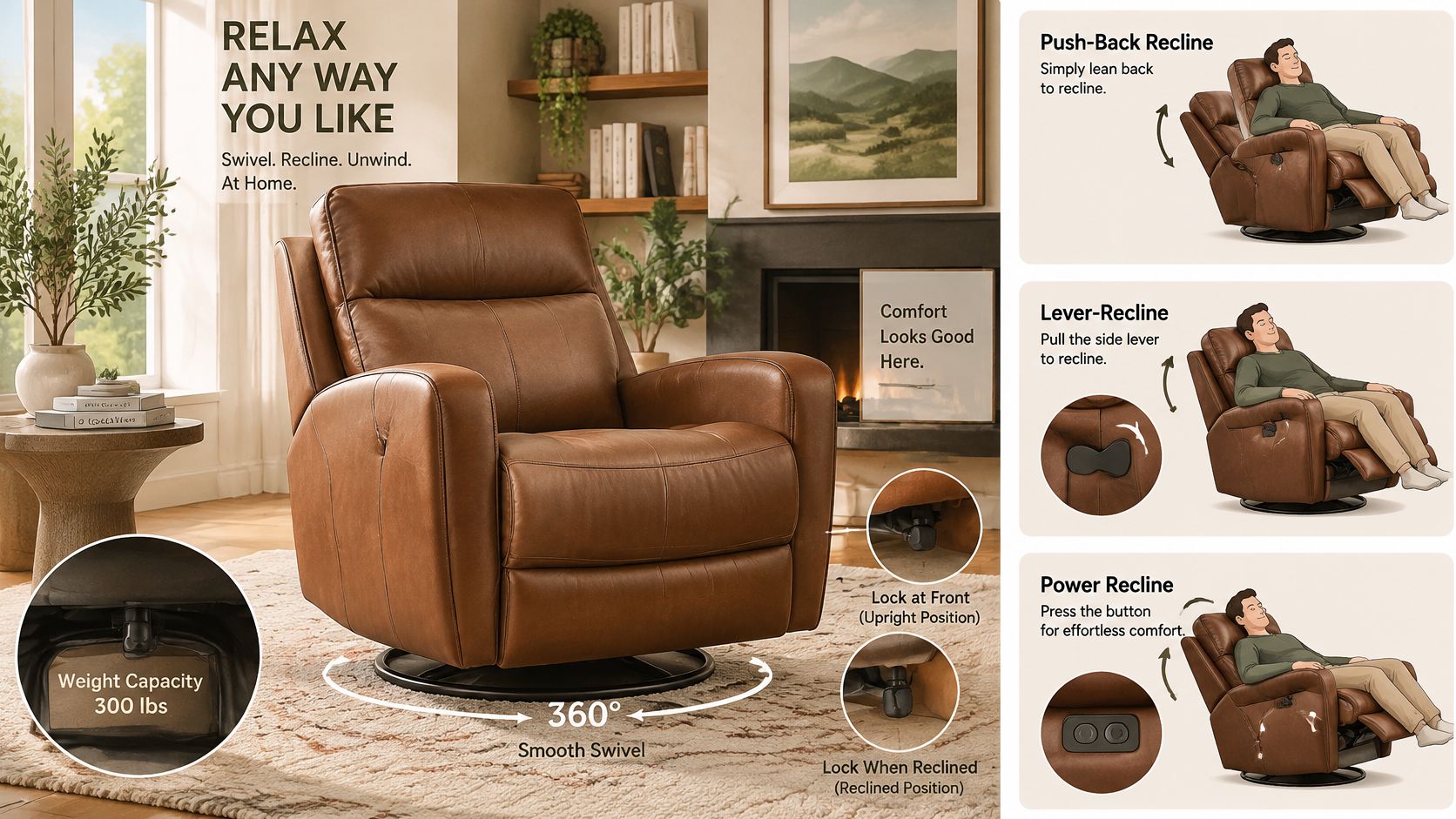
The mechanism determines how the recliner responds to its user. Manual operation favours mechanical simplicity, while power offers controlled adjustment without the same pushing or pulling effort. Power lift adds assistance when rising, but suitability depends on the individual rather than age alone.
Recliner mechanisms compared
| Mechanism | How it operates | What it needs | Suits |
|---|---|---|---|
| Manual | Lever, pull handle or body pressure | No outlet; generally simpler servicing | Straightforward daily use |
| Power | Button or remote controls powered reclining | Nearby outlet or approved battery arrangement and a safe cord route | Easy, controlled adjustment |
| Power lift | Raises and tilts the seat to assist standing | Model-specific clearance and handling for a heavier frame | Users who benefit from standing assistance, including some with knee or hip strain |
For a closer comparison of operation and placement, the power recliner versus manual guide helps distinguish convenience from genuine need.
Examine the base as carefully as the controls
A suitable base should turn smoothly under the intended user's weight and carry a stated load rating. Locking arrangements differ: some chairs lock, some return to centre, and others restrict rotation while reclining. A missing lock isn't automatically a defect, but its behaviour must suit the room.
Confirm whether the swivel mechanism is integrated into the frame or supplied as a separate assembly. A separate base may simplify replacement, provided compatible parts remain available. Power cords must never twist around the base during rotation.
Follow a deliberate showroom routine
- Bring the measurements. Compare the room outline, turning envelope and delivery route with the exact model's specification sheet.
- Allow time for body fit. Spend about ten minutes upright, then a similar period partly reclined and fully reclined. Check that feet rest flat when upright, that the footrest supports them when extended, and that neck support remains comfortable.
- Check permitted rotation. Turn through the manufacturer-approved range. Where locks are fitted, test them facing forward and in a permitted reclined position rather than forcing a movement the chair doesn't allow.
- Inspect the upholstery. Run a hand over each visible panel and request its written material specification. Pay attention to seams and transitions between leather and matching materials.
- Resolve shared-area requirements before purchase. For a condominium lobby, corridor or other common area, obtain upholstery and filling specifications and applicable fire-test documentation. The Canadian Condominium Institute's fire-safety guidance identifies CAN/ULC-S109 as relevant to certain textiles and decorative materials, not as a blanket approval for every chair. The condominium's fire-safety authority or designer should confirm suitability and unobstructed egress.
- Keep identification records. Photograph the model and serial label and retain sales documents with the warranty.
A leather exterior alone doesn't establish the fire performance of the foam, batting or completed installation.
Pairing the Recliner With a Rug and Room Plan
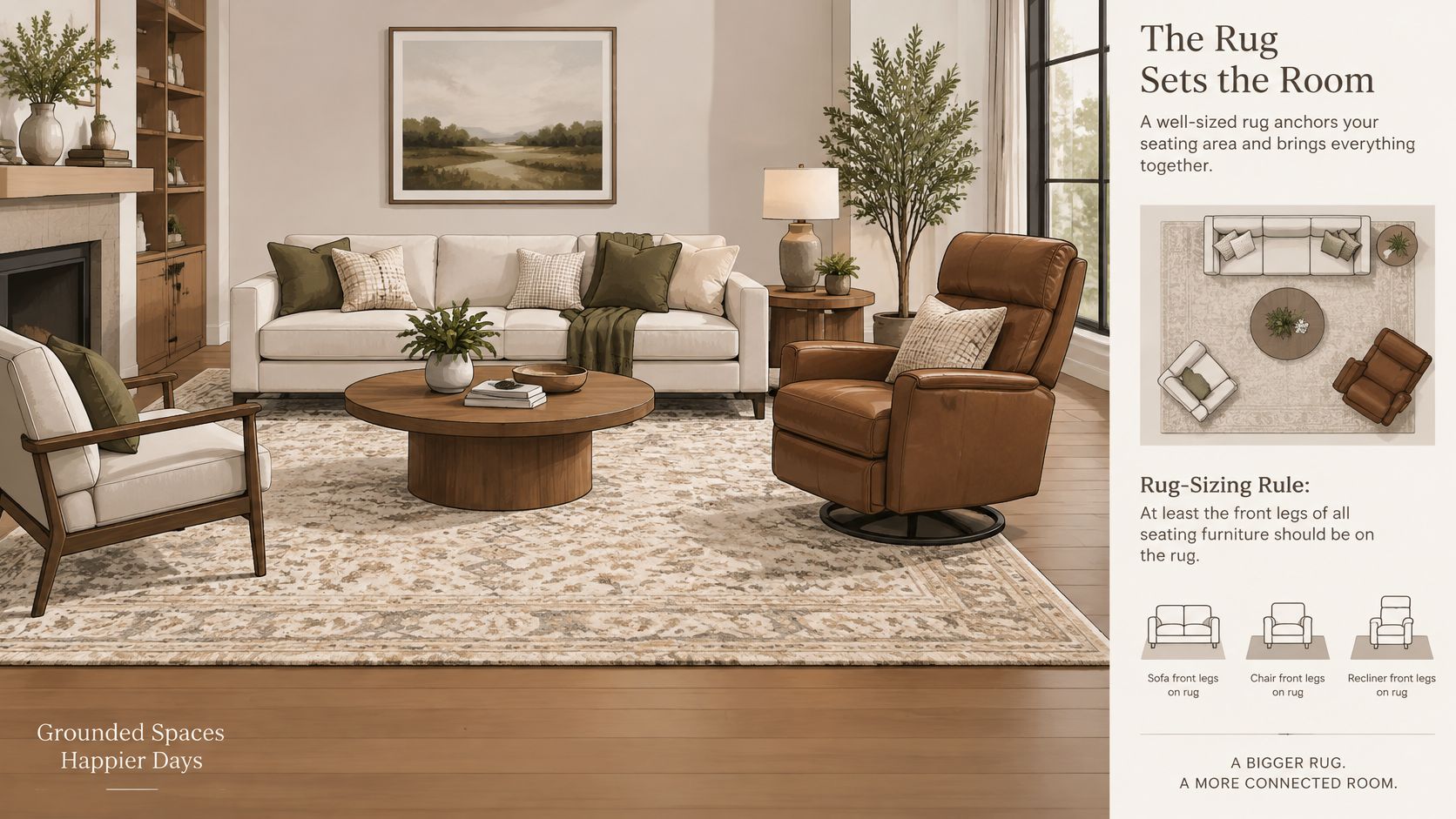
Mark the recliner's footprint on the floor before choosing anything around it. A chair that turns occupies a larger effective footprint than its dimensions suggest, and the rug, side table and reading light all need to respect that circle. When those elements are planned together, the recliner reads as part of the seating group rather than a chair parked at its edge.
A design-forward room doesn't require every material to make an equally strong statement. Bold leather can sit comfortably against a neutral textured rug, while an artisanal pattern can give quieter upholstery more character. Repeating a warm or cool undertone usually creates a stronger connection than trying to match every colour exactly.
Size the foundation around movement
A rug works like the room's floor plan drawn in textile: it tells each piece where it belongs. Size it to the seating group rather than to the chair alone, so the front legs of the sofa and the full base of the recliner share the same surface. That shared surface is what makes a corner arrangement feel intentional.
For a swivel recliner, the base should rest on a consistent surface. A rug edge crossing beneath part of the base creates an awkward transition, so check the taped turning arc against the proposed rug boundary before committing. For legged designs, front-leg placement needs the same attention throughout the movement.
The living-room rug placement guide helps connect the recliner's position with the larger seating arrangement. Side tables should stay reachable without occupying the footrest path.
Designer's Insight: Place the rug so the swivel base sits fully on it through the complete turning arc. A quiet tone gives bold leather room to stand out, while texture adds interest without a second dominant colour.
Let the rug guide the palette
For homeowners exploring hand-knotted rugs in Ontario, viewing texture and colour together is more useful than choosing each item independently. A warm leather may pair with undyed-looking wool, while cooler upholstery can work with muted stone tones.
Treat the Rug Market as Art for your Floor, the place to choose a foundation with enough character to guide later decisions. Bring a photograph of the complete room rather than a tightly cropped image of the chair. Proportion, lighting and material relationships are easier to judge when the whole setting is visible, and that wider view keeps the recliner, rug and delivery position working from the same plan.
White-Glove Delivery and Financing
A well-chosen recliner still needs a clear path from showroom to home. The doorway, hallway and stair measurements from the sizing section answer that question before delivery day, so the remaining work happens at the door and inside the room. A powered chair also needs its approved electrical connection ready, with no cable crossing a walking route or moving linkage.
Critelli Furniture offers White Glove Delivery, including inspection, assembly where required, placement and packaging removal. The white-glove delivery service overview helps homeowners understand that transition. Because the delivery team carries and positions the chair themselves, a tight turn flagged in advance lets them plan the carry, or reconsider the model, rather than improvise on the doorstep. The intended chair position should already be marked on the room plan so placement doesn't become a rushed decision at the doorway.
Make the handover deliberate
- Confirm the item. Compare the delivered chair's identification with the saved model and serial-label photograph and the order documents.
- Check operation and condition. With the delivery team present, operate the permitted recline and swivel functions, check any fitted lock, and visually inspect the upholstery for transport marks.
- Record concerns immediately. Note visible damage or missing components on the delivery paperwork before the team leaves, and retain photographs.
Keep the delivery area clear of fragile objects and loose floor coverings. An existing rug should be clean and dry before furniture is placed on it.
For households arranging specialist rug care alongside a room refresh, Rubber Ducky Rug Cleaning Birmingham's discussion of professional cleaning for hand-knotted Oriental rugs shows the standard of handling a hand-knotted piece receives before new furniture is set on it.
Compare the complete financial commitment
Critelli Furniture offers financing to help align the purchase with a household budget. Written terms should identify the total payable amount, payment schedule, borrowing costs where applicable and any conditions attached to the offer.
Warranty documents deserve separate attention. Upholstery, mechanisms and electrical components may carry different coverage, so ask for the warranty terms separately from the payment schedule. Clear paperwork and an organised handover help the chair arrive ready for everyday use.
Confirm Your Choice and Book a Consultation
Bring the measurements from your sizing notes to the consultation, then add what a tape measure cannot capture: a photograph of the room in daylight, a flooring sample where one is available, and notes on sunlight, pets or moisture. A picture of the doorway and hallway the chair must pass through helps as well, because a recliner that fits the room still has to reach it. That combination gives a designer something concrete to solve.
The goal is to select a configuration whose care requirements, movement and appearance suit the people using it, rather than the longest feature list on the showroom floor.
Connect craftsmanship with accountable service
The Greater Niagara Chamber of Commerce's Critelli profile records more than a century of family-run business in the Niagara region. That history provides substance behind a conversation about heirloom quality and lasting craftsmanship, without implying that every finish is maintenance-free.
For homeowners booking a design consultation in St. Catharines, personalisation should resolve practical questions as well as aesthetic ones. A curated selection is most useful when a designer can explain why a particular material or configuration belongs in the room.
Refine the room before final placement
Critelli Furniture invites customers to a final presentation before their home is complete, where every leather, fabric and configuration is tuned to their style. Bespoke choices then relate to the finished interior rather than sitting as disconnected samples.
Financing and white-glove delivery support that process for homeowners across Greater Niagara, Hamilton and Toronto. With the material decisions documented and the delivery route resolved, attention returns to the reason for the purchase: comfortable seating that belongs naturally in the home.
Critelli Furniture offers personalised design guidance, custom furniture orders and white-glove delivery to help connect a leather swivel recliner with the whole room. Experience the craftsmanship in person at the King Street Showroom and book a complimentary design consultation with Critelli Furniture today. Visit the Rug Market to find the room's foundation.