
Rug Placement Living Room: A Curated Guide 2026

A living room can hold beautiful pieces and still feel unsettled. The sofa may be timeless, the leather chair may be perfectly chosen, and the lighting may be warm, yet the room still seems to drift. In most cases, the problem sits underfoot.
A rug isn't an accessory placed at the end of a project. It's the element that gathers a room into one composed whole. In a heritage home in Niagara, a well-appointed condo in Toronto, or a family room in Hamilton, the right rug placement gives furniture a sense of belonging. The wrong placement makes even heirloom quality pieces feel disconnected.
For a family-run brand with roots going back to 1914, the lesson has remained consistent. Rugs are Art for your Floor. They set proportion, establish mood, and help a room read as a complete room concept rather than a collection of individual purchases. That's why rug placement living room decisions deserve the same attention as upholstery, wood finish, or lighting scale.
Many homeowners begin by choosing colour or pattern. The more reliable approach starts with placement. A room with a properly scaled rug often looks calmer before a single cushion is added. For readers exploring a curated selection of hand-knotted and artisanal pieces, the Rug Market collection of rugs and carpets shows how the foundation of a room can shape everything above it.
Table of Contents
- The Soul of the Room An Introduction
- Finding the Perfect Fit Sizing Your Living Room Rug
- Anchoring Your Space Layouts for Common Seating Arrangements
- Bespoke Solutions for Unique Living Rooms
- The Finer Points Pattern Texture and Orientation
- Finishing Touches and Mistakes to Avoid
The Soul of the Room An Introduction
A well-furnished living room doesn't become memorable because every object is expensive or new. It becomes memorable when each piece feels related to the others. Rug placement is what often creates that relationship.
In practice, the rug does two jobs at once. It gives the seating area structure, and it softens the architecture around it. That combination is why designers so often treat the rug as the room's foundation rather than its finishing touch.
A room feels settled when the rug supports the furniture instead of competing with it.
This matters in every style. A traditional room with Stickley case goods benefits from a rug that reinforces symmetry and weight. A more relaxed, design-forward setting with a sculptural chair and crisp-lined sofa needs the same principle, just expressed with a lighter hand. In both cases, placement brings order.
For many Southern Ontario homes, the challenge isn't taste. It's proportion. Living rooms often need to serve several purposes at once, from conversation and reading to family gatherings and quiet evenings by the fire. A rug placed without regard for the full layout can make the room feel smaller, tighter, or oddly fragmented.
The most successful rooms treat the rug as part of a broader interior composition. That's the same thinking behind a thoughtful design studio process. Furniture, lighting, textiles, and circulation work together. The rug happens to be the piece that makes all of those relationships visible.
Finding the Perfect Fit Sizing Your Living Room Rug
Size is the first decision that shapes everything else. If the rug is too small, the room looks uncertain. If the rug is properly scaled, the same furniture can suddenly feel more architectural, more bespoke, and more at ease.
Start with the seating footprint
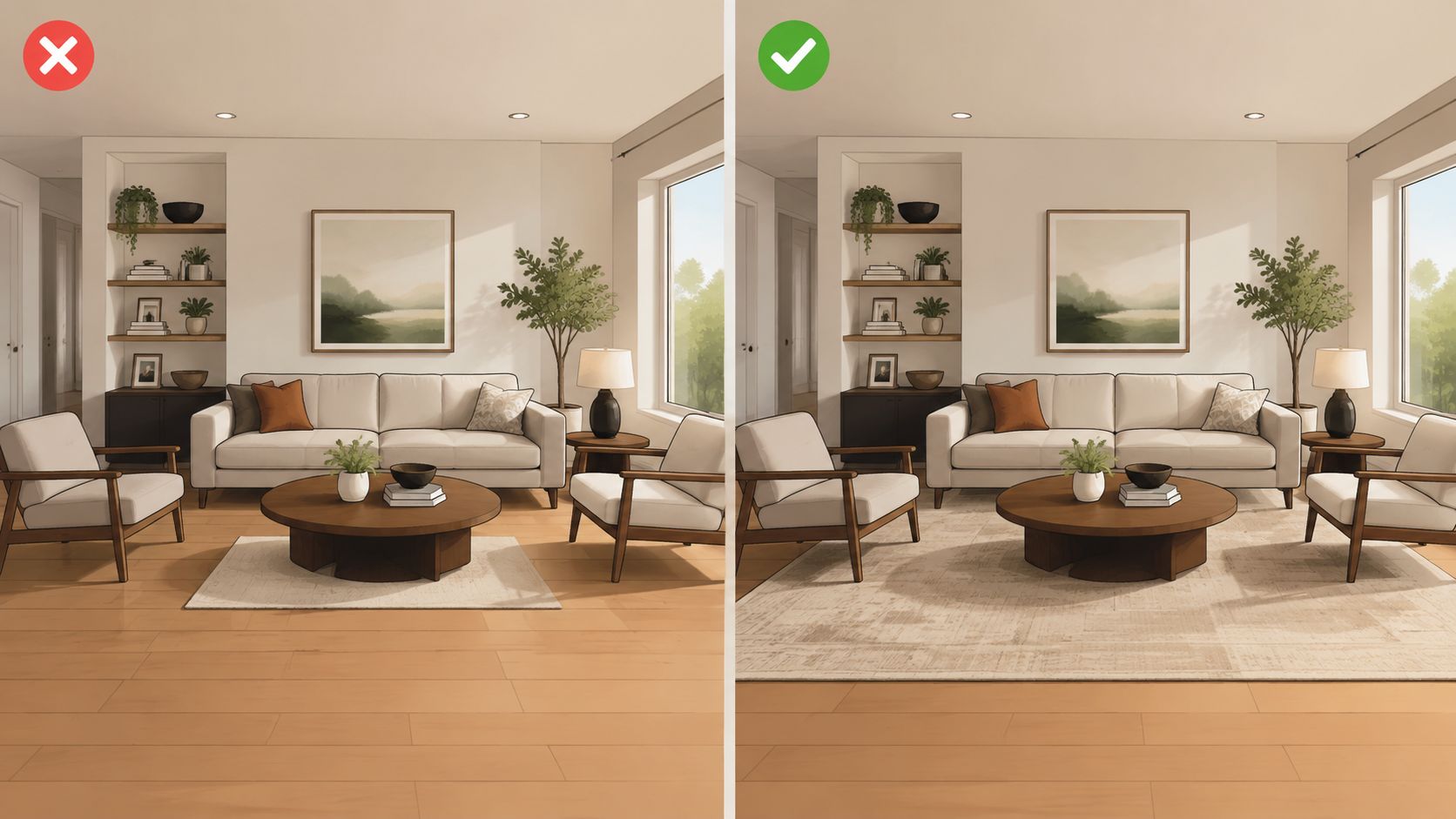
For Southern Ontario homes, a dependable starting point is to size the rug to the seating area rather than to the empty floor around it. Design guidance recommends that a living-room rug extend at least 20 to 30 cm wider than the sofa on each side, with 200 x 300 cm often suited to a two-seater and 260 x 360 cm recommended for a three-seater or modular arrangement, according to living-room rug placement guidance from King Living.
That simple proportional rule changes the room immediately. The sofa doesn't appear perched on the edge of a decorative mat. Instead, the rug reads as a deliberate frame.
A second benchmark comes from broader North American sizing practice. 8 x 10 ft and 9 x 12 ft rugs are commonly used for living rooms, with 8 x 10 ft often treated as the baseline for an average seating area and 9 x 12 ft for more spacious rooms, as outlined in Emily Henderson's rug size guidance. That guideline is especially useful for homeowners comparing metric and imperial sizing while shopping across different collections.
For readers who want a practical comparison of how common sizes behave in real rooms, this overview on living room rug sizing from Woodstock Furniture Outlet is a helpful companion.
Use room borders to create ease
A rug should feel generous, but it shouldn't crowd the walls. Leaving a visible border of flooring around the rug lets the room breathe and keeps the layout from looking compressed.
Practical rule: Leave about 40 cm of exposed floor between the wall and the rug when the room allows. That margin gives the seating zone definition without making the room feel boxed in.
Many otherwise attractive living rooms often lose refinement in their rug placement. The rug nearly touches the baseboards, or it floats too far from the furniture and creates a small island in the centre. Both approaches break the visual rhythm.
A useful planning tool is to mark the proposed rug size directly on the floor before shopping. For homeowners refining dimensions before visiting the showroom, this area rug size guide can help translate room measurements into a more confident shortlist.
Designer's Insight
Bring three measurements when selecting a rug:
- Sofa width: This sets the minimum sense of scale.
- Distance to the nearest wall: This helps preserve a clean floor border.
- Chair depth or coffee table zone: This confirms whether the rug will support the entire seating composition or only the front edge.
Those numbers matter more than colour notes taken on a phone. Once scale is correct, the curated selection becomes much easier to manage.
Anchoring Your Space Layouts for Common Seating Arrangements
Once size is settled, placement decides whether the room feels composed. The strongest layouts create a single conversation area, not a scatter of unrelated pieces.
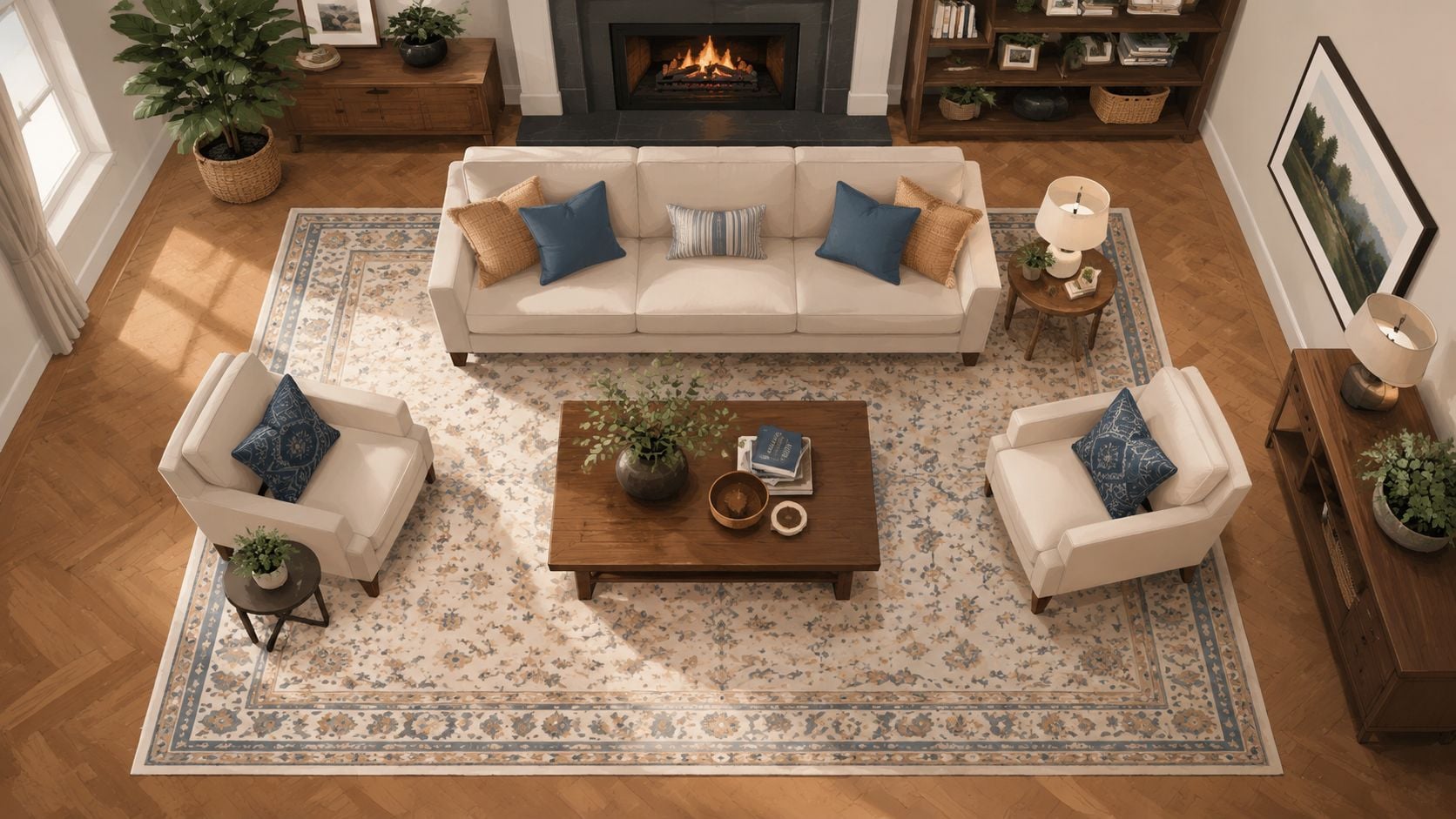
Expert placement guidance recommends that at least the front legs of the sofa and chairs sit on the rug, with better results when the rug supports most or all of the seating group. It also advises avoiding “floating” rugs that sit disconnected from furniture because they weaken the room's visual anchor, as noted in Jaipur Rugs' placement guidance.
The classic sofa and chairs
This is the arrangement most homeowners recognise immediately. A sofa faces one or two chairs, with a coffee table in between. It works beautifully, but only if the rug links the pieces.
The dependable layout is simple. The sofa's front legs sit on the rug, and the chairs also touch the rug with their front legs. That shared footprint makes the room feel like one gathered area rather than a row of furniture around a mat.
If the chairs sit too far back and miss the rug entirely, the room starts to look hesitant. The chairs become satellites instead of participants in the conversation zone.
A practical checklist helps:
- Pull the chairs forward: They should relate to the sofa, not only to the wall behind them.
- Keep the coffee table centred within the rug field: That keeps the composition calm.
- Preserve movement around the grouping: Walkways should remain comfortable, especially between the living room and adjacent spaces.
For homeowners reviewing layout ideas before moving pieces, this living-room furniture arrangement guide is a useful planning resource.
The modern sectional
Sectionals ask more of a rug because their footprint is larger and their shape is more assertive. A rug that's too small usually ends up touching only the chaise, which leaves the rest of the sectional visually unsupported.
In a well-resolved layout, the rug reaches far enough under the sectional to make the entire composition feel grounded. That doesn't always mean every leg must rest on the rug, but the rug should look substantial enough to belong to the full shape.
The sectional shouldn't appear to overpower the rug. The rug should calm the sectional.
This is especially relevant in Southern Ontario homes where larger family rooms often combine a sectional, recliner, and accent seating in one open area. The rug needs enough visual weight to hold that arrangement together.
The conversational grouping
Some of the most elegant rooms don't revolve around a single sofa at all. Four chairs, or two chairs paired with a smaller settee, can create a wonderfully intimate setting. In these rooms, the rug placement living room strategy becomes even more important because there's less linear furniture to establish order.
A good method is to imagine a rectangle connecting the main seating pieces. The rug should support that shape so the grouping reads as one intentional zone.
Consider these placement cues:
| Arrangement choice | What works | What weakens the room |
|---|---|---|
| Four chairs around a table | Rug extends beneath the front legs of each chair | Tiny rug under table only |
| Sofa with two chairs | One shared rug field that connects all pieces | Chairs left entirely off the rug |
| Sectional with one accent chair | Rug reaches under the primary seating edges | Rug touching only the chaise tip |
The broader design principle is that furniture should never appear stranded. In a complete room concept, every major seat belongs to the same visual conversation.
Bespoke Solutions for Unique Living Rooms
Not every living room behaves like a neat rectangle. Older homes in St. Catharines may have fireplaces, alcoves, or asymmetrical openings. Newer homes across the Greater Niagara and Hamilton markets often use open-plan layouts that need subtle zoning rather than rigid separation.
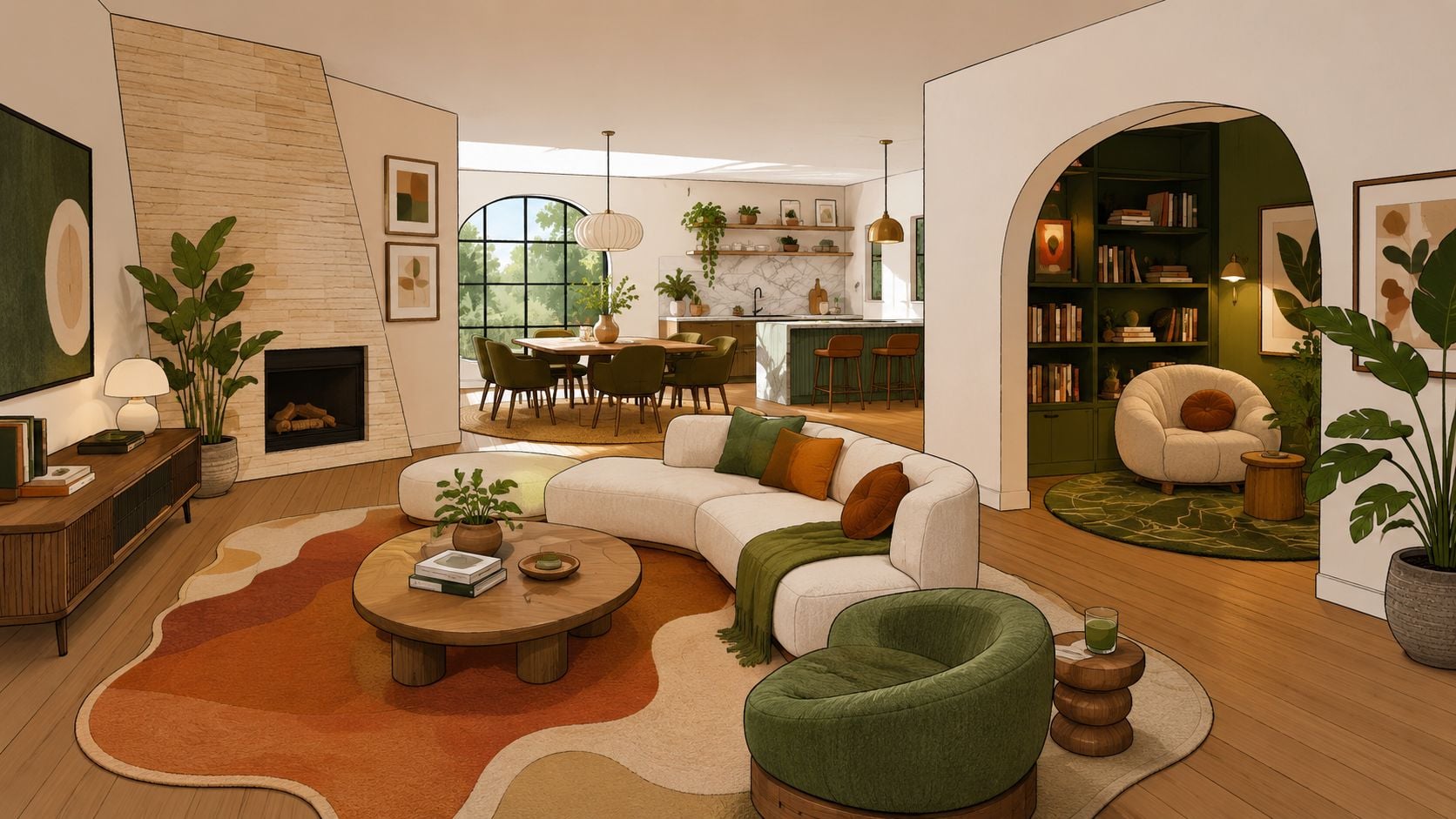
Framing a fireplace with intention
When a fireplace is the visual centre of the room, the rug should support that hierarchy. The placement usually works best when the rug aligns with the fireplace wall and draws the seating toward it, rather than turning the furniture on an unrelated angle.
This doesn't require stiffness. A room can still feel relaxed. But the rug should acknowledge the architecture, especially in homes where mantel, artwork, and seating all contribute to a timeless focal composition.
The visual test is straightforward. If the fireplace feels detached from the seating area, the rug likely isn't doing enough to bind the room together.
Layering rugs in open-plan homes
Layering is one of the most elegant ways to define zones in a larger room. A broad base rug can establish the overall living area, while a second artisanal rug helps anchor the immediate seating group.
That approach has become especially relevant in Southern Ontario. A 2025 CHBA report indicates that 42% of new home renovations in Southern Ontario prioritise “zone definition”, and the overlooked detail is spacing. The guidance gap isn't about whether layering works, but how to make it feel deliberate. The benchmark is a minimum 30 cm of spacing and offset so the layered composition reads as intentional rather than accidental.
A balanced layered arrangement often looks like this:
- Base rug: Quiet in texture or pattern, large enough to define the broader area.
- Top rug: Richer in colour, motif, or artisanal character, placed to strengthen the seating zone.
- Offset: Slight enough to feel curated, not theatrical.
For readers exploring layered and hand-knotted options within the region, the Hamilton rug store collection offers a useful starting point for comparing styles suited to open-plan rooms.
What matters most is restraint. Layering should clarify the room, not clutter it. When done well, it brings a bespoke quality to the home and gives large spaces a more intimate scale.
The Finer Points Pattern Texture and Orientation
Placement solves proportion. Pattern, texture, and orientation shape atmosphere. This is the stage where a rug stops being merely functional and starts behaving like art.
How orientation changes a room
A rug has direction, even when the pattern seems subtle. Linear motifs can make a room feel longer or wider depending on how they're placed. Medallion designs often look most settled when aligned with the room's architecture rather than skewed to a single chair or side table.
In narrow rooms, orientation becomes especially important. A rug that follows the main visual axis usually creates more calm than one placed against it. The room feels organised before anyone notices why.
Texture as a source of warmth
Southern Ontario winters place different demands on a living room than a bright summer cottage does. In lower-light rooms, floor visibility at the edges can become part of the design strategy. For those spaces, generic sizing rules sometimes need adjustment. Verified guidance for winter homes notes that a 15% reduction in rug width can improve perceived room depth by 22% in low-light conditions by allowing more reflected light at the perimeter.
That doesn't mean smaller is always better. It means the right rug placement living room decision depends on how the room feels in real light, especially in January rather than July.
In low-light rooms, a slightly narrower rug can create more depth if it reveals enough floor to catch and reflect available light.
Texture works with that effect. A hand-knotted wool rug adds visual softness and physical comfort. A flatter weave can feel crisper and more architectural. Neither is necessarily superior. The room's light, palette, and use should decide.
Pattern and visual rhythm
Pattern can unify a room or make it restless. The difference usually lies in how the rug relates to the rest of the space. If the sofa has strong shape and the artwork carries movement, a quieter rug often provides balance. If the upholstery is restrained, the rug can carry more of the room's personality.
For readers thinking about rhythm across surfaces, the principles behind designing visual rhythm with tile offer a helpful parallel. Repetition, pause, contrast, and scale matter on the floor whether the material is wool, silk blend, or ceramic.
Homeowners mixing motifs can also benefit from this guide on working with patterns in room design. It's particularly useful when pairing a bold rug with custom upholstery, wood grain, and layered textiles.
A rug from a well-curated Rug Market should do more than fill space. It should contribute texture, pace, and visual depth in a way that feels collected over time.
Finishing Touches and Mistakes to Avoid
The final stage is where a room either looks thoughtfully resolved or slightly unfinished. Most placement problems come down to a small group of avoidable decisions.
The first is the floating rug. If the rug doesn't connect to the seating, the entire room loses conviction. The second is the undersized rug that reads like an afterthought beneath otherwise substantial furniture. The third is blocking natural movement so the room looks attractive but doesn't function comfortably.
A concise review helps:
- Avoid the postage-stamp effect: Small rugs tend to diminish the furniture around them.
- Protect the layout with a rug pad: It helps prevent slipping, adds cushioning, and supports the life of an heirloom quality rug.
- Respect real movement: Entry points, adjoining halls, and paths to adjacent rooms should remain easy to use.
Some finishing details are aesthetic, and some are symbolic. Decorative objects, for example, carry visual and cultural weight beyond scale alone. Readers considering sculptural accents may enjoy this perspective on Buddha statue meaning and style, which shows how placement affects presence.
The last step is physical placement in the home. A rug can be beautifully chosen and still lose its effect if it's dropped into the room without careful positioning. That's where white-glove service matters. Critelli Furniture offers delivery and in-home placement as part of the transition from showroom plan to finished room, which is particularly valuable when larger rugs need to be unrolled, aligned, and set beneath substantial furniture without guesswork.
A timeless living room rarely happens by accident. It's built through measured choices, refined scale, and materials with lasting character. For homeowners seeking a bespoke, design-forward foundation for their space, Critelli Furniture offers a century-shaped perspective on complete room design, from artisanal rugs to white-glove placement. Experience the craftsmanship in person at our King Street Showroom. Book your complimentary design consultation today. Visit the Rug Market to find your room's foundation.