
Art Deco Rugs: How to Spot Authentic Pieces

A homeowner finds a rug online, loves the fan pattern and the black and gold palette, then pauses at the description. It's called Art Deco, antique in style and vintage inspired, all in one sentence. None of those words answers the question that matters most, whether the rug was made in the period, made later in its honour, or printed with a geometric pattern last year.
That's the confusion this guide clears up, step by step. A rug can follow Art Deco principles faithfully and still be contemporary, and there's nothing wrong with that choice, provided the buyer knows which claim the price represents. Authenticity, in other words, is a matter of evidence rather than appearance. Motif, material and provenance each tell part of the story, and no single one of them settles the question on its own.
What Makes a Rug Genuinely Art Deco
An Art Deco rug is a floor covering whose design follows the visual language of roughly 1920 to 1939, built on vertical emphasis, stepped silhouettes and stylised geometric or floral ornament. A later rug that borrows the same language is a revival piece, not an original period work, however convincing it looks in a photograph.
A Skyline Drawn in Thread
The easiest way to read the style is to think of a city skyline reduced to pattern. Buildings rise in setbacks, edges step in and out, and decoration repeats in crisp, ordered units. A period rug does the same thing flat on the floor, with strong verticals, symmetrical fields and borders that step rather than curve. Where an earlier floral carpet drifts and meanders, an Art Deco design marches.
That's because Art Deco isn't a single pattern a weaver copied. It's a design movement that spread across architecture, metalwork, glass, furniture and textiles at the same time. The rug on the floor borrowed its vocabulary from the building around it, which is why stepped borders, radiating fans and sunbursts turn up on both façades and floor coverings.
The Canadian Context
The movement has a real local footprint. A Canadian heritage inventory of Art Deco places identifies 84 historic Art Deco places across the country, and it describes the style through vertical emphasis, stepped silhouettes and stylised geometric or floral ornament. Toronto and other Ontario cities hold interwar examples where floor coverings formed part of one coordinated interior scheme rather than decoration added afterwards.
That context helps Southern Ontario buyers in a practical way. A rug that echoes the architecture of its room reads as considered, while one that fights the millwork and sightlines reads as a costume. Readers who want the wider furniture picture first can start with a primer on the Art Deco furniture style and its defining forms before judging any single piece.
Three checks do most of the work from here. Motif shows whether the design language belongs to the period, material and construction show how and likely when it was made, and provenance shows what can be documented. Appearance opens the enquiry. It doesn't close it.
Motifs and Palettes That Define the Look
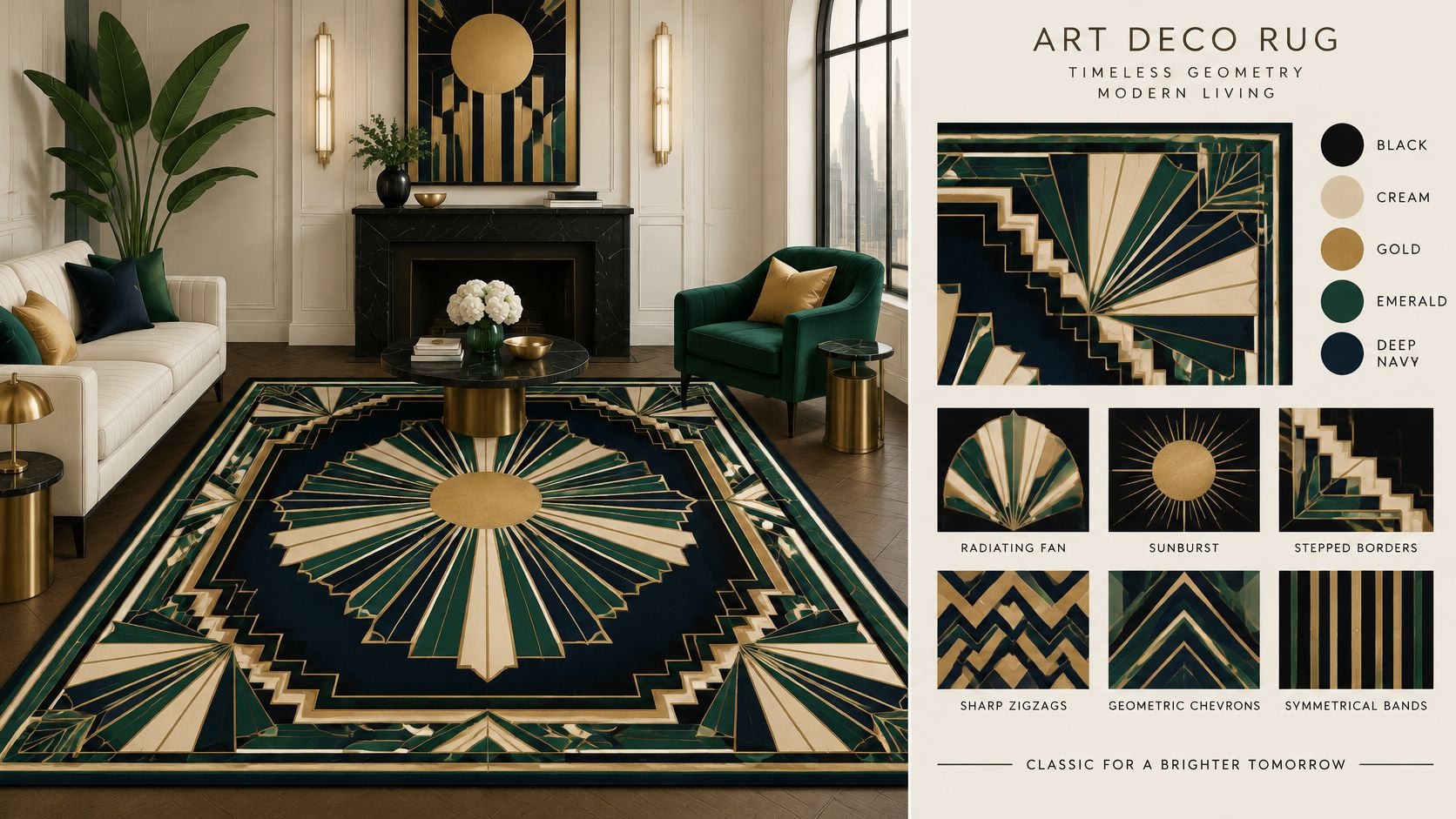
Motifs are the quickest first screen, so it helps to have the short list in front of the eyes before looking at colour at all. The table below names the five forms that carry most period designs.
| Motif | Visual cue | Typical palette | Reading tip |
|---|---|---|---|
| Stepped border | Terraced edges that repeat at the corners | Black and ivory | Mirrors the stepped massing of Art Deco buildings |
| Fan or sunburst | Rays radiating from a central point | Gold on navy or charcoal | Among the strongest signals of the 1920s and 1930s |
| Zigzag chevron | Sharp, repeated angles in bands | Multicolour contrast | Often runs as a border or runner |
| Streamlined botanical | Simplified lilies, fronds and palmettes in flat shapes | Muted jewel tones | Look for stylised, not naturalistic, leaves |
| Geometric medallion | Circle or lozenge set inside a grid | Black, cream and rust | Symmetrical field with a clear focal point |
Why These Forms Belong to the Period
A stepped border copies the setback silhouette of interwar towers, so the corners turn in terraces instead of scrolls. A fan or sunburst radiates from one point, often centred on a doorway or a seating group, and it gives a static rectangle a sense of movement. Zigzag chevrons repeat at a sharp angle, which suits runners and borders where rhythm matters more than a focal point.
Botanical forms mislead readers most often. Period designers flattened lilies, fronds and palmettes into symmetrical shapes with hard edges, so the leaf reads as geometry first and nature second. A rug covered in soft, shaded, naturalistic flowers may be attractive, but it's speaking an earlier language. The medallion works the same way, held inside a grid so the field stays ordered.
Practical rule: A convincing period design usually commits to one dominant geometric system. A rug that mixes fans, chevrons, medallions and trailing florals at once is often a later collage of Deco references.
Reading the Palette Without Being Fooled by It
Black and ivory contrast is the classic ground, with gold or brass tones used as accent rather than field colour. Deep navy and jade carry larger rooms well, while muted pinks and taupes appear more often in later period pieces and in softer revival work. Saturation tends to be controlled, so two or three colours do the work and leave breathing room in the field.
Colour on its own proves nothing about age. Strong palettes were reproduced for decades, modern dyes can copy period tones closely, and a photograph under warm lighting can make a new rug look mellowed. Colour should support a conclusion reached from construction and documentation, never replace it.
For a fast judgement in a showroom, three motifs do the heaviest lifting. The fan or sunburst, the stepped border and the zigzag chevron signal the period most reliably, especially when they appear in a symmetrical, ordered field.
Materials and Weaving Techniques Compared
Two rugs can carry the identical sunburst and differ sharply in value, comfort and lifespan. Construction explains the gap, because it decides how the pile responds to grit, furniture weight, cleaning and time. Buyers who only compare photographs are comparing the least informative part of the object.
| Construction | Typical materials | What to feel and inspect | Period relevance |
|---|---|---|---|
| Hand-knotted | Wool pile on cotton warp | Dense, even pile and knots visible on the reverse | Common in original workshop and commissioned pieces |
| Hooked | Wool or cotton loops pulled through canvas | Loop pile and canvas backing, with stitching visible on the reverse | Found in interwar American and Canadian floor coverings |
| Machine-woven Axminster or Wilton | Wool or synthetic pile on a loom | Uniform pile and woven backing, with a machine-made finish | Produced in volume, more common in later decades |
| Printed or tufted reproduction | Synthetic pile with printed or tufted design | Printed surface and uniform tufted or stamped backing | Revival or contemporary interpretation |
Hand-Knotted Wool, the Reference Point
In a hand-knotted rug, each tuft of wool is tied around the warp threads, so the pattern is the structure rather than a surface applied to it. Turn one over and the design shows through, knot by knot, with small irregularities in spacing. That density is why hand-knotted wool remains the benchmark for heirloom quality pieces and for anyone researching Hand-knotted rugs Ontario options with a long view.
The trade-off is straightforward. It's the most labour intensive route, it costs more, and it asks for professional cleaning rather than aggressive home extraction. In return, the pile can be re-knotted in worn spots, the edges can be re-bound, and the rug can serve more than one household.
Hooked, Machine-Woven and Printed Alternatives
Hooked carpets pull loops of wool or cotton through a canvas base, giving a textured, slightly springy surface. They belong to interwar North American interiors, so a hooked rug isn't automatically a lesser object. Loops can snag on chair casters, pet claws and vacuum beater bars, though, and a pulled loop needs prompt attention before it travels.
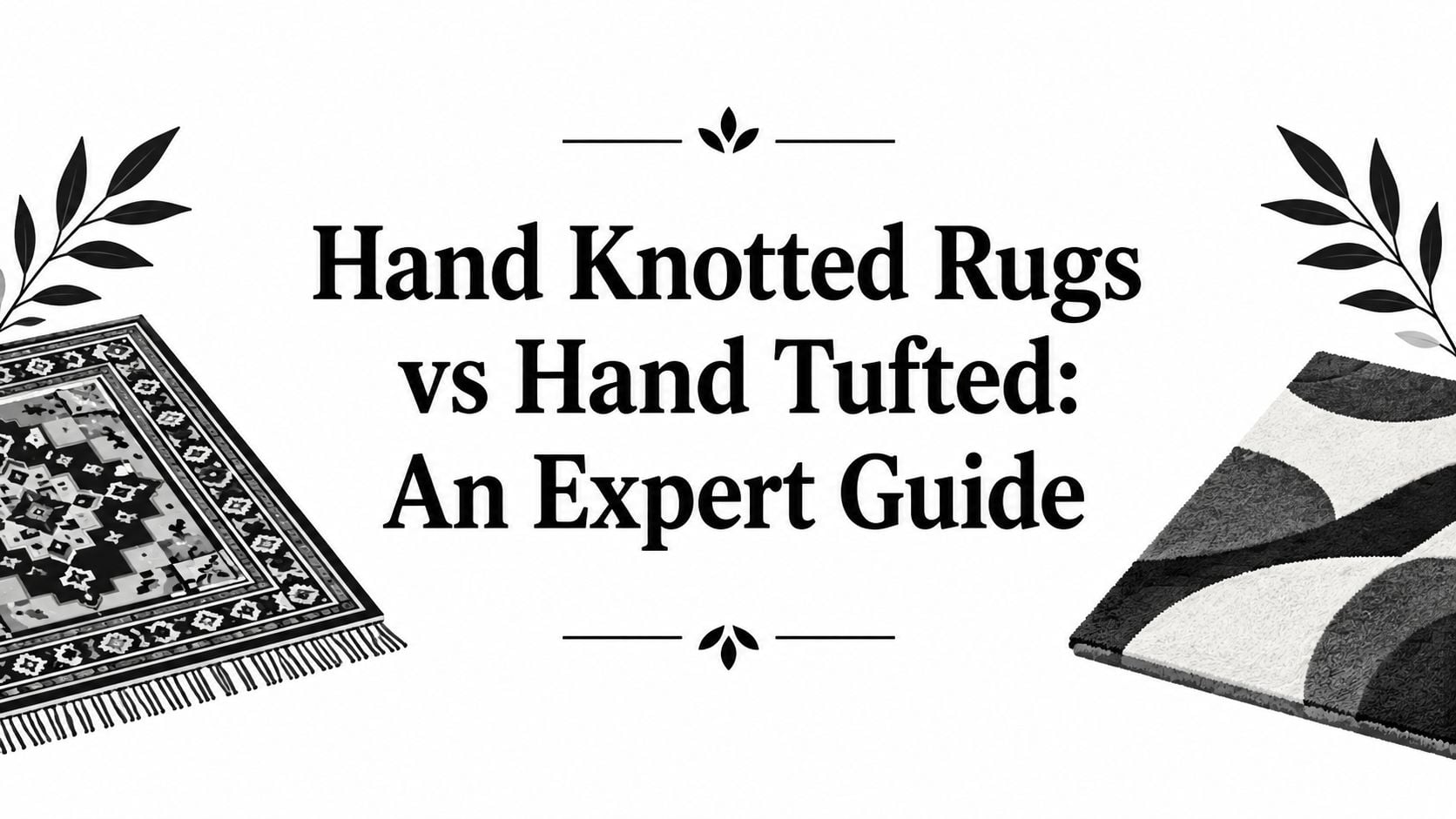
Axminster and Wilton looms weave pile and backing together at volume, producing a very even surface and consistent pattern registration. Many well made examples wear hard for years, but uniformity is also a dating clue, since volume production became far more common in later decades. A side by side primer on hand-knotted rugs versus hand-tufted construction helps readers feel that difference before handling a real piece.
Printed and tufted reproductions sit at the other end. The pattern may be printed onto a finished pile, or tufted through a backing and held with adhesive, so the reverse looks stamped and uniform. These rugs can be a sensible, low commitment way to test a bold motif in a child's room or a rental. They shouldn't be priced or described as period work.
Pile density varies by maker and grade, so a single number on a tag settles very little. The hand and the reverse side give a buyer more honest information.
Fibre matters alongside method. Wool resists crushing, sheds soil more readily and takes dye with depth, while synthetic pile can look flat and hold static. Judge fibre and construction together, because design alone can't tell a buyer how a rug will age.
How to Tell an Original from a Revival
No single test proves age. A clever reproduction can copy a motif exactly, distress a surface convincingly and even soften its colours, so a buyer who relies on one clue will eventually be caught out. The safer method combines several checks and looks for a consistent story across all of them.
| Check | Usually original | Usually revival or modern |
|---|---|---|
| Back of the rug | Hand-tied knots, irregular row spacing and natural dye variation | Uniform printed or stamped backing, fused latex coating |
| Pile and knots | Knot count varies across the field, pile height shows use | Perfectly even density and uniform pile across the surface |
| Edges and selvage | Hand-finished or hand-bound edges with minor irregularity | Machine binding with mechanically straight edges |
| Colour | Soft tonal shifts from natural and early synthetic dyes | Flat, saturated colour with no tonal variation |
| Wear and repairs | Wear concentrated where furniture and traffic fall, with visible restoration | Even wear across the field or no sign of use |
| Provenance | Sale records, auction history, condition reports | No documentation or vague family-story claims |
Start With the Back, Then the Edges
Step one, turn the rug over. Hand-tied knots sit in slightly uneven rows and the pattern reads clearly in reverse. A uniform printed or stamped backing, or a fused latex coating that feels like a single sheet, points to a later manufacturing process. Parting the pile with the fingers shows whether colour runs down the knot or sits only on the tips.
Step two, walk the perimeter. Hand finishing leaves minor irregularity in the binding and small changes in tension. Machine binding runs mechanically straight, with stitching at perfectly regular intervals. Neither finding is a verdict by itself, since edges are commonly re-bound during restoration, but both belong in the record.
Read Wear, Colour and Repairs as Evidence
Real use is uneven. Pile lowers where chair legs pivot, where a doorway funnels traffic and where sunlight falls every afternoon, while the area under a long standing cabinet stays comparatively fresh. Perfectly even wear across a high traffic field is a red flag, because households don't walk that way.
Colour should behave the same way. Natural and early synthetic dyes often shift softly across a field as one dye lot gave way to the next, producing gentle tonal bands. Flat, saturated colour with no variation at all suggests modern dyeing. Repairs, re-piling and small patches shouldn't alarm a buyer, since they indicate a rug that was worth maintaining. Undisclosed repairs should.
Context from the saleroom shows how mixed the market is. Waddington's reported that its 2026 rugs and carpets auction included more than 50 lots of rugs, runners and carpets, plus approximately 30 textiles from a private Montreal collection, including an American Art Deco hooked carpet. Period pieces, later textiles and decorative rugs routinely share one catalogue, which is exactly why lot descriptions and condition notes deserve slow reading. Comparing structure against documented examples, such as hand-knotted Turkish rugs and their knot construction, trains the eye on what a genuine reverse looks like.
Ask for the Paperwork
A documented condition report is the buyer's strongest protection, because it converts an impression into a record that can be checked later. Sale records, auction history, prior appraisals and dated photographs all strengthen a claim. A warm family story, offered instead of documents, isn't evidence.
For a significant purchase, a qualified independent appraiser is money well spent. A lay buyer can screen confidently with the checks above, and should be candid that screening isn't authentication. A consistent set of findings matters more than any single feature.
Styling Art Deco Rugs in Contemporary Rooms
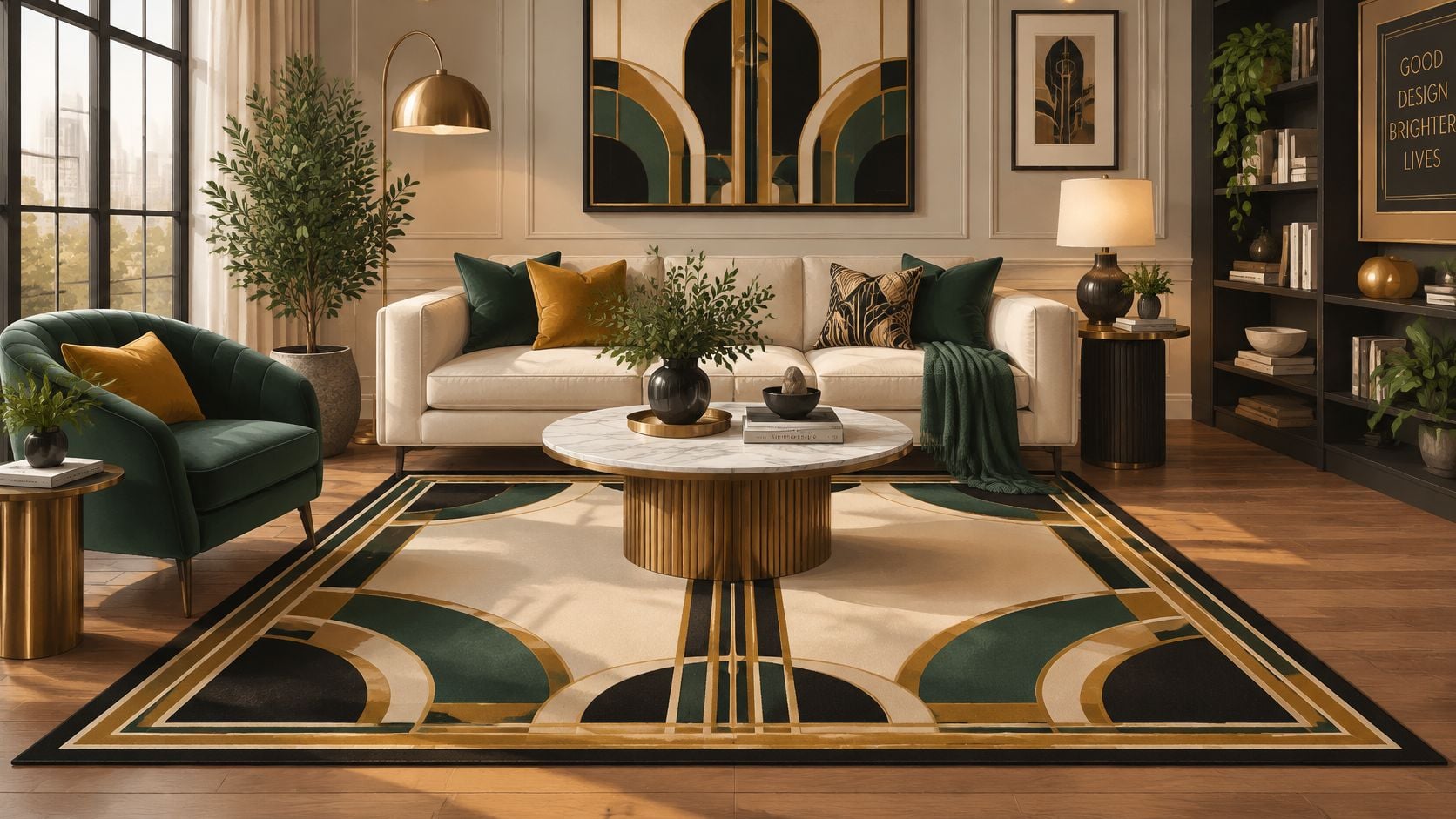
The most convincing Deco rooms aren't recreations. They're contemporary rooms organised around a rug that follows period principles, with symmetry, radiating geometry and controlled contrast doing the work. Treated as Art for your Floor, the rug sets the palette and character for everything placed above it, which is the foundation of a genuine complete room concept.
Scale Before Pattern
Measure the seating footprint, walking routes and clearances first, then choose a geometric pattern or border to fit that map. Ontario's planning rules offer a useful sense of proportion, since the Ontario Building Code compendium for housing and small buildings sets living areas within a dwelling unit at at least 13.5 square metres, whether separate or combined with another space. The code doesn't prescribe rug dimensions, but it reminds a buyer how little spare floor a minimum sized room holds.
In practice, front legs of sofas and chairs sit on the rug so the grouping reads as one conversation rather than furniture floating around a mat. A clear walking path from doorway to seating keeps the border from becoming a trip line. Detailed diagrams for area rug placement in living and dining rooms help readers test these arrangements on paper before moving anything heavy.
Southern Ontario housing adds its own constraints. Narrow Victorian era rooms in Hamilton or older Toronto streetscapes may need a runner format rather than a wide rectangle. Condominium buyers should confirm elevator dimensions and door clearances before ordering a room sized piece. Radiators, built in units and hearth projections should sit outside the border, not on top of it.
Match the Rug to the Architecture
Where original millwork, terrazzo or patterned tile already supplies ornament, a restrained motif in a low contrast palette keeps the room calm. Where the architecture is plain and contemporary, a bolder fan or stepped border can carry the visual interest the walls don't. Ceiling height matters too, since a large scale medallion that suits a tall room can crowd a low one.
Designer's Insight: Critelli's designers suggest pairing a bold Hancock & Moore leather with a neutral hand-knotted wool rug to balance the room's energy, letting one element lead while the other grounds the scheme.
That balance is the real design skill, and it extends across timeless craftsmanship pieces from makers such as Stickley, Stressless and Magniflex, where one strong voice per room is usually enough. Critelli Furniture's design studio plans layouts, finishes and fabrics across a whole room, covering items from architectural lighting to hand-knotted rugs, and serves Interior design services St. Catharines clients plus homeowners across Greater Niagara, Hamilton and Toronto. Shoppers comparing Luxury furniture Niagara showrooms will find that whole room planning prevents the most expensive mistake, a beautiful rug in the wrong scale.
Caring for an Art Deco Rug at Home
Care begins with a distinction that changes everything else. A removable area rug can be lifted, aired, cleaned underneath and sent out for washing, while wall to wall carpet traps whatever reaches its backing and adhesives. That removability is the Art Deco buyer's quiet advantage, provided the household uses it.
Indoor Air, Without Exaggeration
Canadian evidence supports a measured answer. Research in Ontario homes on indoor air quality links frequent floor cleaning and vacuuming with lower fine particulate levels, while ventilation is associated with lower concentrations of several indoor contaminants. The practical reading is that maintenance and fresh air do the work, not the presence or absence of one rug.
Ventilating a room after a new rug arrives is a sensible first step, since backings and adhesives can contribute odour in the early days. Households with children, pets, asthma or allergies should ask about backing materials before purchase and choose a rug that can be professionally cleaned. Dense piles and dark geometric patterns hide dust and spills well, which looks tidy and supports a firmer cleaning schedule rather than a relaxed one.
| Task | Frequency | Why it matters |
|---|---|---|
| Vacuum without a beater bar | Weekly, more often with pets | Removes dust and grit that abrade the pile |
| Spot-clean spills promptly | As needed | Prevents stains and moisture reaching the backing |
| Rotate the rug | Every six months | Spreads wear from seating and traffic |
| Check sun exposure and use UV-filtering treatments | Ongoing | Limits colour fading in south- or west-facing rooms |
| Inspect for pests and moisture | Every few months | Catches damage early in damp or poorly ventilated spaces |
| Professional cleaning for hand-knotted wool | Every one to three years | Removes deep soil and keeps fibres supple |
Preservation Habits That Prevent Damage
Prolonged direct sun fades one end of a rug while the covered end stays rich, and the difference can't be cleaned away. UV filtering window treatments, rotation and a breathable underlay that stops sliding all cost little compared with restoration. Moisture deserves the same attention in Southern Ontario basements and lakefront homes, where a damp floor can mildew a backing before the surface shows anything.
Spills should be blotted, never scrubbed, and tested in a hidden corner first. Readers who want the home technique in detail will find gentle spot removal for oriental rugs a useful companion before reaching for household cleaners. A short refresher on everyday rug rules for traffic, padding and rotation keeps the routine consistent between professional visits.
Framed clearly, an Art Deco rug isn't an air quality hazard or a health benefit. It's a maintenance decision. A removable, cleanable, well ventilated rug in a vacuumed room behaves very differently from a neglected one.
Choose Your Art Deco Rug With Confidence
Price deserves the same scepticism as pattern. At a Canadian auction closing in 2025, Waddington's rugs and carpets auction results recorded a Chinese Art Deco rug dating to approximately 1910 to 1920 at $896, including the buyer's premium. That single result is instructive because it separates three questions buyers often merge. Age is one question, origin is another, and decorative appeal is a third, and the market prices the documented combination rather than the label.
A Buyer's Sequence That Holds Up
- Confirm the construction first: Turn the rug over, part the pile and check the edges before discussing price.
- Request written condition notes: Ask for repairs, re-piling, stains and sun fade in writing, supported by photographs.
- Place offers on the same basis: Compare construction, documented condition and provenance, not photographs and adjectives.
- Agree the delivery date in writing: Confirm who inspects the rug on arrival, who places it and who removes packaging.
- Insist on careful handling: White-glove delivery covering inspection, precise placement and packaging removal protects edges and pile in transit.
Comparing quotes on that basis changes the conversation. A lower price for an undocumented revival piece may be perfectly fair, and a higher price for a documented period rug may also be fair. Trouble starts when a buyer pays the second price for the first object, which is why bespoke and curated selection claims should always be matched with paperwork.
A rug doesn't need to be a century old to be the right purchase. It needs to be honestly described, soundly made and suited to the room it will anchor.
Where Heritage and Service Meet
Critelli Furniture is a family run business founded in 1914 in St. Catharines, and its Rug Market treats rugs as art for the floor rather than floor covering by the metre. Its in-home design service supports Custom furniture Southern Ontario clients who want the rug, seating, lighting and finishes resolved together. Customers can book a design consultation, and the design team guides a project across the entire space rather than one purchase at a time.
Three next steps suit three kinds of reader. Visit the Rug Market to find your room's foundation. Book your complimentary design consultation today. Experience the craftsmanship in person at our King Street Showroom. Each route puts the rug under real light, next to real furniture, which is where Art Deco geometry either earns its place or doesn't.
Critelli Furniture offers a design-forward, artisanal Rug Market alongside whole room design guidance from a family run St. Catharines team, so an Art Deco rug can be judged in person for motif, construction and scale before it anchors a room. Readers ready to compare hand-knotted wool, review documented pieces and plan a complete room concept are invited to visit Critelli Furniture and book a complimentary consultation.