

Walnut Dining Chairs: A Buying Guide for Ontario Homes


The table is chosen, the dining room is nearly finished, and several walnut chairs look equally convincing on screen. Then the details get slippery: one listing says walnut, another says walnut finish, and neither explains what sits beneath the upholstery or how the coating handles everyday spills.
Walnut dining chairs deserve to be judged by construction, finish chemistry and total cost per chair, not brown wood colour alone. The right choice should feel comfortable through a lingering dinner, fit the room without crowding it, and come with enough documentation to make future care straightforward.
Walnut Dining Chair Sizes That Fit Your Table
Start with a tape measure, not a chair photograph. Record the tabletop height, the underside of the apron and the clear distance between the table legs. A chair can fit beneath the tabletop yet catch against its apron or pedestal.
The following hypothetical fitting schedule gives a homeowner concrete dimensions to test against a particular table. These aren't universal ergonomic standards, and the actual chair should be tried at the intended dining height.
Walnut dining chair measurements and clearances
| Measurement | Typical range | Why it matters |
|---|---|---|
| Seat height | Example target of 44–47 cm for a 75 cm table | Keeps thighs level and knees clear of the tabletop |
| Table-to-seat clearance | Example target of 27–30 cm | Leaves room for knees and lap beneath the table; apron clearance needs a separate check |
| Seat width per chair | Example target of 50–55 cm | Provides a practical adult seating width to test |
| Seat depth | Example target of 42–48 cm | Supports the thighs without pressing behind the knees |
| Back height above seat | Example target of 40–60 cm | Provides a starting point for checking back support; curvature determines lumbar contact |
| Table edge per seat | Example allocation of 60–65 cm | Leaves space to sit, rise and reach the plate |
Check the room as well as the chair
For a hypothetical room layout, mark 90 cm between the table edge and wall for chair movement, then test 120 cm where someone must walk behind a seated diner. Painter's tape makes these allowances visible before furniture arrives. Doors, sideboards and radiators must remain usable when chairs are occupied, not merely pushed in.
Armchairs need their own measurements. In an example where arms add 5–8 cm to overall width, that extra space can prevent a chair from fitting between the table legs. Positioning armchairs at the head and foot often works better than squeezing them along a crowded side.
- Check the height relationship: Critelli Furniture's guide to dining table heights helps frame the table-and-chair comparison.
- Account for round tables: MODERN LYFE's guide to spacing around a 72-inch round table offers a useful layout reference when curved edges make seating harder to visualise.
- Measure the delivery route: Include door openings, stairwell turns and narrow corners. Substantial solid-wood frames can be awkward to manoeuvre even when the dining room itself is generous.
Finish by taping the usable table length. Count the proposed seats and multiply by the chosen table-edge allocation, then check that table legs don't interrupt those positions.
Solid Walnut, Walnut Veneer and Walnut-Finish Chairs Compared
Walnut describes a species, a surface or merely a colour, depending on the listing. Those distinctions determine repair options far more reliably than a flattering photograph.
Walnut construction types compared
| Construction | What it means | Durability | Price tier |
|---|---|---|---|
| Solid American black walnut | Seat, back and legs cut from walnut boards | High repair potential; suitable solid sections can be refinished | Premium |
| Walnut veneer over hardwood or plywood | Thin walnut face on a stable core | Good when undamaged; edges can chip and sanding depth is limited | Mid to premium |
| Walnut-finish hardwood | Oak, ash or another wood stained to resemble walnut | Species, joints and coating determine wear | Mid-range |
| Walnut-tone laminate or composite | Printed or veneered surface on MDF or particleboard | Vulnerable to moisture entering exposed edges; swollen cores are difficult to repair | Budget |
These tiers are shopping categories, not guarantees. A well-built veneered chair can be a better purchase than a poorly joined solid-wood chair, and a moulded plywood back can provide a comfortable shape without pretending to be a thick walnut board.
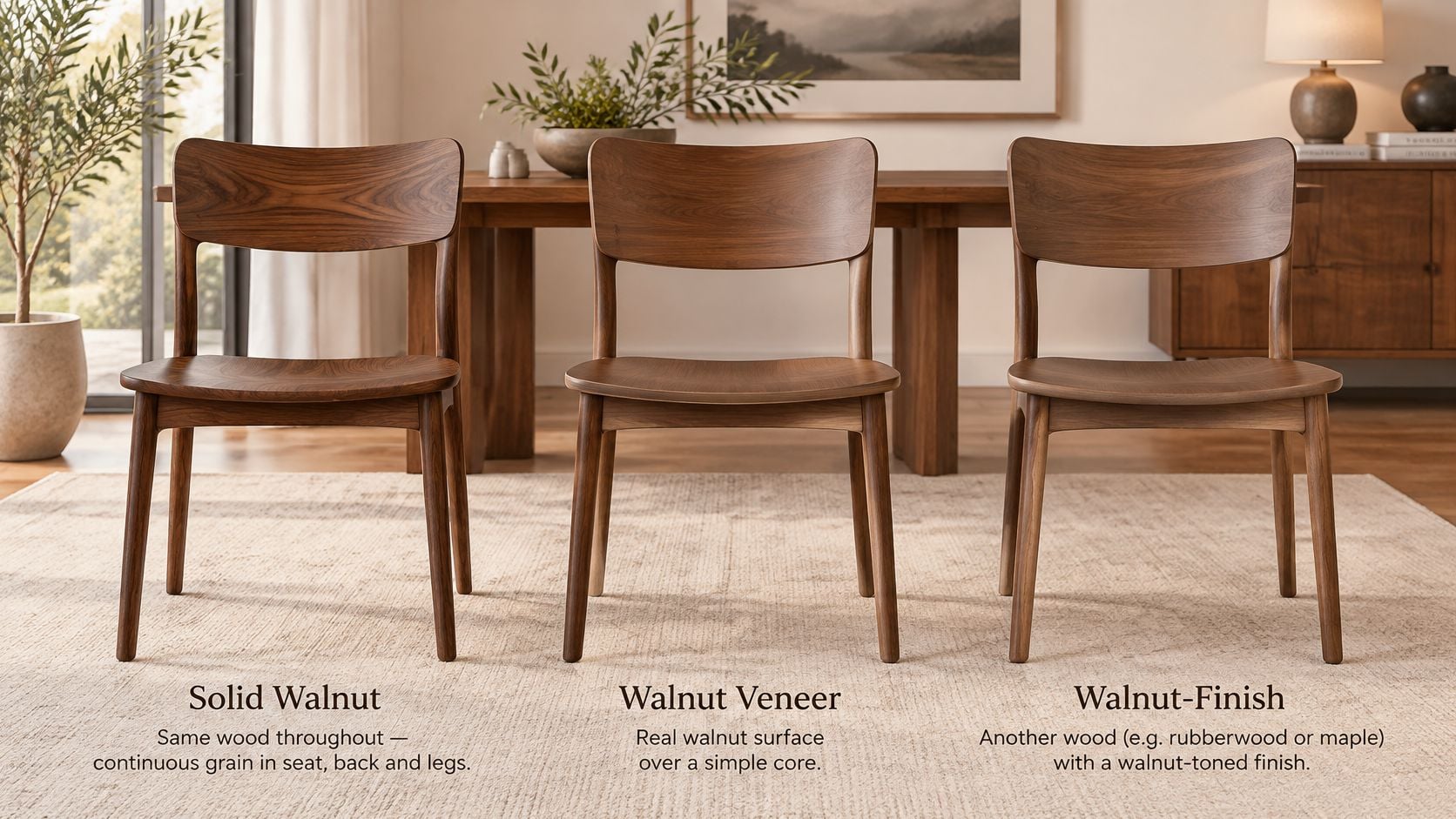
A showroom buying test
- Request a component description. The specification should identify the seat, back, legs, stretchers and curved components separately. Critelli Furniture's hardwood furniture guide provides useful background for comparing material choices.
- Inspect the grain. End grain on a leg and continuity around an edge can help distinguish solid timber from a surface layer. Wrapped veneers and edge banding can disguise construction, so appearance alone isn't proof.
- Examine the seat edge and underside. Look for veneer seams, laminate lines and exposed substrates, then compare those observations with the written description.
Solid wood isn't an indoor-air-quality certificate. The California Proposition 65 furniture guidance identifies composite wood, paints, lacquers and coatings as potential formaldehyde sources and recommends looking for relevant emissions documentation, including CARB Phase 2, TSCA Title VI, NAF or ULEF designations.
For composite panels, the EPA's consumer guidance explains the formaldehyde standards and their relationship to California requirements. These are useful documentation checks for Ontario buyers, not a claim that California law governs every Canadian purchase.
For a broader vocabulary around coatings, RMK Contractors' cabinet finish guide provides a helpful companion reference, although a chair still needs its own finish specification.
Choose solid walnut for heirloom use, quality veneer for a design-forward room with a controlled budget, and walnut-look alternatives only when their construction is clearly disclosed.
How Walnut Finishes Hold Up to Daily Dining
The finish determines what hands touch, how spills behave and how a scratch gets repaired. A soft-looking matte surface isn't automatically fragile, and a glossy coating isn't automatically durable. The formulation, application and curing matter.
Walnut dining chair finishes compared
| Finish | Look and feel | Wear and repair | Best for |
|---|---|---|---|
| Hard-wax oil | Matte, natural and warm | Compatible systems can allow local sanding and recoating | Bright dining rooms with hands-on upkeep |
| Oil finish | Soft, open feel | Usually needs closer monitoring and more frequent renewal than a robust film finish | Relaxed rooms with regular care |
| Lacquer | Smooth sheen | Can chip or scratch at exposed edges; repair method depends on formulation | Formal rooms with lighter use |
| Polyurethane | Hard protective film, available in different sheens | Strong spill resistance; thick films can look plastic, and some formulations amber | Busy households with children |
Hard-wax oil is the preferred starting point for repair-minded owners. It preserves a tactile connection to walnut and can make small maintenance jobs manageable. Pure oil offers a similarly relaxed appearance but generally asks for more attention.
Lacquer provides a polished, even surface, though vulnerable edges deserve inspection. Polyurethane is the stronger starting recommendation for a household prioritising wipeability, but it isn't invariably glossy or the hardest possible furniture coating.
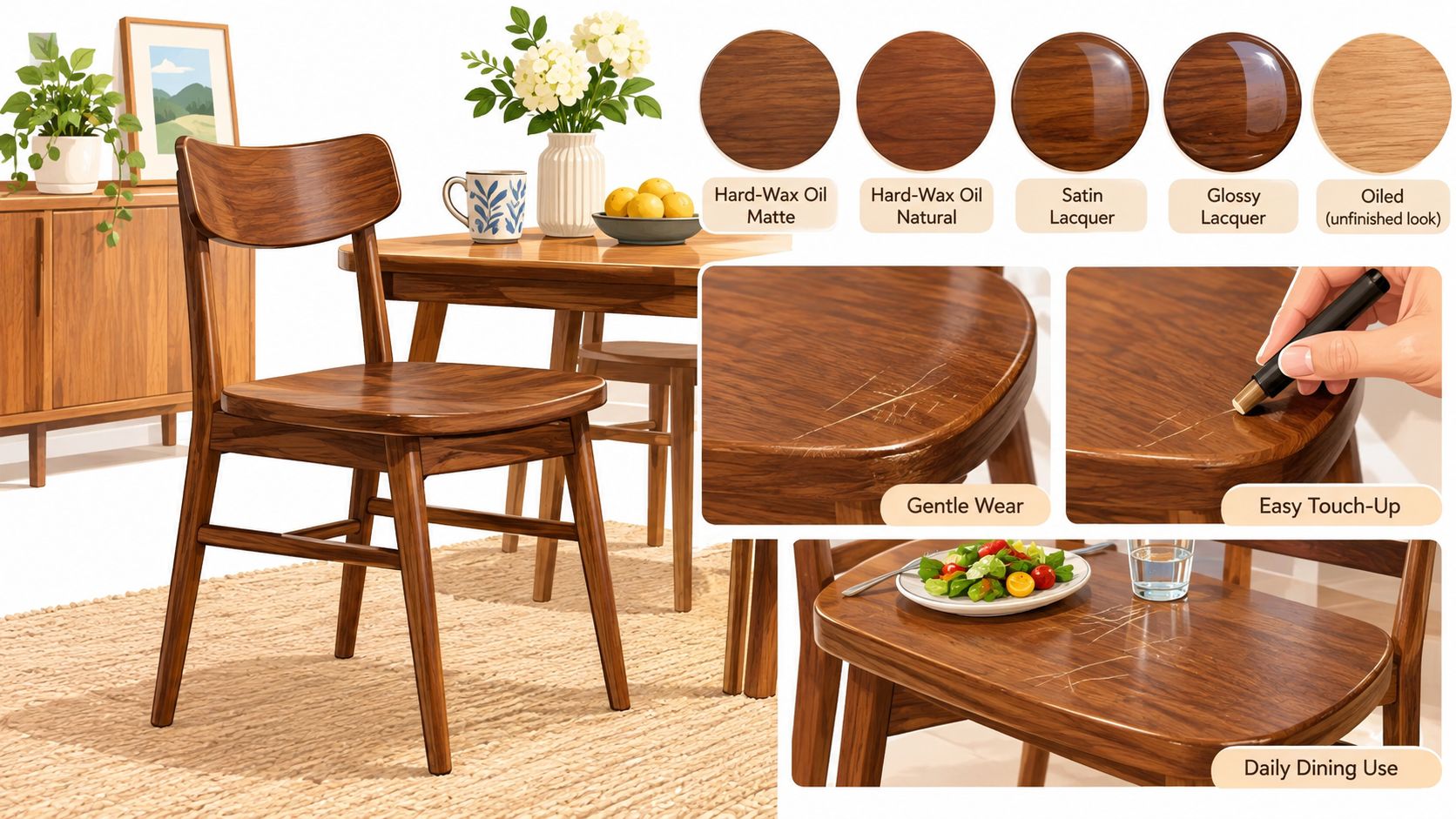
Judge a sample rather than a finish name
Ask whether the colour comes from natural walnut, aniline dye, pigment or a tinted topcoat. Light can change both the wood and its colour treatment, so bright rooms need a conversation about colour stability, not a promise that walnut will remain unchanged.
On a supplier-approved, fully cured sacrificial sample, a hypothetical comparison could use:
- Water exposure: Leave a drop for ten minutes, wipe it away and inspect for darkening or dullness.
- Mug contact: Rest a hot mug for two minutes, then check for a ring after cooling.
- Pressure: Gently press a fingernail against an inconspicuous area to compare indentation and marking.
These tests can damage the sample and aren't certification tests. They shouldn't be attempted on showroom furniture or a purchased chair.
Finish judgement: Choose a coating that suits the household's willingness to maintain it, rather than expecting every finish to behave like a kitchen worktop.
View the sample under the dining room's daylight and warm LED lighting. Walnut that looks balanced in a showroom can appear considerably warmer at home.
Comfort and Construction Features Worth Paying For
Buy support, not puff. A thick seat that collapses against its frame will fail a long dinner. A firmer, well shaped seat stays comfortable without looking bulky.
Specify a 5–8 cm high-density foam core and test it before buying. Pair it with a 3–5 degree backward seat tilt and a 100–110 degree seat-to-back angle. Ask the maker to state foam density in writing. Thickness alone tells you nothing about quality or lifespan, and cheap foam drives up your cost per chair when you replace it early.
Pay for support that fits the sitter
Sit in and demand lower back contact without pushed forward shoulders. Your knees need clearance behind the front edge. Where spills are routine, choose a removable or replaceable cover.
Test arm height against your table. For many dining armchairs, 60–65 cm above the floor clears a standard apron, but measure your opening and sit, shift, and let the cushion compress before you commit.
- Inspect the joints: Mortise-and-tenon or well-executed dowel joints, supported where appropriate by corner blocks, give a stronger starting specification than screws alone. Critelli Furniture's wood joinery guide explains the construction details worth recognising.
- Check the upholstery: Leather and performance fabric both need a clear cleaning method. Request the abrasion-test method and rating rather than accepting performance as a complete specification.
- Try everyday movement: Pull the chair out, turn it and lift it. For a solid-walnut model weighing 6–9 kg, that handling test matters as much as its sculptural appearance.
Inspect upholstery documentation separately
The California furniture-products fact sheet explains upholstery flammability labelling and added-flame-retardant disclosure. For a chair represented as compliant with TB 117-2013, inspect the permanent label and request clarification about the foam, fabric and barrier assembly.
Use the label to confirm what the chair contains.
Finish with a twenty-minute sit, then stand without pushing against the table. Difficulty rising points to a seat that sits too low, runs too deep, or suits a different sitter.
Pairing Walnut Chairs with Tables and Room Styles
Picture a bright room with a six-seat walnut set around a 3 m by 1.1 m table. You have space to set composition first, then check cost per chair against construction and finish before you fall for grain colour alone.
Start with the table footprint, then set chairs in occupied positions with enough pull-out clearance to sit and rise without scraping. A solid walnut frame with a catalyzed finish costs more per chair than a walnut-finish veneer chair, but it resists edge wear and heat marks better in daily use. Critelli Furniture's guide to table shapes and seating arrangements helps connect that furniture arrangement to circulation and clearances.
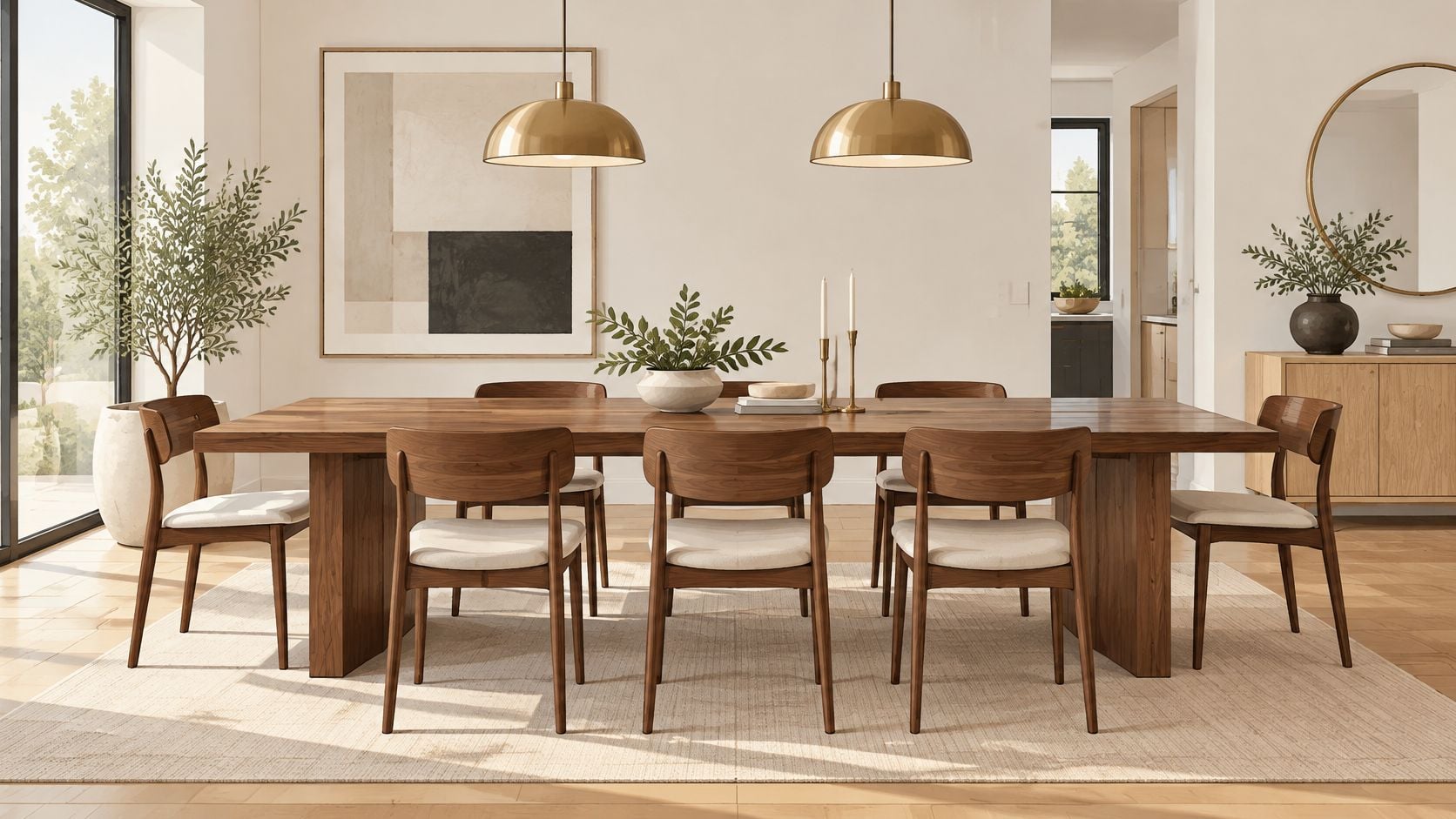
Build the room from the floor upward
For this layout, extending the rug 60 cm beyond each table edge gives a calculated starting size of 4.2 m by 2.3 m. Tape that outline on the floor and pull your actual chairs out to test it.
Deep seats or widely splayed rear legs often need a larger rug to keep back legs supported when someone leans back. Choose a low-pile, tightly woven rug in a neutral tone. It sets the palette, defines the dining zone, and lets expressive walnut grain and sculptural backs stay visible without visual competition. A flat weave also rolls easier under chair feet than a thick pile.
Match undertones, not identical species. Walnut sits comfortably beside white oak, brass and linen in a mid-century scheme. Boucle and warm white walls soften it in a transitional room, while black steel and matte stone sharpen a modern setting. Buy the chair frame for strength and the finish chemistry for your cleaning habits, then let textiles carry the style.
Coordinate the adjoining living space
Carry one shared colour through the sofa, sideboard and dining upholstery. Stop there. Repeating every wood tone and metal in both rooms flattens the look and hides good joinery and weaving.
Select chairs, rug, lighting and textiles as one complete room concept, with attention to natural light and sightlines from the living area. Get the permanent pieces working together first. Then use lighter accessories to finish the setting, and create a welcoming dinner party tablescape without hiding the table material or crowding diners.
Caring for Walnut Chairs Through Years of Meals
Good care is consistent rather than elaborate. Walnut needs gentle cleaning, stable indoor conditions and maintenance products compatible with its actual finish.
A fixed calendar isn't a substitute for the coating manufacturer's instructions. Applying more oil to an unworn surface can leave residue, while conditioning leather with an unsuitable product can change its appearance.
A practical household checklist
- Dust weekly: Use a clean, soft, dry cloth, working along the grain. Grit trapped beneath a cleaning cloth can mark the surface.
- Remove spills immediately: Blot, wipe with a barely damp cloth and dry straight away. Don't treat a timed delay as a safe allowance for water.
- Prevent heat contact: Keep hot cookware away from seats and chair arms. Coasters and placemats also protect adjoining dining surfaces.
- Monitor seasonal dryness: Use a hygrometer and avoid abrupt humidity changes. A winter humidifier can help moderate dry indoor conditions, but the furniture maker's recommended range should guide its setting.
- Renew oil selectively: Refresh hard-wax oil or oil finishes with the specified maintenance product when the surface needs it. Don't mix systems or sand veneer without professional advice.
- Clean upholstery correctly: Follow the fabric cleaning code. Condition leather only with a product approved for that leather type, rather than assuming monthly treatment is necessary.
- Avoid aggressive cleaners: Keep ammonia, steam and silicone-containing polishes away unless the manufacturer explicitly approves them.
Address movement before damage spreads
Inspect accessible fasteners and joints during routine cleaning. Tighten intended mechanical connections carefully, but don't drive extra screws into a loose glued frame or squeeze glue into a finished joint without understanding its construction.
A matched wax repair stick can disguise a small cosmetic scratch on a compatible finish. Structural repairs require a different approach.
A chair that rocks, a joint with a visible gap or a persistent white ring deserves assessment before more force, moisture or polishing is applied.
Critelli Furniture's guide to protecting wood furniture from scratches and stains provides additional preventative-care guidance. A repair specialist should handle unstable frames and damage that doesn't respond to gentle, finish-appropriate cleaning.
Walnut Dining Chair Prices and What They Buy
Judge every walnut chair by cost per seat per year, not by the set price on the tag. A CAD 300 chair that holds its joints and finish for 15 years costs you CAD 20 per year before maintenance. A cheap replacement you toss in three years costs more and wastes your time shopping again.
Use this check before you compare two options:
| Price signal | What it often buys | Demand in writing |
|---|---|---|
| Lower price | Inexpensive substrates, simpler assembly, thinner finish coats | Species, substrate, joint type, coating system |
| Higher price | Better fitted joinery, multi-coat finish, upgraded upholstery | Component list, coat count, repair method, care code |
| Custom quote | Selected fabric or leather, specific finish, included services | Itemized chair spec, upholstery, finish and services |
Styling and distribution also move prices. A higher price supports better joinery and coating in some lines and pays for looks or freight in others. Read the specification. Walnut-finish hardwood belongs in a different comparison from genuine walnut, even when the photographs look similar.
Pay for features that lower total cost:
Material transparency. Solid walnut in the parts that take load and impact. Named veneer substrate and thickness where veneer is correct.
Fitted joinery. Accurately cut and glued connections that stay tight under daily racking. Ask how a loose joint is repaired.
Documented coating. A properly applied multi-coat system with a named repair method. Finish chemistry decides how a chair handles heat, acids and wiping.
Serviceable upholstery. Suitable fabric or leather, replaceable seat components and clear care instructions.
Calculate ownership cost on every candidate. Divide the complete purchase cost by expected years of use, then add delivery, assembly, maintenance and likely repairs. Make CAD 300 per seat your cutoff for incomplete paperwork. If the seller cannot document wood content, joinery and finish, end consideration and move to a chair that can.
Choose Your Walnut Chairs with a Designer
Walk in with numbers and you will walk out with the right chairs. Bring table length, apron height, seat count and a photo of the traffic path around the table. Add two finish samples viewed under your own lighting. That short kit lets a designer match construction, finish chemistry and fit in one pass.
That fit decision is where cost per chair gets real. A CAD 300 seat with thin coating and vague joinery often costs more over ten years than a clearly specified chair with a repairable multi-coat finish. Ask for the build in writing. Ask what the finish resists, how it repairs, and what the upholstery, delivery and assembly add to each seat.
Joseph and Thomas Critelli founded the family business in 1914, according to the Greater Niagara Chamber of Commerce. That long history gives useful context for judging build quality alongside appearance, since dining chairs earn their keep through daily use.
Design help pays off when it stays tied to your room. In-Home Design, Custom Order, Style Guides, Design Advice and Meet Your Designers cover measuring, fabric and leather selection, and coordination of chairs with the table and lighting. Bring your layout and per-chair budget and expect a direct recommendation on solid walnut, quality veneer or a clearly described alternative.
The regional showroom and delivery description no, correct URL is https://www.critellifurniture.com/st-catharines-furniture-store/ identifies service across Greater Niagara, Hamilton and Toronto, with white-glove inspection, assembly, precise placement and packaging removal. Use that final step in your comparison. A set that arrives placed and ready to use carries a different total cost than a set that arrives in boxes.
Bring table measurements, room photographs and finish preferences to begin a practical conversation about a dining room designed for everyday use. Visit Critelli Furniture to talk through walnut dining chairs, coordinated planning and personalised design guidance for the surrounding space.