

White Glove Furniture Delivery: The Complete Guide


A freshly renovated room has a particular stillness before its main furniture arrives. The floors are clean, the lighting has been considered, and the room's proportions are finally ready for the sofa, dining table, or bed that will give it character. Then a truck pulls up, and anticipation quickly turns to concern. Will the piece fit through the doorway? Will the hardwood be marked? Who will remove the packaging, and what happens if the upholstery arrives damaged?
White glove furniture delivery answers those questions through a more complete standard of care. Rather than leaving a pallet at the curb, the service brings the furniture into the home, protects the route, places the piece properly, and completes the final checks. For a homeowner choosing heirloom quality, artisanal, or bespoke furnishings, delivery is not a logistical footnote. It's the final chapter of the design process.
The Moment Your New Furniture Arrives
The engine hums at the end of the drive, and the homeowner watches from the doorway as the delivery team prepares to unload. Inside, a freshly finished living room waits for its centrepiece, perhaps a custom sofa in supple leather or a custom sectional selected after careful consideration of scale, colour, and comfort. The scent of new upholstery mingles with the clean, faintly mineral smell of renovated flooring.
A conventional drop-off can make that moment feel surprisingly ordinary. A driver may leave a pallet near the entrance, signal that the shipment has arrived, and depart while the homeowner is left to solve the difficult part. Moving a substantial sofa across a threshold, protecting a wall corner, and finding the right position can turn a refined purchase into an exhausting household project.

From uncertainty to composure
A white-glove arrival follows a different rhythm. Two uniformed specialists knock, confirm the order, and review the condition of the piece before it leaves the truck. They can discuss the delivery route, identify narrow turns, and confirm that the intended room remains accessible.
Protective runners extend across the hardwood. Wall corners and vulnerable surfaces receive attention before the furniture enters the home. The sofa is handled as a finished object, not as a box to be moved as quickly as possible. That distinction matters when the piece has a solid wood frame, hand-finished surface, delicate upholstery, or a carefully selected finish.
Designer's Insight: Delivery should begin with the room, not the truck. A clear path, measured access points, and an agreed placement plan help the furniture arrive with the same composure it had in the showroom.
The final placement also carries emotional weight. The room's proportions become legible, the rug can be aligned with the seating, and the homeowner can see the design intention as a whole. A delivery team that completes inspection, placement, and cleanup replaces anxiety with relief.
For homeowners considering Critelli's delivery service, that continuity reflects a broader philosophy. Since its 1914 founding, the family-run business has treated furnishings as part of a way of living, not merely as individual objects. The delivery team's work completes the transition from a curated selection in the showroom to a finished room at home.
What White Glove Furniture Delivery Actually Includes
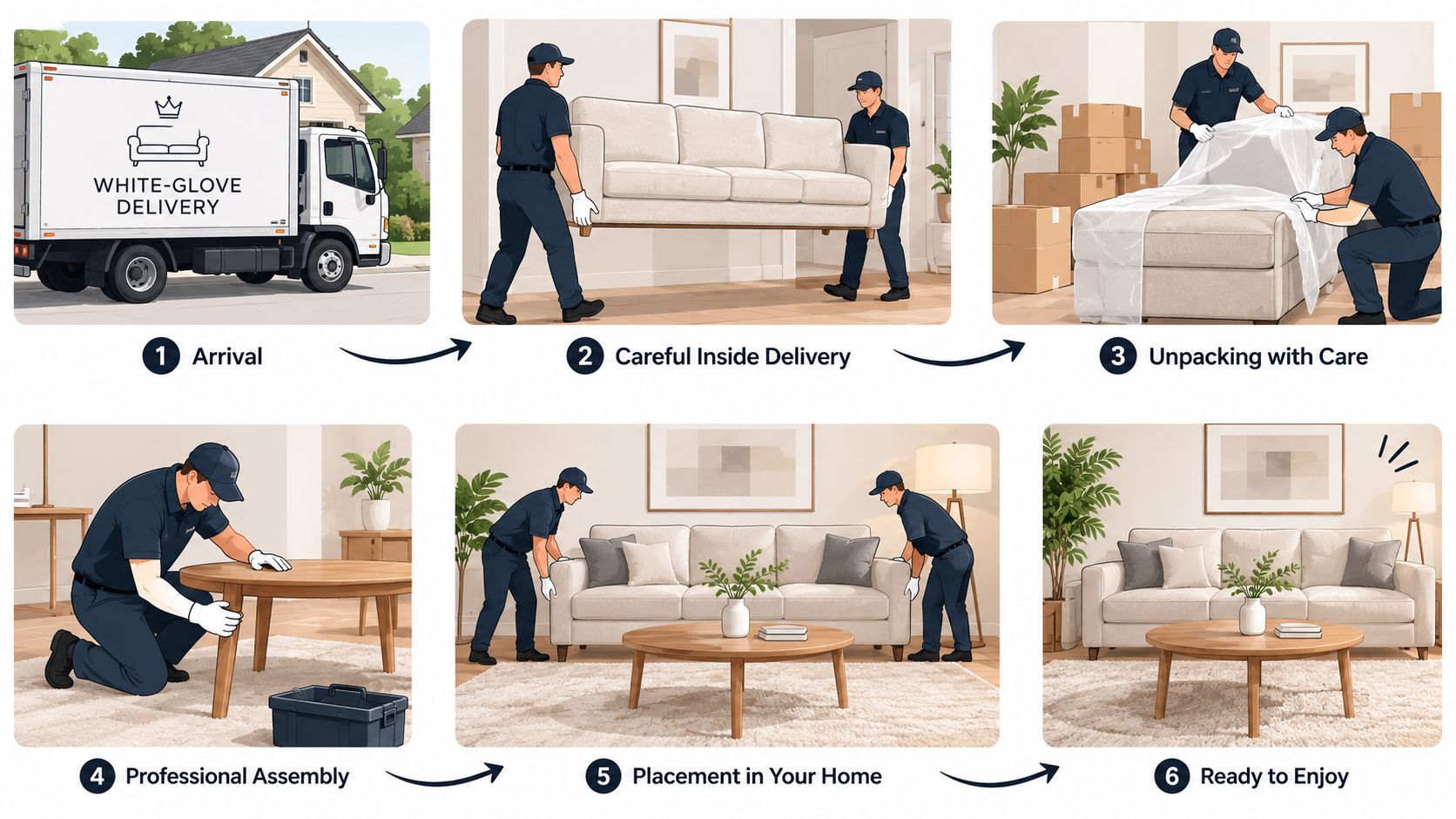
White glove furniture delivery means an end-to-end, in-home service rather than a doorstep handoff. The exact scope should always be confirmed in writing, but a well-defined service generally follows a clear sequence from appointment preparation to final inspection.
The service flow
Pre-arrival confirmation
The delivery provider confirms the appointment window, address, access notes, and the pieces scheduled for arrival. This is the right time to mention stairs, condominium rules, narrow corridors, elevator bookings, or any change to the room where the furniture will be placed.Inspection at the truck
The team examines the packaging and the exposed piece for visible damage before bringing it inside. If an exception appears, it should be recorded before installation or placement begins.Access verification
Doorways, hallways, stair turns, elevator interiors, and landings must accommodate the furniture. A measurement issue can't be corrected by careful handling alone, so access planning remains the homeowner's responsibility as well as the provider's operational concern.Protection of the home
Floor runners, corner protection, and other coverings help shield hardwood, walls, trim, and nearby finishes during movement. The team should also confirm that the path is clear of small tables, artwork, rugs, and other obstacles.Assembly and setup
Depending on the agreed scope, specialists may complete full assembly or minor construction. This can include joining sectional components, attaching legs, assembling a bed, or setting up a dining table. A homeowner comparing service standards may also find this explanation of white glove service for fragile items useful, particularly for understanding why handling and installation are treated as one controlled task.Room-of-choice placement
The furniture is positioned according to the design plan, with attention to wall clearances, circulation, sightlines, vents, outlets, and lighting. Placement isn't just a matter of putting the piece in the correct room. It's the point at which proportion and function are tested in the actual space.Unpacking and packaging removal
Cardboard, foam, protective film, corner guards, and other delivery materials are removed when included in the service. The room should be left ready for use rather than filled with a second project.Final walkthrough
The homeowner and delivery lead review the piece together. Condition, assembly, placement, and any exceptions should be recorded before the paperwork is completed.
What requires separate confirmation
White glove service doesn't automatically include every task inside a home. Electrical work, complex wall mounting, structural alterations, and lighting installation generally require qualified trades. Disposal of old furniture, appliance connections, and extensive relocation of existing pieces should be arranged in advance rather than assumed from the phrase “room of choice.”
Documentation protects both sides. Keep the order confirmation, service description, measurements, photographs, condition report, and signed delivery record together. Clear records make follow-up more straightforward if the promised scope and the completed work don't match.
For a furniture retailer, furniture assembly services should be described with the same care as the product itself. The homeowner deserves to know what will happen at the door before the appointment is booked.
Why Premium Furniture Deserves a Premium Delivery Standard
A premium piece is vulnerable at precisely the moment it leaves the controlled environment of a showroom or workshop. Solid wood frames, hand-finished veneers, marble tops, custom upholstery, and hand-knotted rugs each respond differently to pressure, moisture, impact, and careless positioning. Standard drop-off shipping isn't designed to manage all of those variables inside a home.
Risk begins with access
A custom sectional may need to pass through a condominium elevator, turn through a narrow corridor, and clear a stair landing before reaching the sitting room. A marble-topped table requires stable, balanced handling, while a finished wood cabinet can suffer a lasting mark from an unprotected wall edge or rough threshold.
In dense urban areas, access complexity can add substantial labour and handling exposure. Industry guidance for California notes that hoisting through a window or balcony can add roughly $500 to $2,000 or more when required, because extra labour, rigging, and protection become necessary. The principle applies broadly: the difficulty of the route often matters more than the distance travelled.
Craftsmanship needs informed handling
Artisanal furniture carries evidence of how it was made. Grain direction, joinery, fabric tension, hardware, and finishing layers all deserve attention. A crew moving a piece for flat-pack speed may not approach those details in the same way as specialists who understand that a chair, cabinet, or dining table is a completed work of craftsmanship.
The same principle applies to rugs. A hand-knotted rug should be unrolled carefully, allowed to settle naturally, and aligned with the furniture plan. Treating it as a rolled parcel can create unnecessary creasing or cause the foundation of the room to sit out of balance.
Peace of mind has practical value
Homeowners investing in timeless craftsmanship want certainty at the point of arrival. They want the item selected in the Design Studio to reach the home in the expected condition, fit the intended room, and sit correctly within the composition.
Premium delivery isn't an upsell when it protects the maker's work and the designer's intent. It is the final quality-control stage.
This is why delivery can be understood as an extension of the purchase standard and the care associated with a heritage approach to lifestyle furnishings. The value lies in controlled handling, clear responsibility, and a finished result that honours the original selection.
How Critelli Connects Heritage, Design, and Delivery
A complete room concept begins long before the delivery truck arrives. It may start with an in-home consultation, where a designer studies natural light, architecture, circulation, and the existing pieces that will remain. Fabric, scale, finish, and seating depth can then be considered in relation to the room rather than chosen in isolation.
Critelli's Design Studio treats furniture as part of a broader composition. A sofa may influence the rug size, the rug may establish the room's colour direction, and the lighting may determine how a finish appears throughout the day. The process is design-forward because each selection contributes to the same interior language.
One idea carried through the home
The Rug Market extends that approach to the floor. Based in St. Catharines, Critelli's locations include 126 King Street and 169 St. Paul Street, according to its showroom information published on the Rug Market page. Its philosophy, “Art for Your Floor,” places rugs at the foundation of a room, where colour, texture, scale, and movement begin to relate.
A Toronto-area rug retailer's showroom displays more than 5,000 hand-knotted rugs, illustrating the collector-oriented scale of the Southern Ontario market and the care many homeowners bring to this category through its published showroom information. For a room to feel resolved, a rug can't be treated as an afterthought to the sofa.

Delivery as the closing chapter
When the furniture arrives, the original plan still matters. Placement can follow the layout developed during consultation, while rug alignment, wall clearances, and final styling checks preserve the relationship between each element.
That continuity is particularly useful across the Greater Niagara, Hamilton, and Toronto markets, where a homeowner may otherwise move between a showroom designer, a custom producer, and an unrelated courier. A single standard of care reduces the chance that information about access, scale, finish, or placement will be lost between handoffs.
A family-run design house founded in 1914 brings a heritage of service to this final moment. The furniture isn't delivered to an address. It is received, positioned, and considered within the home it was chosen to shape.
Pricing, Financing, and the True Cost of White Glove Service
A new dining table may require more than a truck and a drop-off point. White glove delivery carries the piece into the home, protects surrounding surfaces, assembles it when required, and leaves the room ready for use. Canadian published rates commonly fall between CAD/USD 100 and 250 per delivery, while some residential furniture delivery services are quoted between CAD/USD 300 and 800, depending on scope, as outlined in this Canadian furniture shipping guide.
Ontario examples show how providers may separate service by distance and level of work. Published offers can begin at $189, with fixed rates including $359 for local delivery, $679 for extended delivery, and $1,299 for national delivery. These amounts are examples rather than universal quotations. Geography, item complexity, access conditions, and the amount of in-home work shape the final figure.
The factors behind the quote
| Cost Factor | Typical Impact | Why It Matters |
|---|---|---|
| Access difficulty | May increase the quoted service | Stairs, narrow turns, elevators, and restricted entries require more planning and labour |
| Item weight and dimensions | May require specialised handling | Large or heavy pieces can need a two-person crew and additional protection |
| Assembly scope | Raises labour when installation is extensive | Joining multiple components takes longer than placing a finished item |
| Packaging removal | Adds handling after placement | The team must sort, collect, and remove protective materials |
| Scheduling requirements | Can affect availability and price | Building windows or special appointment needs may limit routing options |
The quote reflects what the delivery protects. A hardwood floor, plaster wall, marble edge, or heirloom-quality piece can be costly and difficult to repair after an avoidable impact. White glove service may also replace several separate arrangements, including labour, tools, transportation, and disposal.
The work functions like the final fitting of a carefully designed room. After a century of design service, Critelli treats delivery as part of the same care that guides furniture selection, in-home consultation, and the Rug Market philosophy: each element should arrive ready to belong in its setting.
Financing the complete room
Delivery may sit within the overall furniture budget, form part of a design package, or be paid as rooms are completed. Staged purchasing can suit a larger home project when the living room, dining area, bedroom, and rug selections need to develop in sequence.
Financing terms and eligibility vary. The purchase agreement should state whether delivery is included, charged separately, or added during scheduling. Information about furniture financing in Canada helps homeowners assess the full project cost instead of treating delivery as a surprise at the end.
Before signing, request an itemised scope, access review, assembly definition, packaging and old-furniture terms, and any surcharge limits in writing. A clear agreement makes the service easier to understand before the first piece enters the home.
Your Consumer Protections When Delivery Goes Wrong
The delivery crew has left, the wrapping is coming off, and a mark appears on the table edge. Or the truck arrives late enough to disrupt installers and other trades. A previously checked doorway may also prove too narrow. In each case, a calm record gives the homeowner a clearer path to a remedy.
Photograph the packaging before it is removed, then capture the furniture, surrounding room, floors, walls, and any visible damage. Ask the delivery lead to note exceptions on the condition report before anyone signs. Keep the order confirmation, promised dates, measurements, messages, and signed paperwork together.
A measured escalation path
Begin with the delivery lead while the crew remains on site. Request a written incident note and ask what action follows, such as inspection, repair, replacement, or a revised delivery arrangement. Send the same photographs and documents to the design consultant, then contact the retailer's customer service or head office if the matter remains open.
The retailer arranged the sale and delivery, so responsibility does not vanish because a third-party courier performed the physical work. The agreed service terms, promised information, and record of the appointment help establish what was offered and what occurred.
Ontario consumer guidance recommends complaining to the business in writing first, then filing a complaint with the province if the issue is not resolved. The province says it will contact the consumer within 15 business days through its consumer complaint process. CBC has also reported that, under Ontario's Consumer Protection Act, when no delivery date is specified and 30 days pass, a consumer can cancel before delivery and obtain a refund, even where an item was marketed as final sale in its reporting on Ontario delivery rights.

Confidence comes from records
Complaint information also shows why written promises matter. BBB pages report 324 total complaints in three years for Leon's and 23 for The Furniture Depot, while CBC described nearly 700 BBB complaints in one year related largely to delivery delays and communication failures involving Bad Boy in the same report.
Documentation is not an adversarial gesture. It is a practical account of the purchase, the promised standard, and the condition in which the furniture reached the home. That record helps a homeowner seek a fair response without relying on memory or an informal conversation.
Common Questions About White Glove Delivery in Southern Ontario
Will the crew disassemble and reassemble bedroom furniture?
The answer depends on the written service scope and the piece itself. Assembly may include joining a bed frame, attaching legs, or connecting sectional components. Complex modifications, structural alterations, and wall mounting usually require separate arrangements.
Before scheduling, provide product dimensions and photographs of the access route. If the item must be partly disassembled to pass through a doorway, confirm that requirement in advance. The crew should not have to discover the problem at the appointment.
Does packaging and debris removal come with the service?
White glove delivery often includes unpacking and removing packaging, but the agreement should identify what that covers: cardboard, foam, plastic, corner protection, and pallets. Removal of old furniture is a separate service and should not be assumed.
This small distinction affects the final room. A clear description states what leaves with the crew and what remains with the homeowner, which matters especially after a renovation when the space should be ready for use.
How are condominium elevator bookings handled?
Condominium and apartment buildings may require an elevator reservation, a delivery window, loading access details, and information about freight restrictions. The homeowner or design team may need to coordinate those requirements before the retailer confirms the appointment.
These procedures apply across the Greater Toronto Area, including Toronto and Mississauga, and extend to Hamilton and the Greater Niagara region. A lobby or loading-bay handoff may belong to a lower service tier, while room-of-choice placement depends on confirmed building access. Canadian service guidance distinguishes threshold, inside, and white glove levels, and building rules can change what the appointment includes as described in this overview of white glove tiers.
How long does the process take?
Timing follows several moving parts: stock status, custom production, route planning, access approvals, and the agreed appointment window. Made-to-order upholstery, custom finishes, and special-order mattresses require different scheduling from an in-stock accent chair or ready rug.
Ask the retailer to record the anticipated delivery window, the conditions that could change it, and how delays will be communicated. Some service offerings advertise delivery within five working days, while others use regional tiers and scheduled windows. A written date or range gives the homeowner a useful record if plans change.
Hamilton-area homeowners can review delivery service in Hamilton, Ontario alongside the order's access requirements, assembly scope, and placement expectations. That preparation connects the final delivery to the same care given during selection and in-home consultation.
Critelli Furniture brings together a curated selection, Design Studio guidance, artisanal rugs, and white-glove placement for homeowners across Southern Ontario. Visit Critelli Furniture to arrange a complimentary design consultation, experience the craftsmanship in person at the King Street Showroom, or visit the Rug Market to find your room's foundation.