
Accent Tables for Living Room: Sizes, Shapes and Styling

The evening has settled, the lamp is on, and a glass needs somewhere to land. If the table beside the sofa sits too low, too far back, or just beyond a comfortable reach, that small moment becomes an awkward stretch, a spill risk, and a daily irritation. The right accent tables for living room use solve reach first, then add heirloom quality, colour, and character to a complete room concept.
Accent Table Sizes for Every Seat in Your Living Room
Height matters more than finish because a beautiful table at the wrong height won't be used well. Start from the seat it serves, measure the arm or seat height, and choose a top that lets a hand move sideways rather than down or up. That single decision determines whether the piece feels bespoke or merely decorative.
| Placement | Recommended height and footprint | Fit rule |
|---|---|---|
| Beside a sofa arm | 560-660 mm high, compact top beside the arm | Top within 50 mm of arm height |
| Beside an armchair | 500-600 mm high, sized to the chair | Top within easy reach from the seat |
| In front of a sofa (cocktail table) | 380-460 mm high, 900-1,200 mm long | Knees clear without a reach |
| Behind a sofa (console) | 700-760 mm high, long and shallow | Stays below the sofa back |
| Nesting set | Largest 500-560 mm, smallest 350-400 mm | Each table steps down and tucks cleanly under the next |
Beside Sofas and Armchairs
Beside a sofa arm, keep the top within 50 mm of the arm height, which usually means 560-660 mm. A top level with the arm lets a reader set down a drink without lifting the shoulder or hunting below the arm. Beside an armchair, 500-600 mm suits most seats, provided the reach stays short when the sitter leans back.
Seat comfort affects that reach. A cushion that has dipped changes shoulder position, so it's worth checking whether it's time to improve support beneath sagging cushions before blaming the table. Correct the seat first, then set the table height against the restored sitting position.
Cocktail Tables and Consoles
A cocktail table in front of a sofa should sit at 380-460 mm high and 350-450 mm from the sofa front. That gap clears knees when someone stands, yet keeps a tray close enough to reach without leaning forward. A length of 900-1,200 mm serves a typical sofa without crowding the ends, and the detailed proportions in a coffee table size guide help refine length against a specific seat.
Behind a sofa, a console should top out around 700-760 mm and stay below the sofa back. Anything taller interrupts sightlines and makes lamps loom over the seating. A shallow console also protects the walkway behind the sofa, which matters in open plans where that route leads to a dining area or door.
The Cardboard Template Test
Before shopping, cut cardboard to the proposed footprint and tape it on the floor. Stack books or boxes to the proposed height beside the intended seat, then sit down with a drink, a book, and reading glasses. If a shoulder lifts, a wrist twists, or a knee catches the edge, the size is wrong regardless of how artisanal the finish looks.
Practical rule: Test height from the seated position, not while standing in a showroom, because reach changes completely once cushions compress.
Checking Clearances for Mobility and Recliners
A guest with a walker heads for the armchair, the footrest is already out, and the side table sits in the only straight line through the room. The plan looked balanced. The daily route does not.
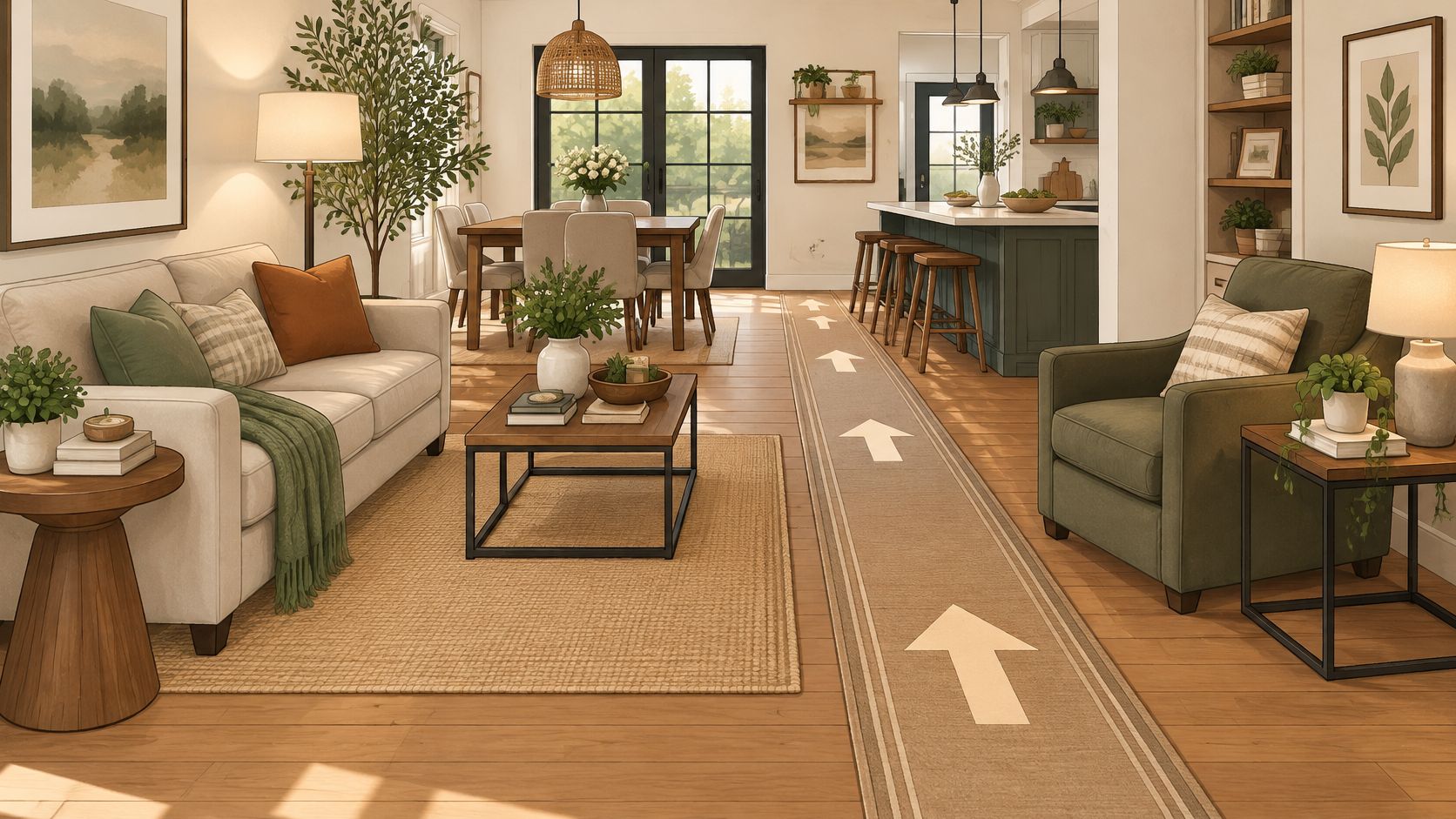
Judge every accent table by reach, clearance, and how people move once the seat is in use. Symmetry on paper will not tell you that. The Canada Mortgage and Housing Corporation guidance recommends a continuous accessible route at least 915 mm wide throughout living spaces and a clear floor area of at least 760 x 1,200 mm in front of furniture and switches. Higher accessibility performance calls for a larger stationary clear floor space and a full turning circle for wheeled mobility devices. Place the side table outside that approach zone, or keep the top compact enough that the rectangle stays open when the seat is occupied. The table is one piece of the room, not a free-standing object you drop in after the sofa is set.
Four Checks Before Buying
- Tape the footprint: Mark the full table outline, including any leg spread or pedestal flare, on the floor with painter's tape.
- Measure the narrowest point: Check the remaining route between the taped outline and the nearest sofa, wall, or rug edge. If that gap falls under the route width above, the table is too big or too far out.
- Test the furniture in motion: Fully extend the recliner, occupy the sofa, and confirm the table does not trap a footrest or block a transfer. Where the wall is close behind the chair, a wall hugger recliner keeps the mechanism from eating the clearance you just measured.
- Confirm the reach: Sit back fully and lift a glass from the proposed spot without leaning sideways or gripping the arm for support. If the wrist twists, move the table closer or lower, not farther into the walkway.
Matching the Check to the Household
A recliner changes its envelope while someone uses it, so the closed position proves nothing. Extend the footrest, recline the back, and only then decide whether a table edge crowds the calves or forces a twisted reach. A pedestal base usually wins here: feet and the mechanism gain room underneath, while a four-leg frame catches a heel on the way down.
For an older occupant, stability outranks a delicate silhouette. A slightly larger, steady table set outside the main path is safer than a featherweight pedestal that shifts when a hand leans on it. Rounded corners, a low centre of gravity, and a top that does not rock matter more than a slim profile.
For a guest using a walker or wheelchair, protect the turning space and leave the approach rectangle empty. In an open room with two walkways, set tables inside the seating group rather than on its corners, where they become obstacles on both routes. Ten minutes with tape answers the question before the order does.
Matching Shape and Type to Daily Use
Traffic should choose the shape before taste chooses the finish. Walk the room at normal pace, carrying a tray or a laundry basket, and notice where hips turn, where children cut corners, and where a dog settles. Tables placed against that evidence get bumped, avoided, or moved within a month.
Shape Follows the Walkway
Round tops soften tight corners and suit open-concept rooms with a walkway through the middle. They remove the sharp point that catches a thigh and they let people angle past without a sidestep. Beside a single armchair, a round side table also forgives imperfect placement because every edge sits at a similar distance from the sitter.
Square tops fit neatly into the corner between two chairs, where their straight edges use dead space without visual bulk. They hold a lamp base squarely and give two sitters a shared surface. The risk appears when a square corner projects into a route, so square pieces belong tucked into a corner, not floating at the end of a sofa beside a doorway.
Rectangular and oval tops echo a long sofa. A rectangle maximises usable surface for trays and books, while an oval keeps that length but removes the corners nearest passing legs. In a narrow room, an oval cocktail table often feels calmer because movement flows around it instead of stopping at four points.
Organic silhouettes add character and can balance rectilinear sofas and cabinetry. They can also hide a fragile or narrow base under an expressive top. Press down on the widest overhang, set a full mug near the edge, and nudge the piece from two directions before buying, because sculptural charm doesn't excuse a wobble.
Three Questions That Settle the Type
Ask who sits beside the table, what will sit on it, and how often it will move. Those answers separate a curated selection from a showroom arrangement. A table for one reader needs reach and lamp space, a table for entertaining needs load capacity and spill tolerance, and a table that moves weekly needs a weight one person can manage without dragging the feet.
A piece that serves two purposes should be sized for the heavier job, then styled down for the lighter one.
A side table serves the person beside it, holding a lamp, a drink, and a book within one easy movement. Reach matters most, and surface area comes second. The classic mismatch is a short, delicate side table beside a deep recliner, where the glass ends up below and behind the sitter's hand, effectively out of use.
An end table at the end of a sectional serves a longer line of seating. It needs room for a lamp plus a second landing spot for a phone or remote, ideally with a lower shelf or drawer so the top stays clear. Choose one too small and objects migrate onto cushions, which signals a sizing failure rather than a tidiness problem.
Anchor Pieces and Flexible Pieces
A cocktail table anchors the room. It carries trays, books, board games, and, in many homes, feet, so the top must survive spills and knocks without complaint. A glass top used as a footrest will chip at the edge and show every scuff, making it the wrong anchor for a relaxed family room however light it looks in photographs.
A console behind a sofa displays objects and holds lamps at a useful height. It's also the piece most likely to be bumped from behind, especially where a hallway runs along the sofa back. Favour a sturdy base, a depth that keeps lamp cords controlled, and enough weight that a brush past doesn't send objects sliding.
Nesting tables suit homes that host often or have little floor space, because extra surfaces appear for guests and disappear afterwards. Flexible sets such as nesting side tables work best when each table stands firmly on its own, not only when nested. A set chosen purely for display, with spindly legs and tiny tops, won't carry a tray of drinks, so test the smallest table with real weight before committing.
Finish with a movement test. Walk the main route with a hand resting lightly on each table edge and note where the body naturally steps, turns, or hesitates. If a table forces a detour, catches clothing, or sits just beyond the seated hand, change the shape or type now, because daily use will only make that friction more obvious.
Materials and Finishes That Hold Up Over Decades
Longevity should lead the material decision, with surface beauty as the reward rather than the starting point. A design-forward table that can't be repaired, refinished, or kept stable through winter heating and summer humidity isn't a lasting value. Read the comparison as an ownership question, asking what each material asks in return for what it gives.
| Material | Strengths | Trade-offs |
|---|---|---|
| Solid hardwood | Can be sanded and refinished after years of use | Heavier and higher cost |
| Veneer on stable core | Rare grain at a lower cost | Thin veneer cannot be refinished more than once or twice |
| Stone top | Resists heat and rings | Heavy, and edges can chip |
| Metal frame | Durable and suits slim profiles | Finish can scratch; cold to the touch |
| Glass top | Light visual weight | Shows fingerprints and can chip at the edge |
| Engineered panel | Stable and affordable | Needs sealed edges and emissions documentation |
Wood, Stone, Metal, and Glass
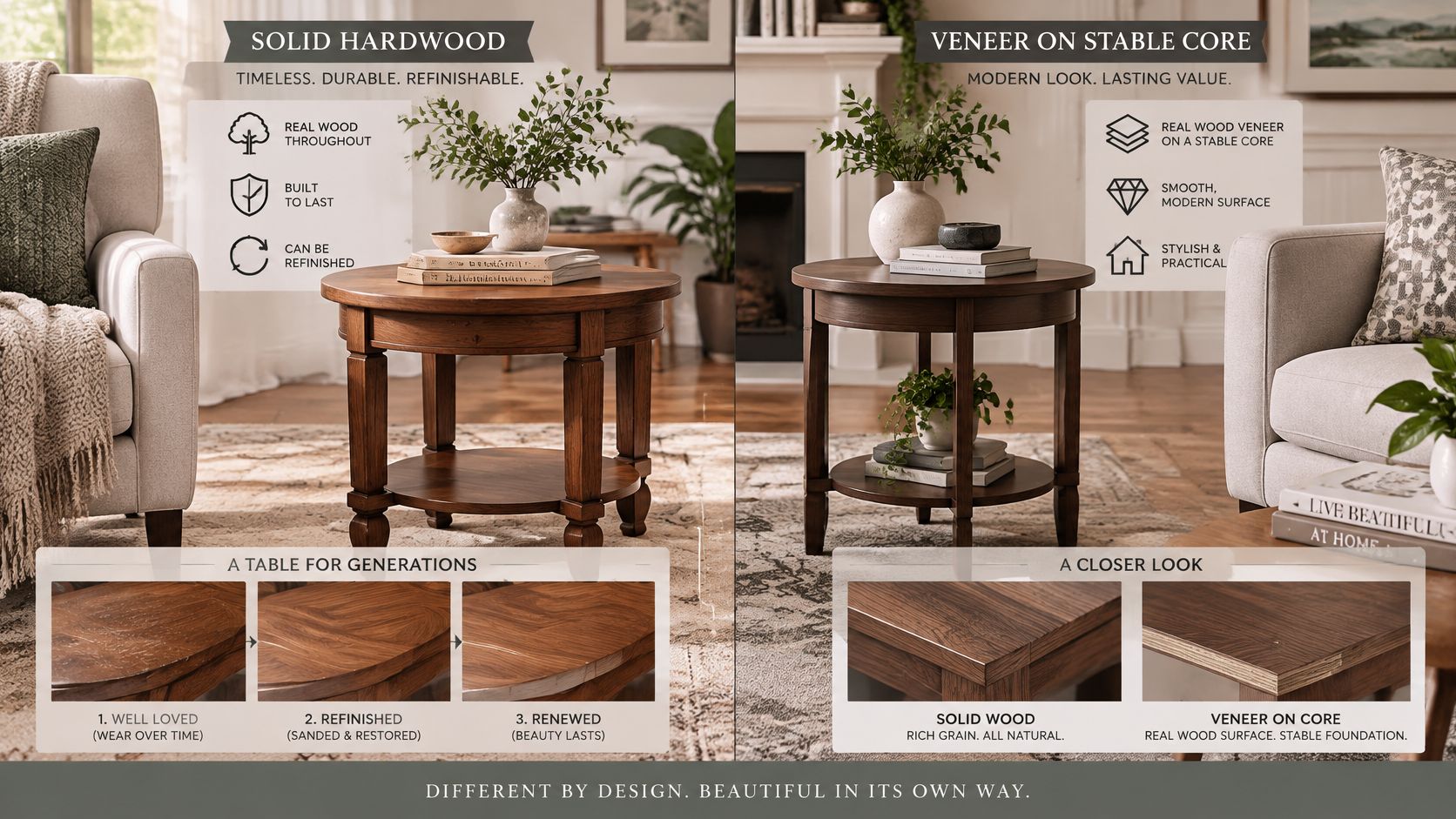
Solid hardwood remains the strongest long-term choice because rings, dents, and worn edges can be sanded back and refinished. For households comparing construction quality, solid wood furniture provides a useful benchmark for joinery and repairability. Veneer over a stable core offers rare grain at lower cost and resists movement well, but a thin veneer allows only one or two careful refreshes before the substrate shows.
Stone resists heat and drink rings, yet weight complicates moving and a dropped object can chip an edge. Dramatic natural stone, seen in Brazilian sodalite accent furniture, shows how colour and veining can carry a quiet room, provided the base and floor suit the load. Metal frames deliver slim, durable profiles but can scratch and feel cold beside upholstery, while glass keeps a small room visually light at the price of fingerprints and vulnerable edges.
Indoor Air and Finish Transparency
Engineered panels and finishes need documentation, not vague assurances. The Health Canada residential indoor air quality guideline for formaldehyde sets a one-hour exposure limit of 123 µg/m³ (100 ppb) and an eight-hour limit of 50 µg/m³ (40 ppb). Health Canada identifies particleboard and other adhesive-containing materials, along with varnishes and paints, as potential indoor formaldehyde sources.
Ask three questions before buying. Which panel substrate and adhesive are used in engineered parts, is emissions documentation available, and which finish system is applied, with a low-VOC option where possible. Ventilate a newly finished table during unpacking, avoid placing it immediately in a small closed room, specify sealed edges on engineered panels, and fit felt or non-marking feet so moves don't scrape finish and expose substrate.
Caring for Your Accent Table Over Time
The first week sets the habit. A drink lands within easy reach, a lamp gets nudged toward the sofa, and the table shifts a fraction when someone stands. Write down the material, the finish system, and any care product that arrived with it, then file that note with the household manuals. Years later a restorer matches colour from that record, not from a faded memory.
Wood and Veneer
Solid hardwood can take a light sand and a fresh topcoat once rings build up. Schedule that work before the finish wears through to bare wood, or the job turns into stain correction. Coasters under glasses and a pad under the lamp base push that appointment back by years.
Veneer fails at the edges long before the centre looks tired. Keep it clear of heat registers and hard afternoon sun, the two spots that open joints and crack a finish. After the heating season, feel the perimeter for a lift. If you find one, stop setting drinks on that corner and have the edge re-glued before the next move of the table pulls the seam wider. Polish will not close a joint that daily reaching has already stressed.
Stone, Glass, and Bases
Clean stone and glass with a soft, pH-neutral cloth. Skip abrasive pads. They dull polish and leave a haze that shows under lamplight. Wipe a spill the moment it lands, and lift a tray instead of dragging it across the top. Felt under a ceramic lamp or a metal sculpture stops the fine scratches that collect where your hand reaches every evening.
Twice a year, tighten the fixings on a metal frame or pedestal and check that the glides sit flat. Replace compressed felt pads, or the table drifts out of its clearance and scuffs the floor on every sit-down. With coasters on the top and fresh pads underneath, the finish stays intact through ordinary daily use instead of being replaced with the next trend.
Styling Accent Tables as Part of a Complete Room
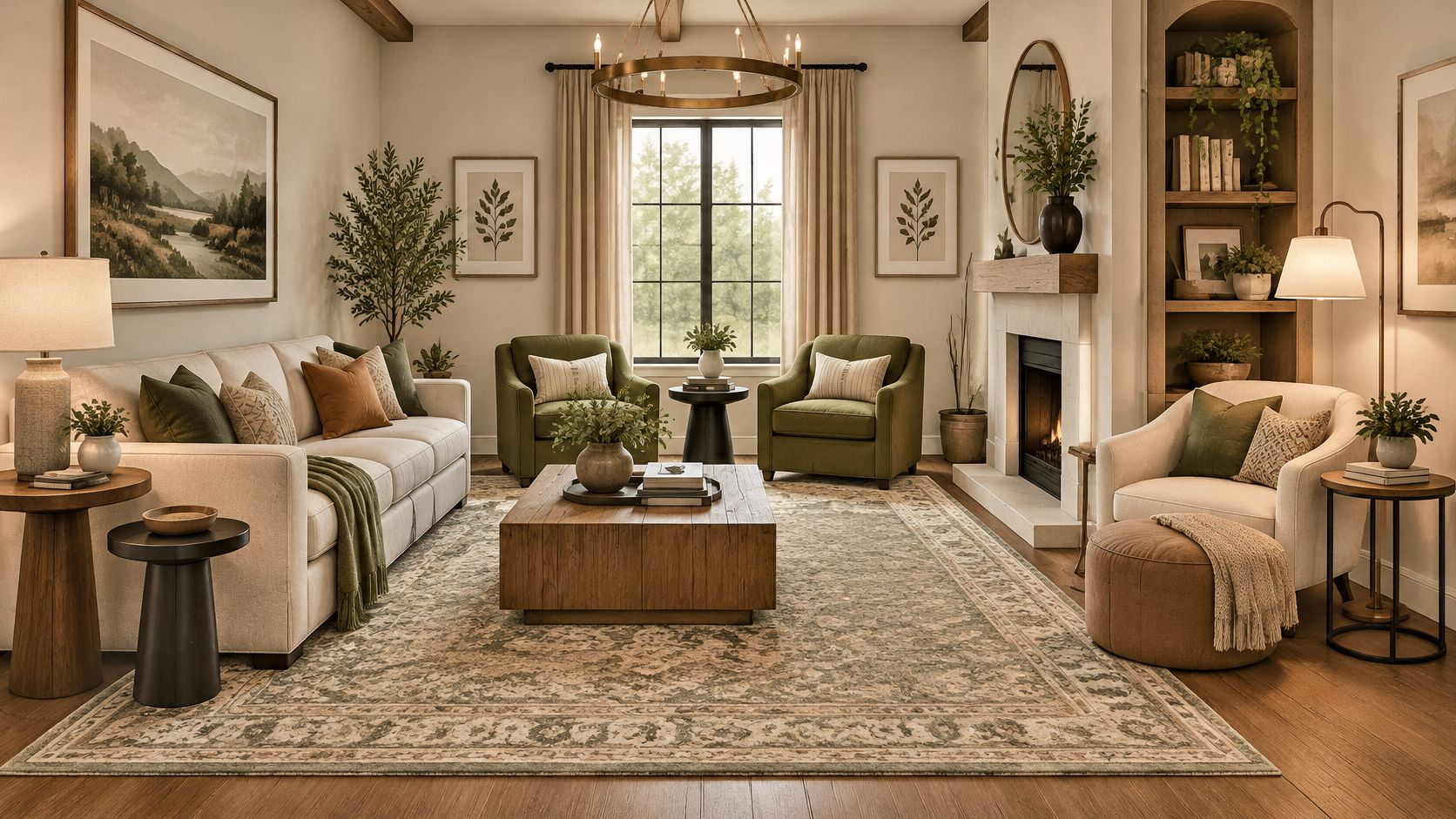
An accent table earns its place inside a complete room concept, coordinated with seating, rugs, lighting, scale, and circulation rather than styled in isolation. Critelli Furniture describes a personalized design experience intended to help customers create a home unique to them, with a process beginning in conversation and continuing through final placement in the home. That framing suits accent tables perfectly because their success depends on everything around them.
Three Compositions That Work
A long sofa flanked by two side tables of different heights feels collected rather than matched, provided each top sits slightly below or level with the arm. One side can carry a lamp and books, the other a smaller sculptural piece and a drink landing. Related finishes, rather than identical ones, keep the pairing calm.
A cocktail table anchored on a rug ties a seating group together when the front legs of sofas and chairs sit on the rug as well. Rugs deserve treatment as Art for your Floor and as the foundation of the room, setting colour, pattern scale, and the boundary of conversation. Guidance on layering furniture and decor to complete a room helps sequence those decisions so tables land on a foundation that already works.
Designer's Insight: Our designers suggest pairing a bold Hancock & Moore leather with a neutral hand-knotted wool rug to balance the room's energy.
A leather armchair, a side table, and a lamp repeating a metal finish from the table base create a quiet reading corner. Group objects in odd numbers, vary heights by 150-200 mm, and keep one functional object plus one decorative piece on each surface so styling never blocks use. A small plant adds softness, and those wanting to find inspiration for styling houseplants can adapt scale and placement ideas to a tabletop without crowding it.
Step back to the doorway for the final check. The eye should land first on the seating group as a whole, then move across lamp, table, and rug without snagging on clutter or a table that floats outside the arrangement.
Confirm Your Table Before You Order
You are one signature away from a table that looked right in the showroom and fights the sofa at home. Keep the tape, the cardboard outline, and a full glass of water in play until the last decision. Showroom scale lies. The glass does not.
The Three-Item Purchase Check
- Reach and height: The top sits within 50 mm of the sofa arm, or at a comfortable seated reach beside a chair, with no shoulder lift or sideways lean.
- Footprint and route: The taped outline preserves the walkway, recliner movement, and approach space, with the table stable under a leaning hand.
- Material and daily load: The surface suits the household's drinks, children, pets, heat, and moving habits, with finish and emissions questions answered clearly.
Order only when all three pass in the actual room, not on a floor plan. A top that meets the arm still fails if the recliner footrest clips it, or if the path to the kitchen shaves a corner every evening. Set the glass down, lean on the edge, and walk the taped outline once with the chair in its usual spot. If any of those three moves feels tight, choose a smaller footprint or a different height before you commit.
Treat the table as one piece of the seating group: reach from the seat, clearance for daily movement, and a surface that can take the load beside the lamp and the rug.
Critelli Furniture offers In-Home Design, Custom Order, Style Guides, Design Advice and Meet Your Designers, and its designers work across the whole space, from architectural lighting to hand-knotted rugs. White-glove delivery then places the table where you measured it, across Greater Niagara, Hamilton, and Toronto.
For an accent table chosen by reach, clearance, and material rather than by photograph alone, Critelli Furniture offers room design guidance and the Rug Market to ground the arrangement. Visit the Rug Market for the floor, then book a complimentary design consultation and confirm every measurement before you order.