
Accent Chair High Back: Choosing the Right Fit and Style


The chair in the photo looked perfect for the reading corner. In the room, the back crossed the window, the seat left your heels off the floor, and the path to the kitchen had to squeeze past one arm. That is a familiar afternoon in Southern Ontario, whether the room is a narrow condo toward Toronto, a Hamilton semi, or a house in the Greater Niagara with a heating register right where the chair wants to sit.
An accent chair high back is a posture decision and an architectural one. The tall back can hold you through a long conversation, or it can block a sightline, a register and the walk through the room. Colour and silhouette come after those checks. A curated selection of heirloom quality seating is worth that patience, because timeless craftsmanship shows up in the frame and the cushion long after the first impression fades.
The Dimensions That Make a High-Back Chair Comfortable
A high back only supports you well when the seat fits first. Measure the person who will use the chair most, then check seat height, width and depth before judging the backrest.
| Measurement | Working guideline | Why it matters |
|---|---|---|
| Seat height | 38–51 cm (15–21 in); about one-quarter of body height as a starting estimate | Feet rest flat and thighs are unpressured |
| Seat width | At least 45 cm (18 in) | Room to shift position without the arms pinching |
| Seat depth | Two to three fingers of clearance behind the knee | The back can meet the lumbar support |
| Backrest height | Around 45 cm (18 in) or more | Gives the upper back a surface to meet |
| Backrest width | Around 35 cm (14 in) or more | Allows the back to rest against the chair |
| Lumbar support position | About 15–25 cm (6–10 in) above the seat | Places support near the lower-back curve |
| Torso-to-thigh angle | Aim for 90 degrees or more | Keeps the posture open rather than folded |
Seat height, width and depth
The Canadian Centre for Occupational Health and Safety gives approximately one-quarter of the user's body height as a starting estimate for seat height. The figures in the table are working guidelines, not a substitute for trying the chair. Feet should rest fully on the floor in normal footwear, with the thighs supported and no pressure behind the knees.
Seat width gives the sitter room to shift without the arms pressing into the hips. For depth, leave about two to three fingers between the seat edge and the back of the knee. A deep seat can push a shorter sitter forward, leaving the lower back unsupported. Use this guide to measure seat depth before narrowing your choices.
Back, lumbar support and open posture
Use the backrest and lumbar figures as practical starting points. A backrest around 45 cm (18 in) high and 35 cm (14 in) wide gives the upper back room to rest against it. Position lumbar support roughly 15–25 cm (6–10 in) above the seat, then check that the torso-to-thigh angle remains open, around 90 degrees or more.
Practical rule: Record the intended user's seat height and body height, then compare those measurements with each chair's published specifications.
A chair should let its primary user sit back with feet supported, rather than slide forward to reach the floor.
Matching Chair Scale to Your Room
A high-back chair is a visual anchor as well as a seat. Placed without a plan, it can dominate a living room the way a tall cabinet does, even when the footprint looks modest on paper.
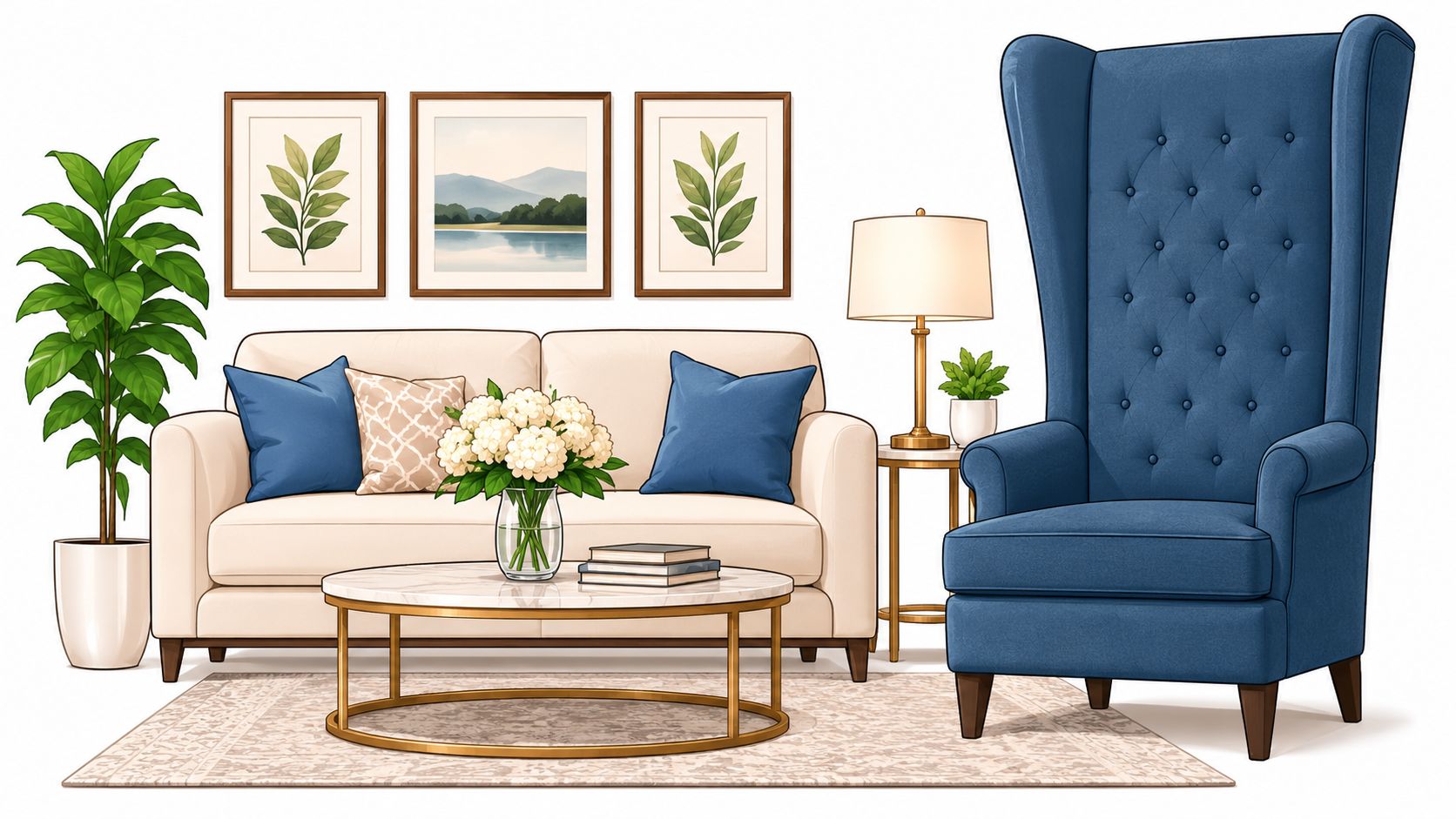
A solid upholstered back adds strong visual mass. It reads as architecture, which is welcome against a plain wall and heavy in a room that already has a large sofa. A tapered or open frame keeps sightlines to windows, artwork and the rest of the seating group. One statement chair can suit a compact condo or a narrow room when the footprint, the swivel arc and the walking path are drawn before the fabric is chosen.
| Space | Placement that works | Check before ordering |
|---|---|---|
| Living room | Angled toward the sofa and a window, out of the main walkway | Keep the path clear and the chair off any heating register |
| Bedroom | Corner beside the reading lamp and bedside table | Room to rise from the chair without hitting the bed or wall |
| Reading corner | Near natural light with the back out of the reader's line of sight to the window | Test the lamp angle at reading height |
| Condo or narrow room | One chair with a tapered or open frame placed off the main circulation path | Measure the footprint and turning arc with tape on the floor |
| Home office | Beside the desk rather than directly behind the user | Check the back does not block a wall outlet or artwork |
What the back interrupts
Walk the intended spot and ask three questions. Does the back cut a window, a picture or a heating register? Does the turning radius cross the path people already use? Can someone pass behind a seated guest without turning sideways?
In a living room, angle the chair toward the sofa and a window, and keep it off the main walkway. In a bedroom, the corner beside the lamp works only if rising from the seat doesn't strike the bed. A reading corner wants the light in front of the reader, not a tall back between the eyes and the glass. A home office chair belongs beside the desk, not directly behind the user, where it hides an outlet or a framed piece.
The floor-tape test
Before any bespoke upholstery is ordered, mark the footprint with painter's tape. Sit in natural light and see how the chair sits beside the existing rug and lamp. Then mark how far a modest recline travels, and confirm the back doesn't meet a wall, a sill or a register. Careful residential space planning treats that tape as the decision, not a formality.
A single open-frame chair, set off the circulation path, often does more for a small room than two smaller seats jammed into the walkway.
Frames, Joinery and Cushioning That Last
A high back is a lever. When someone leans, swivels or drops into the seat, the force travels into the joints. A pretty silhouette on a weak frame racks, creaks and loses its square within a few seasons.
What to inspect
Look for a hardwood or engineered frame with mortise-and-tenon or corner-blocked joints. A spring base should hold its shape under seated weight rather than collapsing into a hammock. Seat foam should be dense enough to keep its height after years of daily use. Soft foam feels plush on day one and leaves you sitting on the deck by year three.
The back's contour is part of the structure, not only the look. A supportive curve should meet the lower back. The upper section should support the shoulders without pushing the head forward. Compare that build with the joinery associated with Stickley and Hancock & Moore, which remain the benchmark for a buyer who wants the frame settled before the cover is discussed. Pieces in that class sit naturally among quality living room furniture chosen for daily use, not for a single photograph.
A three-part showroom check
- Rock the chair gently and listen for creaks at the joints.
- Press the back firmly and feel for flex or give that doesn't return.
- Sit and shift your weight side to side. The frame should stay steady while you move.
Ask the maker about frame material and joint method before you compare fabrics. Structure first, finish second. If a wood show-wood frame will be repainted later to match trim, J.R. Hardwood's furniture painting guide is a useful reference for sanding and coating furniture without damaging the joints underneath.
A chair that creaks in the showroom will not grow quieter at home.
How to Test a High-Back Chair in the Showroom
A high back affects posture, sightlines and circulation, so test how it works in the room as well as how it feels. Set aside about ten minutes and use the dimensions you recorded earlier to choose a chair worth sitting in.
- Sit fully back in the chair. A forward perch can hide whether the seat depth and back height suit you.
- Stay in your usual sitting position and notice whether the chair supports you without forcing you to hold yourself upright. Use the earlier measurements as a guide; focus now on how the chair feels in motion.
- Recline to about 110 degrees. The Prince Edward Island Public Service Commission's office ergonomics guide recommends a reclined backrest that supports varied postures and avoids localized pressure. Check whether your feet remain supported and the headrest stays comfortable.
- Turn and reach as you would to pick up a book or set down a drink. The back and side wings should not restrict your shoulders or make ordinary movement awkward.
- Sit for ten to fifteen minutes. A brief showroom sit can flatter a chair that becomes tiring over time.
- Check your sightline from the seat. The chair should not block a view or dominate the room's main passage when placed where you intend to use it.
What a good fit feels like
You should be able to settle without repeatedly shifting to find support. Pressure behind the knees, restricted movement or a headrest that pushes your chin forward are reasons to try another shape.
Have the person who will use the chair most try it too. A chair that suits one person may not suit another, even when the room and measurements are the same.
Pairing Your Accent Chair With Sofas and Rugs
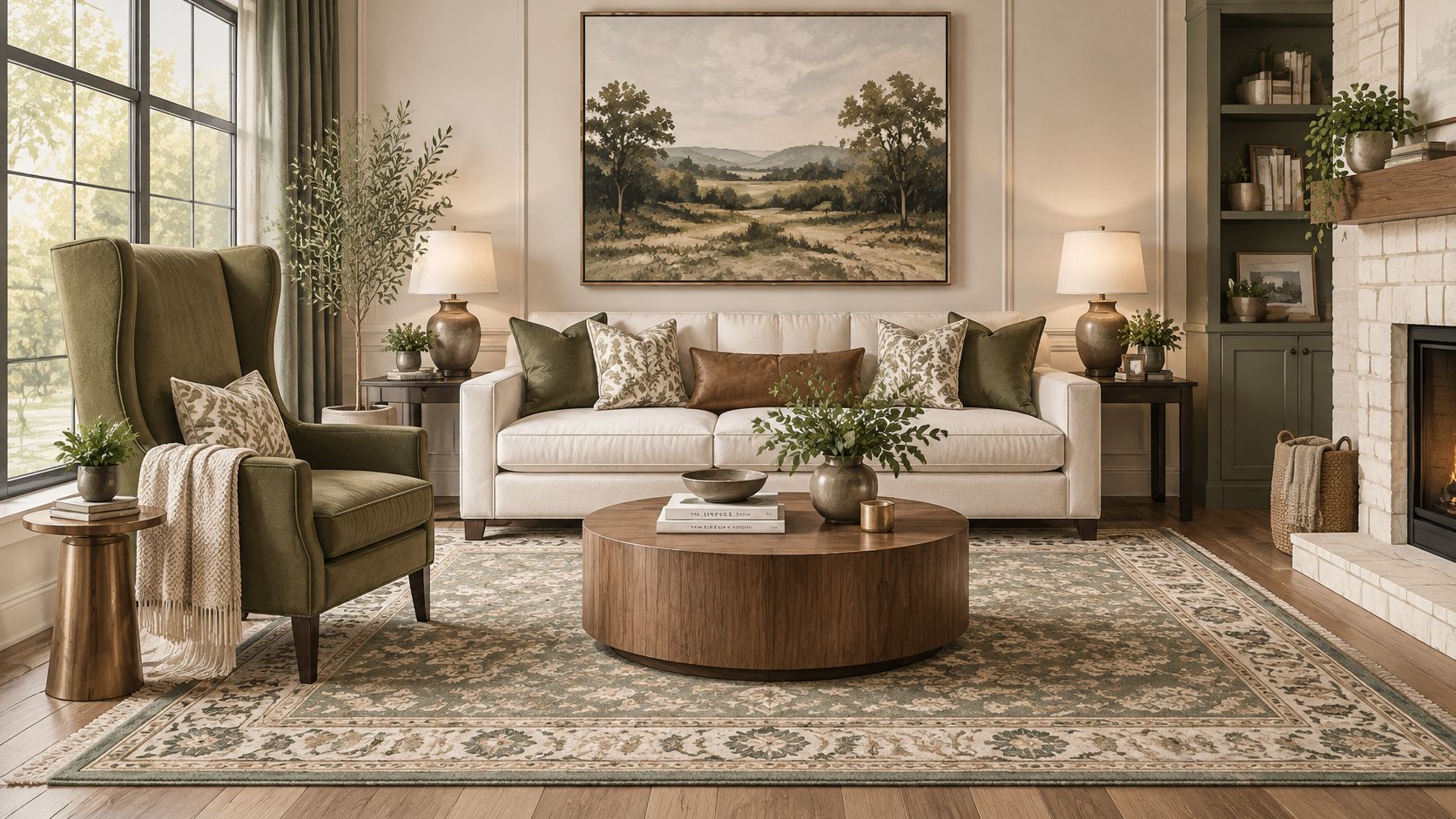
A chair on its own is a purchase. A chair planned with the sofa, the lamp and the rug is a complete room concept. The room works when the pieces share a scale, a colour and a floor line.
Three pairing rules
Match the back to the sofa on purpose. The chair back should echo the sofa's height or rise clearly above it as a deliberate accent. An in-between height looks accidental, as if the chair were borrowed from another room. A tall reading chair beside a low sofa can work when the rise is obvious and the chair sits off the main axis.
Repeat one accent, not five. Pull a single note from the chair, a leather tone or a wool thread, and repeat it in a cushion or a lampshade. That one echo ties the group together without turning the room into a matching set.
Set the chair on the rug. Place at least the front legs on the rug so the chair belongs to the seating group. Rugs are art for your floor and the foundation of the room. Trade Facilitation Office Canada reports knot densities from 25 to more than 1,000 knots per square inch, and at 150 knots per square inch a single weaver may require approximately 2.5 years to complete a 9-by-12-foot rug. That labour is why an artisanal hand-knotted rug can hold a chair and a sofa together visually in a way a thin synthetic mat cannot.
Designer's Insight: Our designers suggest pairing a bold Hancock & Moore leather with a neutral hand-knotted wool rug to balance the room's energy.
If the rug size is still unsettled, area rug size and placement tips help you test whether the front legs, the sofa and the traffic path can share one foundation. Visit the Rug Market to find your room's foundation before the upholstery order is locked.
Fabrics, Leathers and Custom Options Compared
Upholstery decides how the chair looks in daylight and how it lives with the household. The same frame can feel cool and neat in one cover and heavy in another.
| Material | Look and feel | Care and practical notes | Best fit |
|---|---|---|---|
| Linen blend | Relaxed, airy texture | Can feel warm in strong sun; choose a tighter weave | Living rooms with soft natural light |
| Performance fabric | Even colour and a soft hand | Stain resistant; check the cleaning code before buying | Family rooms and high-traffic seating |
| Wool blend | Warm and textural | Can pill over time; spot clean and brush gently | Reading corners and cosy lounges |
| Leather | Sleek, with a patina that develops over years | Condition regularly; keep away from heat and dry air | Statement chairs and studies |
| Velvet | Rich, sculptural depth | Brush gently; sensitive to crushing and rubbing | Formal seating and evening rooms |
Linen blend has a relaxed, woven hand that suits soft natural light. In a sunny bay it can feel warm, so a tighter weave and a spot out of direct afternoon glare matter more than the fibre name.
Performance fabric keeps an even colour and a soft hand, which is why it belongs in family rooms. Stain resistance is real only if you read the cleaning code before you buy. A code you can't maintain at home is not a practical choice.
Wool blend brings warmth to a reading corner. It can pill where arms and clothing rub, so spot cleaning and a gentle brush are part of owning it, not a failure of the cloth.
Leather, full-grain or top-grain, stays sleek and develops a patina. It needs regular conditioning. Left dry beside a heat source, it can crack. A side-by-side look at leather and fabric upholstery clarifies that trade-off before a bespoke hide is ordered.
Velvet gives sculptural depth in a formal or evening room. It marks where people rub and crush it, so it wants gentle brushing and a seat that isn't the household landing pad.
Custom cloth and everyday care
A bespoke fabric or leather from a library should be matched to the rug and the sofa, not chosen from a screen alone. Take the swatch home and view it in the room's own light on the same day you view the rug. Rotate cushions, keep harsh sun off the back, and vacuum the seams. A sound frame and a durable cover are what the price is paying for: how the chair will look after years in the room, not only how it looks on delivery day.
What White-Glove Delivery Covers at Home
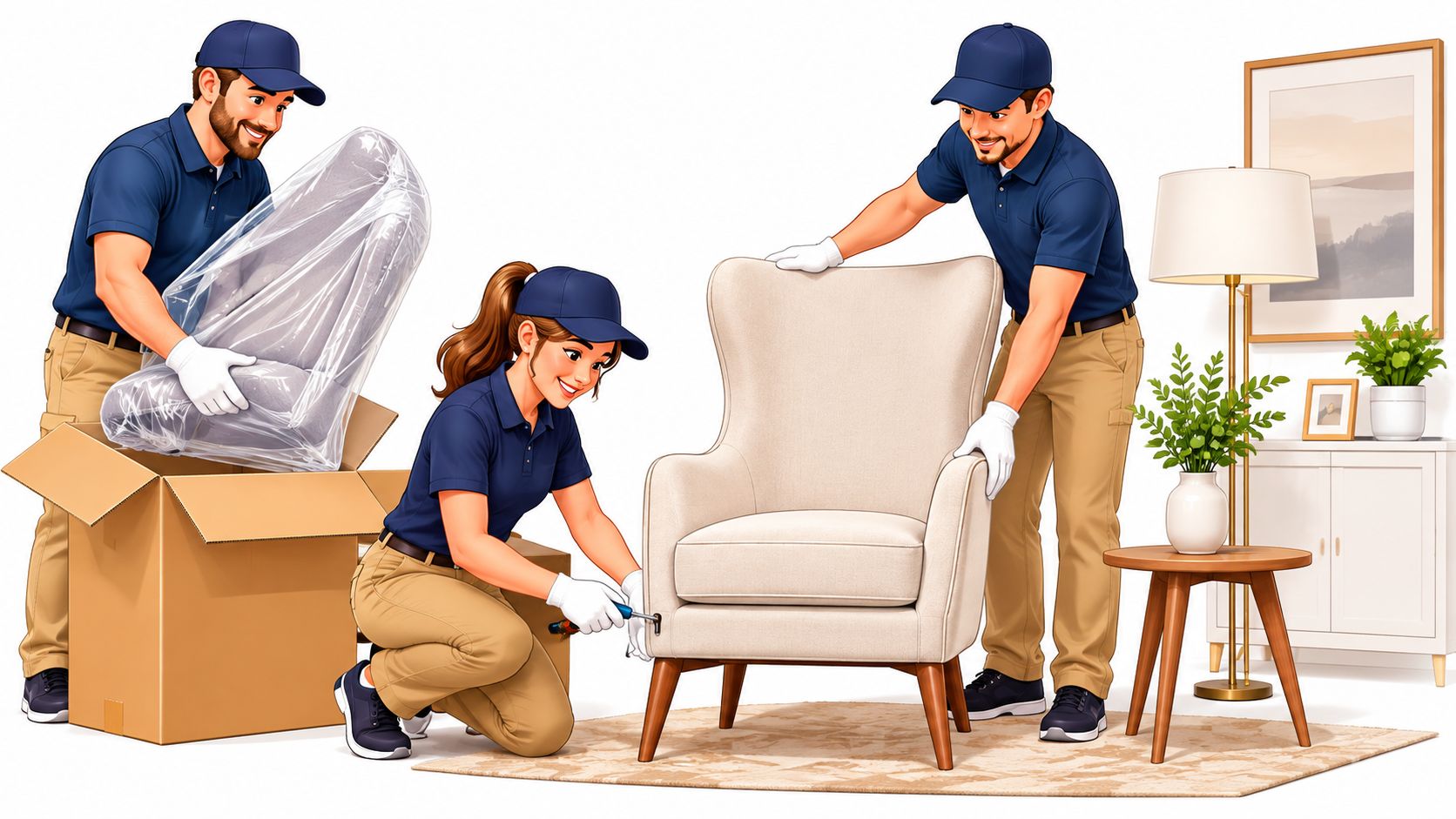
A high-back chair can fit the room and still arrive unable to clear the entryway. White-glove delivery covers unpacking, assembly, placement in the selected room, and removal of packaging and debris. Confirm the delivery scope and access measurements before the order is placed.
Local limits in Niagara, Hamilton and Toronto
Building access can shape the delivery plan. Ask condominium management about elevator bookings, common-area protection and any insurance documentation required from the delivery company. For a tall chair, measure the stair turns and shared corridors as well as the doorway. The Home Removals Sydney premium packing page illustrates careful wrapping and handling; Critelli Furniture describes its white-glove delivery service for delivery from showroom to the room you choose.
Prepare the path
- Measure the narrowest doorway and tightest turn, including handrails.
- Check stairwell and elevator dimensions against the chair's packed and assembled size.
- Clear the route and mark the chair's intended position.
- Confirm the delivery window and building access arrangements before the truck is booked.
Before the crew leaves, check that the chair is complete, undamaged and placed as agreed. Note any concerns while the delivery team is still present.
Book Your Design Consultation Before You Order
A high-back chair can support your posture and give a room a strong visual anchor, but its height also affects sightlines and circulation. Before choosing upholstery, check how the chair relates to the sofa, rug, windows and paths through the room. Critelli Furniture, a family-run business in St. Catharines, offers In-Home Design, Custom Order, Style Guides, Design Advice and Meet Your Designers services to help coordinate those choices. Financing is available.
Why the paperwork is part of the design
An in-store furniture purchase above $50 that is delivered later, or isn't paid in full immediately, is a future performance agreement, according to Ontario government guidance on store transactions. The agreement must be in writing and identify the supplier, describe the goods and services, itemize prices including taxes and shipping, disclose additional charges and payment terms, and state the delivery location. If the supplier misses the stated delivery date, or gives no date and has not delivered within 30 days, the consumer may have cancellation rights. Include white-glove assembly, placement and shipping in the written agreement.
| Item | What to confirm | Why it matters |
|---|---|---|
| Goods | Model, dimensions, frame and upholstery grade | Describes exactly what is being bought |
| Prices | Itemized, including taxes and shipping | Shows the full cost before signing |
| Payment terms | Deposit, balance and any additional charges | Discloses how and when money changes hands |
| Delivery | Stated date, delivery location and white-glove scope | Sets the date the agreement is measured against |
| Cancellation | Stated date, or the 30-day window if no date is given | Defines when cancellation rights may apply |
Before signing, confirm the chair's dimensions, upholstery, intended placement, delivery scope and written terms. Critelli invites customers to a final presentation before their home is complete, where leather, fabric and configuration are tuned to their style. Use that opportunity to check whether the chair's back interrupts a window sightline or competes with the rug.
Book a complimentary design consultation to discuss the room and your options. You can also see the seating in person at Critelli's King Street showroom.
Bring your measurements, rug questions and the spot you have in mind. Visit Critelli Furniture to book a complimentary design consultation.