
Living Room Furniture Leather: Ontario Style Guide 2026

The sofa has finally found its place, yet the room still feels unfinished. Perhaps the colour is right but the seating feels generic, or the leather looked beautiful in the showroom and now sits too close to a sunny window. Choosing living room furniture leather in Southern Ontario requires more than selecting a shade. The hide, finish, frame, proportions, maintenance routine, and surrounding furnishings must all work together.
Leather can be wonderfully practical, but it isn't automatically durable because the label says “leather.” The most rewarding rooms pair heirloom quality with informed specification, thoughtful care, and a design plan that allows the sofa, rug, lighting, and architecture to speak as one.
The Living Room as a Sanctuary of Craftsmanship
A family settles beside the fireplace after dinner. One person reads aloud, another stretches into a recliner, and the sofa carries the relaxed evidence of daily life, not clutter but belonging. In a well-considered living room, leather seating becomes more than a place to sit. It gives the room a visual centre and gathers years of conversation, celebration, and quiet evenings into one enduring form.

A brown leather sofa may begin with clean, precise lines, then acquire a softer visual character as the room changes around it. Its strength lies in that adaptability. It can support a traditional interior with warm wood, a contemporary space with sculptural lighting, or a transitional room where antique references meet modern comfort.
A material with a Canadian history
Leather upholstery also belongs to a longstanding Canadian furniture tradition. The first Canadian furniture company was established in Berlin, now Kitchener, in 1830, followed by another in Toronto in 1834. By 1927, Canadian manufacturers produced household furniture valued at approximately $19.26 million, while upholstered furniture and mattresses added about $4.91 million, as recorded by The Canadian Encyclopedia's history of the furniture industry.
That history gives premium upholstery useful context. Leather isn't a passing decorating impulse. It has supported Canadian furniture making through changing homes, technologies, and tastes, and it remains compelling because it combines tactile comfort with a sense of permanence.
A century-old family-run destination such as Critelli carries that heritage into contemporary Southern Ontario homes. Its origins in 1914, and its continuing family ownership, make the purchase feel connected to a broader culture of craftsmanship rather than to disposable décor.
Let the room tell the story
The surrounding details determine whether leather feels welcoming or severe. A soft wool rug, layered lamps, timber accents, and artwork can temper a structured sofa. Homeowners seeking additional guidance on creating warmth can also explore these interior pros on cozy decor, particularly when the room needs atmosphere as well as furniture.
The frame matters as much as the visible hide. Buyers interested in the construction beneath the upholstery can review wood joinery techniques before comparing sofa silhouettes, arm profiles, and leg treatments. Timeless craftsmanship begins where the eye can't immediately see it.
Understanding Leather Grades and Their Character
Leather terminology can make a premium purchase unnecessarily confusing. The useful approach is to separate how much of the natural hide remains visible, how the surface has been treated, and whether the seating uses leather throughout or only on selected areas.
Five categories worth distinguishing
Full-grain leather retains the hide's natural grain. It can display variations, scars, and markings, then develop a patina as it responds to use. Those changes appeal to homeowners who want a material with visible history, but the surface may require more thoughtful care and won't look perfectly uniform.
Top-grain leather has been refined at the surface to create a more consistent appearance while retaining a strong leather structure. It often suits a busy family room where the homeowner wants luxury without embracing every natural variation.
Corrected-grain leather receives additional surface treatment to create a more even colour or texture. It can provide a controlled design effect, though the coating influences how the leather feels, ages, and responds to cleaning.
Split leather comes from a lower layer of the hide. It can be useful in furniture construction, but its performance depends heavily on finishing and application. Buyers should ask where it appears and whether it is used on seating surfaces, backs, or sides.
Bonded leather combines leather fibres with other materials and a surface coating. It shouldn't be treated as equivalent to a high-quality hide. A California television investigation documented Bay Area consumers whose bonded-leather furniture began cracking or peeling after roughly two years, despite expectations of a longer service life. The report also noted that bonded leather used in furniture may contain only 15–20% leather, or less, as described in the NBC Bay Area consumer investigation.
Questions to ask before choosing
A showroom conversation should establish the upholstery specification, not merely confirm that a piece is “genuine leather.” Buyers should ask:
- Material designation: Is the piece full-grain, top-grain, corrected-grain, split, bonded, or polyurethane-coated?
- Surface consistency: Do the seating surfaces, outside arms, backs, and sides use the same material?
- Finish behaviour: Is the visible surface natural, pigmented, embossed, or heavily coated?
- Warranty language: Does the warranty address cracking, peeling, delamination, and finish failure?
- Care requirements: Which cleaner and conditioner does the manufacturer approve?
Natural patina usually appears as gradual variation in tone, softness, and surface character. Peeling, flaking, or delamination indicates finish failure rather than desirable ageing. A useful technical overview of these distinctions is available in Critelli's guide to leather types for furniture.
Practical rule: A higher price doesn't identify the correct leather by itself. Documented material information, construction quality, and a realistic care plan matter more than the word “leather” on a product card.
Durability Science and Environmental Considerations
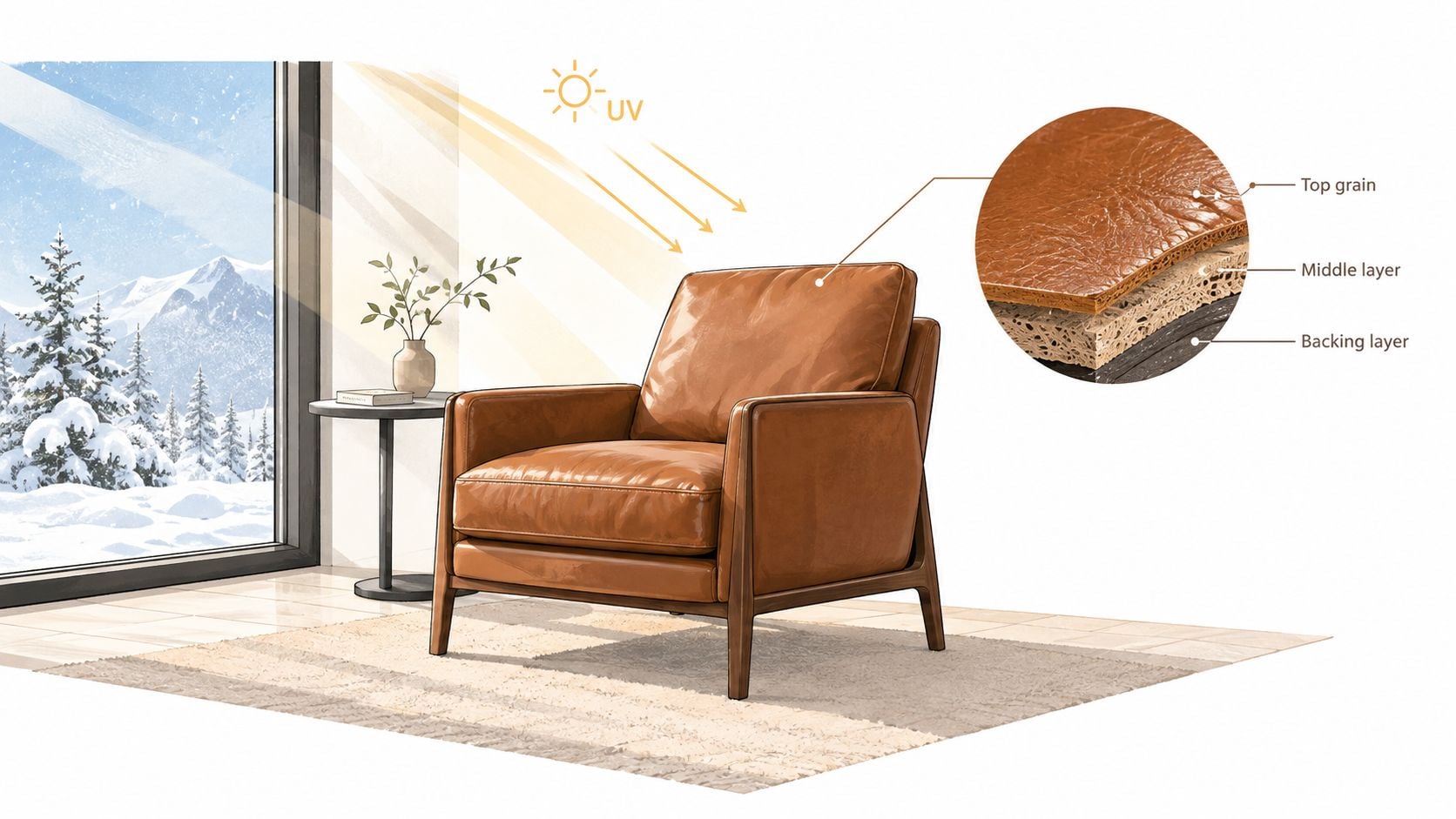
Southern Ontario gives leather a demanding indoor climate. Winter heating can dry the air, summer conditions can increase humidity, and sunlight can steadily alter colour and surface coatings. Leather performs best when the room is treated as part of the specification.
The Canadian Conservation Institute's upholstery guidance recommends avoiding damp conditions because relative humidity above 65% increases mould risk. It also advises monitoring humidity and using ventilation or dehumidification when necessary.
Measure performance, not just appearance
Leather properties vary with finish, thickness, coating, and conditioning state. That makes casual comparisons unreliable. EN 13336:2022 identifies defined test methods, recommended performance values, sampling, and conditioning procedures for furniture-upholstery leather. Buyers should request technical information on:
- Abrasion resistance, especially for frequently used family seating.
- Finish adhesion, which helps indicate how well the surface coating remains attached.
- Flex resistance, relevant to cushions, arms, and recliner movement.
- Colour fastness to light, particularly near large windows.
- Seam and construction specifications, since upholstery can fail through construction even when the hide performs well.
A sofa used every evening needs a different performance profile from a formal-room chair. A single durability figure also can't promise a universal lifespan, because traffic, body oils, pets, cleaning chemistry, sunlight, and indoor climate all influence the result.
Protect the room around the furniture
Positioning prevents many avoidable problems. Keep leather away from radiators, baseboard heaters, forced-air vents, exterior-wall condensation, and direct sunlight. A hygrometer, filtered window covering, and suitable clearance from heat sources provide simple safeguards. Winter humidity should be managed with a room humidifier rather than by directing moisture at the upholstery.
Indoor air quality deserves similarly balanced attention. Leather and other dry furniture materials can emit VOCs, while emissions vary with chemistry, adhesives, temperature, humidity, loading, and air exchange. Research on California residences with mechanical ventilation found that higher ventilation was associated with a 44% reduction in average formaldehyde concentration compared with earlier California results, with most measured pollutants below health guidelines, as reported in this research on ventilation and indoor pollutants.
Buyers concerned about emissions should request testing for the complete sofa assembly, including foam, adhesives, dyes, and finishes, rather than asking only about the hide. Critelli's information on sustainable furniture materials can also help frame that broader conversation.
Designing with Leather and Creating Complete Room Concepts
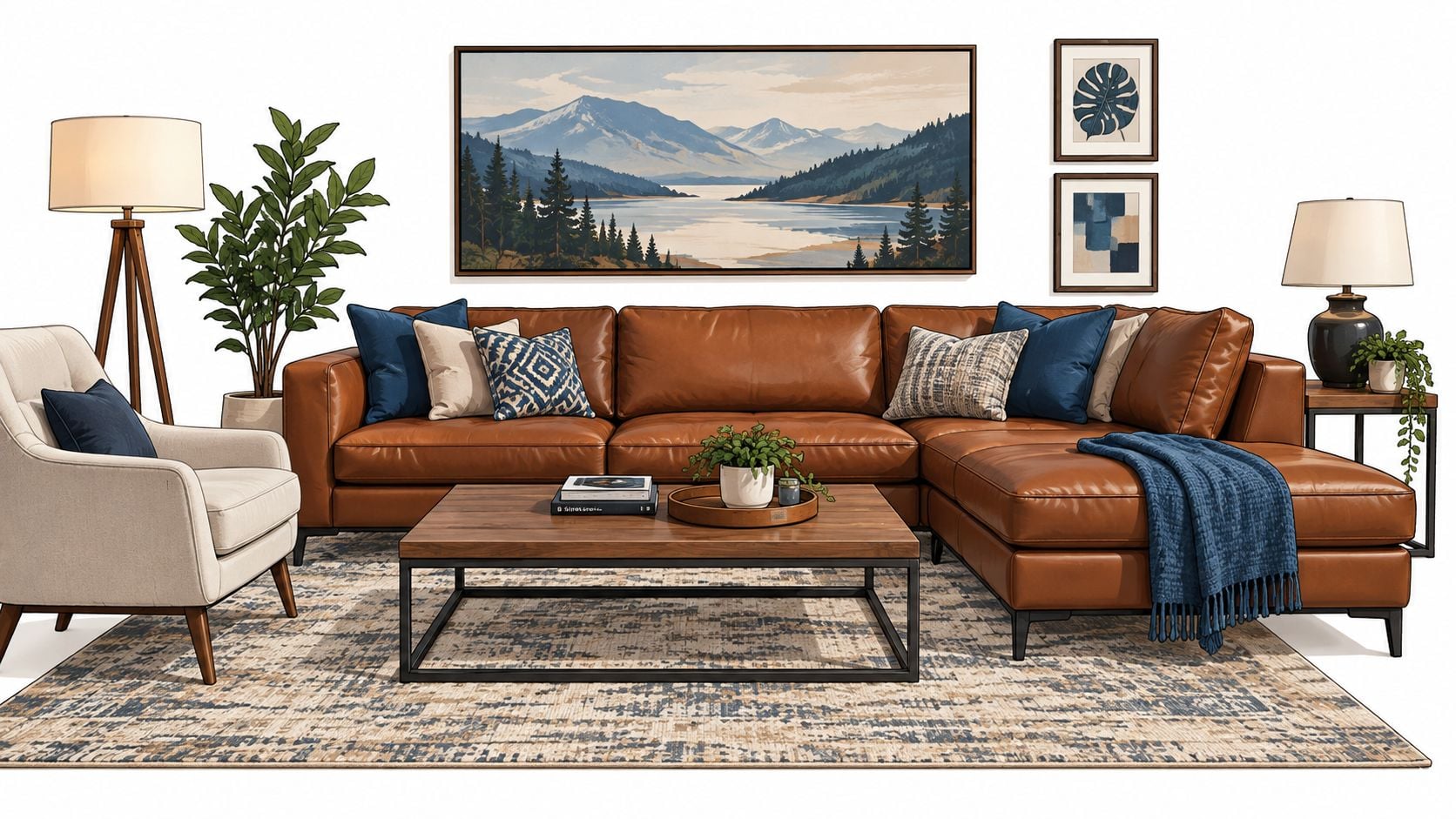
A leather sofa shouldn't be selected in isolation. Its scale, undertone, sheen, and visual weight influence every other decision in the room. A successful complete room concept begins with the sofa but resolves through the rug, tables, lighting, art, window treatments, and smaller upholstered pieces.
Start with scale and foundation
A substantial sectional needs enough visual breathing room around it. A compact leather sofa may suit an urban sitting room, while a deeper configuration can anchor a large family space, provided the rug extends generously beneath the seating group. The rug isn't an afterthought. At the Rug Market, hand-knotted pieces are treated as Art for Your Floor, establishing the palette, texture, and rhythm that the furniture occupies.
A bold hide often benefits from a quieter foundation. A rich saddle, tobacco, or espresso tone can work beautifully with a neutral hand-knotted wool rug, while a pale leather may need warmer timber or textured textiles to prevent the room from feeling flat. The coffee table should relate to the sofa's visual weight, whether through dark wood, natural stone, or a refined metal finish.
Designer's Insight: Pair a bold Hancock & Moore leather with a neutral hand-knotted wool rug to balance the room's energy. Let the leather provide depth and let the rug soften the transition between seating, floor, and architecture.
Shape the mood through contrast
Traditional rooms can use rolled arms, exposed wood, and patterned rugs without becoming formal. Contemporary rooms benefit from clean planes, restrained stitching, and sculptural lighting. Transitional spaces often achieve the most flexibility by combining a leather sofa with clean lines and a softly textured chair and an expressive rug.
Industrial interiors can handle darker leather and stronger metal accents, but too many hard surfaces create an unwelcoming echo. Layering linen, wool, timber, and artwork brings necessary softness. Homeowners arranging a larger wall can use this resource on structure and scale for bare walls to keep the composition proportionate to substantial seating.
Build the room before approving the sofa
A design studio approach tests the full arrangement rather than judging a sofa alone. Consider the sightline from the entry, the distance between seats, the clearance for recliners, and the way sunlight moves across the leather during the day. A curated selection should feel coherent from every angle, including the back of a sectional placed in the centre of the room.
Critelli's guidance on layering furniture and decor to make any room feel complete reflects this principle. The result is design-led rather than showroom-staged, with every element supporting comfort and proportion.
Matching Leather to Your Lifestyle and Maintenance Commitment
The best leather is the one a household can live with. A family with children, pets, frequent guests, and little interest in maintenance needs a different finish from a couple who enjoys natural variation and treats conditioning as part of home care.
A practical comparison
| Household priority | Suitable direction | Main trade-off |
|---|---|---|
| Visible patina and natural character | Full-grain leather | Natural marks show, and care requires consistency |
| Daily family use with a more uniform appearance | Top-grain leather | The finish may feel less organically varied |
| Controlled colour and texture | Corrected-grain leather | Surface treatment influences ageing and touch |
| Occasional seating with a specific application | Split leather | Performance depends strongly on finish and placement |
| Lowest initial specification | Bonded or coated alternatives | Peeling and delamination can become the decisive risk |
Full-grain leather can be rewarding in a household that welcomes character. It may show marks from daily life, and those marks can become part of the piece's story, but only if the owner accepts that the surface won't remain perfectly pristine.
Top-grain or corrected-grain options can suit busy rooms where consistent colour and simpler upkeep matter more. They still require protection from heat, sunlight, unsuitable cleaners, and excessive moisture. No finish is immune to neglect.
Care routines that preserve the surface
Routine care should begin with soft-bristle brushing or gentle vacuuming, followed by the manufacturer-approved cleaner and conditioner. Household solvents, abrasive products, vinegar, ammonia, and harsh disinfecting wipes can damage finishes. Spills should be blotted rather than rubbed, and a hidden area should be tested before any new product reaches a visible surface.
Pets don't automatically rule out leather. Trimmed nails, nearby pet beds, washable throws, and quick cleanup reduce avoidable wear, while the layout can keep the sofa away from scratching posts and high-impact play.
Leather may be a poor choice for a room with intense direct sunlight, strong heat exposure, or unstable humidity that the household can't manage. In those settings, a carefully specified textile or a different room placement may protect both the design intention and the investment.
The Critelli Experience and Heritage Customization and Service
You can feel the difference between an impulse purchase and a settled decision the moment you sit down. In a leather living room, that difference shows up in seat depth, arm height, how the hide catches light, and whether the scale suits the room you live in through Ontario winters and humid summers. A good showroom experience gives a homeowner the chance to test all of that before committing to a piece that will anchor the home for years.
Critelli Furniture was founded in 1914 by Joseph Critelli and his son Thomas at the corner of Ormond and Albert Streets in Thorold. The business remains family-owned, with fourth-generation owner Joe Critelli and fifth-generation owner Julia Critelli leading the company, a history documented through Critelli's family legacy.

Two settings for considered design
The company's history records Thomas Critelli opening a third store in downtown St. Catharines in 1939. Today, the St. Catharines locations include Critelli Furniture at 126 King Street and Critelli Modern at 169 St. Paul Street. The distinction matters. Traditional and contemporary rooms ask for different proportions, wood tones, and leather finishes, and separate settings make those differences easier to judge in person.
The showrooms let homeowners compare sofas, recliners, chairs, sectionals, wood finishes, and rugs side by side rather than as isolated items. The curated collection of solid-wood, reclining, and upholstered silhouettes supports a broader design conversation, with clear opportunities to compare joinery, cushion support, leather hand, and overall scale under real lighting conditions.
That kind of comparison is especially useful during customization. The Interior Design Studio assists with space planning and made-to-order decisions across leather, fabric, and finish options. It helps when a sectional needs to work around a fireplace wall, when a recliner must sit comfortably within an existing arrangement, or when a rug should establish the room's palette before upholstery is finalized.
Delivery as part of the design service
Delivery shapes the final result as much as selection does.
A documented Ontario delivery policy describes white-glove service that brings pieces into the home, unpacks and inspects them, assembles them when required, places them in designated rooms, removes packaging and installation debris, and completes a final walkthrough. Distance-based pricing begins with a 0–100 kilometre tier, and the service fee is disclosed before order finalization.
For leather furniture, that process has practical value. Placement affects exposure to sunlight, airflow from vents, circulation paths, and the visual balance of the room. Serving the Greater Niagara, Hamilton, and Toronto markets, the delivery team helps a purchase arrive as a finished interior decision rather than a box left at the threshold.
Critelli also identifies flexible financing options and a Low Price Guarantee as part of its purchasing support. In a family-run business with more than a century behind it, the service matters because it helps homeowners choose carefully, customize with purpose, and bring home leather furniture that feels resolved from the first day.
Investing in Heirloom-Quality Living Room Furniture
A leather sofa earns its place in a home when it performs three jobs at once. It provides dependable comfort, anchors the room's composition, and gains character without becoming visually dated. Those qualities don't come from the label alone. They come from matching the grade and finish to household use, confirming construction details, managing Southern Ontario's indoor climate, and caring for the surface with discipline.
Furniture also becomes more important during major home transitions. Statistics Canada reported average household furniture spending of $760 in the referenced household-spending period, while an earlier analysis estimated that homebuyers spent an average of $2,788 on furniture compared with $1,371 among homeowners who weren't moving, as recorded in Statistics Canada's household-spending data. Those figures include broader furniture categories, but they illustrate why a move or major redesign is a useful moment to consider the room as a complete investment.
A thoughtfully chosen sofa can remain relevant through new paint, changing artwork, different rugs, and evolving family routines. The leather may soften, the room may gather memories, and the original decision can become part of the home's heritage. Guidance on heirloom-quality furniture helps place that decision within a longer view of comfort and craftsmanship.
The most reliable path is deliberate. Test the seating in person, request technical information, inspect the material designation, consider the room's light and heat, and select the rug and surrounding pieces as part of one design-forward composition.
Critelli Furniture offers leather sofas, chairs, sectionals, recliners, rugs, and design guidance for homeowners creating a considered living room in Southern Ontario. Experience the craftsmanship in person at our King Street Showroom, Critelli Furniture, book your complimentary design consultation today, or visit the Rug Market to find your room's foundation.