
Couches with Recliners: How to Choose


It's a familiar weeknight in a Niagara living room. Someone wants to stretch out for the news, someone else needs an easy route to the kitchen, and the sofa mustn't block the walk to the hall. A reclining couch sounds like the answer, until its footrest occupies the very space everyone needs to cross.
The best couches with recliners do more than offer a comfortable resting position. They suit the people using them, leave the room workable and come with a credible route to repair. Choosing well starts with daily habits, not the longest feature list.
Match a Recliner Couch to the Way You Sit
A reclining couch isn't a single product type. Some designs prioritise straightforward operation; others offer independently adjustable support or combine upright and reclining seats. A household can narrow the choice considerably by deciding whose comfort needs the most adjustment and how the room functions during an ordinary evening.
Recliner couch types and where each one fits
| Type | How it moves | Space need | Best for | Main trade-off |
|---|---|---|---|---|
| Manual | Handle or push-back, no motor | Footrest projection, no cord | Secondary rooms and simple ownership | Less precise positions |
| Power | Remote for back, footrest and often headrest | Outlet plus full footrest projection | Daily television and shared households | More parts to service |
| Zero-gravity | Legs raised near heart height | Longest open footprint to plan for, confirmed by model | Long reading or recovery evenings | Needs the most floor |
| Modular sectional | Mix of fixed and motion seats | Determined by which seats recline | Conversation plus lounging in one room | Console seats can block transfers |
| Lift-assist | Seat rises to help standing | Clear space in front for the rise | Sit-to-stand difficulty | Not the same as a power sofa |
| Wall-hugger | Reclines close to the wall | Only a small gap behind the back | Narrow living rooms | Still needs footrest clearance in front |
These categories can overlap. A power sofa can also use a wall-hugger mechanism, and a modular sectional can include power-reclining ends alongside fixed seats. The useful question isn't which label sounds most advanced, but which combination serves the household.
Start with the usual evening
For someone who watches television upright before reclining, independent back and footrest adjustment can be more useful than a dramatic fully open position. A reader should test whether the headrest supports the head without pushing the chin towards the chest. The principles behind an ergonomic sofa or couch help distinguish genuine fit from a briefly pleasant showroom impression.
Manual motion suits a den where simple ownership matters. The user must still be able to operate the handle or push-back action and close the footrest comfortably. No cord doesn't mean no effort.
A zero-gravity position raises the legs near heart height, but the name isn't a promise of medical benefit. For recovery use, suitability should follow the person's care guidance rather than a furniture label.
Choose the useful combination
A wall-hugger can make sense in tighter Greater Niagara, Hamilton and Toronto rooms because it limits the space required behind the back. It doesn't eliminate the moving footprint in front.
The practical verdict is straightforward:
- Everyday lounging: A power wall-hugger is a useful starting point when convenient adjustment and rear clearance matter.
- Difficult standing: Lift-assist deserves a separate trial, with attention to the user's balance and transfer needs.
- Fewer mechanisms: Manual motion suits households prepared to trade fine adjustment for simpler operation.
How to Measure Closed and Reclined Clearance
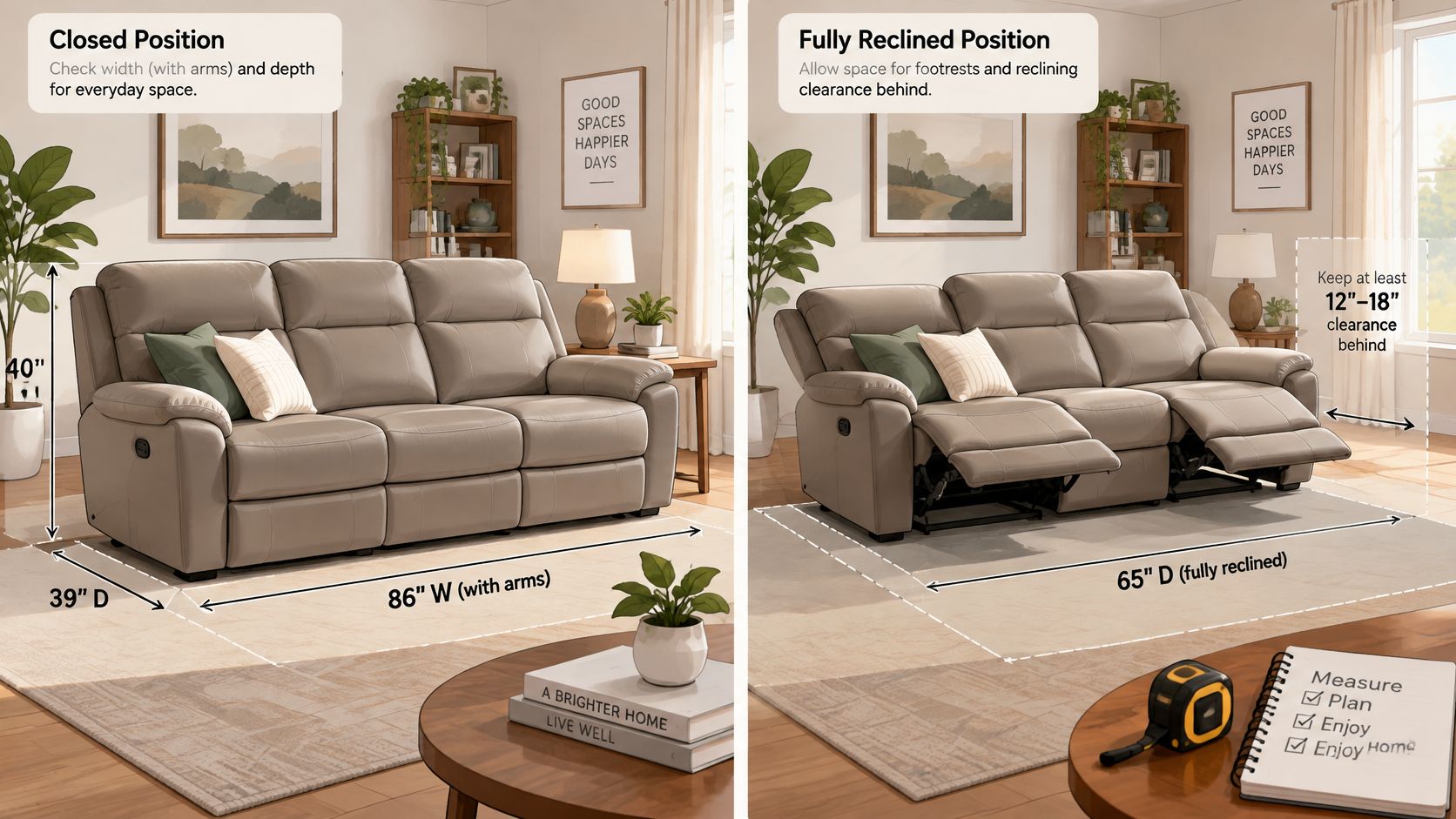
A recliner can fit neatly against a wall when closed and still block a walkway once its footrest opens. Measure both positions before deciding where it belongs. A tape measure, painter's tape and a simple floor sketch make the difference clear.
Mark the operating space
- Record the closed and open footprints. Measure the full width, including the arms, and the closed depth. Then find the fully reclined depth with every intended footrest extended. That open footprint is the space the sofa needs during everyday use.
- Tape the open outline onto the floor. Mark it before moving the coffee table or chairs. This shows whether the recliner fits without sacrificing another useful part of the room.
- Trace the circulation routes. Keep the route to each doorway and adjacent seat usable. A passage that forces someone to turn sideways is awkward for daily movement.
- Allow space for access and turning. If a wheelchair user needs access, plan clear floor space beside the seat they will use. An open aisle elsewhere in the room may not provide enough room to approach or turn.
For wheelchair planning, Accessibility Standards Canada's clearances guidance provides the clear-floor and turning references below. Treat these as planning references, not mandatory private-home rules.
Reference clearances
| Measure | Reference | Applies to |
|---|---|---|
| Clear floor area | 820 mm by 1,390 mm | Wheelchair user |
| Turning diameter | About 1,800 mm | Where a turn is needed |
Test people and delivery routes
- Check the occupied seat. Try the sofa in person, because cushion compression and leg length affect how its dimensions feel. The user's feet should feel supported, and the seat edge shouldn't make them slide forward to reach the floor.
- Operate the mechanism during a walk-through. Keep the helper clear of moving parts while the recliner opens and closes. Check that the movement doesn't block an adjoining route or the space someone needs to transfer beside the seat.
- Measure the journey into the room. Check doorways, stair turns, elevator openings and landings as well as the final spot. Ask the delivery team whether any parts can be removed rather than assuming the back or arms detach.
A wall-hugger recliner can reduce the space needed behind the sofa, but it still requires the manufacturer's specified rear gap. Skirting boards, window coverings and projecting sills can affect that clearance.
Practical rule: Each intended reclining position should work without moving another piece of furniture.
Choose the Mechanism Cushion and Cover
Comfort begins with the body, but confidence begins with documentation. A polished cover and quiet demonstration don't reveal the occupant load, service requirements or warranty boundaries.
Before ordering, the manufacturer's specification should establish:
- Occupant load: The stated limit for the relevant seat and mechanism.
- Durability information: Available mechanism-cycle or other testing documentation, with an explanation of what was tested.
- Warranty exclusions: Separate treatment of the frame, moving components, electrical parts and upholstery.
- Written care: Approved cleaning methods and products for the selected cover.
Separate support from softness
A meaningful sit-test lasts several minutes, not a quick bounce on the front edge. The user should settle back, place both feet comfortably and notice whether the cushion supports the pelvis without creating a hollow.
A high-resiliency foam core with a softer upper layer can combine structure and surface comfort. It isn't a guarantee by itself; the cushion, suspension and seat geometry must work together. A very deep, soft seat may feel luxurious while making the return to standing unnecessarily difficult.
Optional headrest, lumbar and heat controls should solve a specific comfort need. They aren't evidence of a better frame. With the footrest extended, the frame should remain planted, and the power pack, cables and releases should stay clear of feet and moving joints.
Match the cover to household life
Performance fabric can offer a forgiving surface for daily use, but its cleaning code matters more than the category name. A textured mid-tone may disguise ordinary marks better than a pale, flat weave. Removable-looking covers shouldn't be assumed washable.
Leather offers a different character. Some finishes develop a visible patina, while others retain a more uniform appearance; conditioning should follow the maker's instructions rather than a general leather-care routine. A leather-versus-fabric upholstery comparison is most useful when judged against pets, spills, sunlight and maintenance habits.
Canada has no federal regulation specifically governing upholstered-furniture flammability, as explained in the federal risk-management scope concerning TCPP and TDCPP. A claim about meeting Canadian standards therefore needs clarification about the component and test involved, not an assumption that a single recliner certificate exists.
Children shouldn't climb or play on extended footrests. Before operating a mechanism, adults should check for children, pets and objects beneath or beside it.
The final sit-test should involve both regular users. Each should reach the controls, find useful arm support and stand without rocking the sofa.
Plan Seating for Aging in Place
85% of Canadians prefer to age in place, rising to 96% among people aged 65 and older, according to the federal report on housing for diverse seniors, which recognises furniture as part of accessibility. For everyday independence, assess how the seat works for its user, not just how many motors it has.
Power recline helps only if the seat itself suits the user. A control can spare the effort of operating a handle, while a seat that is too deep or too soft may still make standing difficult.
Test independence rather than features
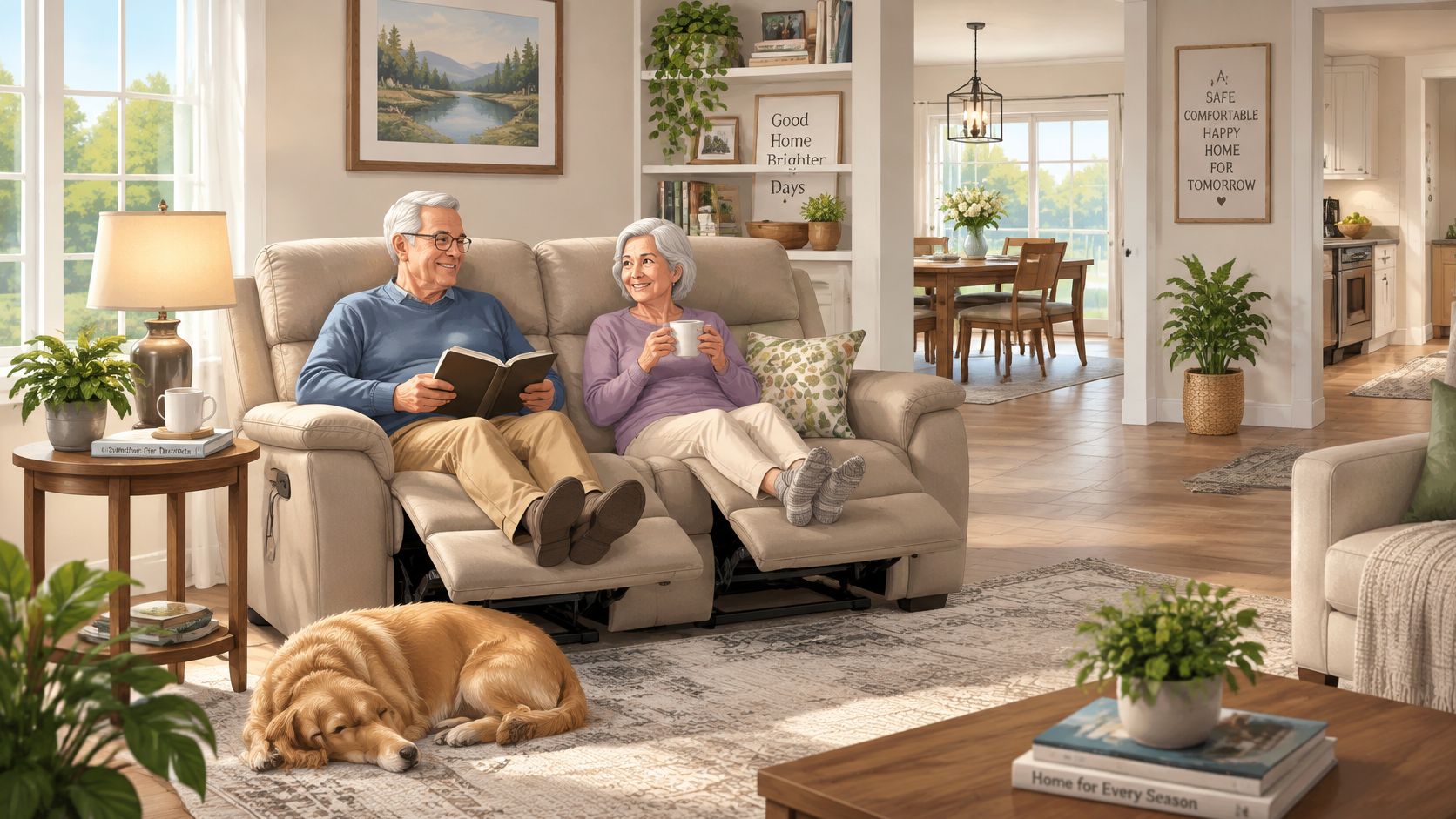
The seating references provide a starting point. In the showroom, follow the user's movement from approaching and sitting to finding the control, reclining, and returning upright.
Check these practical details:
- Readable controls: Buttons should be distinguishable in ordinary room lighting and usable with the person's hand strength.
- Supportive arms: The user should reach them naturally, without leaning awkwardly or pushing against a loose cushion.
- Caregiver access: A helper needs a stable place to stand outside the footrest's operating path.
- Outage behaviour: Ask how the seat can return to an exit position if electricity fails.
For households deciding between a rising chair and a reclining sofa, this guide can help you compare lift chairs for seniors. Focus on the transfer support the user needs, rather than whether the chair matches the sofa.
Allow for different needs in the same household
Consider a couple planning for later life. One person may prefer an adjustable reclining end, while the other feels steadier on a firmer fixed seat. A mixed arrangement lets each person choose the support that suits them.
For someone who uses a walker, plan a place to park it within easy reach but outside the route back to the seat. A suitable rise function may matter more than an extended lounging position.
A review of chairs for posture can help frame questions about support. For difficult transfers or balance concerns, furniture selection should not replace individual clinical advice.
Before ordering, decide where the walker will rest so it stays within reach without blocking the path through the room.
Ask Whether the Sofa Can Be Repaired
Longevity is a buying test, not an afterthought. In Canadian government research on repair behaviours, 44% of respondents repair furniture when it breaks, while 44% report lacking the skills or knowledge and 31% identify cost as a barrier.
A higher purchase price doesn't automatically produce a longer useful life. The stronger choice is the sofa whose mechanism, cushion, wiring and cover can be serviced when something wears out.
Make the service route visible
A powered sofa can be easier to use every evening while introducing more components that may eventually need attention. The answer isn't necessarily to avoid power, but to establish who diagnoses problems and how individual parts can be replaced.
Repairability checks before you order
| Check | Ask this | A serviceable answer | Why it matters |
|---|---|---|---|
| Motor or mechanism | Can one seat be repaired on its own? | That seat or motor can be serviced | Avoids replacing the whole sofa |
| Parts | Are replacements available in Canada? | Named parts with a supply path | Makes likely downtime easier to assess |
| Cushions | Can cores or wraps be renewed? | Cushions are replaceable | Comfort can be restored |
| Cover | Can fabric or leather be cleaned or refinished? | A written care and appropriate refinishing route | Heirloom use stays realistic |
| Power loss | What happens in an outage? | A documented manual release or compatible battery backup | Establishes how the user can exit |
| After warranty | What is excluded later? | Clear exclusions and a service contact | Cost of ownership stays visible |
A general assurance that parts are available isn't as useful as an identified component and a named service route. Written answers should distinguish manufacturer coverage from paid work after coverage ends.
Battery backup also needs precise explanation. Its presence alone doesn't establish which functions operate or how it is maintained. Likewise, not every powered mechanism has a manual release.
Compare ownership rather than the ticket
A practical comparison includes the purchase, delivery, likely care requirements and the accessibility of future service. A sofa that needs specialist transport for a minor repair presents a different ownership proposition from one that can be serviced in place.
White-glove placement gets the furniture into the home. It doesn't, by itself, answer questions about electrical troubleshooting, replacement cushions or later upholstery work.
Heirloom quality should mean that useful parts can be renewed, not merely that the original cover looks substantial. The same principle applies when assessing quality living-room furniture: construction and repair access deserve equal attention.
For each finalist, the homeowner can mark the scorecard as documented, unresolved or unavailable. The preferable sofa is the one whose worn parts can be replaced, rather than one destined to be discarded like an unserviceable large appliance.
Style the Sofa Inside a Finished Room
A reclining sofa changes how the rest of the room works. In a narrow living room, a small side table may be easier to reach than a central table near the footrests. A lamp beside a fixed arm can provide reading light while keeping its cord out of the hall's walking route.
Give the room a quiet structure
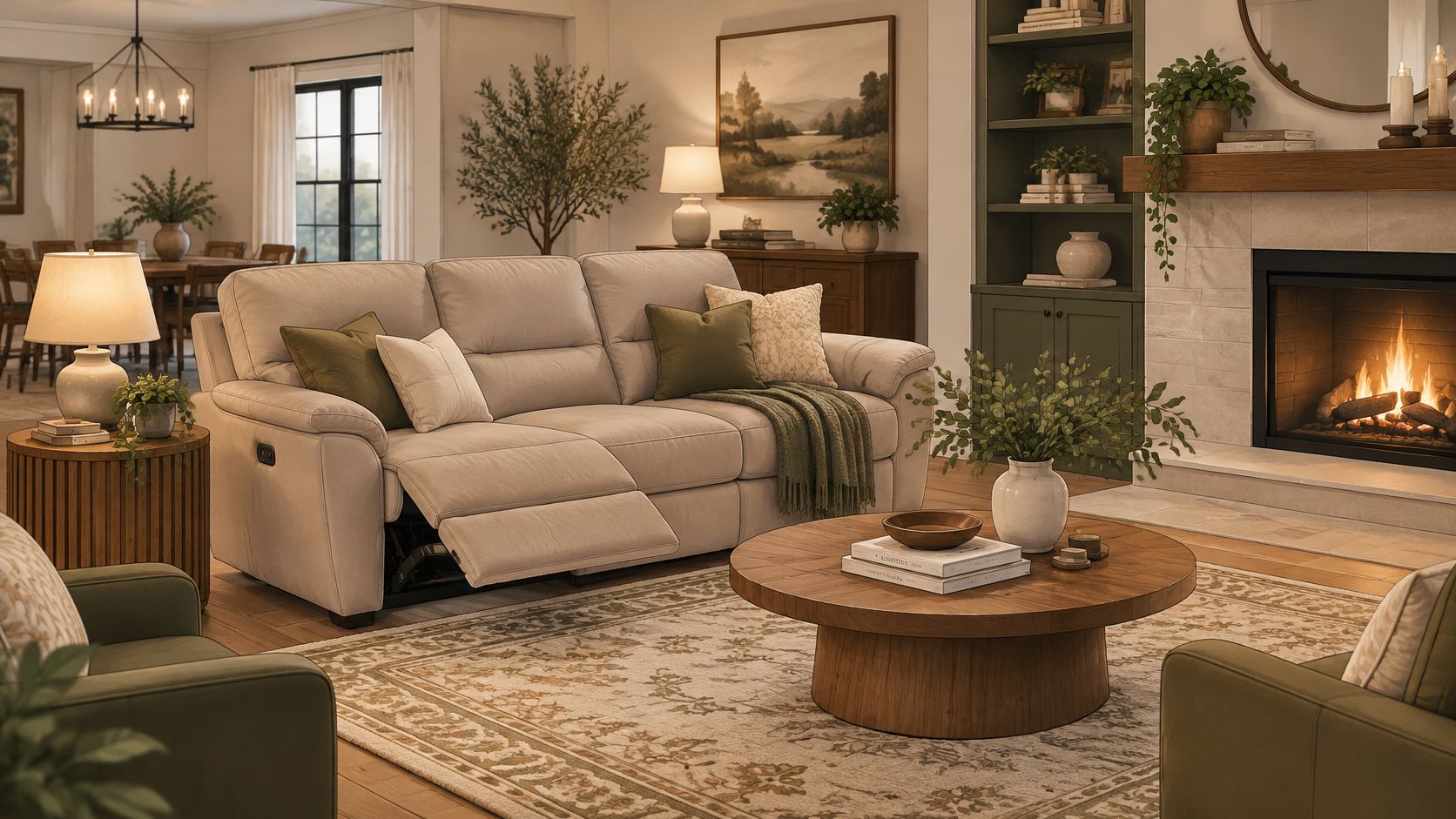
Start with proportion. Leave enough visual space around the sofa so its back doesn't crowd a window, artwork or nearby lamp. Repeating a wood tone in a table or frame can connect the furnishings; varying the scale keeps the room from looking like a matching set.
A warm wood table can complement motion seating, while the sofa's upholstery and shape remain part of the room's design. Choose nearby pieces for their function and scale, then use small accents to tie the colours together.
Build colour from the floor
A rug can set the room's palette and soften the transition between the sofa and other furnishings. Choose a pattern or texture that relates to cushions, wood finishes or artwork without making the seating area feel visually crowded.
In multi-unit housing, BKL's building-acoustics guidance identifies area rugs or carpet as a measure that can help reduce impact noise below, while noting that rugs generally aren't effective against substantial flanking transmission through the building. A rug may help with some footstep noise, but it won't resolve every sound travelling through a floor.
Keep the rug and underlay flat, with edges clear of transfer routes and moving parts. Before choosing a size, compare the rug's placement with the sofa's open footprint so the extended footrests won't catch an edge or press against it.
Visit the King Street Showroom Before You Order
A recliner couch needs to work for the person using it every day. At the King Street Showroom, you can assess the feel of the cushions, try the controls and consider how easily you can stand. Bring your room measurements and questions about repairability to a complimentary design consultation.
Critelli Furniture's recliner selection includes Stressless, Flexsteel, Palliser, American Leather, Hancock & Moore and IMG, as well as Power Lift Reclining Chairs from Ultra Comfort. A swivel base is available on most recliners at a minimal cost. Custom orders let customers tailor fabric, leather and layout to their needs.
Document the selection and the handoff
Ask for a written record of the chosen model, upholstery, configuration, delivery commitment and itemised charges. That specification gives you a clear reference if the delivered sofa differs from what you selected.
Critelli Furniture has a White Glove Delivery page describing its delivery service. Under Ontario's Sale of Goods Act, buyers who haven't previously examined delivered goods must have a reasonable opportunity to inspect whether they conform to the contract before being deemed to accept them.
Ontario's consumer-protection guidance states that consumers may ask for a refund when an ordered product remains undelivered 30 days after the promised delivery date. Keep the delivery commitment in your agreement, then check the upholstery and test the controls when the sofa arrives. Document any discrepancy before the delivery visit concludes.
A successful showroom visit ends with a selection that suits your routines and a written agreement that makes the handoff clear. Visit Critelli Furniture to book a complimentary design consultation.