

How to Choose a Living Room Chair with Ottoman


The most popular advice about a living room chair with ottoman is also the least useful. Matching fabric, a generous footprint and the softest cushion in the showroom don't guarantee a comfortable sit at home. In compact Southern Ontario condos, townhomes and older houses, the largest matching ottoman often steals the walking path, lifts the knees and turns a reading corner into an obstacle.
Comfort comes from something quieter. The chair and ottoman have to share seat geometry, preserve walking clearance and support the body through a long evening, not a brief showroom perch. Treated that way, the pair becomes one heirloom quality piece inside a complete room, chosen with timeless craftsmanship in mind rather than as two items that merely share a colour.
How to Measure Before You Order
A chair can fit the sitter and still fail at the doorway. Measure in order: the person, the room, then the route from the entrance to the chair's final position. A tape measure, painter's tape and notebook are enough to catch many sizing conflicts before ordering.
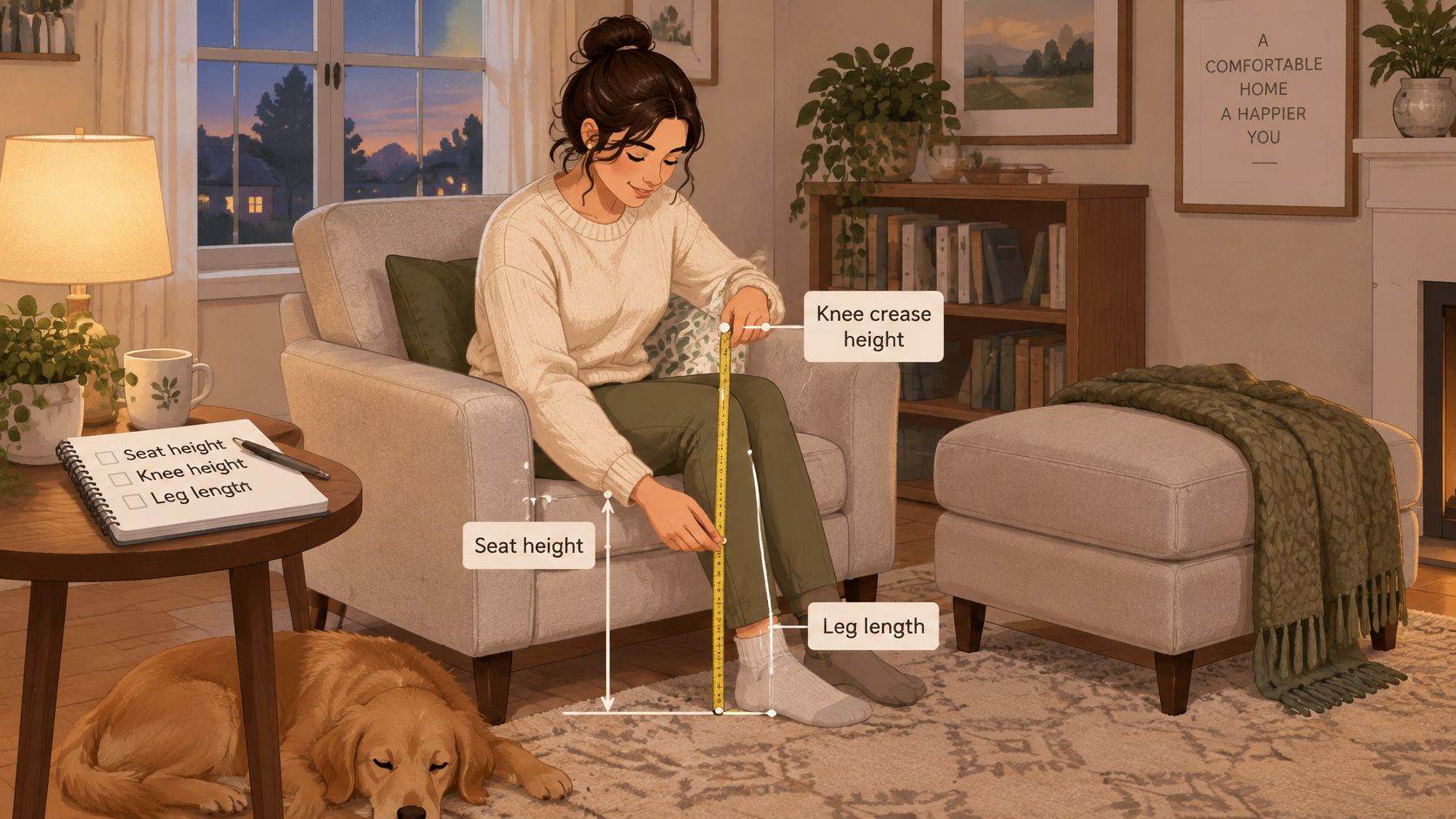
Start With the Sitter
- Measure popliteal height in everyday shoes: Sit with your feet flat and measure from the floor to the crease behind your knee. Use this as a starting point when assessing seat height.
- Measure hip-to-knee length: Sit with your pelvis against a firm support and measure to the back of your knee. Compare that distance with the chair's seat depth to avoid a seat that encourages perching.
- Note your preferred posture: Reading upright, conversation and reclined rest call for different positions. Write down which posture matters most so you can assess the chair and ottoman together.
Tape the Room Before Choosing a Silhouette
Mark the chair and ottoman footprints on the floor, then tape the gap between them. Walk the route from the doorway to the sofa, kitchen or window. In a compact room, the largest matching ottoman can be the wrong choice if it narrows that route or crowds nearby furniture.
Measure the tightest doorway, stair landing and elevator, not just the room. Check radiator, vent and baseboard locations too, so the furniture does not obstruct heat or sit awkwardly against the wall. For a step-by-step approach, use this guide to measuring furniture before ordering.
| Check | Target | Why it matters |
|---|---|---|
| Walking path on the traffic side | Treat 76 centimetres as a planning rule of thumb, then confirm it suits your room | Helps keep the ottoman from blocking the route |
| Two people passing | Treat 91 centimetres as a planning rule of thumb, then confirm it suits your room | Allows more room for shared circulation |
| Recliner behind the chair | Check the manufacturer's clearance specification | The space needed depends on the recline mechanism |
| Swivel chair | Clear circle at the chair's widest point | Lets the chair turn without dragging |
| Popliteal height | Measure in everyday shoes | Gives you a starting point for assessing seat height |
For a swivel chair, tape a circle around its widest point and turn the chair through its full range. For a recliner, use the manufacturer's clearance specification rather than relying on a general distance. Mechanisms differ, and the wrong estimate can leave the chair too close to a wall.
Finish With a Real Sit Test
In the showroom, sit for 10 to 15 minutes and try reading, conversation and recline. Notice pressure behind the knees and whether the chair supports the posture you prefer. Test standing as well, but treat the ottoman as a footrest, not a mobility aid.
Record the seat height, seat depth, recline setting, ottoman distance and upholstery name. These details help you compare what you tried with the measurements and finish you plan to order.
Practical rule: If the taped layout makes you turn sideways to pass, reconsider the footprint before choosing the upholstery.
Sizes That Make a Chair and Ottoman Work
A larger ottoman is not automatically the more luxurious choice. If its height or position disagrees with the chair, the pair can feel awkward even when the upholstery and wood finishes match. Comfort comes from shared seat geometry: the ottoman supports the lower legs while the sitter remains settled against the chair back.
The Canadian office seating technical specification describes standardized ways to measure chairs, including ISO 24496 and BIFMA's Universal Measuring Procedure. Residential shoppers need not follow a formal testing protocol. The useful lesson is to compare actual dimensions rather than rely on labels such as “standard” or “oversized.”
The Ottoman Height Rule
As a starting point, look for an ottoman top level with the seat front or slightly lower. Then check the fit in the chair: if the knees lift noticeably, the ottoman may be too high; if the calves lose support, it may be too low or too far away. Small changes in seat height can alter how the whole pair feels.
Seat height and depth depend on the sitter and the chair's shape, so treat any measurements as a starting point to verify in person, not universal standards. A shorter thigh may call for a shallower seat; a longer thigh may need more depth. In either case, the sitter should be able to rest against the back without the cushion pressing behind the knees.
| Situation | Ottoman |
|---|---|
| Petite adult | Match the ottoman to the seat front, then check that the feet or lower legs are comfortably supported |
| Everyday adult | Aim for a top level with, or slightly below, the seat front |
| Tall sitter | Choose a height and position that support the calves without pushing the knees upward |
| Recliner with footrest | Compare the integrated footrest with a separate ottoman for support and room fit |
| Swivel lounge chair | Choose a movable ottoman that can follow the chair's position |
| Storage ottoman used as a seat | Check that the top feels stable and firm enough to sit on; use a tray only if it rests securely |
Three mismatches account for many uncomfortable pairings. An ottoman that sits too high can push the knees upward. One placed too far away can leave the calves unsupported. A seat that is too deep for the sitter can encourage perching forward, away from the backrest.
Before comparing styles, note the chair's seat height and depth, the ottoman height, and the space between them. Those dimensions help you judge the pair as one piece of furniture within the room, rather than choosing an ottoman by size alone.
Comfort for Hours and Easy Standing
Maximum softness can fight accessibility. A low, deep, plush chair feels indulgent during a short visit, then lets the sitter slide, round the lower back and struggle to stand. A firmer, slightly higher seat often serves older adults, people with limited mobility and anyone who rises frequently far better over an evening.
That trade off is increasingly relevant beyond occasional reading. Canadian chair market reporting identifies rising demand for adjustable and ergonomic seating, driven partly by remote work and concern about posture and spinal health, in Canada chair market reporting. A lounge chair now has to support a novel, a conversation and, for many hybrid workers, a laptop.
Five Checks in Order
- Seat height: Both feet should reach the floor, or the lower legs should rest on the ottoman, without pressure behind the knees.
- Seat depth: Two to three fingers should fit behind the knee while the pelvis stays against the lumbar support. The guide to seat depth measurement and fit explains why that small gap matters.
- Arm height: Forearms should rest without shrugging the shoulders or leaning sideways.
- Ottoman angle and distance: The whole lower leg should feel carried, not balanced on the heels.
- Rise test: Standing should happen from the chair itself, without using the ottoman as a push off point.
Order matters. Checking arm comfort before seat depth can hide the main problem, because a sitter who has slid forward will judge every other dimension from the wrong position.
Test the Postures That Fill Real Days
A hybrid worker should try a laptop posture, not only a recline. A lounge pitch that's perfect for a film can collapse the lower back at a keyboard, pushing the head forward and tiring the neck. Reading with a book at chest height, talking with feet on the floor and resting with legs raised each deserve a few minutes within the same 10 to 15 minute test.
A swivel base, available on many recliners, helps a conversation corner turn toward guests without dragging the chair across a rug. Stressless models are often considered for that kind of movement, while a stationary chair may suit a fixed view toward a fireplace or garden. Neither choice is better on its own. The room's social pattern decides.
If standing is the hard part, a higher stationary lounge chair or a power lift option deserves honest comparison. There's no rule that an heirloom chair must sit low. Critelli Furniture offers In-Home Design services and has a Meet Your Designers page, which gives shoppers a route to discuss fit, mobility and room layout together rather than treating comfort as a styling question.
The right chair still feels supportive at minute fifteen, and it lets the sitter stand without planning the manoeuvre.
The posture that remains supported at the end of the test should be recorded by name. That note guides fill firmness and recline choice more reliably than a first impression of softness.
Frames Fills and Covers Compared
A chair and ottoman can look like a matched set yet feel wrong together. Their comfort depends on how the seat supports the sitter and how the ottoman meets the legs, not on matching dimensions or upholstery alone. Choose materials for the room's light, daily use and care routine.
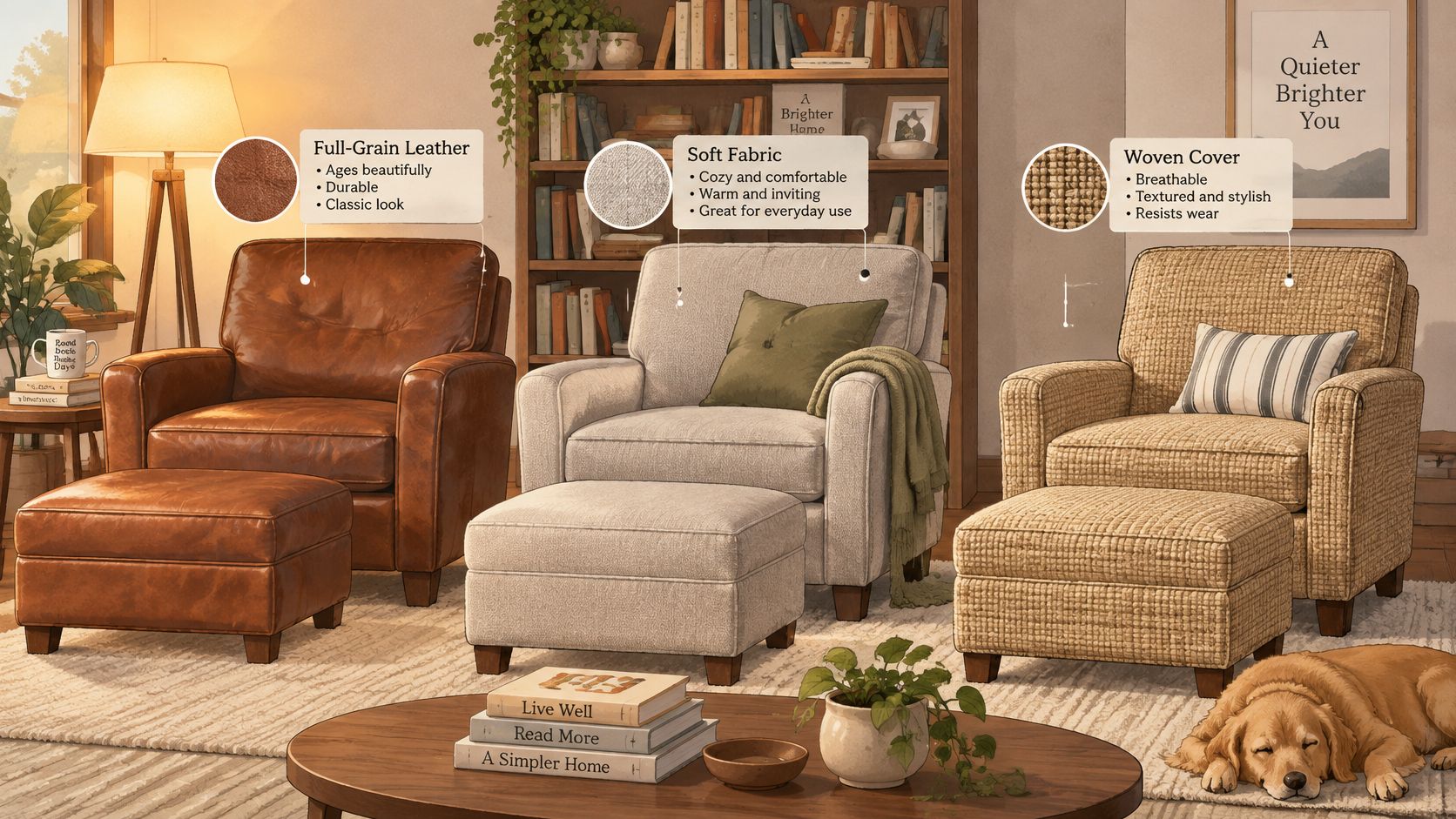
Full-grain or semi-aniline leather develops a patina with use. It can suit a chair used for nightly reading, though sunlight may fade it unevenly and pet claws can mark the surface. A damp cloth is often enough for everyday cleaning; follow the care instructions for the specific leather.
A performance weave or tightly woven, cleanable fabric can be practical in a busy room with pets or frequent spills. It may feel less supple than leather, a trade-off some households prefer for easier upkeep. This guide to choosing between leather and fabric upholstery explains how hand feel and maintenance differ.
| Option | Best for | Daily care | Watch-out |
|---|---|---|---|
| Semi-aniline or full-grain leather | Reading, with a patina welcome | Wipe with a damp cloth; follow the leather's care instructions | Sun exposure can fade it; claws may mark it |
| Performance weave | Busy family rooms, pets, bright windows | Blot spills; vacuum with an upholstery tool | May feel less supple than leather |
| High-resiliency foam core | Sustained sitting and hybrid work | Rotate loose cushions if the design allows | A thick down wrap needs regular plumping |
| Down-blend wrap over foam | A softer, more relaxed seat | Plump after use | Too much sink can make standing harder |
| Eight-way hand-tied springs | Frames built with this suspension | Follow the maker's care guidance | Ask about construction and suspension warranty |
| Sinuous-spring tight back | A lighter, contemporary silhouette | Follow the maker's care guidance | Ask about construction and suspension warranty |
| Storage ottoman | Compact rooms needing storage or an extra perch | Empty before moving; use felt pads if appropriate | A soft lid may not provide stable seating |
What Sits Under the Cover
The frame and suspension shape how a chair feels over time. Kiln-dried hardwood and corner blocks are construction features to ask about when comparing frames. Eight-way hand-tied springs are one suspension option, not a guarantee of quality on their own. Check the product's specifications and written warranty for the suspension system, including what is covered and for how long.
A high-resiliency foam core can offer steady support for longer sitting. Foam density varies by product, so ask the seller for the specification rather than assuming a particular range. A down or down-blend wrap softens the surface, but needs plumping to maintain its shape. Too much sink can make standing less comfortable.
The ottoman should support the legs at a comfortable height and distance from the chair. If it will double as a seat, confirm that its construction is designed for sitting, not just resting feet. Critelli's furniture collections are organized into Relaxed Comfort, New Traditional, Contemporary, Casual Traditional and Uptown Style. Those style categories can help narrow the look, while frame, suspension and cushion details determine how the pair serves everyday use.
Customize the Chair and Ottoman Build
Custom furniture in Southern Ontario becomes manageable when decisions follow the order in which they affect price, lead time and fit. A designer led sequence also prevents a beautiful detail from being chosen before the geometry that makes the chair comfortable.
Decide Structure Before Decoration
- Upholstery: Judge fabric or leather from the showroom swatch set against the window light of the intended room, not only under store lighting. Colour and texture shift noticeably between north and south facing glass.
- Frame and finish: Select hardwood and wood tone, with corner blocks and eight-way hand-tied springs for an heirloom build, or a sinuous spring frame for a lighter contemporary profile.
- Seat fill: Choose high-resiliency foam for daily use, adding a down blend wrap only where a softer formal look justifies regular plumping.
- Function: Decide among a standard, storage or swivel ottoman, and whether the chair needs a recliner mechanism, a swivel base or a power lift.
Details come after those structural choices. Nailhead trim, leg finish and seam piping personalize the silhouette without changing seat geometry, so they're the safest place for a bold preference. A change in leg height is different, because it can alter seat height and ottoman alignment.
Scale should be recorded from measurement, not from a nominal label. Seat height, depth and ottoman gap belong on the order beside the upholstery name and finish. The overview of custom furniture made simple outlines how those choices come together as a bespoke specification.
Each material change also affects the product file. Foam, barrier, frame and cover form one specified combination, so a late substitution isn't a minor clerical matter. Approving the final specification in writing protects the shopper, the designer and the delivery team from three different versions of the same chair.
Design-forward customization doesn't mean changing everything. It means changing the elements that improve fit, use and longevity, then stopping.
Place the Pair Inside the Room
In a St. Catharines parlour with a fireplace, a sofa facing it and a narrow route to the dining room, the largest matching ottoman may be the wrong luxury choice. The pair needs room to support the body and let people pass. Start by placing a rug so it catches the sofa's front legs, the chair's front legs and the entire ottoman. That shared footing makes the chair and ottoman read as one piece within the seating group.
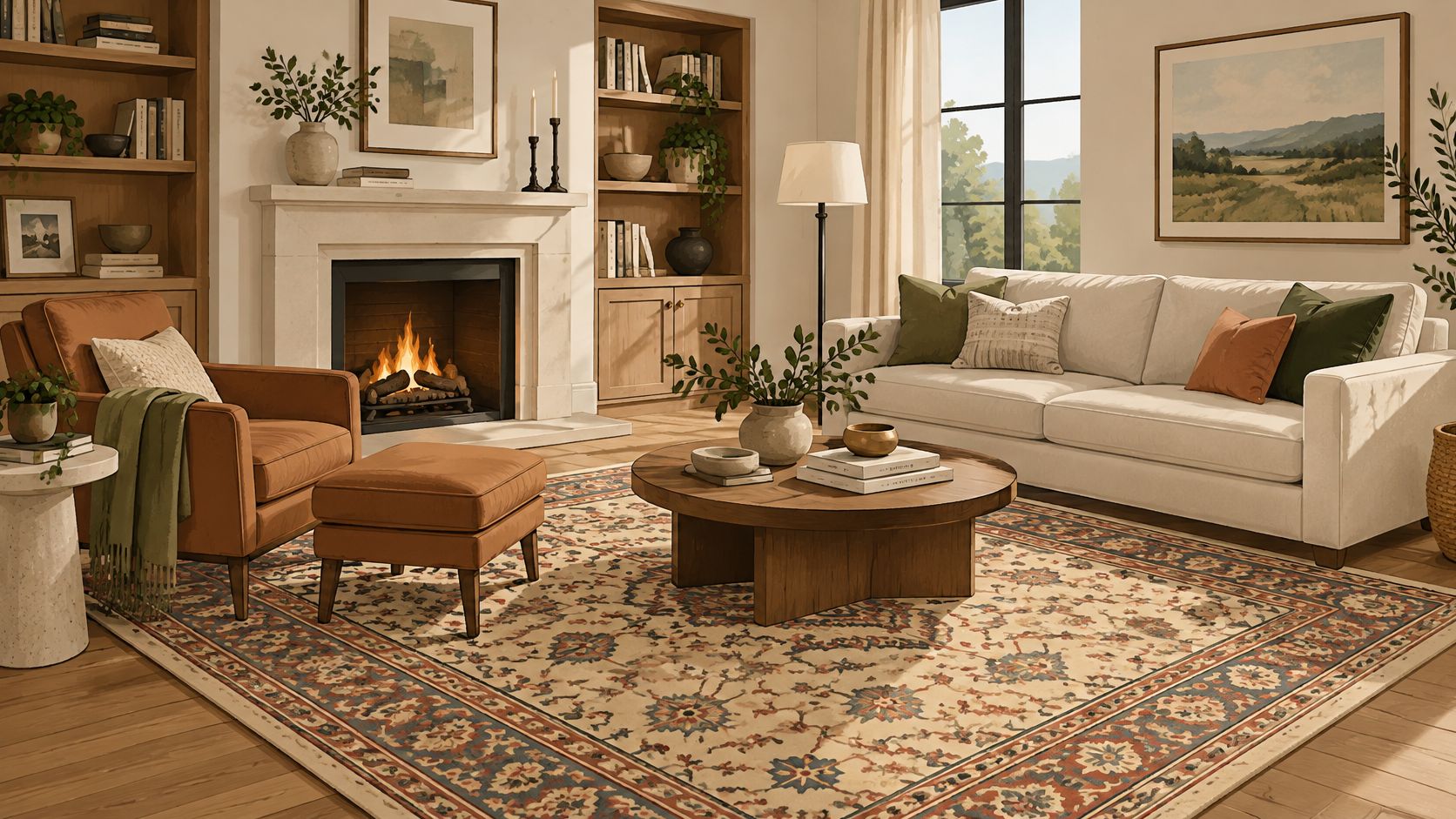
One Worked Layout
Bring the ottoman close enough to support the lower legs, with about a hand's width between it and the chair, or their fronts nearly touching. A wider gap can leave the calves unsupported during a long sitting session. Angle the chair toward the sofa for conversation, while keeping the ottoman within the chair's line and clear of the walking route to the dining room.
A rug's texture and colour help connect the pair to the rest of the room. Critelli Furniture sells rugs and home decor, including accessories, and its shop includes a Rug Market category. A wool rug can suit a busy seating area; keep delicate materials out of the main path where foot traffic is heavier.
For more guidance on how to arrange furniture in a living room, consider how seating, circulation and adjoining spaces work together. Readers looking to plan furniture layouts for daily living can use the same principle: leave clear routes first, then place the chair and ottoman where they support conversation and rest. Critelli's design guidance includes selecting fabric and planning a complete room layout.
Designer's Insight: A bold leather chair can anchor a seating group, while a quieter rug keeps the floor from competing for attention.
In a compact room, a smaller, movable ottoman can serve as a footrest or extra perch and shift aside when the route needs more space. A large ottoman may offer more surface area, but if it crowds the walking path or forces the chair too far back, that extra size works against comfort. Leave visible rug around the furniture where possible, so the seating group feels grounded without swallowing the room.
Confirm the Order Care and Delivery
Before confirming a custom chair and ottoman, check that the order records the upholstery, finish, wood tone, seat fill and ottoman type. The written specification should describe both pieces clearly. If a material is substituted, ask whether the documentation applies to the new combination of upholstery, foam and other components.
For fire-safety questions, ask the seller for documentation covering the exact materials in the ordered chair. A general description such as “fire-rated fabric” may not explain which components were tested or whether the information applies to a custom substitution.
Care That Protects the Investment
Use a soft brush attachment to vacuum fabric or leather, and blot spills instead of rubbing them. Rotate a loose ottoman cushion if its design allows. Strong sunlight can fade upholstery, so consider a blind or adjust the placement, particularly with semi-aniline leather.
Felt pads beneath the feet help protect floors, while a suitable rug pad helps protect rug pile. Empty a storage ottoman before moving it, and use a tray only on a firm, stable surface. Small habits can help keep the chair and ottoman in good condition.
Critelli Furniture offers White Glove Delivery, along with In-Home Design and custom furniture orders designed for customers' needs. Before delivery, confirm the chair's placement, the ottoman's position and any required access through the home. At arrival, check the pieces against the order details and make sure the pair fits the measured footprint.
Good care and careful placement support a chair and ottoman chosen for long use. Critelli Furniture's design services include guidance on fabric selection and complete room layouts, which can help resolve remaining questions about how the pair fits the room.