
Accent Chairs Swivel: Find Your Perfect Style in 2026


A beautifully furnished room can still feel awkward to live in. The sofa faces the television. The fireplace sits off to one side. A lovely window deserves attention, but the accent chair planted in the corner never quite joins the conversation. The room looks complete, yet the seating asks people to choose one direction and stay there.
That's where swivel seating changes the rhythm of a space. A well-made swivel chair doesn't only fill an empty corner. It lets one seat respond to the room as life happens, turning toward guests, natural light, a side table, or a quiet evening by the fire. In homes across Southern Ontario, especially in open-concept layouts, that flexibility often matters as much as silhouette or fabric.
Since 1914, family-run furniture houses have helped clients see furnishing not as a collection of isolated pieces, but as a complete room concept shaped by use, movement, and lasting comfort. Swivel accent chairs belong naturally in that tradition. They offer timeless craftsmanship with a practical intelligence that suits contemporary living.
Table of Contents
- An Introduction to Dynamic Seating
- The Functional Elegance of a Swivel Chair
- Curating Your Style and Materials
- Sizing and Placing Your Swivel Chair
- The Hallmarks of Timeless Craftsmanship
- From Our Showroom to Your Home
An Introduction to Dynamic Seating
Some chairs decorate a room. Others improve how the room works.
A swivel accent chair belongs in the second category. In a living room with a sectional, for example, a fixed chair often feels stranded at the edge of the arrangement. A swivel chair can face inward for conversation, then turn toward the fireplace or the view without anyone dragging it across the floor. The difference sounds small until the room is used every day.
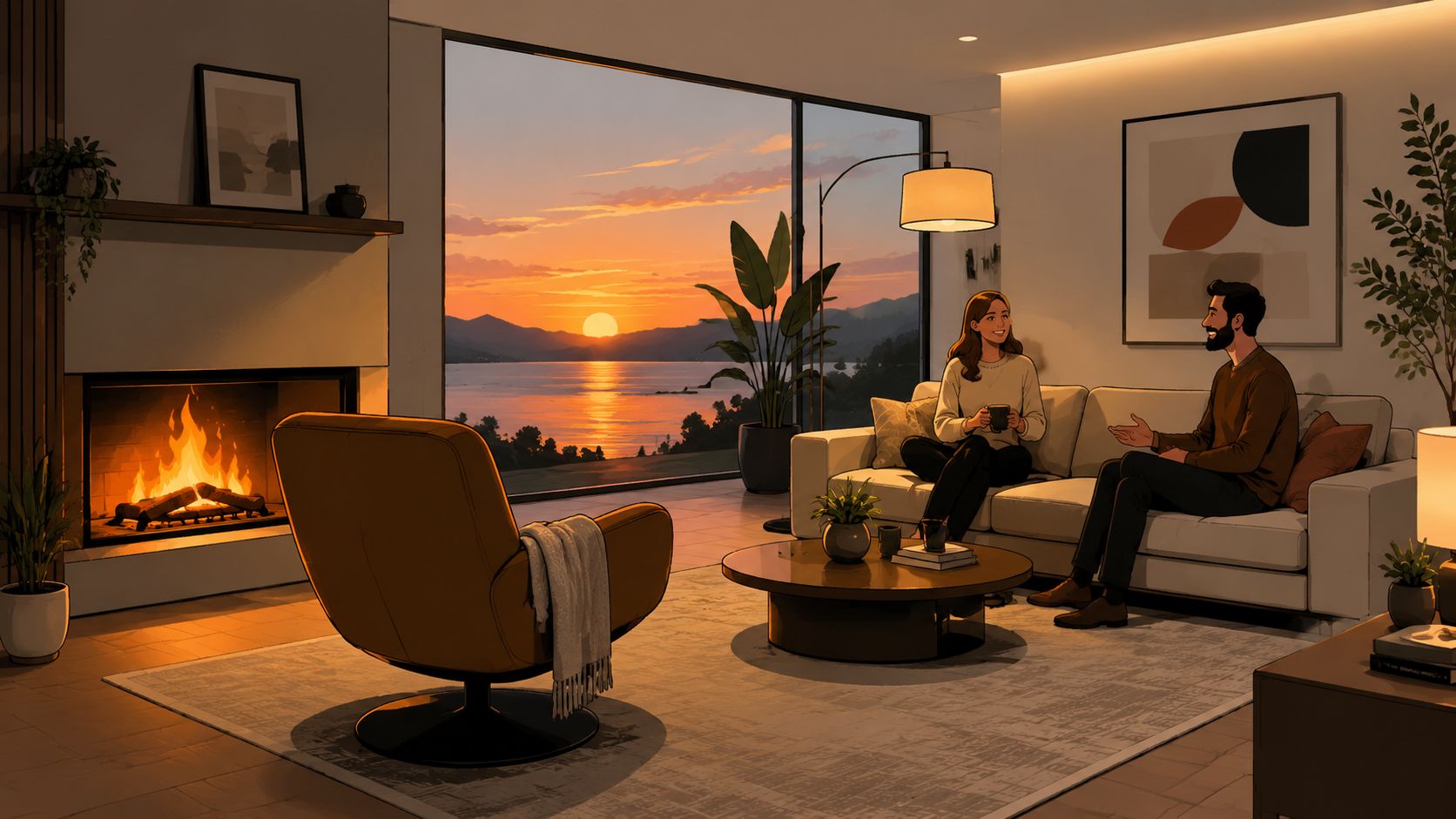
Swivel accent chairs have become a staple in North American design, particularly for open-concept layouts. In Canada, that interest sits within a sizeable furniture sector. Statistics Canada reported about C$17.4 billion in 2024 sales for Canadian retail furniture stores, which reflects a market large enough to support specialised seating categories such as swivel accent chairs, as noted in this Canadian market overview.
That broad appeal makes sense. Accent chairs swivel designs solve a problem many homeowners recognise but can't always name. The room needs one more seat, but it also needs air, circulation, and a sense that furniture can respond to different moments instead of fixing everyone in place.
A swivel chair often succeeds where a static accent chair fails. It gives one seat more than one role.
For readers comparing silhouettes, the more useful question isn't only “Does it match the sofa?” It's “Can it connect the room?” That's why room planners so often return to this category when working with sectionals, fireplace walls, or large windows. For additional placement inspiration, this guide on five ways to use an accent chair offers helpful visual starting points.
The Functional Elegance of a Swivel Chair
Why rotation changes a room
The central advantage of a swivel chair is simple. The chair turns, so the room doesn't have to be rearranged.
That matters most in modern homes where one living space often serves several purposes at once. A single chair may need to engage with the sofa during conversation, angle toward a television in the evening, then turn toward a window or bookshelf during quieter hours. A fixed chair does one of those jobs well. A swivel chair can do all of them gracefully.
This is why accent chairs swivel options often feel unusually intelligent in open-plan homes. They help connect zones without introducing visual heaviness. A chair placed near the boundary between a family room and kitchen can participate in either space, which makes the room feel less segmented and more fluid.
Three situations tend to reveal the benefit immediately:
- Near a sectional: The chair can face inward when guests gather, rather than sitting permanently at an odd angle.
- Beside a fireplace or view: The sitter can turn toward whichever feature matters in the moment.
- At the edge of a multipurpose room: One piece can support reading, conversation, and media use without constant repositioning.
For readers thinking through shape alone, that's usually the missing piece. The swivel function isn't a novelty. It's a planning tool. Guidance on choosing living room lounge chairs can help place that choice within the broader seating arrangement.
Comfort that supports daily living
Good design also helps the body move with less effort. A swivel mechanism allows the sitter to turn toward conversation or a nearby surface without scraping the chair across the floor or twisting awkwardly from the torso.
That practical benefit becomes even more meaningful when comfort and accessibility enter the conversation. The functional value of swivel seating extends to aging-in-place design, because easier turning and seated interaction can support long-term usability, as discussed in this overview of swivel accent chair comfort and accessibility.
Practical rule: If a chair will be used often by someone who prefers easier entry, exit, or turning while seated, swivel can be a functional feature, not just a style feature.
Refined interiors and everyday wellbeing converge. A beautiful chair should never ask too much of the person using it.
Curating Your Style and Materials
Material is a design decision and a maintenance decision
A swivel chair asks more of its upholstery than a stationary chair does. It turns, it gets used from multiple angles, and it often becomes the seat people reach for first. That means the surface you choose affects comfort, upkeep, and how well the chair holds its character over time.
The easiest way to judge material is to start with the room's real use. A pale, nubby fabric can look beautiful in a quiet sitting room that sees occasional company. In a family room used every evening, that same fabric may ask for more attention than many households want to give. Durable synthetics and performance fabrics are often chosen for frequent use because they tend to resist everyday wear, clean more easily, and keep a consistent appearance.
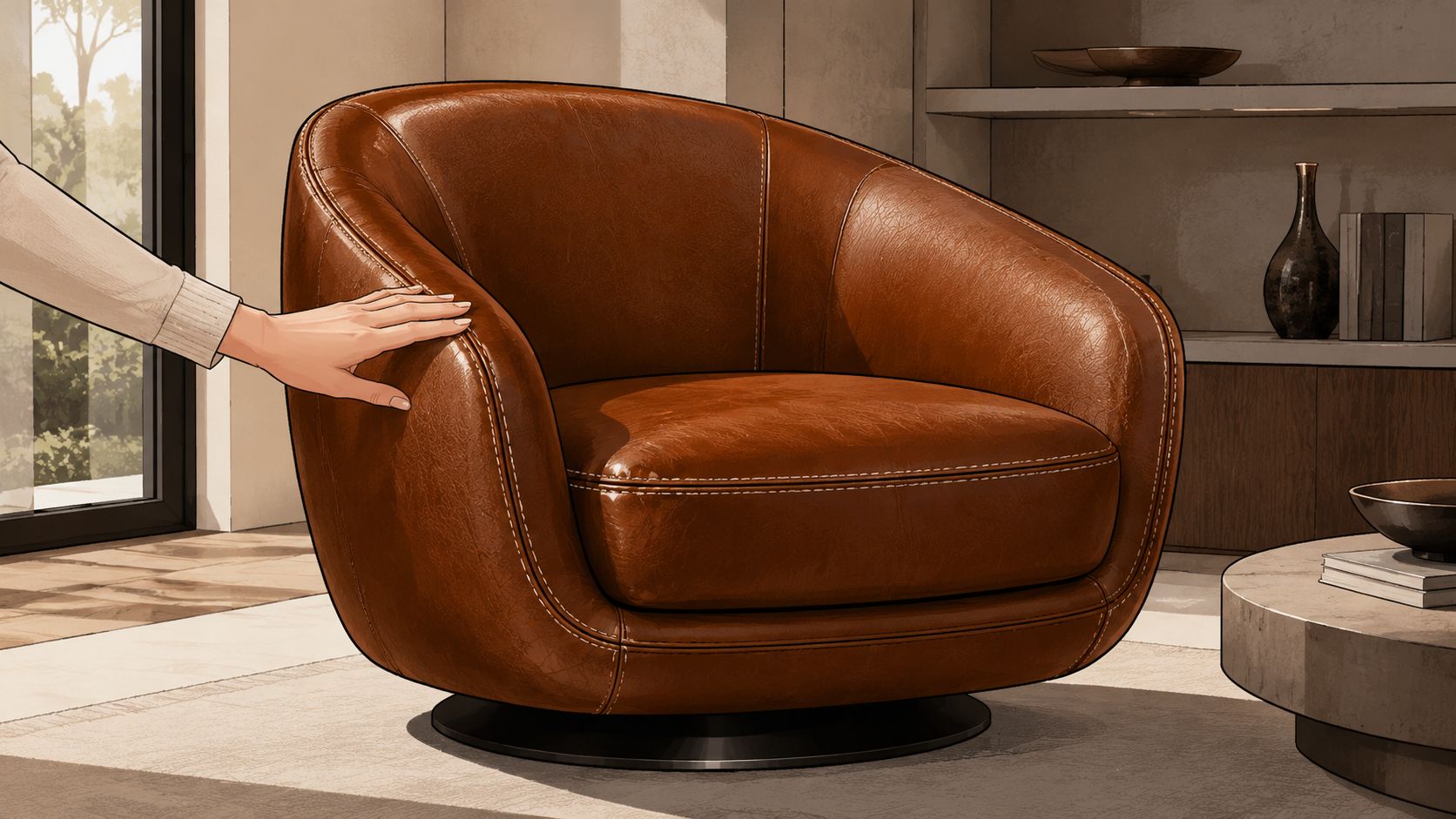
There is also a mechanical side to this decision, and it is often overlooked. On a swivel chair, the body shifts and turns rather than settling in one fixed direction. Upholstery with a forgiving hand and good recovery usually wears more gracefully under that kind of movement. For readers comparing finishes in detail, this guide to upholstery materials, leather types, woven fabrics, and performance options can help clarify the differences.
Material & Lifestyle Suitability
| Material | Best For | Considerations |
|---|---|---|
| Leather | Formal living rooms, libraries, structured interiors, buyers drawn to artisanal character | Develops visible character over time. Usually suits rooms where patina is welcome and a clear silhouette matters. |
| Performance fabric | Family rooms, homes with children or pets, high-use seating | Easier maintenance can reduce stress in daily living. Often a practical choice for a primary swivel chair. |
| Velvet | Bedrooms, dressing rooms, dramatic sitting areas | Rich surface and depth of colour. Works best where texture and light can be appreciated. |
| Bouclé or textured weave | Contemporary interiors, soft neutral palettes, sculptural barrel chairs | Brings warmth and softness, though heavy texture can feel visually dense in very compact rooms. |
| Linen-look woven fabric | Casual, formally designed rooms, light-filled spaces | Relaxed and elegant. The specific weave and finish determine how forgiving it will be in regular use. |
How style and texture complete the room
Material should also answer a visual question. What does the room need more of? Softness, structure, sheen, or contrast?
A swivel chair often acts like the pivot point in a composition. If the sofa is long and linear, a rounded chair can relax the room. If the seating group feels too soft or visually loose, a leather swivel chair with a crisp profile can bring definition. The goal is balance, not sameness.
Texture helps with that balance. Leather reflects light differently than woven fabric. Velvet deepens colour. Bouclé catches shadow and gives a sculptural chair more presence. Those details may sound subtle on paper, yet they are what make a room feel finished rather than merely furnished.
A rug also plays a practical role here. It grounds the chair visually and softens the motion of a piece designed to turn. In design terms, the chair is the moving note and the rug is the steady one. Together, they make the seating area feel intentional.
Within Critelli Furniture's assortment, the Robinson Swivel Chair is one factual example of a chair offered with a swivel feature. Pieces like that are chosen most successfully when the material, shape, and surrounding finishes are considered as one complete room plan.
Sizing and Placing Your Swivel Chair
How to measure before choosing
A swivel chair needs more than floor space. It needs turning space.
That's the point many style guides miss. In constrained floor plans, common in Canadian apartments and other multi-unit homes, the rotation radius and base footprint determine whether the chair improves the room or crowds it, as noted in this layout guidance for compact spaces.
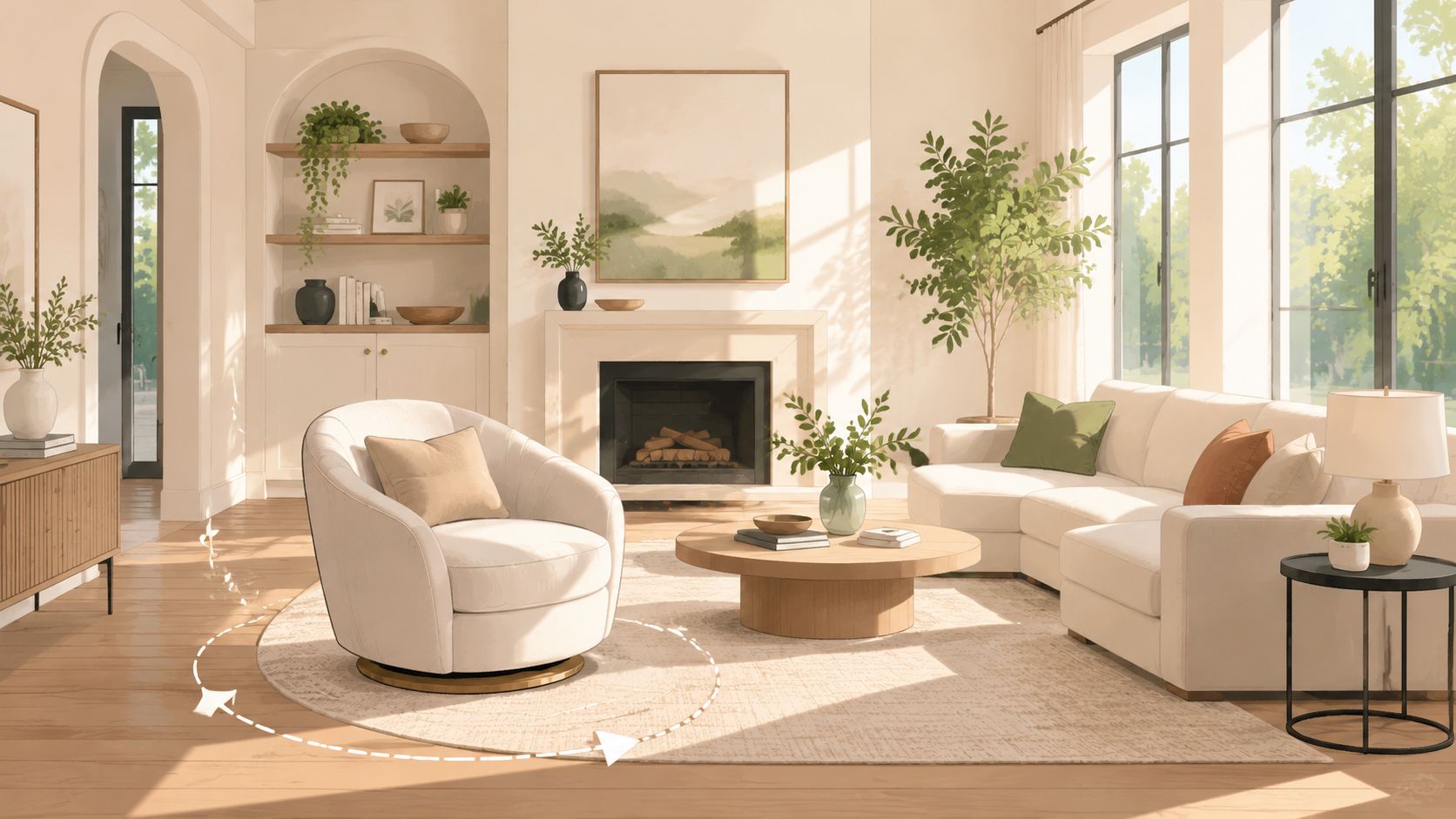
A simple measuring routine usually prevents disappointment:
- Mark the chair footprint: Tape the width and depth on the floor where the chair may sit.
- Account for turning: Check what happens when arms, wings, or a rounded back swing toward nearby tables, sofas, or walls.
- Test access paths: Make sure people can still move around the chair easily when it's occupied and turned.
- Look at visual weight: A room can have enough physical clearance but still feel crowded if the base is too broad or heavy.
For homeowners unsure where to begin, this article on how to arrange furniture in a living room can help translate measurements into a more coherent layout.
Where swivel works best and where it doesn't
Swivel chairs usually excel in a few reliable settings.
In a spacious room with a sectional, one swivel chair often acts as the flexible counterpoint that keeps the arrangement from feeling rigid. In a bedroom corner, it can face the bed, then turn toward the window or a reading lamp. In a home office that doubles as a guest space, a compact swivel chair can soften the room and still remain useful.
But swivel isn't always the answer.
- Very tight corners: If the chair barely clears the wall, the swivel function becomes wasted.
- Narrow walkways: A turning chair can interrupt circulation if placed too close to a path.
- Rooms needing visual lightness: In some small rooms, an armless or open-frame stationary chair will feel easier and more graceful.
- Decorative-only corners: If the chair will almost never be used, a swivel mechanism may add bulk without adding value.
Sometimes the right design choice is restraint. If the chair can't turn comfortably, it shouldn't swivel at all.
That honesty matters. A chair should serve the architecture, not fight it.
The Hallmarks of Timeless Craftsmanship
The mechanism is the true test of quality
A swivel chair often wins attention with fabric, shape, or a handsome silhouette. Daily satisfaction comes from something less visible. The chair has to turn with quiet control, stop without a shudder, and feel steady every time someone sits down.
That is why experienced furniture makers inspect the mechanism first. A well-built swivel base works like the hidden hinge in a fine cabinet door. You may not study it at first glance, but you feel its quality every time it moves. High-quality bearings, solid base engineering, and proper weight distribution are what create a smooth rotation instead of a loose, noisy spin.
A homeowner does not need technical vocabulary to judge this. Sit down. Turn fully to one side, then back again. The motion should feel centred and calm. If the chair wobbles, scrapes, clicks, or seems slightly off balance, the construction is already telling you what the chair will be like after years of use.
What to inspect beyond the base
Timeless craftsmanship in a swivel chair comes from several parts working together. The visible upholstery matters, but the lasting value sits underneath the fabric and inside the frame.
Look closely at these details:
- Frame construction: Kiln-dried hardwood usually provides a steadier, longer-lasting structure than lighter materials that can loosen over time.
- Seat support: Quality suspension helps the cushion hold its comfort and shape, especially in chairs used every day.
- Upholstery discipline: Clean seams, careful pattern matching, and even padding show a practiced hand and better quality control.
- Base integration: The swivel system should feel built into the chair's design, not attached to the bottom as a separate idea.
- Floor contact: A well-made base moves with control and helps reduce unnecessary wear on wood, tile, or area rugs.
These points are easy to overlook because they are quiet virtues. Yet they are the difference between a chair that merely photographs well and one that still feels composed years later.
Relaxed yet refined rooms especially benefit from that kind of discipline. A swivel chair is both a working seat and a visual anchor, so any weakness in its construction shows up quickly in comfort, posture, and daily use.
Visible beauty draws you in. Hidden construction earns your trust.
For a family business that has furnished homes since 1914, quality has always been judged by touch, balance, joinery, and motion before fabric is ever discussed. Delivery matters too, because a well-made chair should arrive and be placed with the same care used to build it. That is part of why many homeowners ask about white-glove delivery for premium furniture. A good swivel chair is not merely attractive. It is built to serve the room, support the body, and keep doing its work with grace for many years.
From Our Showroom to Your Home
A chair should fit the room and the life inside it
The right swivel chair is never chosen by silhouette alone. It should suit the room's scale, support the way people sit, and belong to a larger furnishing plan that includes upholstery, rug, circulation, and sightlines.
That is where design services become especially valuable. Rather than treating the chair as a standalone purchase, a thoughtful studio treats it as part of a complete room concept. The result feels composed because each decision supports the next, from the angle of the chair to the texture underfoot.
For households furnishing across St. Catharines, the Greater Niagara region, Hamilton, or Toronto, that design perspective often saves more than time. It prevents the common mistake of buying a beautiful piece that never sits comfortably within the architecture of the room.
The final placement matters
Delivery is part of the design experience too. A premium chair deserves more than a carton at the front door and an uncertain shuffle across hardwood.

White-glove service closes the gap between showroom selection and a finished interior. It allows the chair to be inspected, placed correctly, and integrated with the rest of the room from the first day. Readers can learn more about what that process includes through this explanation of white-glove delivery.
That final step matters because placement is rarely incidental. A swivel chair often needs a subtle adjustment to angle, distance, or clearance before it feels exactly right. When that care is built into the process, the room settles more naturally and the investment feels complete.
For those considering accent chairs swivel styles as part of a refined living space, Critelli Furniture offers a heritage perspective shaped by family-run service since 1914, design consultation, the Rug Market's hand-knotted foundations, and white-glove care from selection to placement. Experience the craftsmanship in person at the King Street Showroom, book your complimentary design consultation today, or visit the Rug Market to find your room's foundation.