

Round Solid Wood Coffee Table: How to Choose the Right One


Traffic from the hall and the kitchen keeps catching one corner of the living room. A round top takes that corner away, and the harder question is whether the piece will still sit true after an Ontario winter, a condo corridor, and years of mugs and toys.
Why a Round Solid Wood Table Earns Its Place
A round solid wood coffee table gives people moving between the hall, kitchen, and seating area fewer sharp corners to bump into. It also keeps a useful surface within reach of the sofa and chairs.

Solid wood means the top is made from wood boards rather than a thin veneer over an engineered core. A thicker wood surface can allow for later sanding and local repair, although the amount of material and the table's construction determine what work is possible.
The Greater Niagara Chamber of Commerce's account of Critelli Furniture's history records its founding in 1914 by Joseph Critelli and his young son Thomas, first at Ormond Street and Albert Street in Thorold. That family history is part of the furniture retailer's local context, while a table's value still comes down to its own specification. An advertised price alone does not tell you about its construction or finish.
Choose the shape for how people move through the room, then judge the table by its materials and build. At Critelli Furniture's King Street showroom in St. Catharines, you can assess wood tone and proportion in person.
Wood Species Compared for a Round Top
Janka hardness is the pounds-force needed to press a steel ball halfway into the wood. A higher number resists dents from keys, mugs, and toys. Species sets that baseline. Construction and finish decide how the table behaves.
| Species | Janka hardness (lbf) | Grain and colour | Relative price | Best suited for |
|---|---|---|---|---|
| Hard maple | 1,450 | Fine, even grain, creamy white | Mid to upper | Busy households, contemporary rooms |
| White oak | 1,360 | Open grain, pale to honey tones | Mid-range | Family rooms, traditional and modern |
| White ash | 1,320 | Pale, strong grain with bold stripe | Mid-range | Lighter, airy rooms |
| Red oak | 1,290 | Bold grain, pinkish undertone | Mid-range | Budget-conscious oak look |
| Teak | 1,070 | Golden brown, naturally oily | Upper | Contemporary and coastal palettes |
| Black walnut | 1,010 | Rich chocolate tones, dramatic grain | Upper | Design-forward rooms with warm palettes |
| Honduran mahogany | 900 | Warm reddish brown, straight grain | Upper | Classic, formal living rooms |
| Cherry | 950 | Smooth grain that darkens with age | Upper | Traditional and heirloom pieces |
| Eastern white pine | 380 | Soft, knotty, light | Budget | Casual rooms; dents easily as a daily surface |
Three households, three sensible picks
A house with children or a dog should start at the top of the hardness column. Hard maple at 1,450 lbf and white oak at 1,360 lbf take the daily knocks that softer boards record as dents. White ash and red oak sit close behind if the room wants a paler or pinker grain at a mid-range price.
A quieter study or a design-forward sitting room can accept black walnut at 1,010 lbf. The chocolate tone and dramatic grain earn the softer surface, provided cups stay on coasters and the table isn't a homework desk. Cherry, around 950 lbf, belongs with traditional and heirloom pieces because the colour deepens as the wood ages. Honduran mahogany, at 900 lbf, gives a formal reddish warmth for a room that is looked at more than it is worked on.
Teak, at 1,070 lbf, is naturally oily and holds its shape well, which suits contemporary and coastal palettes even when the table never leaves the house. Eastern white pine is the budget board. At about 380 lbf it dents under ordinary use, so it fits a casual room, not a surface that sees laptops and toys every evening.
Practical rule: Buy the species for the household's habits, then spend the rest of the budget on a top that can move and a finish you can repair.
A curated selection of solid wood furniture is the right place to compare these tones side by side, because a screen flattens both colour and grain.
How to Judge Build Quality and Movement Before You Buy
Start with the top, not the silhouette. A sound round top is a panel of solid boards glued edge to edge, with growth rings alternating so the panel resists cupping. The stock should be kiln-dried, and each board should be checked with a calibrated moisture meter at several points, not one lucky reading.
The Canadian Wood Council reports that indoor wood in Central Canada, Ontario included, typically reaches an equilibrium moisture content of 7–8% annually, with seasonal values around 5% in winter and 10% in summer. A single target isn't a permanent state. The top will still expand and contract after delivery. Good work plans for that. Elongated figure-eight fasteners, tabletop clips, or slotted screws let the panel move. Clearance around the base-to-top connection does the same job. Finish on both faces, and on every exposed edge, slows uneven moisture exchange. A top screwed rigidly across its grain is the detail to walk away from. Keep the finished table off radiators and out of strong sun.
What the base has to do
A narrow pedestal, or a skimpy fastener pattern under a wide top, tips when someone leans on the rim. Loose leg-to-apron joints, gaps, and splits in the end grain are signs the frame was forced together. Wood joinery techniques such as mortise-and-tenon or well-fitted dowels hold a round top's lever arm better than a few short screws into end grain.
A six-step check you can do in the showroom
- Confirm the top sits evenly on a rigid base, with support that doesn't leave the rim springy.
- Check that every leg meets the floor. Rock the piece. Adjustable glides fix a floor, not a twisted apron.
- Inspect leg-to-apron joints for gaps, looseness, and end-grain splitting.
- Press moderately downward at the perimeter, from several directions, and watch for lift at the opposite side.
- Repeat the check after the table has rested in the home for a week or two, once it has met the room's humidity.
- Photograph any defect and note measured movement, so a later seasonal shift can be compared with a record.
Ask for diameter, thickness, base footprint, approximate mass, finish type, and maximum intended load in writing. "Heavy duty" isn't a specification. These checks don't produce a pass rate for Ontario homes. They give you an acceptance method you can repeat after the first heating season.
Choosing a Finish That Protects Both Wood and Air
Solid wood isn't automatically gentle on indoor air. The boards may be a straightforward material, and the finish, the glue, and any hidden core may not be. Health Canada identifies furniture, varnishes, glues, and composite wood products as potential sources of indoor VOCs and formaldehyde, and notes that exposure depends on the substance, the concentration, and how long you are near it.
Ask for four things before you treat a finish as a health choice: the species, the finish type, the curing time, and whether the piece contains MDF, particleboard, veneer, or a concealed engineered part. A solid top and a wood-look top are different products. A compliant engineered shelf isn't automatically unsafe, and an undisclosed high-emission coating can undo the appeal of a natural board. Health Canada recommends low-emission products, ventilation after installation, and composite parts that meet established formaldehyde limits.
| Finish | Look | Protection and repair | Everyday care |
|---|---|---|---|
| Hardwax oil | Matte, natural feel | Moderate; worn spots can be repaired individually | Light buffing; spot-oil worn areas |
| Penetrating oil | Low sheen, warm | Lower; needs more frequent refreshing | Re-oil as wear shows |
| Water-based lacquer | Clear, slight sheen | High; sealed surface | Damp cloth; repairs often need refinishing |
| Oil-based polyurethane | Glossy, ambers over time | High; hard surface | Damp cloth; avoid abrasive pads |
| Shellac | Warm amber, glossy | Moderate; sensitive to alcohol and water | Dry cloth; keep spirits and wet spills off |
Care that matches the coating
Choose the lower-emission option you can maintain, air the room after delivery, and let a new film cure before you set books or a tray on it. Day to day, wipe with a damp cloth, use coasters for hot and wet items, and skip ammonia and abrasive pads. Refresh oil when wear shows. A film finish usually needs a proper refinish, not a spot of oil.
If a soft pine piece is headed for a colour change rather than a clear coat, Alex Trend Painters' pine furniture guide is a useful read on how spray work sits on that grain. For the wood itself, sustainable furniture materials are worth naming in the same conversation as emissions, because a long-lived board and a disclosed finish belong together.
Sizing a Round Table for Your Room and Building
Diameter controls circulation more than it controls how large the table looks in a photo. Leave roughly 14 to 18 inches between the table edge and the sofa, and set the top near seat height, usually 16 to 18 inches. Closer than that and knees hit the rim. Farther, and a drink is a reach.
| Diameter | Seating it suits | Clearance from sofa | Practical note |
|---|---|---|---|
| 30 in (76 cm) | Loveseat or two armchairs | 14 to 16 in | Compact; easier through corridor turns |
| 36 in (91 cm) | Standard three- or four-seat sofa | 14 to 18 in | Most common family size |
| 42 in (107 cm) | Sectional or deep sofa | 16 to 18 in | Greater visual weight; confirm the door path |
| 48 in (122 cm) | Sectional in a large living room | 18 in or more | Needs generous floor space; check every entry route |
A single large top balances a deep sectional. It also becomes a rigid object that has to turn corners. The Condo Authority of Ontario annual report notes that approximately 1.92 million people in Ontario live in condos, and that condos represented 16.7% of new construction in 2025, when nearly 81,000 new residential homes were built. For many of those homes the unanswered question isn't the living-room diameter. It's whether a heavy top clears the front door, the elevator, the stairwell landings, and the hallway turns.
Measure the path before you fall for a diameter
Compare smaller rounds, a pedestal that doesn't add corner bulk, removable legs, a lighter species, and two-piece or nesting tops. A coffee table size guide helps with the room. The building needs its own list, written down before anyone orders:
- Front-door width: Measure the clear opening, not the slab, including the narrowest point at the handle.
- Elevator interior: Note width, depth, and diagonal, plus the door opening.
- Stairwell landings: Check the turn, not only the stair width.
- Hallway turns: Include tight corners and any bulkhead.
- Packaging size: A crated top is larger than the finished diameter.
- Table height and sofa clearance: Confirm both against the 14 to 18 inch gap.
- Building rules: Note booking windows, elevator pads, and any ban on weekend moves.
White-glove delivery is the point where those numbers get used, especially for condos across Greater Toronto and the Hamilton–Niagara corridor. Heat also steals floor space. Where a conventional radiator crowds the path beside a sofa, it helps to find vertical radiators for narrow walls so the round top isn't pushed into the walkway.
Pairing a Round Table With the Rest of the Room
The table is one object in a complete room concept. Scale, light, and the finishes already on the walls decide whether a round profile feels calm or stranded.
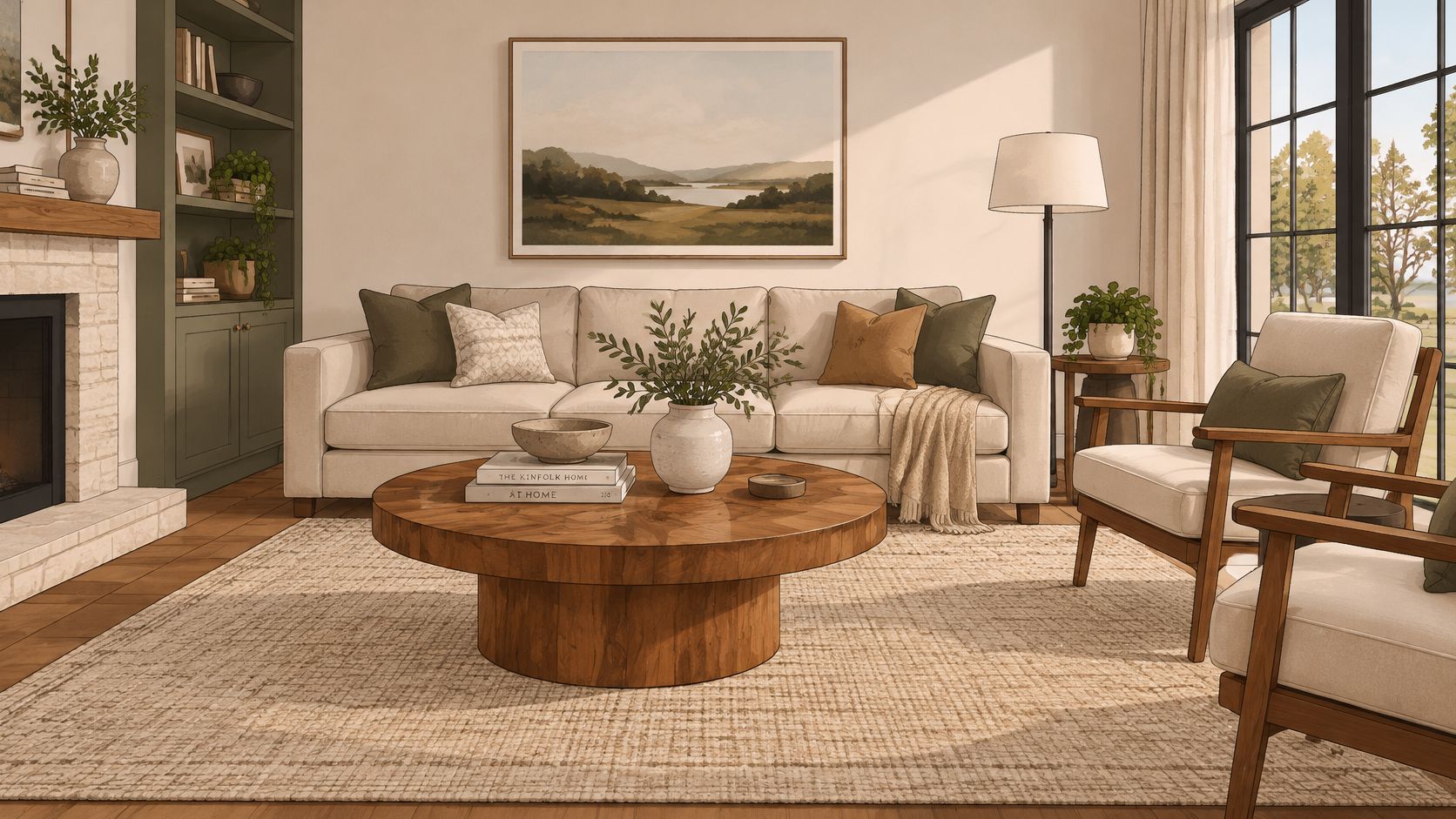
Critelli's design process includes a complimentary consultation, professional space planning, bespoke work across fabrics, leathers, and finishes, and in-home consultations that account for natural light and architecture. That is how a round edge gets tested against room flow, seating clearances, and sightlines, including for interior design services in St. Catharines and custom furniture across Southern Ontario.
Tone, seating, and the floor
White oak and hard maple sit easily with clean-lined seating and light walls. Black walnut wants leather and warm metals. Cherry and mahogany belong with wing chairs and richer textiles. Teak pairs with relaxed, natural cloth. Stickley-style joinery carries a traditional room. Hancock & Moore leather gives a richer contemporary balance without fighting the wood.
A rug is art for your floor, and it is the foundation of the palette. Match its undertone to the table's grain so the centre of the room doesn't split into two unrelated colours. Hand-knotted rugs Ontario collectors look for in the Rug Market do that job under a round top, because the circle reads clearly against a field of wool.
Designer's Insight: Our designers often pair a bold walnut top with a neutral hand-knotted wool rug, letting the rug settle the room's energy while the table anchors the centre.
Styling the surface is a separate, lighter task. A short guide to how to decorate a coffee table keeps trays and books from covering the grain you chose the species for. Luxury furniture in the Niagara market earns its place when the table, the seating, and the rug are chosen as one composition.
Confirm Your Size and Book Your Design Consultation
Four checks settle the decision. The species matches the household and the style. The build has passed the six-step test, with fasteners that allow movement. The finish is disclosed, including curing time and any engineered parts. The diameter fits both the sofa gap and the measured path through the building.
The King Street showroom is where those checks become visual. Compare wood tone, tabletop proportions, joinery, and finish in one visit, and bring the worksheet from the building walk-through. Critelli Furniture offers custom furniture orders suited to what the room and the entrance need, including species, size, and finish, plus fabrics and leathers for the seating in the same scheme.
Before you order, ask again for diameter, thickness, base footprint, approximate mass, finish type, and maximum intended load in writing. Delivery timeframes for custom made furniture vary between brands, so confirm the schedule when you book. Furniture bought from the showroom floor is available for immediate delivery at your convenience. Critelli Furniture offers White Glove Delivery, and the team can confirm which services apply to your building, from Greater Niagara through Hamilton and Toronto.
Experience the craftsmanship in person at our King Street Showroom. Book your complimentary design consultation today. Visit the Rug Market to find your room's foundation.
Critelli Furniture curates round solid wood coffee tables as part of a full room, from bespoke wood and leather to hand-knotted rugs and white-glove placement. Bring your door, elevator, and sofa measurements, and compare tone and joinery on the floor before you commit. Visit Critelli Furniture to book a complimentary design consultation or to see the King Street showroom.