


Entryway Coat Rack Ideas to Organize and Elevate Your Home


A late winter afternoon in Southern Ontario can turn an orderly foyer into a bottleneck. Damp coats arrive first, followed by bags, scarves, boots marked with salt, and the everyday rush of a household trying to get inside without tracking the season through the home. A well-chosen entryway coat rack gives each of those items a place, but its deeper value is that it establishes calm at the threshold.
Canadian households continue to wrestle with changing storage needs. A survey found that 73% of Canadians were eager to declutter when the season changes, while 62% said they scramble to prepare the home before guests arrive. The same survey reported that 84% had at least one junk drawer and 31% cited limited space as a barrier to organising, details that help explain the lasting relevance of practical entryway storage such as coat racks (Canadian Tire survey findings).
Finding Calm in the Chaos of Your Entryway
Consider a busy family returning home through a compact front entrance. One person needs a place for a work coat, another has a school bag, a guest is carrying a wet umbrella, and winter boots need to remain near the door without blocking it. A single decorative hook may look attractive, yet it won't solve the daily pattern. A thoughtfully designed rack, paired with a bench, tray, or concealed bin, can turn that moment of arrival into a simple sequence: hang, sit, remove, contain.
The entryway is both a practical landing zone and the home's first impression. Visitors notice whether coats are piled on a chair, whether footwear has a defined boundary, and whether the furnishings feel intentional. A rack with timeless craftsmanship can support the household's routine while contributing to the architectural character of the foyer.
A family-run perspective
Critelli Furniture has been family-run since 1914, with a long-standing focus on furnishings that serve both daily life and lasting interiors. That heritage matters in a small piece because an entryway coat rack receives frequent handling, seasonal weight, and visual attention. The right choice should feel considered rather than disposable, with materials and proportions that remain appropriate as the surrounding room evolves.
The Canadian category itself is mature and strongly import-dependent. A Canada-focused market report estimated the coat rack market at CAD 180 million to CAD 230 million in 2025, with approximately 2.5 million to 3.0 million pieces sold and imports representing 80% to 85% of units (Canada coat rack market analysis). For homeowners, that abundance creates choice, but it also makes a curated selection more useful than an impulsive purchase.
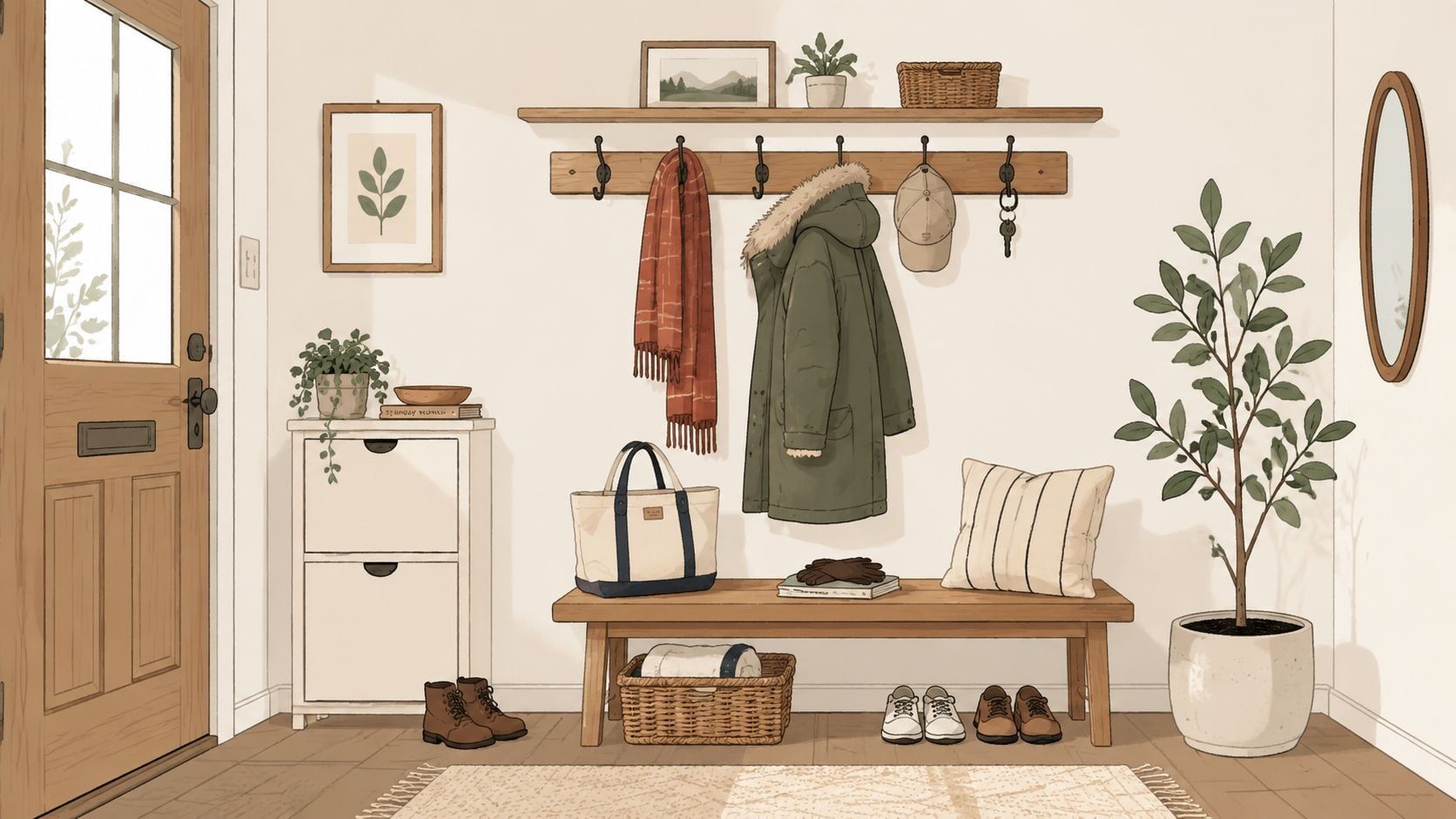
The entryway as a complete room concept
The strongest solutions begin with the household's behaviour, then bring in design. Wall width, door movement, hook access, damp-weather storage, and seasonal overflow all matter before colour or finish enters the discussion. From there, material, lighting, a mirror, a bench, and a rug can make the rack feel like part of a room rather than an isolated utility.
A designer's approach moves in a clear order: identify the pressure point, choose the structure, plan its position, install it safely, and style it for the season. That sequence protects the home's flow while giving the entrance the warmth expected from an heirloom-quality interior.
How to Choose the Right Entryway Coat Rack for Your Home
The best rack type depends on the shape of the entrance and the work it must perform. A narrow vestibule usually benefits from a wall-mounted rail or a shelf with hooks because the furniture stays close to the wall. An open foyer may accommodate a freestanding rack or hall tree, particularly when a seat and lower storage would help the household change footwear.
Comparing rack formats
| Rack format | Best suited to | Main consideration |
|---|---|---|
| Wall-mounted rack | Tight halls and open-plan entrances | Requires careful anchoring and wall planning |
| Freestanding rack | Larger foyers and flexible layouts | Needs a stable base and clear circulation |
| Hall tree | Families needing seating and storage together | Occupies more floor depth |
| Shelf with hooks | Small entries and accessory storage | Works best when overflow stays controlled |
Hook count should reflect actual use, not an idealised photograph. A family may need separate access for adults and children, while guests and seasonal layers create additional demand. Multiple hook heights can make the system easier for children to use and reduce the tendency for everyone to reach for one crowded row.
Materials also change the character of the entrance. Solid wood offers visual warmth and can suit heritage architecture, while metal brings a sharper, more contemporary presence. Mixed finishes, such as wood with aged metal, can bridge traditional millwork and newer furnishings. Homeowners comparing smaller hardware components can also review robe hook options from Tiles Mate to understand how shape, finish, and projection influence a wall composition.
Designer's Insight: A substantial wood rack gains a design-forward quality when its finish relates to the home's flooring or console, while a restrained metal detail can keep the arrangement from feeling overly matched.
Look beyond the first season
A rack that handles only light spring jackets may feel inadequate once heavier coats, hats, and winter accessories return. The selection should account for seasonal overflow, the depth of garments, the wall's visual scale, and whether nearby storage can receive gloves, bags, and footwear.
A minimalist room doesn't require the smallest possible object. It requires fewer competing objects, each selected with purpose. Guidance on minimalist interior design can help homeowners distinguish between visual restraint and insufficient storage. The goal is a bespoke balance, not an empty wall that leaves daily belongings without a home.
Measuring and Planning Placement Like a Designer
A beautiful rack can still fail if it interrupts the door, narrows the walkway, or leaves winter gear without a containment zone. Planning begins with the wall, but it ends with the household's movement through the entrance.
Measure the available wall width, then note the ceiling height and the position of trim, switches, vents, and lighting. Mark the door's full swing on the floor with painter's tape. Repeat the same exercise for the main walking route, including the space needed to remove boots and turn toward the rest of the home.
Read the entrance as a working map
A wall-mounted rack often makes sense when a freestanding piece would make a small entrance feel tight. Canadian retail guidance recognises that wall-mounted options can preserve floor area, while placement advice stresses the need to protect door movement and walkway clearance. The useful decision isn't just wall-mounted versus freestanding. It is whether the selected format supports the way each person enters, unloads, and leaves again.
Use painter's tape to outline the rack's width and depth before drilling. Hang a temporary coat from the proposed hook area, then check whether it brushes the door, obscures a light switch, or competes with a nearby artwork. If children use the entrance, reserve accessible hook positions rather than placing every hook at adult reach.
A small notebook can clarify the pattern. For several days, the household can note where coats, bags, boots, and umbrellas land. That observation often reveals whether the main problem is hanging capacity, concealed storage, seating, or moisture control.
Establish the visual centre
The rack should relate to the architecture around it. A mirror can provide a practical final glance, while hallway art can introduce colour and personality above or beside the storage. For homeowners considering how artwork should relate to scale, sightlines, and furniture, Printano's hallway art guide offers useful visual context.
A rug defines the entry zone and protects the floor from salt and water. Critelli's interior design space planning service frames placement as part of the broader room arrangement, which is particularly helpful in open-plan homes where the entrance shares visual space with a living or dining area.
Practical rule: A rack belongs where coats naturally come off, but it shouldn't become the first obstacle encountered when the door opens.
Installing Your Entryway Coat Rack With Confidence
Installation should be treated as part of the design, not as an afterthought. A wall-mounted rack transfers everyday pulling and hanging forces into the wall, so the fixing method matters as much as the visible hardware.
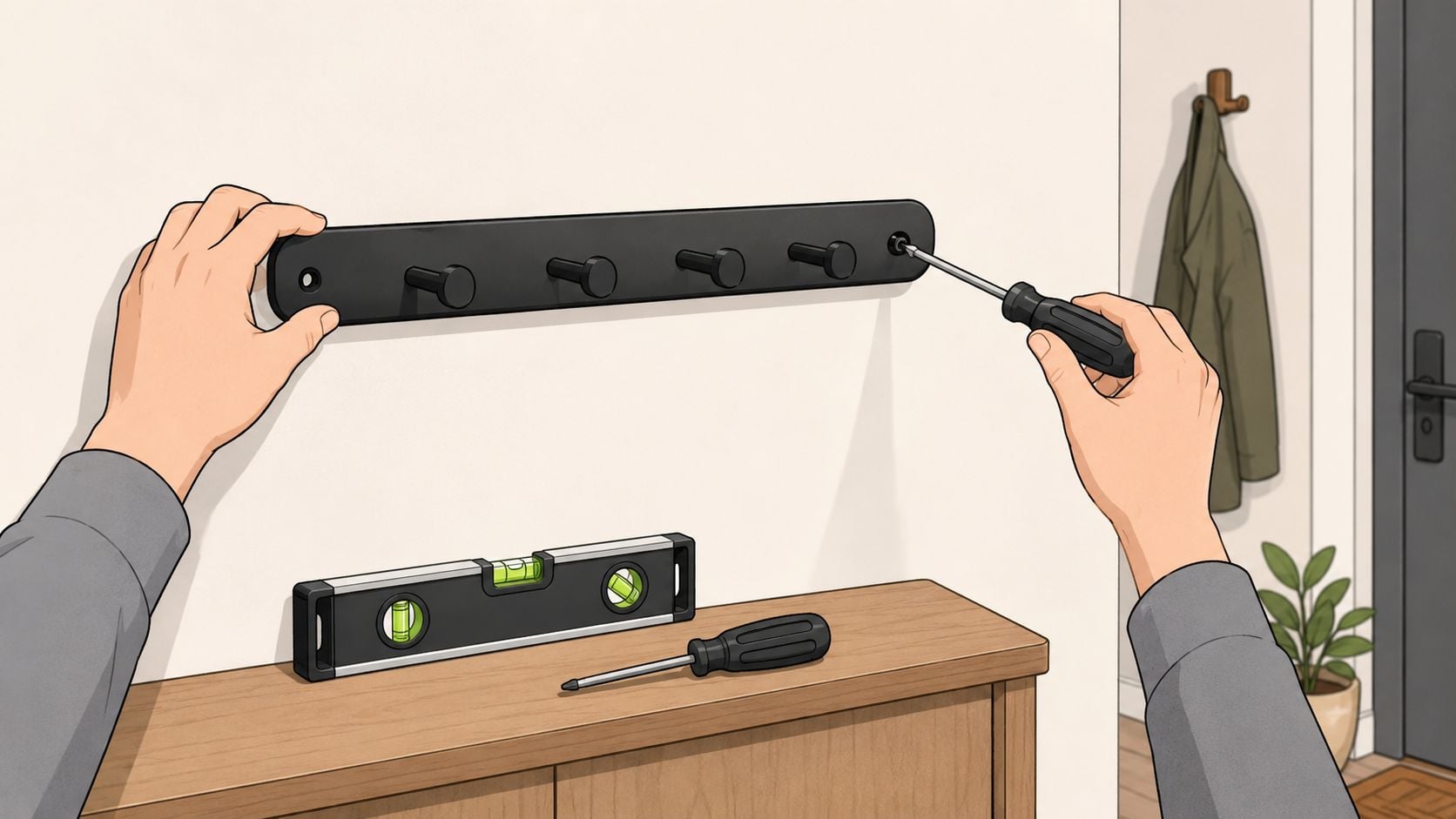
Wall-mounted installation
A stud finder, level, pencil, drill, screwdriver, measuring tape, and the correct fasteners form the basic toolkit. Locate the studs, mark their positions, and hold the rack in place while checking that it sits level relative to the trim and surrounding architecture. Mark the pilot holes only after confirming that the proposed height and width still respect the door swing.
The safest Canadian installation method is to fasten the rack into a wall stud whenever possible. Health Canada guidance advises using anti-tip devices, securing furniture to a wall stud, or selecting heavy-duty drywall anchors designed for the specific furniture type. Tip-over prevention depends on transferring the load into structural framing rather than relying on drywall alone (wall-mounted coat rack safety guidance).
When a stud doesn't align with the rack's mounting points, the anchor must match the wall construction and the furniture's expected load. Plaster and masonry walls require more specialised assessment, especially in older homes where wall conditions can vary. A professional installer is the sensible choice if drilling may affect concealed services or if the rack will carry substantial winter garments.
Freestanding and hall tree placement
Freestanding designs don't require wall drilling for their primary support, but they still need a level floor and a stable base. A hall tree should sit fully on the floor, with its bench and storage doors operating without striking nearby walls or furniture. Wall-tethering and anti-tip hardware add an important layer of protection, especially in homes with young children or pets.
The installation can be handled through Critelli's furniture assembly services when the homeowner prefers a more seamless result. White-glove service in the Toronto and GTA market commonly includes in-home delivery, assembly, inspection, and placement, making it a practical option for carefully finished furnishings (Ontario white-glove delivery information).
Complete the winter drop zone
A rack alone can't contain moisture. A boot tray, moisture-resistant mat, and washable bin give wet footwear and small accessories a defined boundary, so water and salt don't travel into adjoining rooms.
Safety comes before styling. A level rack with correct anchoring will serve the household better than a beautifully arranged piece that shifts under load.
Styling Your Rack for a Premium and Winter Ready Entry
A premium entry doesn't hide its function. It gives practical objects enough structure and beauty to appear intentional. The rack becomes the vertical centre of a composition that may include a slim bench, a mirror, a tray for keys, a closed bin for gloves, and lighting that makes the arrival feel warm in the evening.
Winter changes the brief. Canadian guidance on entryway organisation emphasises damp coats, wet boots, seasonal rotation, boot trays, moisture-resistant mats, labelled bins, and multiple hook heights rather than hanging space alone (Ontario winter gear organisation advice). Those elements should be selected as one system, with the wettest items closest to the door and decorative details placed beyond the splash zone.
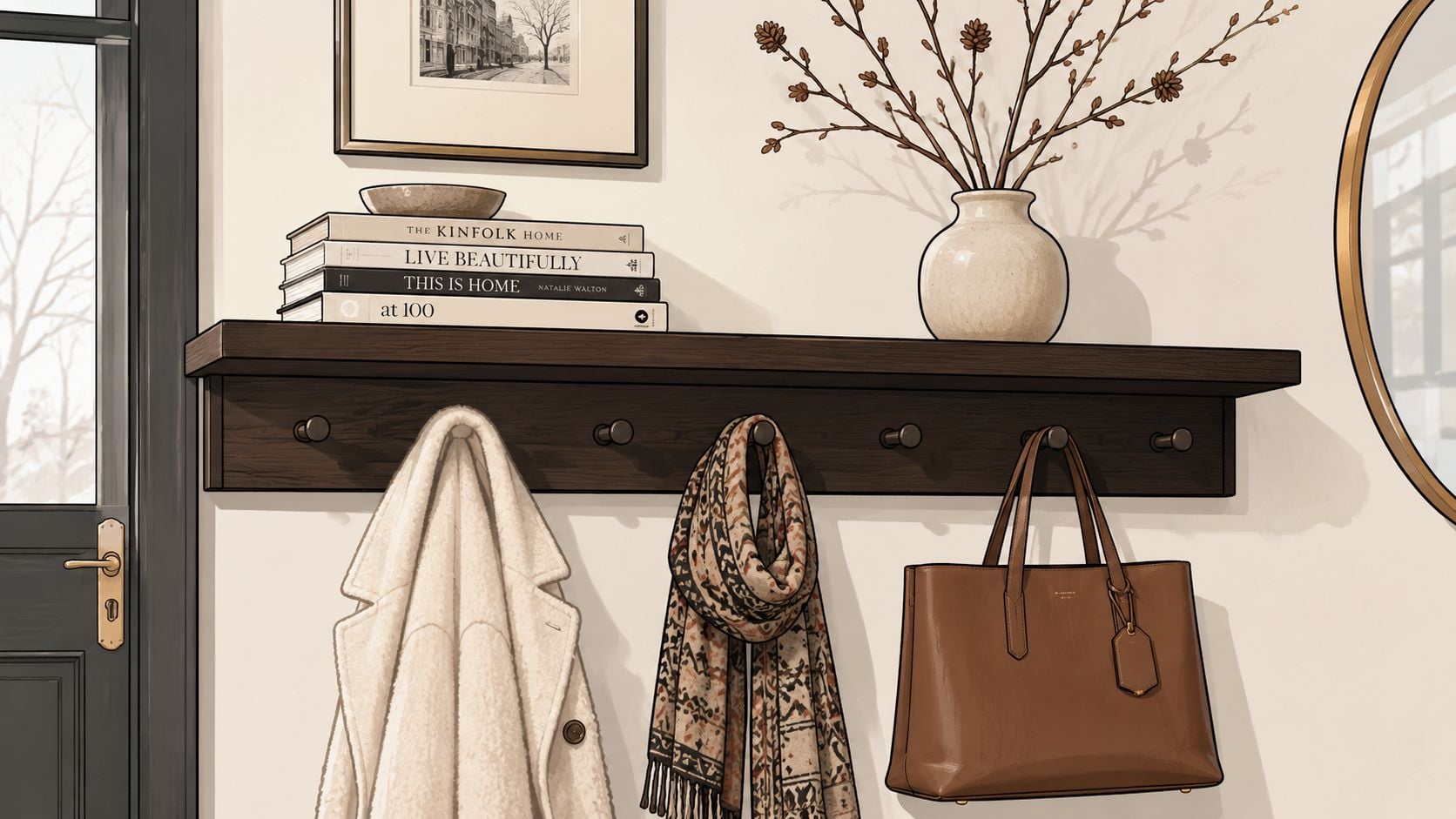
Layer materials with restraint
Wood, leather, wool, metal, and woven fibres create a welcoming balance when each material has a role. A warm timber rack can relate to a leather bench, while a quiet wool rug softens the hard transition between exterior and interior. Collections from Stickley and Stressless can sit comfortably within a broader room scheme when their finishes support the architecture rather than compete with it.
The Rug Market treats rugs as “Art for Your Floor”, and that principle is especially helpful at the entrance. A hand-knotted wool rug can establish the room's palette, while the rack and bench provide the functional line that makes the composition useful.
Keep the visible layer edited
Each hook should have breathing room. Seasonal rotation prevents the rack from becoming a permanent display of every coat in the home, while labelled bins give hats, gloves, and scarves a discreet destination. A mirror can reflect light and make the entrance feel more finished, and a small lamp or warm wall light can add evening softness where wiring permits.
Texture is what keeps a restrained arrangement from feeling flat. Critelli's guide to texture in interior design provides a useful framework for combining smooth finishes, tactile textiles, and artisanal accents without introducing unnecessary clutter.
Designer's Insight: The most elegant winter entry keeps the evidence of winter contained. Wet boots remain on the tray, damp coats receive air, and the visible rack holds only the pieces needed for the current routine.
Bringing Your Entryway Vision Home With Critelli
An entryway coat rack becomes a worthwhile investment when it supports the entire room rather than filling a single wall. Heirloom quality appears in the details, from a considered finish and durable hardware to proportions that remain useful through changing seasons and household routines.
Critelli Furniture's family-run legacy reaches back to 1914, and its King Street showroom gives Southern Ontario homeowners a place to assess craftsmanship, scale, and finish in person. The Interior Design Studio approaches furnishings as part of a complete room concept, with space planning, materials, rugs, lighting, and seating considered together. Its collaborative design process can help connect a practical entrance to the rooms beyond it.
The Rug Market adds another layer by treating rugs as Art for Your Floor, allowing the entry zone to begin with a hand-knotted foundation rather than an afterthought. White-glove delivery then supports the final transition from showroom to home, with professional handling, assembly, and placement available across the Greater Niagara, Hamilton, and Toronto markets.
A considered entryway doesn't need to feel formal. It needs to feel resolved. When the rack, rug, bench, and winter storage work together, the entrance welcomes the household home and gives guests a clear sense of the care found throughout the property.
Critelli Furniture offers a curated selection of design-forward furnishings, artisanal rugs, and interior design guidance for Southern Ontario entryways. Experience the craftsmanship in person at the King Street Showroom, book your complimentary design consultation today, or visit Critelli Furniture to begin shaping a winter-ready complete room concept.