CRITELLI'S SUMMER SALE | UP TO 70% OFF



Collaborative Design Process: Create Your Dream Home

A great many homeowners begin in the same place. Saved photos pile up. Fabric swatches look beautiful on their own. A sofa feels right in the showroom, yet it's hard to tell whether it will still feel right beside existing flooring, art, light, and daily life.
That uncertainty doesn't mean the vision is vague. It usually means the vision hasn't yet been translated into a clear plan. A strong collaborative design process turns instinct, taste, and practical needs into a room that feels resolved, personal, and lasting.
Table of Contents
- Your Vision Realized The Power of Partnership in Design
- Understanding the Collaborative Design Framework
- The Five Stages of Collaborative Design
- Your Role Preparing for a Successful Collaboration
- Navigating the Journey Benefits and Common Pitfalls
- Begin Your Design Journey with Confidence
Your Vision Realized The Power of Partnership in Design
A homeowner may know that a room should feel calm, cohesive, and welcoming, yet still struggle to explain why one chair feels too formal, why one rug feels too busy, or why a beautiful table seems wrong once it enters the space. That's the moment when a design partnership becomes valuable. The process isn't about buying pieces one by one. It's about creating a home with intention.

In Southern Ontario, trust matters because a home is personal, and good design asks clients to make many decisions that affect daily life. That's one reason heritage-led firms continue to matter. Critelli Furniture was founded in 1914 by Thomas Critelli in Thorold, Ontario, and has operated as a family-run destination in St. Catharines for over 110 years, establishing a century-old legacy that serves as a cornerstone of trust in Southern Ontario's luxury furniture market. Homeowners exploring interior design services in St. Catharines through a complimentary consultation often discover that clarity arrives faster when the conversation begins with lifestyle rather than product.
A home tells a fuller story
A living room isn't only a seating plan. It may need to welcome grandchildren, support quiet reading, soften acoustics, hold up to pets, and still feel polished enough for entertaining. A bedroom isn't only about a bed. It's a place where texture, scale, and flow can either support rest or work against it.
Good design listens for what a homeowner means, not only what a homeowner says.
That's why a collaborative design process feels so reassuring. The client brings the personal story. The designer brings trained eyes, proportion, materials knowledge, and the ability to shape a complete room concept from scattered preferences. Together, they move from “something feels missing” to a design-forward plan rooted in timeless craftsmanship.
Understanding the Collaborative Design Framework
A thoughtful room rarely comes together by accident. It comes together because someone has organised the moving parts, tested ideas against real constraints, and kept the vision intact from first conversation to final placement.
Why structure creates freedom
A useful comparison is custom clothing design. Off-the-rack clothing asks the client to adapt to the garment. A custom-fitted garment adapts to the client's proportions, habits, and preferences. Interior design works the same way. An heirloom-quality room doesn't come from random selection. It comes from a framework that aligns comfort, scale, finish, budget, and function.
Research on collaborative design shows why this matters. Concurrent design focuses on rational, fact-based decision-making, requiring results of estimates and calculations to be presented to the team to test if values align with expert experiences. Presenting these for team feedback has been shown to result in more specific trade-offs and focused discussions according to this collaborative design methodology paper. In plain language, better decisions happen when the room is measured, the options are tested, and everyone discusses the same facts.
Homeowners who want a broader view of project delivery often benefit from understanding design build models, especially when furnishings are part of a larger renovation. For room-specific planning, a helpful next step is learning how to start the interior design process for a room.
Who shapes the outcome
The strongest projects are clear about roles. That prevents overlap, hesitation, and avoidable confusion.
| Partner | Primary Role | Key Responsibilities |
|---|---|---|
| Client | The Visionary | Shares lifestyle needs, preferences, priorities, functional concerns, and decision feedback |
| Designer | The Curator | Interprets the vision, plans layout, refines selections, presents options, and protects cohesion |
| Tradespeople | The Artisans | Build, deliver, install, adjust, and execute technical details with precision |
Clarity prevents the common misfires
Without a framework, a client may approve a sofa by appearance alone, then realise the depth doesn't suit the room or the seating style. A designer may hear “modern” when the client means “clean but still warm.” Trades may receive an incomplete direction and install beautifully made pieces that don't fully support the intended flow.
Practical rule: every key choice should answer two questions. Does it suit the room, and does it suit the people living in it?
That's the quiet strength of a collaborative design process. It replaces assumptions with shared understanding.
The Five Stages of Collaborative Design
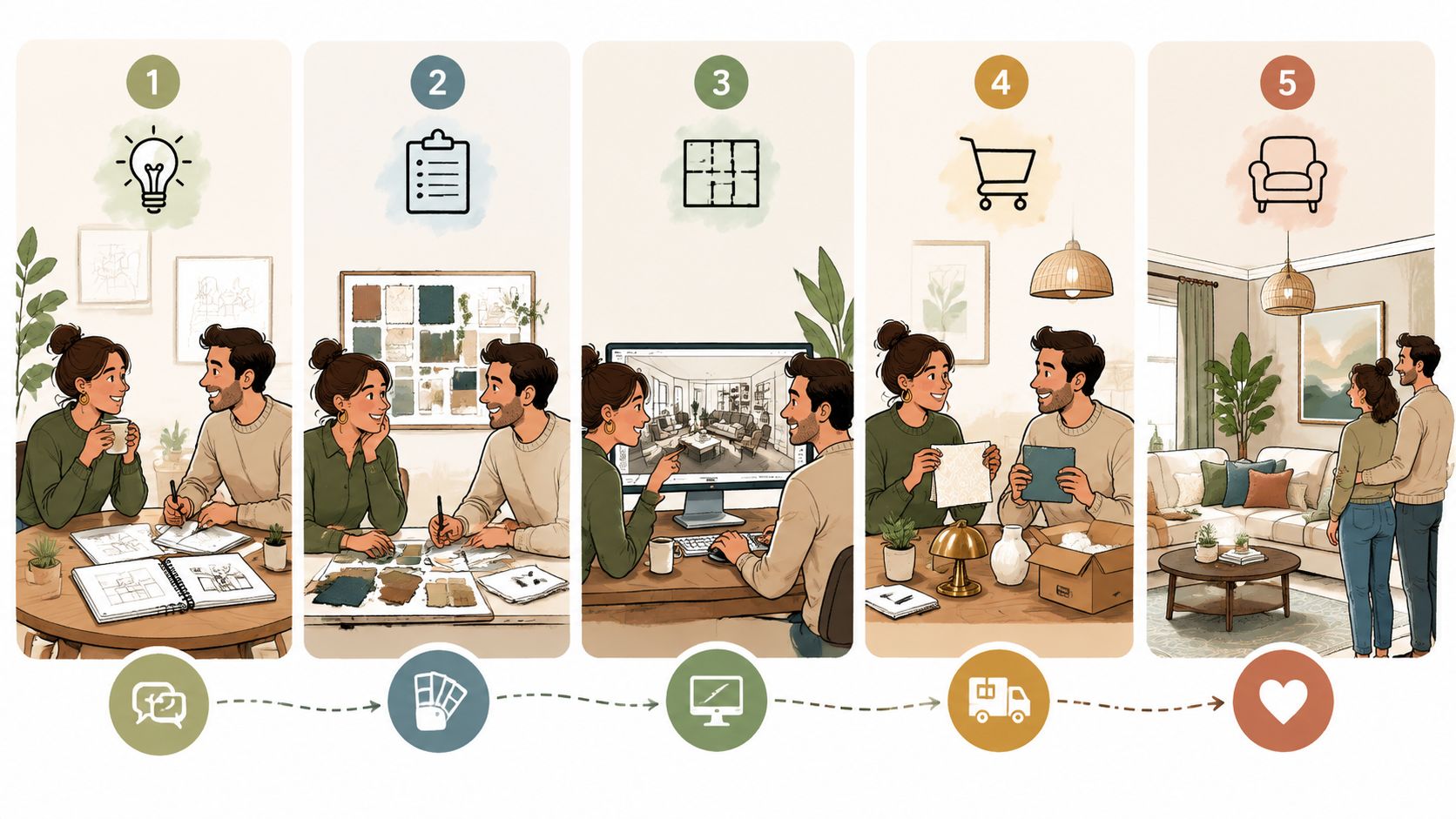
The design journey becomes much less intimidating when it's broken into clear stages. Each one has a purpose, and each one protects the quality of the final result.
Stage one discovery
The first stage is listening. During this stage, room dimensions, traffic flow, architectural details, natural light, household routines, and style references begin to form a usable brief. During a complimentary consultation, homeowners often realise that what felt abstract can be discussed clearly.
Useful discovery questions include:
- How should the room feel: calm, formal, layered, energetic, soft, refined, or relaxed.
- What must the room do well: host guests, support reading, handle children, anchor open-concept living, or create better storage.
- What should stay: existing art, a family table, a favourite rug, or inherited pieces with emotional value.
Stage two and three from concept to detail
Once the direction is clear, the concept takes shape as a complete room concept, where furniture stops being a standalone purchase and starts acting as part of a larger composition. Scale, silhouette, material, and placement begin to work together.
The next stage narrows the choices. Fabrics, leathers, finishes, wood tones, and bespoke details are considered in relation to the room rather than in isolation. Then, a curated selection becomes so helpful. A homeowner doesn't need endless options. A homeowner needs the right options.
Designer's Insight: A bold Hancock & Moore leather often settles beautifully when paired with a neutral hand-knotted wool rug. The room keeps its character, but the overall energy feels balanced.
Clients who enjoy learning how these phases map onto larger architectural work may appreciate BIM Heroes' architectural design guide. For a furnishings-focused perspective, understanding the furniture buying journey from first research to final decision helps connect showroom discovery to final confidence.
Stage four and five selection and installation
Selection is the point where the room gains its final depth. Upholstery is confirmed. Finishes are approved. Accent pieces are chosen. Rugs often become decisive here because they ground the palette and visually tie the room together. In many homes, Art for your Floor is what turns a nice collection of furniture into a cohesive interior.
Installation is the final stage, but it should never feel like an afterthought. Critelli's White-Glove Delivery service covers the Greater Niagara, Hamilton, and Toronto markets, providing meticulous inspection, assembly, precise in-home placement, and full packaging removal to ensure homes are showroom-ready immediately after delivery.
A five-stage process works because each phase solves a different problem:
- Discovery clarifies the brief.
- Concept development creates direction.
- Design development refines the bespoke details.
- Selection and finalisation commits the room to a cohesive scheme.
- Delivery and installation brings the plan into lived reality with white-glove care.
Your Role Preparing for a Successful Collaboration
The client's role is more important than many people realise. Designers don't need clients to speak in technical terms. They do need clients to communicate clearly enough that preferences can be translated into plans, materials, and proportions.
How to translate feeling into direction
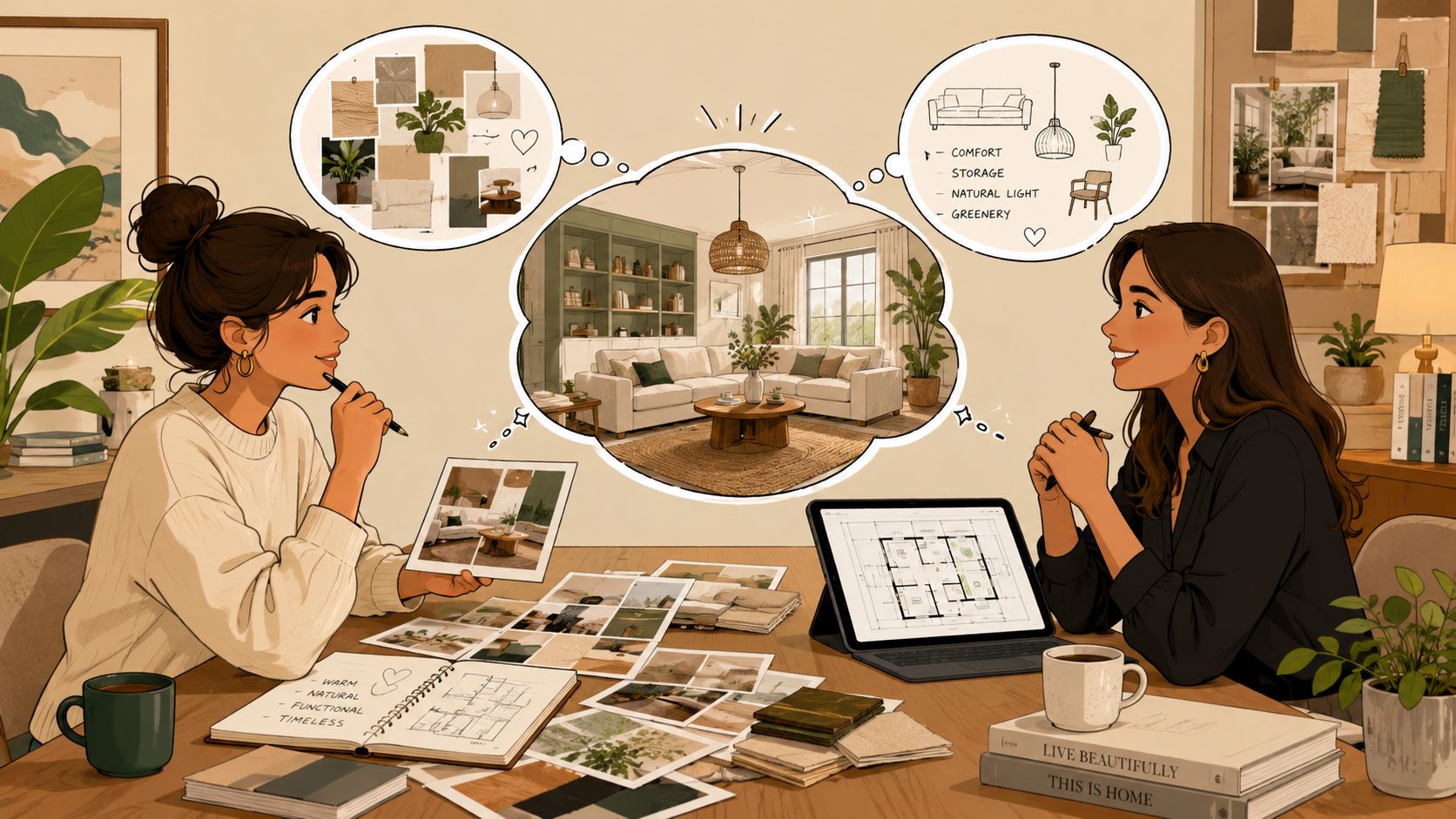
One of the biggest obstacles in any collaborative design process is the language gap between homeowners and design professionals. Research notes that to achieve a shared understanding in design, explicit effort is needed at the project's outset to overcome the distinct conceptualizations and 'languages' each group holds in this design communication study. That's why phrases like “I want it to feel better” need a little unpacking.
A stronger way to prepare is to describe the room in human terms first.
- Name the mood: calm and cocooning, polished and social, bright and easy, or grounded and quiet.
- Name the frustrations: not enough seating, awkward traffic flow, too many unrelated finishes, or a room that feels cold.
- Name the must-haves: washable fabric, deeper seats, better lighting, storage, or pet-friendly surfaces.
The clearest clients aren't the ones with the most design vocabulary. They're the ones who can describe how they want to live.
Homeowners who want a parallel perspective on preparing for a professional design relationship may find Invilla's architect engagement guide useful, especially for understanding how early conversations shape later decisions.
What to bring to the first conversation
Preparation doesn't need to be elaborate. It needs to be focused.
A productive first meeting often includes:
- A small set of inspiration images: not hundreds. A short, consistent collection reveals patterns in taste.
- Measurements and photos: these help turn preference into practical planning.
- A priority list: comfort, entertaining, storage, durability, elegance, or flexibility.
- A realistic investment range: that allows the designer to present options that fit the brief.
- An open mind about refinement: sometimes the piece a client loves most in a photo isn't the piece the room needs.
For homeowners considering bespoke upholstery or made-to-order pieces, getting started with custom order can make that first conversation much easier. It gives the client a clearer sense of what details matter before customisation begins.
Navigating the Journey Benefits and Common Pitfalls
A well-run collaborative design process does two things at once. It makes the room better, and it makes decision-making less stressful.
What the process protects
The biggest benefit is cohesion. When furnishings, rugs, lighting, and finishing touches are chosen as part of one vision, the room feels settled. It doesn't read as a series of separate purchases made months apart.
A complete room concept also gives homeowners access to better decision-making. Critelli offers a complete room concept through two distinct showrooms, Critelli Furniture on King Street and Critelli Modern on St. Paul Street, enabling customers to curate bespoke, design-forward interiors with customizable fabrics, leathers, and finishes, as shown in this showroom overview. That kind of breadth matters because timeless craftsmanship depends on fit as much as beauty.
Where projects usually drift
Most design problems begin with one of three issues.
- Too many options: clients keep searching long after good choices are on the table.
- Unclear priorities: every item becomes equally important, which slows decisions.
- Loose communication: a preference is mentioned casually, then treated as final direction.
Each problem has a practical answer.
- To avoid analysis paralysis: trust the curated selection rather than reopening the search with every new image.
- To avoid budget strain: decide early where the room should carry heirloom quality and where restraint makes sense.
- To avoid mismatch: review selections in relation to the whole room, not as isolated favourites.
A room rarely fails because no beautiful items were available. It usually drifts because the process wasn't strong enough to protect the original vision.
Begin Your Design Journey with Confidence
A home comes together beautifully when feeling, function, and craftsmanship are allowed to support one another. That's the promise of a collaborative design process. It gives structure to creativity and turns scattered ideas into a resolved interior that feels both personal and enduring.
For homeowners seeking Luxury furniture Niagara, Interior design services St. Catharines, Custom furniture Southern Ontario, or Hand-knotted rugs Ontario, the most reassuring path is one that values partnership from the first conversation onward. Heritage, curated selection, bespoke options, and white-glove care all matter because they make the journey smoother and the final result more meaningful.
Rugs deserve a final note because they so often anchor the entire room. Critelli's Rug Market holds the largest selection of high-quality Tribal Rugs in Southern Ontario, featuring hand-knotted, artisanal pieces that function as art for your floor, according to their Rug Market presentation. For anyone still discovering a personal design direction, the design style quiz can be a helpful place to begin.
A well-designed room doesn't just look complete. It supports the life unfolding inside it.
Experience heirloom quality, timeless craftsmanship, and a complete room concept with Critelli Furniture. Experience the craftsmanship in person at our King Street Showroom. Book your complimentary design consultation today. Visit the Rug Market to find your room's foundation.