
Hand Knotted Turkish Rugs: A Curator’s Buying Guide

A couple stands in Critelli's King Street showroom, torn between a refined sofa and a more relaxed chair. Both pieces are beautiful, yet neither feels settled in the room. Beneath them, a hand-knotted Turkish rug holds the answer. Its colour, scale, and geometry establish the conversation that the furniture has been waiting to join.
For homeowners searching for hand-knotted rugs Ontario designers can confidently place in a finished interior, the purchase should begin with more than appearance. Construction, regional identity, fibre, documentation, room use, and after-sale terms all matter. A fine rug can be heirloom quality, but only when the buyer understands what has been acquired and how it will live at home.
A Rug That Anchors the Whole Room
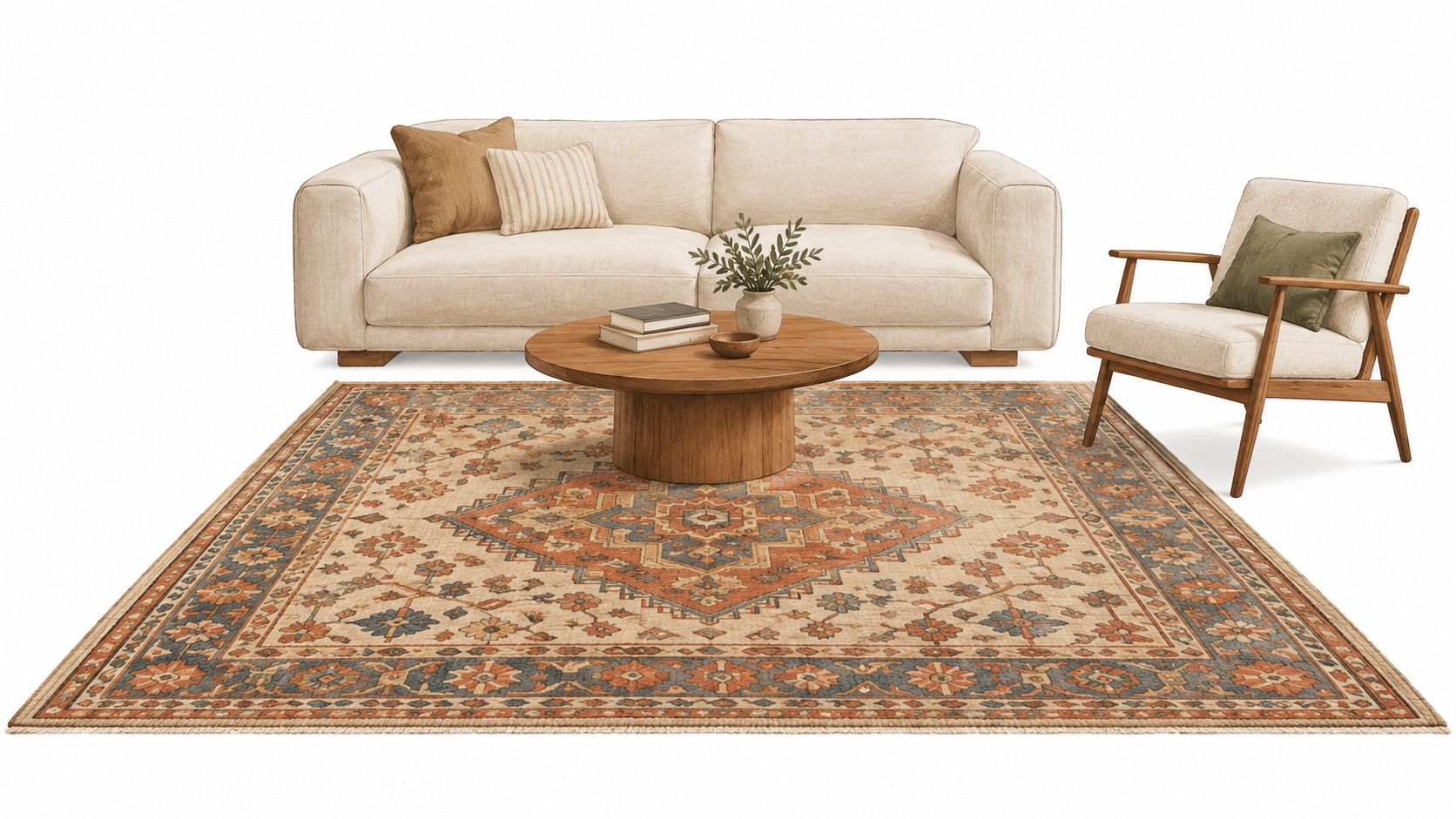
The couple moves between two layouts. One arrangement places a clean-lined sofa over a softly faded rug, with a sculptural chair angled toward the room. The other uses a bolder geometric pattern beneath lighter upholstery. The furniture changes the mood, but the rug changes the architecture. It determines where the eye rests, how seating relates to one another, and whether the room feels collected or merely furnished.
That's why an experienced designer often begins at the floor. A rug establishes the room's visual temperature before a fabric sample, lamp, or artwork enters the conversation. A quiet wool ground can give a richly carved wood frame room to speak. A strongly patterned Anatolian design can make neutral seating feel deliberate rather than cautious. The decision is especially important in open-concept Southern Ontario homes, where one rug may define the living zone inside a larger kitchen, dining, and family area.
The floor sets the brief
A rug's scale decides whether furniture appears connected or scattered. Its palette influences wall colour, upholstery, metal finishes, and timber tones. Its pattern also controls the room's rhythm. Repeated borders can frame a seating group, while a spacious central field can make a compact room feel calmer.
Critelli Furniture's guidance on area rug placement for balanced rooms reflects a practical truth: furniture should be selected with the rug's proportions in mind, not squeezed onto it after the fact. The same principle applies whether the room is a downtown St. Catharines condo, a broad Greater Niagara home, or a design-forward residence near Hamilton or Toronto.
Designer's Insight: A room reads as intentional when the rug, seating, and lighting share a clear relationship. The rug shouldn't look like an afterthought beneath expensive furniture.
A hand-knotted Turkish rug also carries a sense of continuity. The strongest pieces don't depend on a passing trend. They bring warmth, irregularity, and material depth that can accommodate changing upholstery over time. That makes the rug more than an accessory. It becomes the foundation of a complete room concept, and often the piece that remains when other furnishings evolve.
The Origins and Heritage of Turkish Weaving
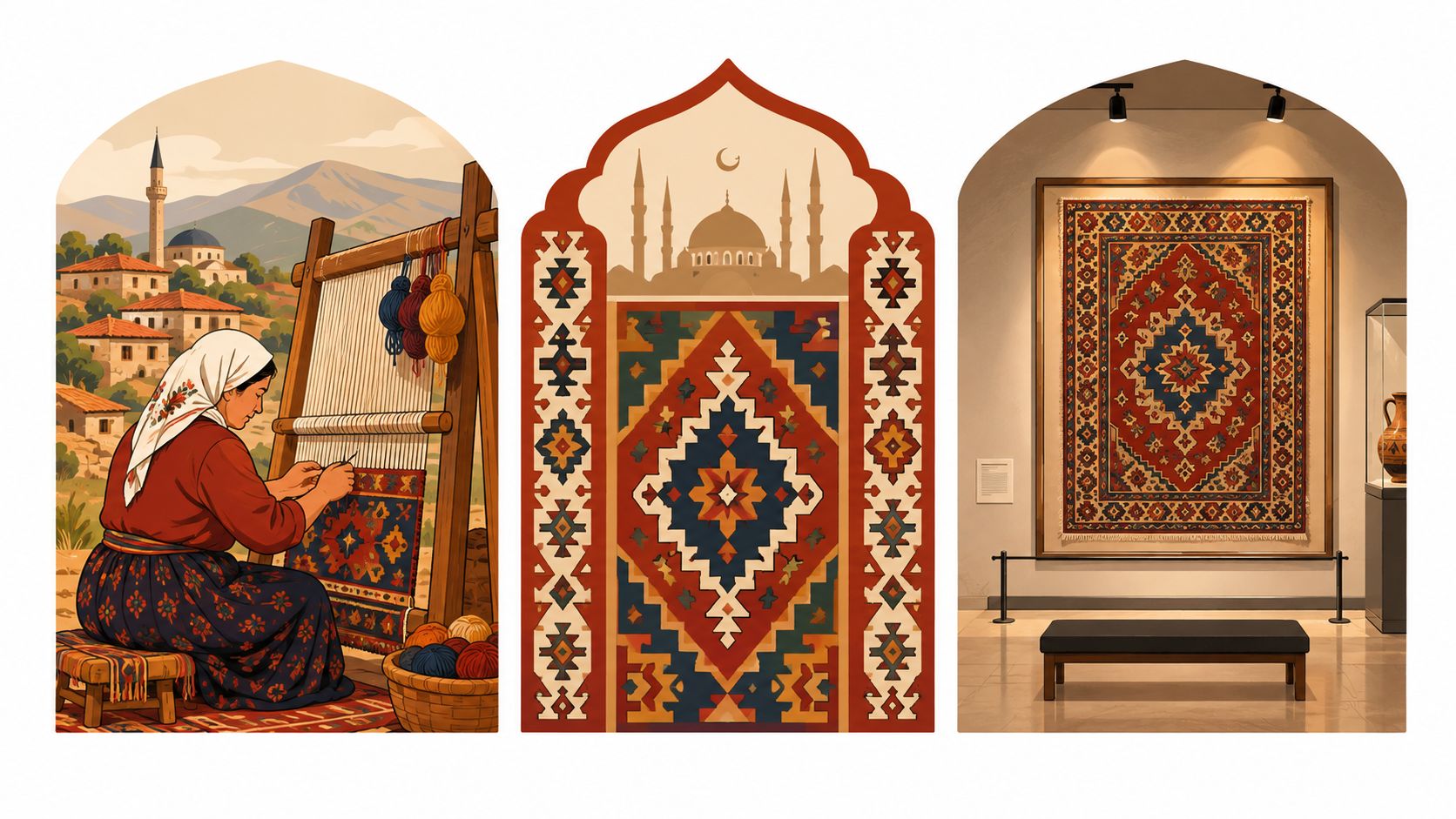
Turkish rug history begins with Anatolia, where village and tribal weavers developed visual languages suited to local materials, beliefs, and daily life. Geometric medallions, stepped forms, stylised flowers, prayer designs, and border systems weren't merely decorative choices. They expressed place and tradition through the limited vocabulary of the loom.
Ottoman court workshops later introduced a more formal, imperial vocabulary. Floral compositions became more elaborate, architectural references grew more controlled, and luxury materials supported finer surfaces. Village weaving and court production shouldn't be treated as a hierarchy in which one automatically outranks the other. They represent different intentions. A village rug may carry a forceful, memorable geometry, while a city workshop piece may pursue intricate drawing and polished symmetry.
Region gives the rug a visual accent
A buyer doesn't need to memorise every weaving centre, but regional knowledge improves judgement. The place associated with a rug can explain its palette, pattern scale, knotting approach, and cultural importance. It also helps separate an authentic regional object from a rug described only as Turkish-style.
The hand-woven area rug collection and construction guidance offers a useful starting point for recognising why handmade surfaces feel different from uniform factory production. A hand-knotted rug carries the maker's decisions row by row. Slight changes in tension, colour, and alignment create the living surface that collectors value.
California's museum history shows how seriously these objects can be treated. From November 10, 1990, through February 17, 1991, San Francisco's M. H. de Young Memorial Museum hosted Ancient Color and Geometry: Anatolian Pile Carpets from the Christopher Alexander Collection. The exhibition presented approximately 80 Turkish carpets and coincided with the 6th International Conference on Oriental Carpets. The Christopher Alexander collection archive records how the exhibition positioned Anatolian pile carpets within a major museum and academic setting.
Why provenance matters
A rug's origin shapes the questions a serious buyer should ask. Is the design associated with the stated region? Was the piece made for village use, formal presentation, or a workshop market? Has it been repaired, re-bordered, overdyed, or inaccurately described?
LACMA's investigation of a knotted wool-pile carpet demonstrates why attribution remains an active discipline. The carpet measured approximately 6 by 8 feet, was initially dated to around 1600, and was later placed between 1650 and 1750, with Ladik in Turkey's central Konya region identified as its origin. The Los Angeles Times account of the LACMA investigation describes how iconography, architectural details, provenance, dye analysis, and radiocarbon dating contributed to the reassessment.
That example should make buyers cautious of absolute claims based on colour or pattern alone. A documented origin doesn't replace visual pleasure. It gives the pleasure a credible foundation.
Knot Types, Knot Density, and Materials
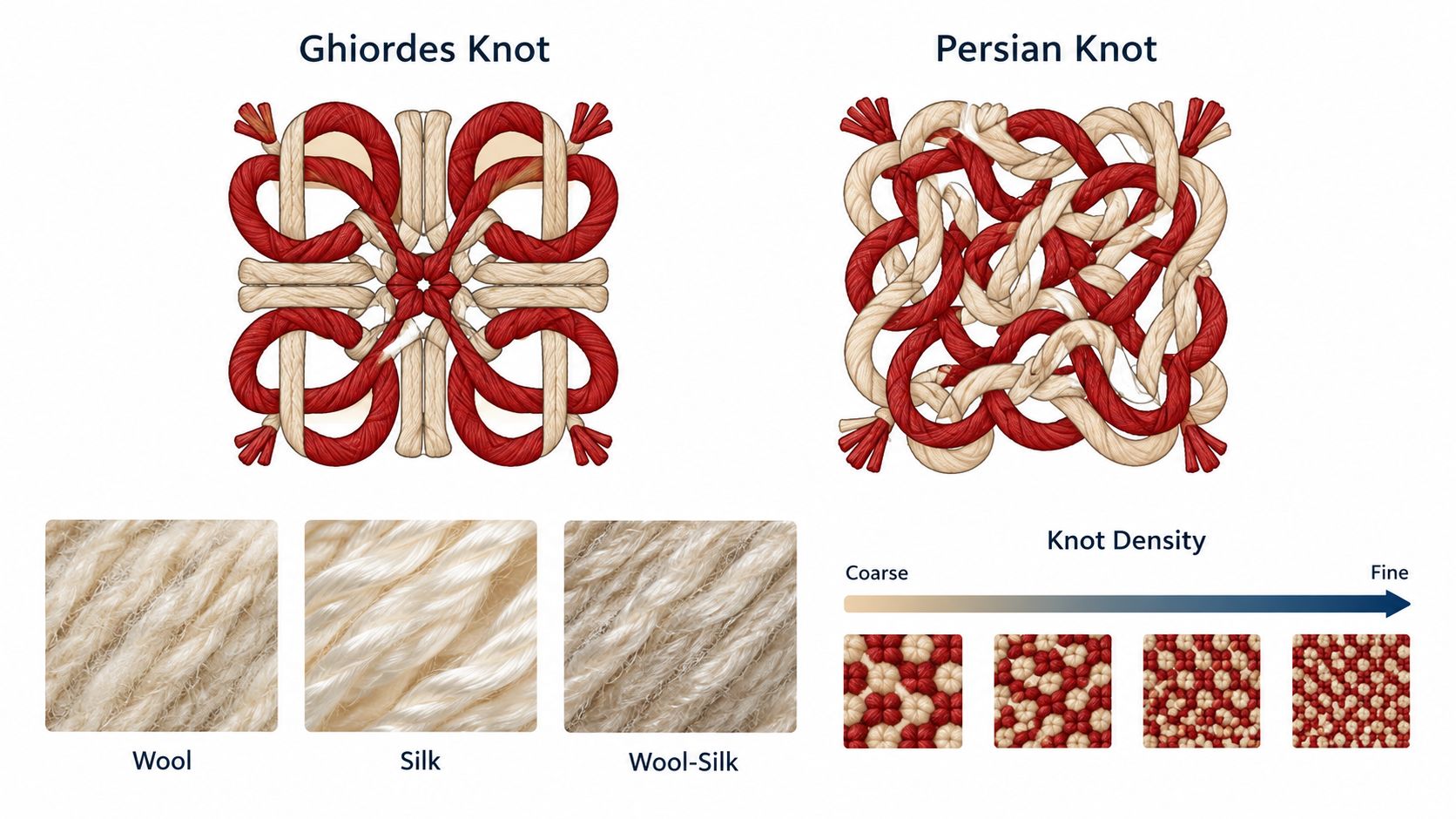
The construction of a rug determines how it looks, feels, and behaves underfoot. Turkish weaving is commonly associated with the Ghiordes knot, also called the symmetrical knot. The yarn wraps around adjoining warp strands, producing a secure pile structure. Persian, or Senneh, knotting is asymmetrical and can support fine drawing through a different relationship between yarn and foundation.
Neither knot type automatically makes a rug superior. The question is whether the construction suits the design, fibre, age, and intended use. A strongly built wool rug with a confident geometric pattern can be more appropriate for a family room than a finer silk piece whose surface belongs in a quieter setting.
Fibre changes the experience
Wool is the practical workhorse. It offers resilience, tactile warmth, and a forgiving surface for a household that expects the room to be used. A well-made wool rug can still feel refined, particularly when the yarn, dye, and pattern have enough variation to avoid a flat commercial appearance.
Silk brings sharper lustre and a more jewellery-like surface. It can carry minute curves and intricate motifs, but it's more vulnerable to prolonged moisture and ultraviolet exposure than wool. Wool-silk combinations occupy the middle ground, pairing some of silk's visual refinement with more substance underfoot.
Knot density should be read as design resolution, not as a complete quality grade. Fine hand-knotted Turkish rugs can use asymmetrical knots, and silk examples may reach approximately 400 to 1,000 knots per square inch, as discussed in this technical guide to silk rug construction and care. Higher density permits smaller motifs, finer curves, and more intricate medallion geometry. It also creates a surface that demands more careful placement and cleaning.
Match construction to traffic
A densely knotted silk or wool-silk rug belongs in a low-traffic formal room. It shouldn't sit at an entry, beneath dining-chair pivots, or in a hallway where repeated abrasion will challenge the pile. A wool rug with a more substantial construction is the better choice for active Southern Ontario households.
A useful showroom comparison is to place a fine rug beside a sturdy wool piece and look at the reverse of each. The pattern should remain visible on the back of a genuine hand-knotted rug, with slight irregularity in the knots. A perfectly uniform backing can indicate machine production or another construction method. The fringe should appear integrated with the foundation rather than merely sewn on as decoration.
Practical rule: Never approve wet cleaning for a valuable hand-knotted rug before a professional performs hidden-area colourfastness testing. Over-wetting can cause dye migration and affect the foundation.
The hand-knotted wool rug selection in an 8 by 10 format illustrates why size and fibre should be considered together. A rug isn't just a pattern measured in feet. It's a woven structure that must tolerate the room assigned to it.
Regional Styles Worth Knowing
Regional names function like design shorthand, but they shouldn't become rigid labels. A rug's actual character comes from the relationship between place, pattern, fibre, age, condition, and workshop practice. Still, four names give Southern Ontario buyers a helpful map when comparing pieces in person.
Heriz is the confident extrovert. Its bold geometric medallions and strong border structure can hold their own against contemporary architecture, dark timber, or substantial leather. Heriz-inspired patterns often bring the right amount of tension to a room that might otherwise feel too polished.
Oushak is softer in voice. Large-scale floral motifs, generous spacing, and a luminous palette make Oushak rugs natural companions for light upholstery, pale walls, and relaxed architectural interiors. Their expansive drawing can make furniture feel composed without creating visual clutter.
Hereke is more exacting. Fine knotting, detailed pattern work, and silk surfaces can give a Hereke rug the presence of a precious textile rather than a casual floor covering. Such a piece should be given visual space and protected from punishing traffic.
Ladik, associated with Turkey's central Konya region, is especially important for buyers interested in documented Anatolian origin. The LACMA example discussed earlier demonstrates why a Ladik attribution should be supported by examination rather than assigned from a motif alone.
Matching Turkish regional styles to room use
| Region | Design Character | Typical Fibre | Best Room |
|---|---|---|---|
| Heriz | Bold geometry, strong medallions, defined borders | Wool | Living room or library |
| Oushak | Soft florals, open fields, gentle colour movement | Wool or wool-silk | Open living area or bedroom |
| Hereke | Fine detail, luminous surface, formal presence | Silk or wool-silk | Quiet salon, formal sitting room |
| Ladik | Anatolian structure, architectural motifs, regional character | Wool | Study, living room, or collection-focused space |
The table should guide questions, not replace inspection. A beautiful Oushak-style rug may have been made outside Oushak, and “Turkish design” doesn't prove Turkish origin. That distinction becomes essential when a buyer is paying for regional history rather than selecting a pleasing palette.
Critelli's design-forward approach treats the rug as the room's first major decision. A Heriz can set the direction for considered seating and aged wood. An Oushak can soften the lines of contemporary furniture. A finer Hereke can sit almost like art beneath a restrained arrangement. The right regional style is the one that supports the room's function while giving the interior a recognisable point of view.
How to Verify an Authentic Hand Knotted Rug
A buyer should ask for written verification before discussing whether a rug is beautiful. The invoice should explicitly state the country of origin, whether the rug is 100 percent hand-knotted, its fibre composition, and whether the design is native to the stated region. A label describing a piece as “Turkish design” may indicate that it was made elsewhere.
This standard protects the buyer from confusing appearance with provenance. Visible irregularity can support a hand-production assessment, but uneven edges, slight alignment changes, and shifting colour don't independently establish Turkish origin or value.
The showroom inspection
A serious inspection is tactile and methodical. The rug should be viewed in full light, turned over, and handled without rushing.
- Front: Look for a coherent pile, readable pattern, and colour movement that feels integrated rather than printed.
- Back: Confirm that the design is visible on the reverse and that individual knots show slight human variation.
- Fringe: Check whether the fringe grows from the foundation instead of being sewn on as a finish.
- Knots: Ask the dealer to identify the knot structure and explain how it relates to the rug's regional attribution.
- Fibre: Request a written statement identifying wool, silk, cotton foundation, or any combination used.
- Dyes: Any wet or colourfastness test should be performed professionally in a concealed area before cleaning.
- Dimensions: Record the actual measurements, including any irregularity that affects placement.
- Origin: Require the country and, where claimed, the specific regional attribution in writing.
- After-sale terms: Review return, approval, exchange, restoration, delivery, and damage responsibilities before payment.
The Canadian consumer warning about misrepresentation involving origin, construction, fibre, age, and price reinforces why documentation matters. A buyer shouldn't rely on oral assurances when a detailed invoice can define the purchase.
Ontario documentation rights
For an Ontario in-store purchase exceeding $50 where delivery is arranged or payment is deferred, the transaction is treated as a future-performance agreement and should be documented in writing. The record should identify the supplier, describe the goods and services accurately, itemise prices including taxes and shipping, disclose additional charges, state payment terms, and specify the delivery destination, as set out in Ontario's requirements for safe store transactions.
Ontario's Consumer Protection Act also establishes that when a product isn't delivered within 30 days after the promised delivery date, the consumer may cancel the agreement and request a refund. If no delivery date appears in the agreement, the cancellation right can arise after 30 days have passed since the agreement was made. The Ontario consumer protection guidance makes the written delivery commitment a practical part of a white-glove purchase, not an administrative afterthought.
The agreement should also identify the total amount payable, payment information, delivery or completion dates, and any supplier-offered rights concerning cancellation, return, exchange, or refund. For a bespoke rug, those details separate the textile from the services surrounding it.
Pricing, Value, and What You Are Really Paying For
A hand-knotted Turkish rug's price reflects a layered set of decisions. Origin, fibre, knot density, age, condition, rarity, scale, and documentation all matter, but they don't matter in isolation. A modestly detailed wool rug with excellent construction and a compelling regional identity can provide more lasting value than a finer-looking piece with uncertain origin.
Consider two rugs with similar colours. One may be a practical wool piece with a sturdy pile, clear dimensions, and a credible Turkish attribution. The other may use silk, carry much finer knotting, and have a documented history, but require a formal room and more exacting care. They may look related from across the showroom, yet they serve entirely different purposes.
Value follows the life of the rug
A buyer should decide whether the rug is being acquired as:
- A working foundation: Choose wool, a forgiving pattern, and a construction suited to daily use.
- A formal textile: Silk or wool-silk can make sense when traffic is controlled and visual refinement is central.
- A collectible object: Prioritise documented origin, rarity, condition, restoration quality, and historical significance.
- A long-term design anchor: Select a palette and scale that can accommodate future changes in furniture.
Age alone doesn't establish value. A historic rug with extensive damage may require careful restoration, while a newer piece can offer excellent material quality and strong design integrity. Documentation helps the buyer understand what the price represents and whether the description will remain credible for insurance, resale, or family records.
Critelli's curated hand-knotted rug guidance is most useful when treated as a filter for this decision. A discerning showroom process should help buyers compare construction, origin, condition, and intended room use rather than pushing every customer toward the most delicate or elaborate piece.
The right question isn't whether a rug is expensive. It's whether the rug's craftsmanship, identity, and practical demands align with the home. A well-chosen wool rug can become the most frequently appreciated object in a family room. A documented silk rug can function as art for your floor, provided the room respects its limitations.
Sizing and Styling for Southern Ontario Interiors
The best rug size is determined by furniture relationships, not by the empty area of floor. In a living room, the front legs of major seating should generally sit on the rug so the arrangement feels connected. A rug that ends just before the sofa can make the room look fragmented, even when every individual piece is well chosen.
Dining rooms require equal discipline. The rug should extend at least 60 centimetres beyond the table on every side, allowing chairs to remain on the surface as they're pulled back. This is particularly important in open-concept homes, where the rug also defines the dining zone against nearby living furniture.
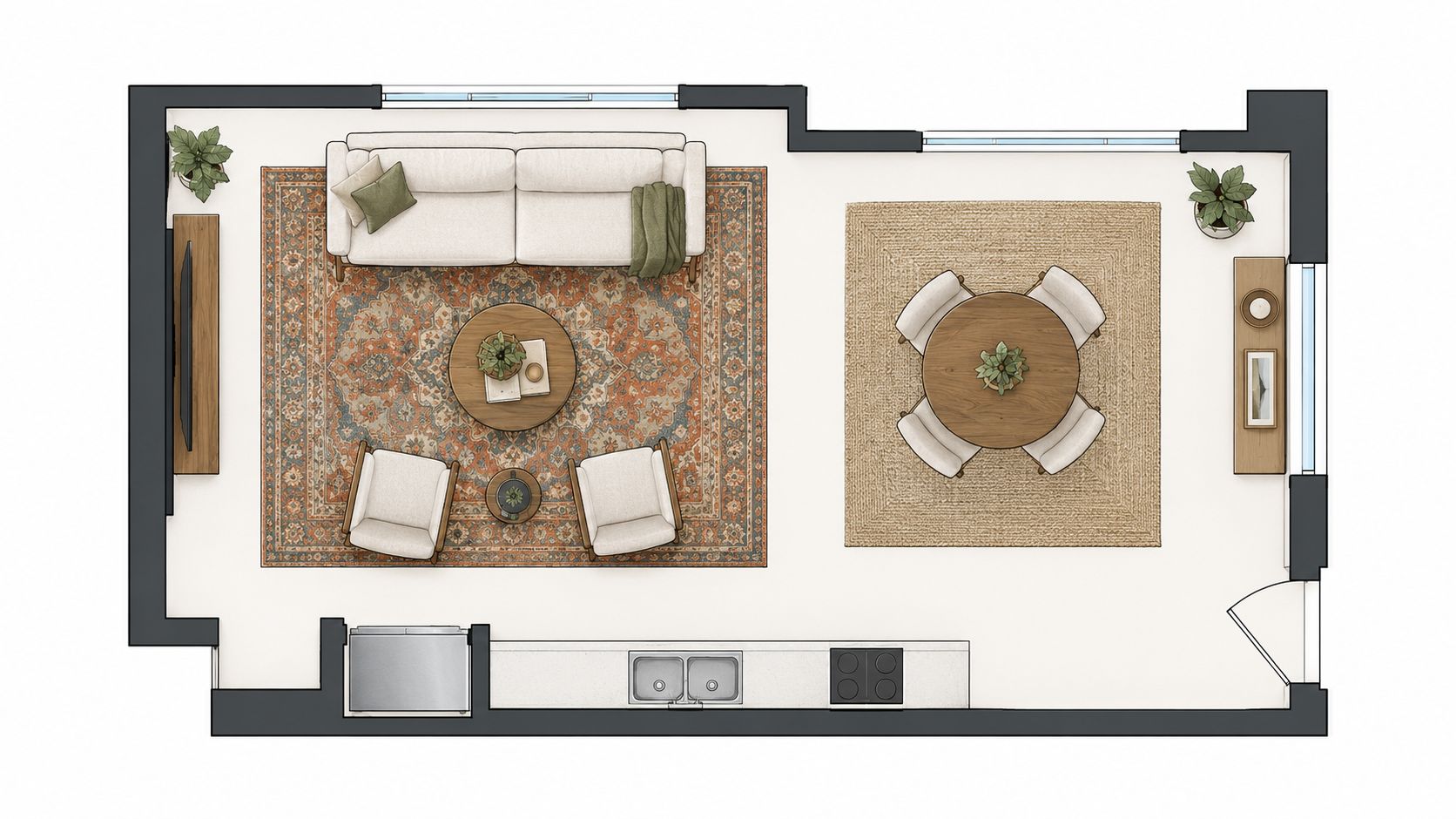
Build the room around proportion
For bedrooms, the rug should create a comfortable landing around the bed rather than disappear beneath it. In condos and narrower rooms, a pair of runners can sometimes preserve the room's proportion better than forcing an oversized rectangle into a tight footprint.
Layering also solves real design problems. A smaller antique or highly characterful rug can sit over a larger neutral ground rug, giving the room more presence without requiring the antique to fill the entire seating area. The larger layer establishes scale, while the smaller textile provides the point of view.
Greater Niagara homes often have generous rooms that can support a more expansive foundation. Hamilton interiors may need a rug to define zones within a long open plan. Toronto condos benefit from careful attention to clearances, furniture footprints, and visual weight. The principle remains constant: the rug should make the room easier to read.
Designer's Insight: A bold hand-knotted wool rug pairs beautifully with neutral seating, including a calm leather profile from Hancock & Moore. The rug supplies pattern and energy, while the upholstery protects the room from visual noise.
Critelli's St. Catharines design studio approaches furniture as part of a complete room concept. That means coordinating the rug with seating, lighting, case goods, and circulation before the final selection is made. The result feels curated rather than assembled.
Care, Restoration, and the Critelli White Glove Experience
Ownership begins with placement. In California, care guidance recommends indoor relative humidity around 30 to 50 percent and below 60 percent to reduce mould and mildew risk, especially over cool stone or hardwood floors, and favours a breathable pad over an impermeable rubber layer because moisture and heat can dissipate beneath the rug. The same principle is useful in Southern Ontario, where seasonal indoor conditions change and dampness can become trapped beneath a textile. The rug material care guide for coastal interiors provides the relevant maintenance framework.
Use a non-aggressive vacuum setting, blot spills promptly, rotate the rug to distribute wear and fading, and keep it away from persistent moisture. Professional colourfastness testing should precede wet cleaning, particularly for silk, wool-silk, older dyes, or rugs with uncertain treatment history. For broader practical guidance on moisture management, homeowners can also review how to stop mould in humid Miami homes, while remembering that local conditions still determine the appropriate care plan.
Critelli's white-glove furniture delivery service supports the final transition from showroom to home. The service model includes inspection, placement, assembly where required, and packaging removal across the Greater Niagara, Hamilton, and Toronto markets. That attention matters when a rug is the foundation of a room and the furniture must arrive in the right relationship to it.
Critelli Furniture offers a curated selection of artisanal rugs and design-led furnishings, supported by complimentary design consultations and a white-glove path from showroom planning to home placement. Visit Critelli Furniture to experience the craftsmanship in person at the King Street Showroom, book a complimentary design consultation today, or visit the Rug Market to find your room's foundation.