
Hand Woven Area Rugs: A Curator’s Guide


A room can have beautiful furniture, considered lighting, and carefully chosen art, yet still feel unsettled. The usual reason is beneath the furnishings: the floor has no visual foundation. A hand woven area rug gives the eye somewhere to land, gathers the room's colours, and establishes the mood before a single chair is selected.
For a discerning Southern Ontario homeowner, the right rug is more than a practical textile. It's art for your floor, a tactile expression of heritage craftsmanship, and often the first decision in a complete room concept. The strongest pieces bring heirloom quality, artisanal character, and a design-forward point of view to homes across Greater Niagara, Hamilton, and Toronto.
The Foundation of Timeless Craftsmanship
A living room without a rug often feels unfinished. The sofa drifts away from the coffee table, the armchair feels disconnected from the curtains, and the colour story never settles into a clear point of view. Add a hand woven area rug, and the room starts to read as a deliberate composition. The furniture gains context, the circulation becomes clearer, and the entire space feels grounded.
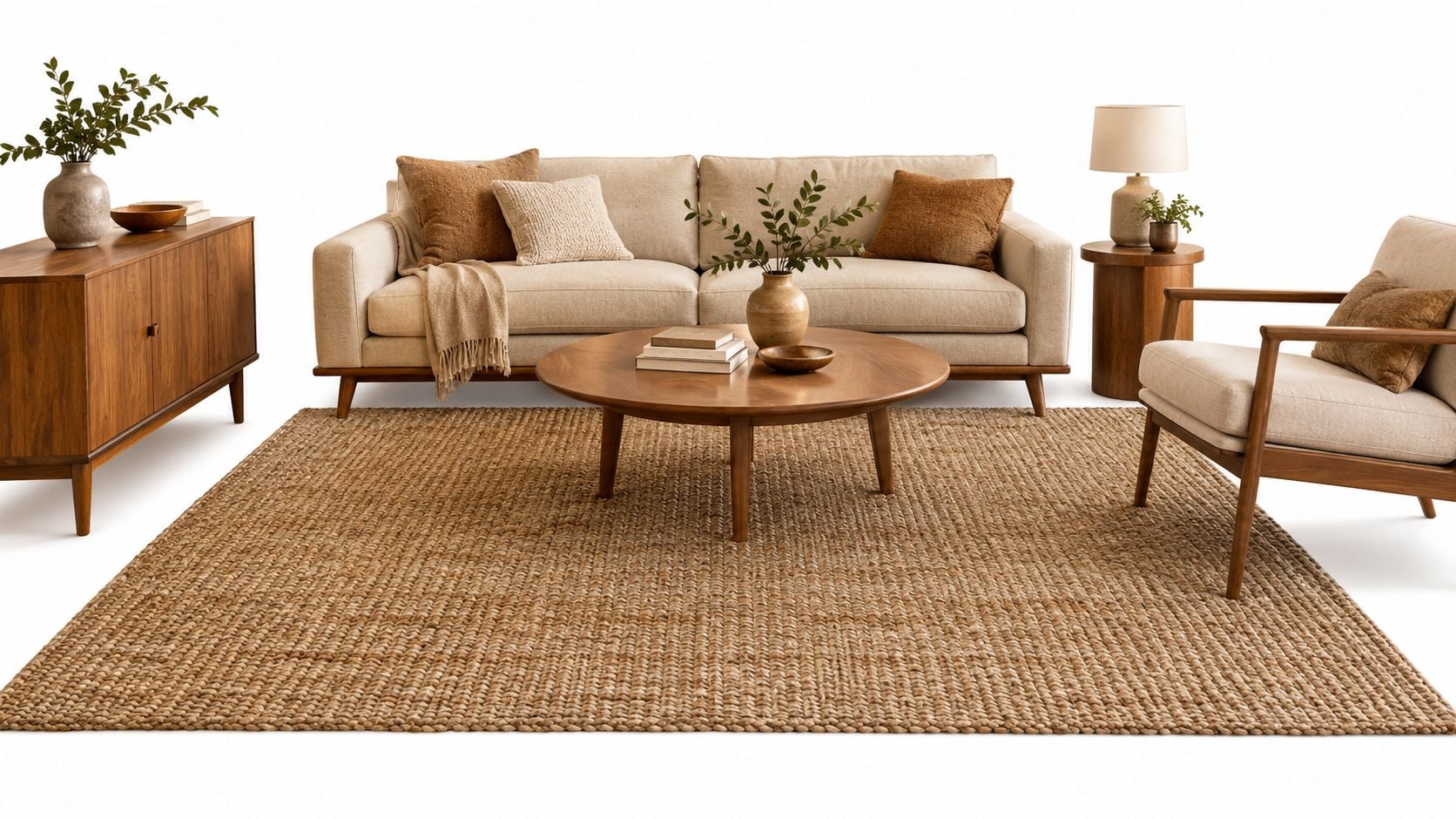
That is why the rug belongs near the top of the selection list, not at the end. Its ground colour can steer upholstery choices, its quieter tones can guide wood finishes, and its scale can decide whether a seating area feels intimate or lost in the room. In a well-edited interior, the rug does more than decorate. It sets the visual rules.
A category with real heritage
Hand woven and handmade area rugs carry a long commercial history in California, and specialist galleries there have operated since the late 1970s. Their continued presence shows that the category sits inside a serious design tradition, not a passing trend. Mansour's Oriental Rug Gallery is one example of the specialist-gallery model that has kept this market visible to discerning buyers.
That continuity matters because heritage craftsmanship is not only about age. It is about selection, patience, and the ability to read a textile for more than its surface pattern. A well-made rug brings depth, character, and a clear sense of authorship into a home, qualities that matter in rooms designed to last.
The family-run furniture tradition associated with the King Street showroom reaches back to 1914, and that history shapes how a rug should be chosen. A serious purchase asks for more than a quick style match. It asks for proportion, material judgement, provenance, and an honest view of how the piece will live through real use, including Canadian seasonal climate swings.
Designer's Insight: Choose the rug before you finalize the rest of the room. Its colour can lead the upholstery, its pattern can set the pace for the drapery or wall treatment, and its scale can keep the room from feeling either crowded or vague.
A hand woven rug is art for the floor, and it should be treated that way. In a Canadian home, that means choosing a piece that can support a traditional library, soften a contemporary dining room, or add warmth beneath restrained furniture while still handling dry winter air and humid seasonal shifts with composure. The right rug gives the room its authority. Every other element should answer to it.
Decoding Artisanal Weaving Techniques
A handmade rug describes a method of making, not one uniform type of construction. Hand-knotted, flat-woven, and hand-tufted rugs each create a different surface, structure, and experience underfoot. Before choosing a pattern or colour, identify how the yarn is attached to the foundation. That decision determines how the rug will perform and how convincingly it will serve as art for the floor.
Hand-woven and hand-knotted rugs are made by interweaving warp and weft threads on a loom, with the weaver controlling tension, colour placement, edge treatment, and small variations throughout the process. An overview of woven and oriental rug construction explains the basic relationship between these threads and the finished textile. Such irregularities can signal human authorship rather than poor workmanship. I look for consistency in the overall structure, then accept minor variation as part of the rug's character.
Hand-knotted construction
A hand-knotted rug is built knot by knot around vertical warp threads. The pile is secured directly into the foundation, and the reverse generally reveals the logic of the pattern rather than a separate glued covering. Its construction has the integrity of fine joinery. Each knot contributes to the whole, allowing a well-made rug to develop patina while retaining its underlying strength.
Choose hand-knotting for a principal sitting room, library, dining room, or residence intended to mature over time. It suits homeowners who value timeless craftsmanship and want a textile with the presence to become part of the family's visual history. Wool supports resilient everyday use. Silk is selected for its luminous surface and intricate detail, with placement and care requiring greater discipline.
A hand-knotted rug should command the room's design concept. Let its scale establish the furniture arrangement, and let its colour rhythm guide surrounding upholstery, drapery, or painted surfaces. The construction carries visual authority, so avoid burying it beneath competing patterns.
Flat-woven construction
Flat-woven rugs have no raised pile in the same sense as a conventional plush rug. Warp and weft create a slim, relatively light surface that may be reversible, depending on the technique. Their low profile works well beneath doors, around dining chairs, and wherever furniture needs to move freely.
A flatweave gives a room a relaxed, architectural quality. It keeps the flooring visible, allowing furniture and room proportions to carry more visual weight. Use it in casual rooms, layered arrangements, or interiors that need a crisp transition between different flooring materials. Its restraint can also balance a strongly shaped table or a richly detailed collection.
Hand-tufted construction
Hand-tufting inserts yarn into prepared canvas with a specialised tool, then uses a backing to secure the fibres. This method permits expressive patterning and a generous, soft surface. It works well in bedrooms, reading corners, and other rooms where comfort and immediate visual impact take priority over generational longevity.
A hand-tufted rug suits a homeowner seeking a plush contemporary statement without commissioning a fully knotted piece. Its backing and fibre attachment require careful moisture control. Review hand-tufted area rugs when comparing softness, pattern experimentation, and the permanence required by the room.
A practical inspection
Inspect the underside before buying. A hand-knotted rug generally shows a woven pattern and integrated foundation, while a hand-tufted rug commonly has a secondary backing. Examine the fringe as well. Fringe that grows from the foundation relates structurally to the warp threads. Fringe applied afterward serves a decorative function.
The right construction depends on traffic, moisture exposure, furniture arrangement, and intended lifespan. A design-forward bedroom can welcome a richly textured tufted piece. The central rug in a long-term home deserves the stronger structural case for hand-knotting. Choose the method that gives the room a lasting foundation, then build the rest of the concept around it.
Selecting Natural Fibres for Canadian Climates
The first winter morning reveals whether a rug suits the room. Wet boots cross the entry, salt dries near the threshold, and heated flooring changes the air beneath the furniture. Choose the fibre according to that daily route, not colour alone. A hand-woven area rug is art for your floor, so its material should establish both the room's visual direction and its ability to withstand Canadian seasonal shifts.
Wool earns the busiest rooms
Wool is my first recommendation for living rooms, dining areas, bedrooms, and many entry-adjacent spaces. Canadian retail guidance presents wool as a warm, durable option, while handmade wool rug guidance for Canadian homes identifies 100% wool as naturally soil-repellent and hard-wearing. That combination makes wool the most forgiving natural fibre for a household that values refinement without treating the rug as untouchable.
Wool also recovers well beneath furniture and develops visual depth over time. Its surface can support a traditional room with quiet richness or give a restrained modern interior the texture it needs. It is a stronger entry choice than a highly absorbent fibre, although prompt care still matters when snow and road salt are brought indoors.
Use a low-pile weave in busy passages. It is easier to vacuum, less likely to catch on footwear, and better suited to frequent movement. Place a washable entry mat and boot tray at the threshold. Under a wool rug on hardwood, use a felt-plus-rubber pad for cushioning, floor protection, and reliable grip. If salt slurry reaches the rug, blot it immediately with plain water, then arrange professional cleaning rather than scrubbing the fibres.
Silk belongs in controlled settings
Silk is suited to rooms where its lustre and fine detail can be properly appreciated. Place it in a formal sitting room, bedroom, or low-traffic conversation area, away from grit, damp footwear, and repeated abrasive movement. Silk beside a busy back door is a poor material decision, regardless of how beautiful the pattern looks in a sample.
Radiant heat requires careful setup. Confirm the rug's construction and care guidance before placing it over heated flooring. Keep the floor system within its recommended operating parameters, and prevent moisture from becoming trapped beneath the rug. A measured installation protects both the fibre and the floor.
Jute needs honest assessment
Jute contributes handsome irregularity and a grounded coastal or contemporary character. It can work in a well-used room, but only where the household can keep moisture under control. Use a rug pad, blot spills immediately, and avoid damp zones. Natural fibre is not always better. Maintenance belongs in the design decision alongside provenance, texture, colour, and the room's actual demands.
Practical rule: Keep snow and salt at the threshold. A boot tray, washable entry mat, and prompt blotting protect a valuable rug more effectively than late repairs.
Homeowners comparing the best hand-knotted rugs should assess the entire path from exterior door to final placement. Wool offers the most forgiving balance for Canadian living, silk rewards controlled use, and jute belongs in dry areas where its texture can remain undisturbed.
Assessing Quality and Supply Chain Transparency
A high price doesn't prove authenticity, and the phrase “hand woven” doesn't answer every question. Premium buyers should ask how a rug was made, where it was made, what fibres were used, how the dyes behave, and whether the seller can explain the piece without relying on decorative language.
Canada's finished rug-set supply is heavily import-dependent, with more than 95% sourced from abroad, while India, Turkey, and China account for an estimated 75% to 85% of imports. Canada's trade data makes the supply-chain question especially relevant. Imported craftsmanship can be exceptional, but origin should be stated plainly, not blurred behind terms such as “inspired,” “artisan style,” or “handcrafted look.”
Compare the structure before the label
A genuine artisan-made rug shows evidence of human decisions. Small variations in weave, shading, edge tension, and pattern alignment can be entirely appropriate. A machine-produced rug may offer a precise design at a lower cost, but it shouldn't be represented as equivalent because its surface imitates traditional motifs.
Hand-tufted pieces occupy a useful middle ground. They can deliver strong colour, softness, and contemporary scale, yet their construction differs from a hand-knotted rug and should be priced and cared for accordingly. The buyer should examine the back, ask whether a secondary backing is present, and request clear information about fibre content and country of origin.
A value spectrum, not a single price
Canadian listings show a wide range, from approximately C$74 for a hand-woven wool area rug on an Etsy Canada seller listing to C$27,999 for a large hand-knotted Tabriz Persian wool rug on a Canadian rug marketplace. Canadian rug-market listings illustrate why price alone cannot define quality. Size, age, fibre, knotting, condition, provenance, design complexity, and the credibility of the seller all affect the purchase.
Premium hand-tufted wool and hand-knotted segments are projected to gain 3 to 5 percentage points of value share by 2035, according to the Canadian market analysis cited in the available trade research. The Canadian area rug market analysis frames this as a movement toward design-led, higher-margin pieces, not proof that every expensive rug will appreciate.
Evaluating Rug Construction and Value
| Construction Type | Durability & Lifespan | Value Retention |
|---|---|---|
| Hand-knotted | Strong structural integrity, particularly suitable for a long-term principal room when properly maintained | Highest potential for heirloom status when provenance, materials, design, and condition support it |
| Flat-woven | Practical low profile with a lighter, more informal presence and easier furniture movement | Depends heavily on fibre, craftsmanship, design, and condition |
| Hand-tufted | Comfortable and expressive, but backing and moisture sensitivity require disciplined care | Often selected for design impact and comfort rather than long-term collecting |
| Machine-produced | Consistent appearance and accessible pricing, with construction varying by material and manufacturer | Generally valued for immediate utility and style rather than artisanal provenance |
The discerning buyer should request a written description of construction, fibre, origin, dimensions, and care. A collection of heirloom quality furniture reflects the same purchasing principle: lasting value begins with transparent information and ends with a piece that suits the home.
Specialized Care and Preservation Protocols
A hand woven area rug is art for the floor, so its care must protect both its structure and its visual character. Never clean it like wall-to-wall carpet. Pile, foundation, fringe, dye, and natural oils function as one fibre system. A careless process can loosen the weave, flatten the pile, cause colour bleed, or alter the rug's dimensions.
Begin with a proper diagnosis
Before any cleaning, a specialist should identify the fibre, pile density, weaving method, country of origin, dye fastness, and current condition. An older or weakened foundation needs a gentler approach than a newer, tightly constructed piece. Inspection determines the treatment. A standard procedure applied to every textile is poor practice.
Professional area and oriental rug cleaning guidance should cover inspection, dusting or vacuuming, fringe finishing, stain and soil-resistant treatment, and controlled drying. These steps reduce colour bleeding and mildew risk, making professional area and oriental rug cleaning guidance more relevant to a valuable rug than generic carpet advice.
Colour-safe testing comes next. Fibre-appropriate solutions must be selected after the assessment, since some constructions require gentle hand washing while others may tolerate controlled machine cleaning. Canadian rug-care guidance on fibre and dye assessment reinforces the need for an individual protocol rather than a fixed formula.
Choose controlled washing
Delicate hand woven rugs generally call for full-immersion washing in cold water with pH-balanced solutions. This method respects the fibre system while helping preserve wool lanolin, pile structure, colour depth, and dimensional stability. Harsh steam extraction and aggressive chemistry can strip natural oils, loosen the pile, and accelerate colour bleed.
Drying deserves the same level of discipline. A specialist may dry the rug horizontally or use a monitored air-drying room to limit bleeding, shrinkage, mould, and fibre distortion. Dense hand-knotted rugs and flat-woven pieces respond differently to moisture and tension, so each requires individual handling.
Canadian homes add another concern. Heated winter air can leave fibres and foundations dry, while summer humidity raises the risk of mildew. Keep the rug away from persistent dampness, maintain steady indoor conditions, and use a quality pad that allows the floor and textile to remain stable.
Care principle: The safest cleaning plan is chosen after the rug is inspected, not after a machine is switched on.
Owners responsible for large commercial textiles can review hotel carpet deep cleaning services to understand how extraction, drying, scale, and site conditions affect professional work. Residential rugs still need a fibre-specific protocol, especially when wool, silk, fringe, or natural dyes are involved.
Routine care remains precise: vacuum without an aggressive beater bar, rotate the rug when the room allows, blot spills promptly, and keep outdoor footwear from bringing in grit. A carefully selected hand-knotted wool rug in an 8 x 10 size deserves a maintenance plan from the day it enters the home.
Integrating Rugs into a Complete Room Concept
A rug should establish the room's direction before the furniture order is finalised. Its scale determines the seating plan, its palette influences the upholstery, and its texture helps decide whether the room feels formal, relaxed, architectural, or richly layered.
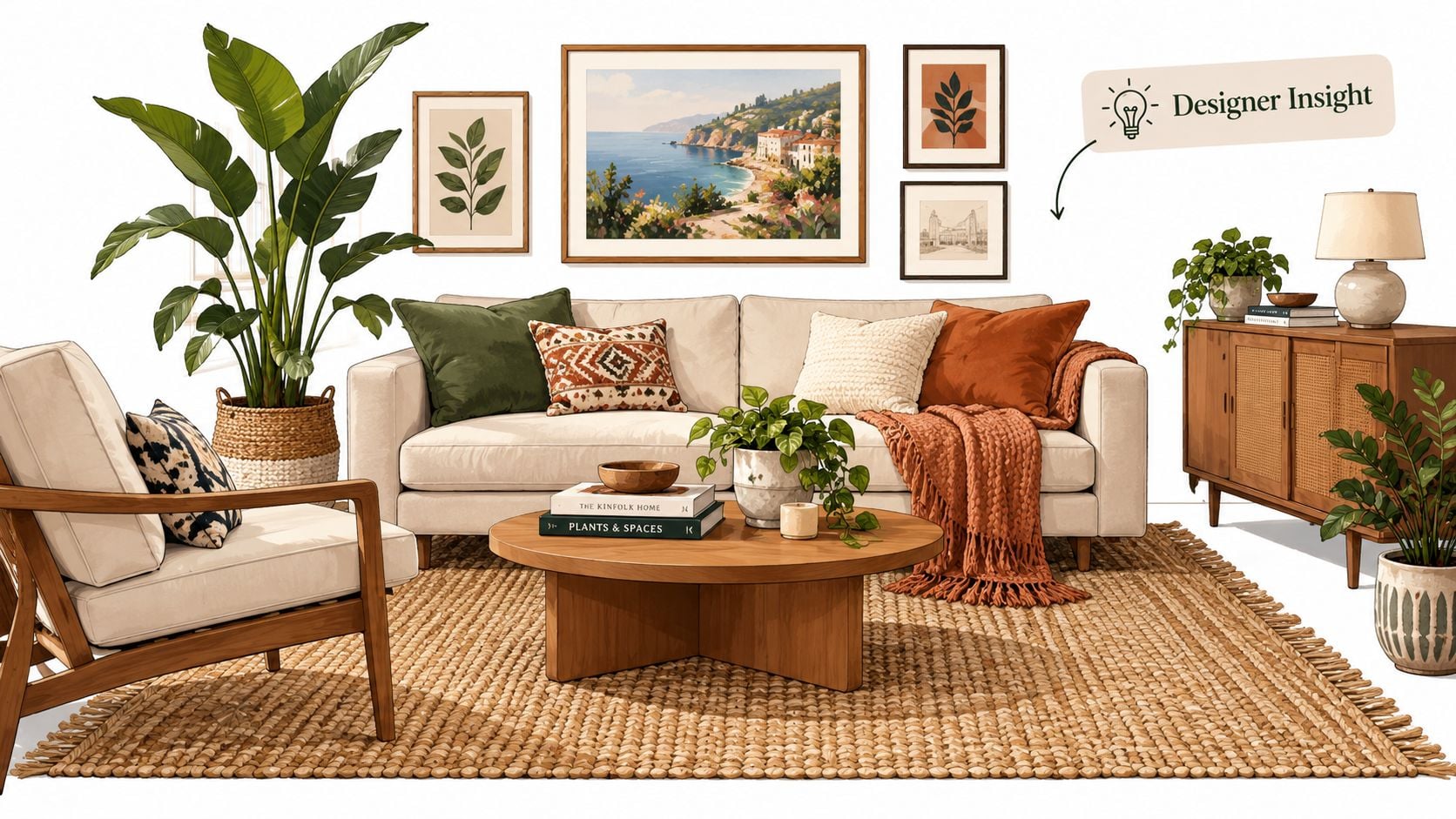
A neutral hand-knotted wool rug can quiet a room filled with expressive furniture. A patterned rug can give a restrained space its needed rhythm. A jute rug can support natural wood, linen, and relaxed upholstery, provided the room stays sufficiently dry and the household accepts the additional care.
Begin with proportion
The rug should relate to the furniture group, not float beneath a coffee table. In a living room, the principal seating may sit fully or partially on the rug, creating a coherent island rather than a series of disconnected pieces. In a dining room, the rug needs enough visual and practical presence to support the table and chairs without making movement awkward.
The design studio serving homeowners seeking Interior design services St. Catharines can use the rug as a planning instrument. A room plan may begin with the rug's dimensions, then establish circulation, lighting positions, upholstery, case goods, and artwork around it. That approach is more reliable than choosing furniture first and searching for a textile that merely fits the remaining space.
Designer's Insight: A bold Hancock & Moore leather sofa pairs beautifully with a neutral hand-knotted wool rug when the room needs balance. The leather supplies weight and authority, while the rug softens the composition and gives the room a calmer centre.
Let the rug direct the furniture
Custom furniture Southern Ontario homeowners often seek becomes more successful when the textile has already established the room's character. A warm rug may favour a deeper wood finish, antique brass, or tobacco leather. A cooler design may support pale oak, brushed metal, or linen upholstery. Collections from Century and Stickley can then be considered as part of a unified palette rather than as isolated product choices.
A homeowner exploring partnering with a home designer benefits from discussing the rug at the beginning of the process. A designer can evaluate the room's daylight, floor tone, door clearances, furniture scale, and maintenance realities before the rug dictates a costly correction.
The result should feel collected, not coordinated to the point of stiffness. A curated selection allows the rug to carry history and irregularity while the furniture provides comfort, proportion, and contemporary function. That is the difference between placing a rug in a room and designing a room around one.
The White-Glove Showroom Experience
A rug's character can't be fully judged through a screen. The hand needs to feel the density of the pile, the eye needs to see colour shift in natural light, and the homeowner needs to understand how the scale relates to actual furniture. In-person viewing is especially valuable for hand-knotted rugs, where subtle variations are part of the piece's identity.
The King Street Showroom and Critelli Modern on St. Paul Street give homeowners a setting in which rugs and furniture can be considered together. The family-run business has served the region since 1914, and its design approach treats the Rug Market as art for your floor, not as an afterthought added to complete a checklist.
The service should continue beyond selection. A genuine white-glove process includes careful inspection, professional handling, delivery into the home, and precise placement so the rug arrives as part of the intended room concept. White-glove delivery service supports that smooth transition from showroom to home.
Homeowners across the Greater Niagara, Hamilton, and Toronto markets can use the showroom visit to compare hand-knotted rugs, assess fibre and scale, and discuss bespoke furniture choices with the rug already in mind. The right piece should feel considered on the day of purchase and increasingly natural as the room matures.
Critelli Furniture offers a curated Rug Market, premium furnishings, and design guidance for homeowners building a complete room concept around heirloom quality textiles. Visit Critelli Furniture to experience the craftsmanship in person at the King Street Showroom, book a complimentary design consultation today, or visit the Rug Market to find the room's foundation.