

Home Improvement Financing: Your Smart Guide


The smartest renovation decisions usually happen at the kitchen table, not at the lender's desk. A couple starts with a backsplash, then realises the living room needs a proper reset, the rug is tired, and the sofa is no longer worth rescuing. That is where home improvement financing stops being a money question and becomes a design question.
For Southern Ontario families, the right funding tool depends on what the room is trying to become. A quick cosmetic update can sit on a very different path from a hand-knotted rug, a Stickley casegood, or a full room concept shaped around timeless craftsmanship. Critelli has built its reputation since 1914 as a family-run destination in St. Catharines, which makes this a natural conversation for a showroom that treats furniture, rugs, and layout as one complete composition. Getting started with custom order guidance fits that way of thinking because financing should follow the scope of the project, not the other way around.
Why Home Improvement Financing Starts with the Project, Not the Loan
A renovation is easiest to finance when the homeowner knows exactly what kind of result the room is meant to carry. A white-glove dining set for a long-term home, a bespoke sectional for daily family use, and a fast paint-and-hardware refresh all deserve different funding logic. The mistake is treating every project like a generic expense.
The room decides the borrowing style
A modest update can often be handled with savings because the work is contained and the timeline is short. A larger room concept, especially one that includes heirloom-quality seating, custom fabrics, and a foundation rug, asks for a more deliberate plan because the pieces are meant to last. That is why the project's permanence matters more than the borrowing product's marketing language.

The right question is not, “What loan is available?” It is, “Which funding tool matches the life of this room?” A hand-knotted rug that anchors the whole home belongs in a different mental bucket from a quick backsplash swap, because the rug shapes the entire design direction and usually survives far longer than the trend driving the update.
Practical rule: finance the thing that defines the room first, then decide whether the rest deserves cash, credit, or equity.
Critelli's family-run legacy since 1914 matters here because design and funding are both being judged through a long view. In a showroom that works with custom furniture Southern Ontario homeowners expect to keep, financing should support craftsmanship, not chase convenience for its own sake. Custom order process details are relevant because a custom project needs clear scope before any lender should be asked to weigh in.
Designer's Insight
Designer's Insight: Treat financing as part of the curated room concept. If the room needs an artisanal rug, statement seating, and a restrained finish palette, the funding plan should preserve the room's hierarchy instead of forcing every purchase into the same repayment box.
The Four Funding Paths Every Homeowner Should Know
A renovation budget should follow the room, not the reverse. A fast backsplash update, a built-in seating run, and a custom rug all sit on different timelines and deserve different funding tools. Savings keeps the most control in your hands, but once the project starts shaping the home's long-term value, the financing choice becomes part of the design decision.
Most homeowners in Canada still begin with savings, and that is the cleanest route whenever the work can wait. The Harvard Joint Center for Housing Studies found that almost 86% of homeowners still use savings or tax refunds to pay at least part of remodel costs, while financing through home-equity debt or unsecured credit products accounts for almost one-third of remodeling expenditures in Canada Harvard Joint Center for Housing Studies. Financing usually fills the gap, it should not dictate the whole plan.
Funding Options at a Glance
| Funding Path | Typical APR Range | Approval Speed | Collateral | Best Fit |
|---|---|---|---|---|
| Cash and savings | None | Immediate | None | Contained updates, staged purchases, foundation pieces |
| Home equity products | About 7.20% to 10.85% APR for HELOCs and 7.15% APR fixed-rate example for eligible borrowers | Slower than unsecured credit | Home equity | Larger projects, phased renovations |
| Unsecured personal loans | 9.24% to 24.99% APR | Faster than equity-based borrowing | None | Mid-sized purchases, speed-sensitive work |
| Store or dealer financing | Varies by lender and offer | Often quick at point of sale | Often none or limited | Premium furnishings, single-room purchases, split-payment planning |
Cash buys freedom. Equity buys lower borrowing cost, but it puts the home on the line. Unsecured loans move faster and involve less paperwork, yet the price of that speed is higher borrowing cost. Store or dealer financing belongs in a layered plan, especially for premium furnishings that need to be ordered, delivered, and installed on a tight schedule.
That is why a room-by-room budget check matters before any order is placed. A practical guide such as budgeting for a kitchen remodel helps keep the spend aligned with the actual scope. For custom pieces and made-to-order furnishings, furniture financing in Canada works best as one part of a broader plan, not as the only source. If the project is a kitchen refresh, Trademaster kitchen remodeling financing is a useful reference for how project-specific funding can be matched to ordering and installation timelines.
Designer's Insight
Designer's Insight: Fund the part of the room that sets the standard first. A statement sofa, a hand-finished table, or a built-in storage run deserves a funding choice that matches how long it will stay in the home and how much craftsmanship it carries.
Critelli's family-run legacy since 1914 matters because both design and funding should be judged with a long view. In a showroom that works with custom furniture Southern Ontario homeowners plan to keep, financing should support craftsmanship, not distract from it. The right question is whether the payment plan preserves the room's hierarchy and leaves room for quality finishes, not whether it is the easiest approval to grab.
What Lenders Actually Evaluate Before They Approve You
A lender is rarely judging the beauty of the project first. The approval decision usually comes down to the borrower's profile, the home's equity position, and whether the payment can be carried without strain. A handsome room concept does not override weak income stability or thin equity.
The four underwriting lenses
Credit profile is the first lens. Stronger credit tends to open more options and better pricing, while a thinner file usually narrows the field. Home equity is the second. If the homeowner has limited equity, secured products can become harder to access, which is why public repair programs matter for qualifying work.
Debt-to-income ratio is the third lens. Lenders want to know whether the new payment fits alongside mortgage, insurance, and the rest of household obligations. Income stability is the fourth. A consistent paycheque supports confidence that the loan can be repaid without forcing the household to compromise other priorities.
The practical checklist is straightforward.
- Review credit before applying: Clean up avoidable late payments and know where the file stands.
- Estimate usable equity accurately: Do not assume a home can support more borrowing than it can.
- Stress-test the payment: Fit the monthly cost into the household budget, not the aspirational one.
- Document income clearly: Stable employment and predictable earnings matter more than optimism.
- Match the project type to the loan type: Essential repairs belong in one category, discretionary upgrades in another.
When equity is limited, qualifying repair programs deserve attention. USDA Section 504 repair assistance can provide loans up to $40,000 and grants up to $10,000 for very-low-income homeowners, while HUD's Title 1 and FHA 203(k) programs are intended for qualifying repairs and improvements rather than premium finishes USDA repair loans and grants. For homeowners comparing a major room refresh with a more basic scope, that distinction matters.
What is included in an interior design consultation becomes relevant because a detailed specification gives the lender a clearer picture of what is being funded.
The Real Cost of Borrowing for Design-Led Projects
APR is only the headline. The true cost shows up in fees, lien risk, flexibility, and how long the household is tying up future borrowing power. A secured loan can be cheaper on paper and still be the wrong move if the project is modest, staged, or likely to change during ordering.
Secured money is cheaper, but it comes with strings
HELOCs and home equity loans usually cost less than unsecured borrowing because the home stands behind them. That lower cost of capital is attractive, especially for bigger projects, but the trade-off is real. The property is now part of the agreement, and any change in home value or repayment strain affects the household directly.
Unsecured personal loans are simpler. They usually skip a lien, appraisal, and long closing process, which makes them useful when speed matters. First Citizens notes that personal home-improvement loans may provide up to $75,000, typically with no lien on the home, no equity, no appraisal, and no lengthy closing process First Citizens. That convenience is worth paying for when the project is time-sensitive or when the homeowner wants to avoid using the house as collateral.
For premium furnishings, the cost test should include longevity. A Hancock & Moore leather sofa, a Magniflex mattress, or a carefully selected rug is not a disposable purchase. The question is whether a slightly higher borrowing cost is justified by a piece that will live in the home for years and hold the room together with far less replacement risk.
Critelli's financing options, including store financing, belong in that conversation as a tactical bridge rather than a lifestyle decision. A shopper with locked-up equity or a HELOC already stretched across another phase may prefer a structured retail payment plan for the seating piece while keeping equity for the built-in work. Interior design consultation cost context can help frame the project before any borrowing choice is made.
Bottom line: the cheapest loan is not always the smartest design decision. The best one protects craftsmanship, timing, and the room's final result.
Building a Layered Funding Plan for a Whole-Room Design
A whole-room redesign rarely belongs to a single bucket. The smartest households split the plan by what each piece of the room needs to accomplish, then fund each part accordingly. That is especially true in Luxury furniture Niagara, Interior design services St. Catharines, and neighbouring Greater Niagara, Hamilton, and Toronto markets where customers often want one room to feel finished, not pieced together.
A practical sequence for a living room
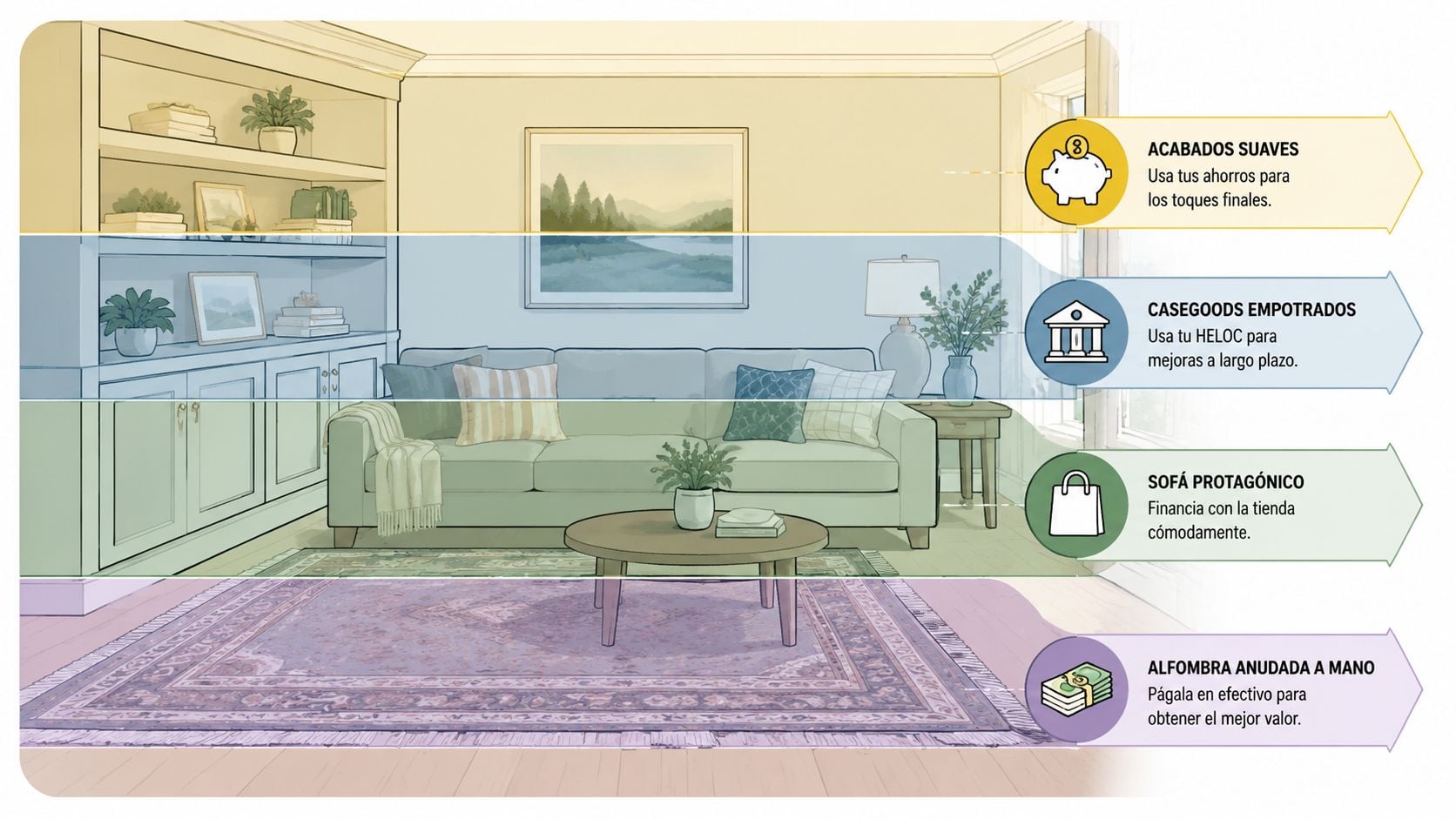
Start with the floor. A hand-knotted rug Ontario buyers can live with for years is the foundation, and it should usually be treated as the room's anchor rather than an afterthought. That is the piece that tells the rest of the room how to behave.
Next comes the structural furniture. Casegoods, built-ins, and the main seating are often the best candidates for a more deliberate funding path because they set the room's rhythm and are harder to replace casually. Then come the soft finishes, which can be staged with savings as the room settles.
- Cash for the foundation: The rug, measured correctly and chosen for the room's scale.
- Equity for the built work: Casegoods or built-ins that need more capital and have longer usefulness.
- Store financing for statement seating: A sofa or recliner that belongs in the final composition but does not need the same payment structure as the room shell.
- Savings for finishing touches: Lamps, pillows, and accent pieces that complete the palette.
Critelli's collaborative design process matters because a lender or financing partner wants a clear scope, not a vague wish list. Collaborative design process details support that clarity by turning inspiration into measurements, material choices, and a practical ordering sequence. Once the room is specified, white-glove delivery from the showroom to the home protects the investment by ensuring the pieces arrive, are placed, and are handled properly.
Art for your Floor stops being a slogan and starts becoming a funding principle. A room with a serious rug, a custom sofa, and coordinated casegoods deserves a layered plan that respects how each element contributes to the whole.
When Not to Finance, And What to Do Instead
Borrowing should not be the default just because a room needs attention. If the work is cosmetic, modest, or easy to stage over time, cash usually wins because it avoids interest and keeps the household flexible. That is especially true for homeowners who already know the room's direction and only need patience to finish it.
A staged approach is often the most disciplined one. Buy the foundation first, usually the rug, because it sets the scale and colour direction. Add the main seating and casegoods next. Finish with the artisanal accents once savings refill.
Simple rule: if the project can be broken into phases without weakening the design, it probably should be.
That advice also applies when an existing mortgage or line of credit already offers room to manoeuvre. Adding another loan on top of a stretched household balance sheet can create more pressure than value. For smaller design-led updates, disciplined saving and careful selection often produce a better result than a new payment stream.
Critelli's Low Price Guarantee and trade program can make a cash plan stretch further without turning the room into a compromise. That matters for homeowners who want a curated selection, not a rush purchase. Financing is a tool, not a verdict.
Your Application Roadmap and the Mistakes Worth Avoiding
The application process should begin with documents, not optimism. A homeowner needs proof of income, recent statements, and a realistic view of property value before asking for money. If multiple funding sources are being used, the sequence should be planned in advance so that each draw, order, and delivery date lines up cleanly.
A straightforward path from showroom to funding
- Clarify the scope. The room, the pieces, and the timing need to be defined before the application starts.
- Gather the paperwork. Income verification, account statements, and property details should be ready.
- Match the funding type to the piece. Use the right source for the right part of the project.
- Place the order after approval. That keeps the financing and the design aligned.
- Schedule delivery with care. White-glove handling should fit the ordering window, not fight it.
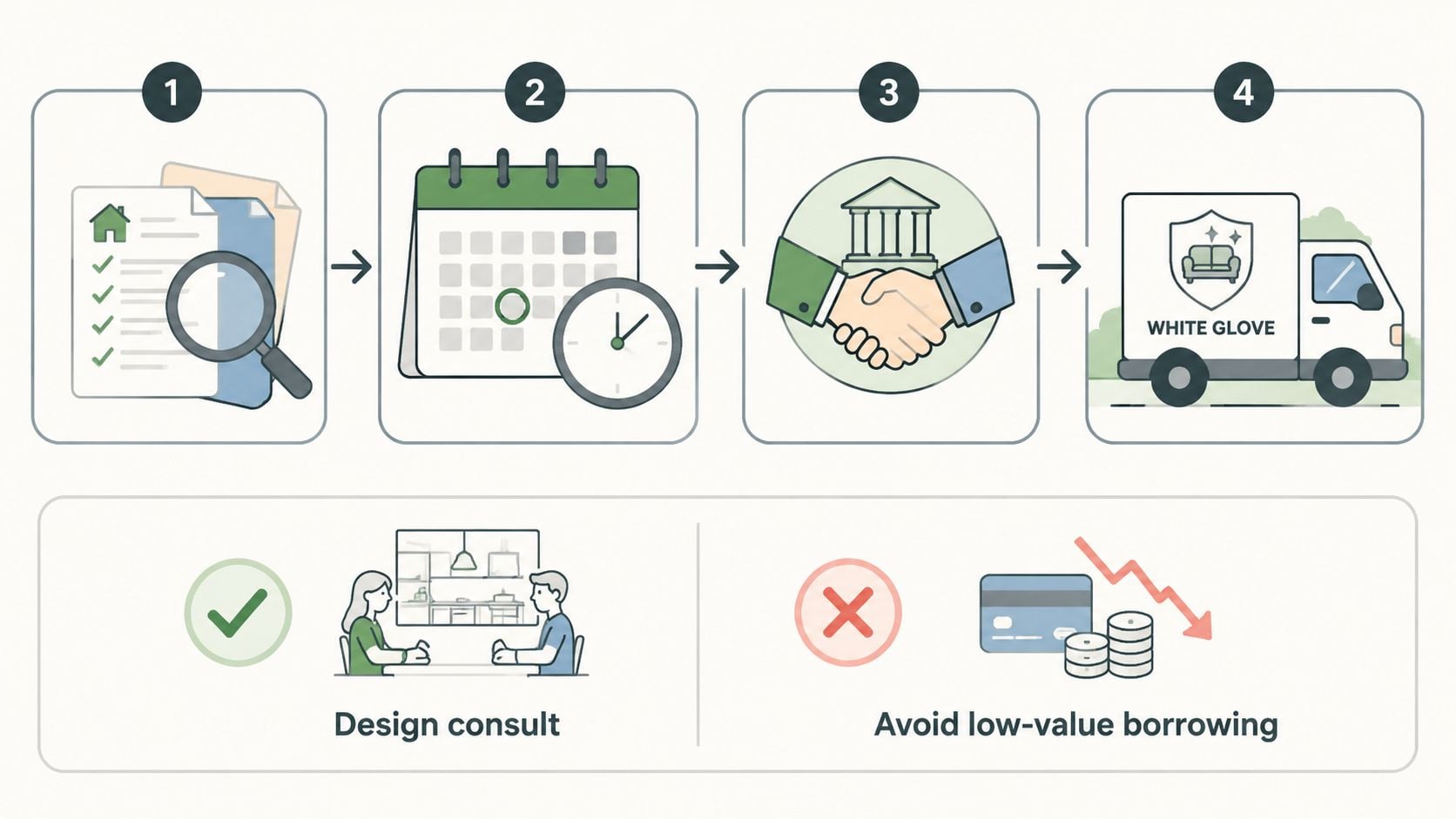
The most expensive mistakes are usually predictable. Borrowing against equity for a project that will not add proportional value is one. Ignoring prepayment penalties is another. Opening a HELOC before the project is properly scoped also causes trouble, because the household can end up borrowing on a moving target instead of a finished plan.
A better habit is to start with the design consultation, then let the financing follow the actual specification. That prevents overbuying, reduces confusion, and keeps the room coherent from first drawing to final placement. For homeowners in Southern Ontario who want the financing decision tied to craftsmanship rather than impulse, the cleanest next step is a showroom visit that allows the design and payment plan to be reviewed together.
Visit Critelli Furniture to explore premium furnishings, rugs, and design services that help turn a financing plan into a room with real permanence. The King Street Showroom can help align the project scope, the materials, and the delivery plan so the investment feels as refined as the finished space.