
Track Lighting Systems: A Homeowner’s Design Guide


The room is furnished, the rug is in place, and the artwork has finally been hung. Yet the space still feels strangely flat. The sofa looks heavier than it did in the showroom, the dining table lacks intimacy, and the wall that should draw attention disappears after sunset. The problem is rarely the furniture. More often, the lighting plan was left until the end.
Track lighting systems deserve a more thoughtful reputation than the builder-basic fixture they're often assumed to be. A well-specified system can be repositioned as furniture moves, aimed at art as a collection grows, and adapted when a room's purpose changes. It should be treated as a long-term design investment, not a row of spotlights attached to a ceiling.
That approach aligns with the Critelli Design Studio philosophy of a complete room concept, where lighting works with furniture, colour, architecture, and rugs rather than competing with them. A useful primer on the wider planning process is choosing lights for your Dublin renovation, particularly for homeowners coordinating electrical decisions with a larger renovation.
When the Room Is Finished but the Lighting Isn't
A St. Catharines homeowner recently completed a polished living room with a custom sofa, a hand-knotted wool rug, and carefully chosen artwork. During the day, the room felt balanced. In the evening, a single central fixture washed the ceiling while the seating area, bookcase, and artwork remained underlit. The room was finished, but the design had no hierarchy after dark.
That's the moment many homeowners discover that lighting isn't a finishing touch. It controls how every other decision is experienced. A beautiful leather chair needs enough directional light to show its grain. A rug needs gentle illumination to reveal its pattern. Art needs a beam that lands on the work rather than the glass.
Track lighting offers a practical remedy because the system can follow the room instead of forcing the room to follow a fixed fixture. Heads can turn towards a gallery wall, a reading chair, or a dining setting. The rail can remain in place while the room evolves, which makes it particularly useful for open-plan homes and interiors where furniture layouts change.
Flexibility with intention
Flexibility alone doesn't create elegance. A rail crowded with mismatched heads looks improvised, while a carefully planned line can feel architectural and quiet. The distinction comes from choosing the system, finish, beam spread, and control strategy as one composition.
Homeowners exploring mood lighting for a living room will find the same principle applies beyond track lighting. Ambient, task, and accent layers should support the way a room is used, not just increase brightness.
Designer's Insight: A track system should be planned alongside the sofa, rug, and artwork. It belongs to the room's visual language, not to the contractor's leftover list.
For clients considering luxury furniture Niagara, Interior design services St. Catharines, or Custom furniture Southern Ontario, this matters because lighting determines whether a carefully curated selection looks atmospheric or ordinary. The same is true for Hand-knotted rugs Ontario, where texture and colour need controlled illumination to read properly.
What a Track Lighting System Actually Is
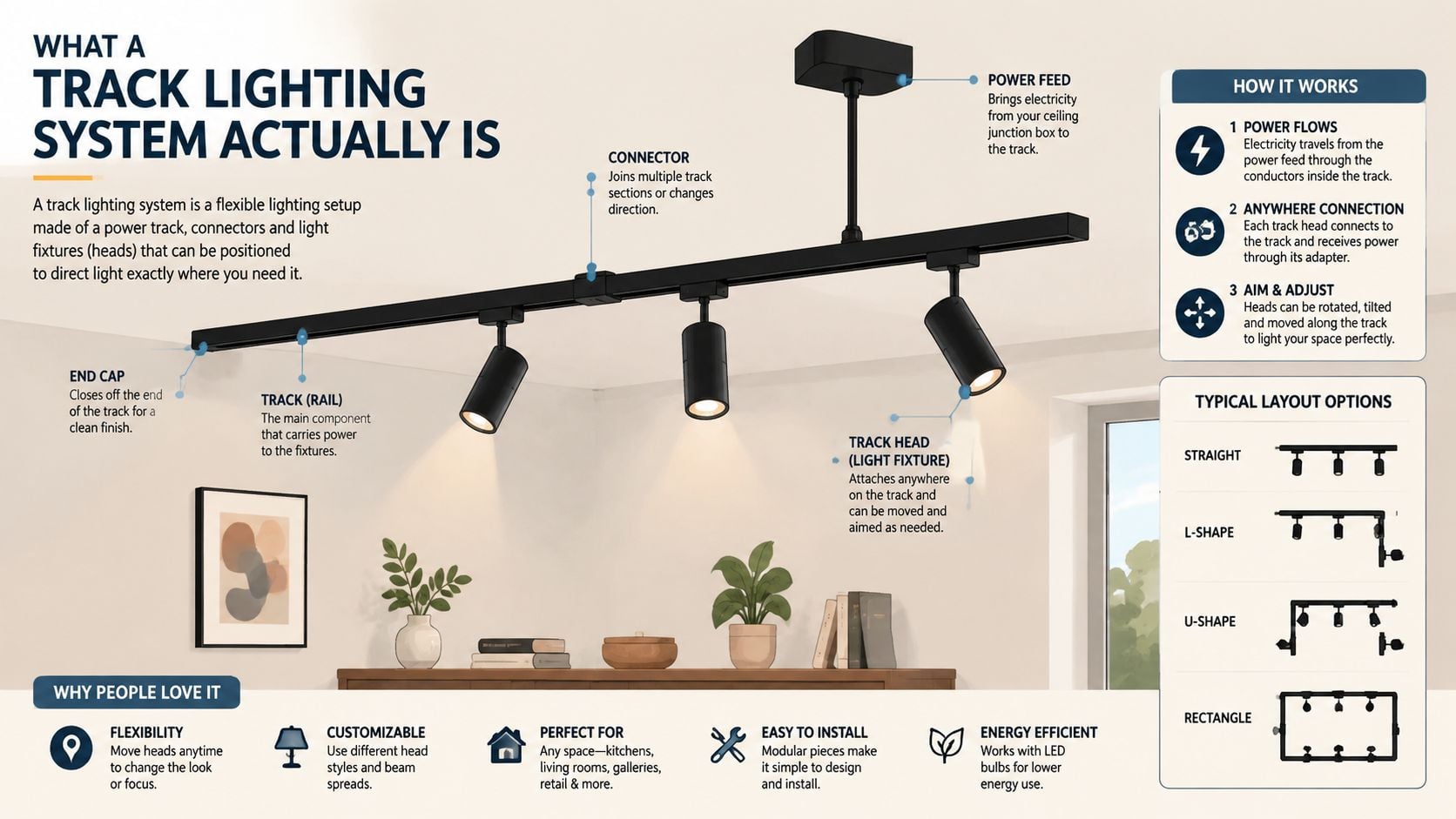
A track lighting system is easiest to understand as a ceiling-mounted rail with movable clips. The rail carries electrical power, while individual heads attach to it and can be repositioned without opening the ceiling. The arrangement resembles a curtain rod whose clips can slide to suit a changing window treatment, except the clips carry light fixtures.
The system has four basic parts:
- The track forms the structural and electrical backbone. Straight sections suit corridors and long rooms, while connectors allow the rail to turn or change direction.
- The heads attach to the track and direct light. They may be adjustable spotlights, pendants, or other compatible fixtures.
- The feed connects the rail to the home's electrical supply. It may sit at the end of the track or at another approved connection point.
- The transformer, where required, changes the incoming supply for a low-voltage system. It must be compatible with the track family and the selected heads.
Hardwired and plug-and-cord formats
A hardwired ceiling track connects to the home's electrical wiring, usually at a ceiling junction box or an existing feed point. It gives the cleanest architectural result, but any new feed or junction-box work belongs with a licensed electrician.
A plug-and-cord system connects to a receptacle and can suit a rental, a room where ceiling access is difficult, or a homeowner testing a layout before committing to permanent wiring. It's more visible, so cord management becomes part of the design.
The value appears after installation. A living room rail can illuminate a gallery wall one season and turn towards a reading corner after the seating arrangement changes. In a dining room, pendant-style heads can provide a more intimate layer than exposed spotlights.
Track lighting also belongs in a broader lighting composition. Wall-mounted lighting fixtures can provide a softer vertical layer, while the track handles directional emphasis. That combination prevents the ceiling from carrying every lighting responsibility.
Choosing the Right Rail Format and Voltage
The most important purchase decision happens before finish or head style. Homeowners need to choose a track family and stay within it. H, J, and L systems aren't interchangeable just because the rails look similar, and a head that fits physically may still be electrically incompatible.
The rail format refers to the contact arrangement inside the track. H systems, J systems, and L systems each use their own matching heads and accessories. The label on the packaging or fixture should identify the family, voltage, and connection type. If the information is unclear, the fixture shouldn't be purchased on appearance alone.
A practical comparison
| Rail or System | Typical Voltage | Best Suited For |
|---|---|---|
| H-style track | Line-voltage or system-specific supply | Homeowners seeking a common modular format with readily planned head changes |
| J-style track | Line-voltage or system-specific supply | Renovators committing to a defined head and accessory family |
| L-style track | Line-voltage or system-specific supply | Homeowners who prefer its particular connector and head profile |
| Low-voltage track | Reduced system voltage supplied through a compatible transformer | Design-led accent lighting where compact heads and controlled output are priorities |
| Line-voltage track | Direct household supply, subject to the installation design | Straightforward ceiling layouts and homeowners seeking a simpler electrical arrangement |
The table is a decision aid, not permission to combine families. A line-voltage head belongs on the rail it was designed for. A low-voltage head requires the correct transformer and system components. A plug-and-cord product also has different installation implications from a permanently connected system.
The voltage decision
Line-voltage systems can make sense when the layout is simple and the homeowner wants to avoid a separate transformer location. Low-voltage systems can suit a more refined accent plan, especially where smaller heads and precise aiming are central to the design. Neither option is automatically superior.
The better choice depends on the feed method, ceiling construction, desired head styles, dimmer compatibility, and future replacement plan. A showroom consultation should begin with those questions, not with a finish sample. A timeless craftsmanship approach means selecting a system that can be maintained and adapted, not merely one that looks attractive on installation day.
Laying Out Track Lighting Room by Room
A good layout begins with the room's focal points, not the centre of the ceiling. The rail should serve the architecture and furniture arrangement. A quick sketch can show whether the system needs to follow a wall, cross a circulation path, or turn around a corner.
The Canadian Conservation Institute explains that light levels fall quickly as the beam spreads and the throw distance increases, which is why tighter beam control and shorter mounting distances create stronger accent contrast. That principle is useful beyond galleries. It helps a homeowner decide whether a painting needs a narrow, close beam or whether a broader wash is more appropriate.
Kitchens
In a kitchen, the track should support preparation surfaces without placing heads directly behind the person working. A straight rail can run parallel to the island, while an L-shaped layout can address both the island and a wall of cabinetry. Heads should aim at counters, shelves, and display areas rather than directly into seated occupants' eyes.
For a kitchen with changing display objects, adjustable heads are preferable to fixed decorative pendants as the sole source of task light. Pendants may still belong over an island, but the track can add directional illumination to the work surface and surrounding joinery.
Dining rooms
Dining rooms benefit from a deliberate centre of gravity. A track can run along the table's length, with heads aimed down and slightly outward to illuminate place settings, artwork, and nearby surfaces. A flexible rail can be useful where the table may change orientation.
The light should flatter the setting without creating glare on glassware. Dimming is essential here, because a dining room often shifts from bright daytime use to a quieter evening atmosphere.
Living rooms and hallways
Living rooms need more than one aim. One head can address artwork, another a reading chair, and another a textured wall or shelving display. The rail should avoid producing a harsh line of isolated pools across the floor.
Hallways are excellent locations for a narrow straight track. It can establish rhythm along a long passage and turn towards artwork without requiring a series of independent ceiling fixtures.
Home galleries
For art, rugs, and collections, beam control matters more than decorative finish. Tighter beams and closer mounting can give a painting or textile presence, while wider beams create a calmer, less theatrical wash. The final aim should be checked from the normal viewing position, not only from the ladder.
A rail is the infrastructure. The heads are the editing tools. Good design leaves room for future edits.
Bulbs, Beams, and Dimming That Actually Work
The finish gets attention in the showroom, but the lamp, beam, and dimmer determine whether a track system feels composed at home. A beautifully finished head can still flicker, buzz, or produce a cold glare if its electrical pairing is wrong.
LED has become the sensible default for modern track systems because it supports compact heads, directional control, and lower operating demand than older lamp technologies. The important point isn't just choosing LED. The head, lamp specification, driver, and dimmer need to be treated as one system.
Colour temperature and beam spread
Warm light usually suits living rooms, dining rooms, and bedrooms. A range around 2700K to 3000K is a practical recommendation for these spaces, but the chosen colour should also relate to the room's finishes and daylight.
Beam spread should follow the job:
- Narrow beams suit artwork, sculpture, architectural details, and selected rug areas.
- Medium beams work well for shelving, seating zones, and focused general illumination.
- Wider beams are more appropriate when a room needs an even wash rather than dramatic accents.
A narrow beam aimed from too far away can look severe. A wide beam placed too close may flatten the object it was meant to highlight. The correct decision comes from testing the actual head in the room.
Dimming without disappointment
The most common avoidable failure is pairing an LED head with an incompatible dimmer. Before purchase, the homeowner should confirm that the dimmer is rated for the specific LED driver or head, that the system supports the intended control method, and that the minimum dimming level suits the room.
A renovation with several lighting layers may benefit from an architect's review. Homeowners wanting a broader perspective can contact Hutter Architects for guidance on energy-conscious lighting design. For dining spaces, a carefully selected ceiling lamp for the dining room can also complement track lighting rather than duplicate it.
Installation, Electrical, and Canadian Code Basics
Track lighting is modular, but electricity isn't casual. In Canadian dwellings, lighting tracks must connect to a branch circuit protected by an overcurrent device rated at 15 A or less, as set out in the relevant CSA track-lighting requirements for dwelling units (Canadian Standards Association track-lighting notice).
The Canadian standard covers wall- and ceiling-mounted systems rated up to 347 V and 40 A, and it also includes plug-and-cord systems rated at 120 V (CSA C22.2 No. 250.570 scope). It addresses incandescent, fluorescent, LED, and HID sources, so the system type and source technology both matter.
Three installation categories
A homeowner may encounter three broad formats:
- Permanently connected track, wired into the building supply and normally requiring professional electrical work for a new feed.
- Plug-and-cord track, connected to a receptacle and subject to cord placement, receptacle access, and product-specific requirements.
- Extra-low-voltage grid systems, which use a transformer and require careful planning for transformer placement, wiring, and compatible components.
Swapping a compatible head or adding an approved plug-in pendant may be manageable for a confident homeowner when the product instructions allow it and power is isolated. A new ceiling feed, junction box, branch-circuit alteration, or transformer run is not an appropriate casual DIY task.
Plan the electrician's scope early
The electrician needs the chosen rail family, feed location, track configuration, head count, dimmer information, and ceiling construction before installation begins. That information affects junction-box placement and the finished appearance.
Homeowners comparing track lighting with other ceiling strategies may find Lighthouse Energy Services recessed lighting useful for understanding how a different approach affects planning. Track lighting remains attractive precisely because it can preserve future aiming flexibility, but only when the initial electrical work is sound.
Maintenance, Safety, and When to Bring in a Designer
Maintenance begins with isolation. Power should be switched off before heads are removed, lamps are changed, or connections are inspected. A head should never be forced along the rail, and replacement parts should match the system family and electrical rating.
Dust can be removed with a soft, dry cloth or a carefully controlled brush. Finishes such as black, brass, or painted metal can mark easily, so abrasive cleaners and saturated cloths are poor choices. The rail should be checked periodically for looseness, visible damage, or signs of heat.
Professional attention is warranted when a homeowner notices:
- Flickering, especially after a dimmer change.
- Buzzing or crackling, which can indicate an electrical or compatibility issue.
- Discolouration, scorching, or unusual warmth on the rail or canopy.
- Loose heads or connectors that no longer lock securely.
A designer earns their fee before the ladder appears. The position of the rail, the relationship between beams and artwork, and the visual balance of the ceiling are easier to revise on paper than after holes have been drilled. Critelli's interior design consultation can help coordinate lighting with furniture scale, rug placement, and the room's complete concept.
For homeowners in the Greater Niagara, Hamilton, and Toronto markets, a white-glove approach also means considering how the room will look once furniture is placed, not merely how the ceiling appears during construction.
Choosing the Right Track Lighting System for Your Home
Three homeowner profiles make the decision clearer.
The renovator needs a flexible living-room system that can follow changing seating, shelving, and artwork. A compatible line-voltage rail with adjustable LED heads is a strong starting point, provided the dimmer and feed are planned together.
The entertainer wants atmosphere over a dining table or kitchen island. A rail with carefully aimed heads, warm light, and reliable dimming creates drama without making the ceiling visually busy. Decorative pendants can be introduced where the system supports them.
The collector needs controlled illumination for art, textiles, and architectural details. A low-voltage system may suit a more precise, design-forward composition, while beam spread and mounting distance should receive as much attention as the rail finish.
The final recommendation is simple. Choose the system family first, verify electrical compatibility, plan the room around its focal points, and select heads for their optical performance rather than their finish alone. For a broader selection of integrated ceiling options, explore contemporary lighting for the ceiling.
Experience the craftsmanship in person at our King Street Showroom. Critelli Furniture's Design Studio can help Southern Ontario homeowners shape a complete room concept that brings together lighting, heirloom quality furniture, and the Rug Market's Art for Your Floor approach, with white-glove delivery serving the Greater Niagara, Hamilton, and Toronto markets. Book your complimentary design consultation today, or visit Critelli Furniture to begin a curated lighting and furnishing plan.