

Mood Lighting for Living Room: Essential Guide 2026

At six o'clock on a February evening in St. Catharines, the daylight over the Niagara Escarpment fades before the living room is ready for night. A bright ceiling fixture comes on, the television becomes the room's harshest source, and a carefully chosen sofa, rug, and oak table suddenly look flatter than they did an hour earlier.
That change isn't a furniture problem. It's a lighting plan that was never designed around the way the room is used. Effective mood lighting for living room spaces should transition smoothly from practical brightness to a warm, intimate atmosphere, with no need to rearrange lamps or search for several switches.
Critelli's Design Studio approaches the room as a complete room concept. Seating, rugs, architecture, wall colour, and light belong to one composition. The aim is heirloom quality, not a collection of fashionable fixtures that will need replacing when the room's furniture changes.
A Living Room That Feels Different at Dusk
A well-designed Southern Ontario living room has a second life after sunset. The reading chair remains comfortable, the hand-knotted rug retains its texture, and the fireplace wall gains depth instead of disappearing into shadow. Ambient light washes the room softly, a reading light settles beside the primary chair, and a restrained accent source brings out the grain of the console or the edge of a framed artwork.
Nobody needs to touch a switch because the plan is layered and properly controlled. The room can support a family conversation, a quiet book, a dinner with guests, or a film without relying on one exposed overhead source.
Lighting starts with the room's materials
A fixture chosen in isolation often creates the wrong emphasis. A large pendant may dominate a low-ceilinged room, while a small table lamp on a long console produces a weak pool of light at one end. The right solution depends on the position of the sofa, the scale of the rug, the height of the windows, and the architectural features that deserve attention.
This is why a design-forward consultation is more valuable than a shopping list. Critelli Furniture has operated as a family-run business since 1914, and its approach treats furniture as part of a considered interior rather than a standalone purchase. A Stickley frame, a Stressless recliner, or an artisanal rug should influence the lighting plan from the beginning.
Designer's principle: The light source should be noticed only after the room itself has been noticed.
A practical starting point
A homeowner assessing an existing room should look for three symptoms:
- A single bright centre: The ceiling fixture does all the work, leaving corners and furniture faces underlit.
- Uncomfortable glare: Bare bulbs reflect on screens, glass, polished tables, or artwork.
- No evening transition: The room has only “on” and “off”, with no setting for reading, conversation, or relaxed viewing.
The same planning logic applies throughout the home. For a separate approach to atmosphere in another private space, these bedroom lighting ideas for every budget offer useful context, especially around low-level and bedside sources.
For living rooms, the essential question is more specific: what should the room feel like when daylight has gone? The Critelli living-room lighting guide provides a natural companion to that decision, particularly for homeowners planning furniture, rugs, and architectural controls together.
The Three Layers Every Living Room Needs
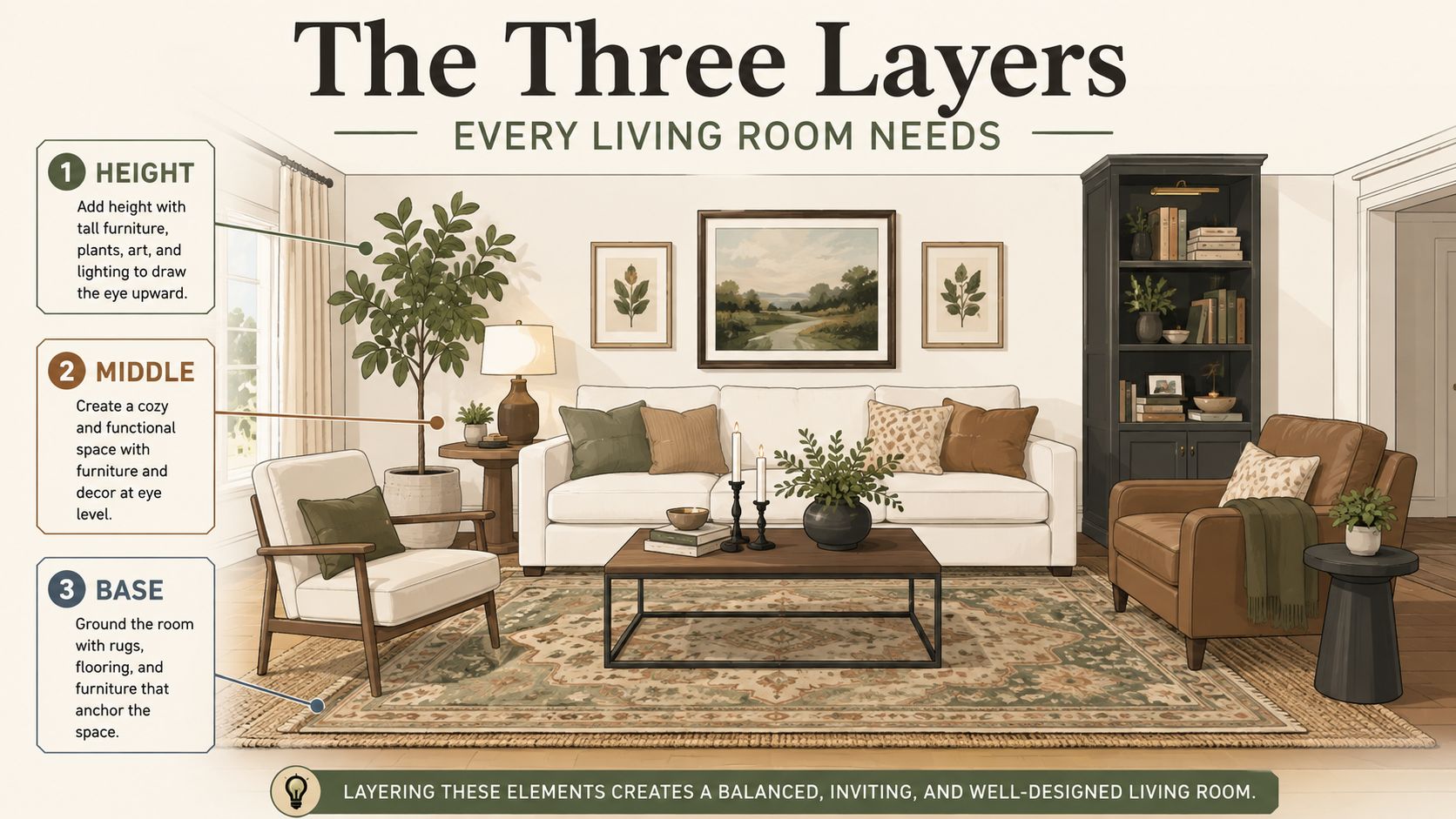
A living room needs ambient, task, and accent lighting. Each layer has a distinct job, and the room feels balanced only when they work together.
Ambient light fills the room
Ambient lighting is the general glow that allows people to move comfortably and see the room as a whole. Natural Resources Canada recommends soft, diffuse ambient light, and identifies upward-directed wall sconces as an effective way to spread illumination without creating a hard beam. Natural Resources Canada's home-lighting design guide also recommends indirect lighting, portable sources, glare control, and accent lighting for flexible living-room scenes.
Suitable ambient sources include:
- Upward wall sconces: They bounce light from the wall or ceiling and make the room feel calmer.
- A diffused pendant: It can provide a central glow without exposing a sharp point of brightness.
- Cove or concealed lighting: It gives architectural surfaces a quiet wash rather than lighting faces from above.
A single overhead fixture fails because it compresses all the room's visual energy into one place. It can illuminate the floor while leaving the sofa back, artwork, and corners visually dull.
Task lighting serves a specific activity
Task lighting gives a person enough focused light for reading, writing, sorting papers, or serving drinks. A Stressless recliner deserves a dedicated floor or wall light positioned for the occupant, while a console used for pouring wine or arranging a tray may need a controlled pool of light nearby.
The beam should reach the activity without shining into the reader's eyes. The fixture also needs to stay useful when the person changes posture, which makes a well-positioned adjustable arm or directional sconce more valuable than a decorative lamp placed too far away.
Accent light creates depth
Accent lighting directs attention. It can skim a textured wall, pick out a painting, illuminate a shelf, or reveal the pattern in a rug. It's the layer that gives a room an intimate evening character.
A homeowner can identify the missing layer by observing the room at night. If every surface is equally bright, accent lighting is absent. If reading is uncomfortable, task lighting is weak. If faces and pathways fall into shadow, ambient lighting needs improvement.
For a detailed treatment of central fixtures and proportion, the Critelli guide to pendant lighting for a living room offers another useful reference.
Choosing the Right Bulbs for Warmth and Clarity
Colour temperature, colour rendering, and output must be selected together. A warm bulb can still feel poor if it renders leather and upholstery inaccurately, while a high-output bulb can ruin a quiet room if it creates glare.
For most living rooms, the clearest direction is soft white between 2,700K and 3,000K. Ontario residential guidance commonly places living-space lighting in the 2,700K to 3,300K range, with 3,000K specifically suited to relaxed family-room use and warm wood finishes (residential lighting-control guidance). Canadian home-lighting advice also favours 2,700K to 3,000K for cosy living rooms, while 3,500K to 4,000K is generally better reserved for kitchens, offices, and other task-oriented rooms (Canadian energy-efficient lighting guidance).
Warmth should flatter the room
Wood, wool, natural leather, linen, and aged metals respond best to a warmer palette. A 3,000K source keeps a family room clear enough for conversation while preserving the warmth of oak, walnut, and soft neutral upholstery. Cooler light often makes a living room feel more clinical than refined.
Colour rendering matters just as much. A bulb with a CRI above 90 will show the character of a leather Hancock & Moore chair or a Persian-inspired rug more faithfully than a low-quality LED that mutes subtle tones.
Output belongs to the layer
Ambient lighting should establish a comfortable overall glow, task lighting should be stronger at the reading or serving zone, and accent lighting should remain controlled so it highlights rather than competes. Independent living-room guidance commonly places ambient illumination around 100 to 200 lux, with reading areas raised to approximately 300 to 500 lux (living-room lux guidance).
| Layer | Colour Temperature | CRI Minimum | Approx. Lumen Target |
|---|---|---|---|
| Ambient | 2,700K to 3,000K | 90+ | Soft, room-filling output |
| Task | Around 3,000K | 90+ | Stronger output at the reading or serving zone |
| Accent | 2,700K to 3,000K | 90+ | Focused, restrained output |
The table should guide fixture selection, not replace a room assessment. A dark wall, dense drapery, or heavily textured hand-knotted rug absorbs more light than pale, reflective finishes. A designer should size each layer around the room's surfaces and the activity beneath it.
Why Dimming Changes Everything
Dimming is the most impactful improvement in a living-room lighting plan. A beautiful fixture at full power can still feel wrong, while an ordinary source becomes far more useful when its intensity matches the time, activity, and season.
The strongest plan uses architectural dimming for wired fixtures and compatible controls for lamps or low-voltage systems. A dim-to-warm LED is especially effective because its colour becomes warmer as its output falls, creating the familiar evening softness associated with incandescent light without forcing the homeowner to install multiple bulb types.
Four scenes cover real life
A living room doesn't need a complicated catalogue of settings. Four well-designed scenes are enough for most households:
- Dinner: Ambient sources remain warm and sociable, with accent light bringing out artwork and the table setting.
- Movie: The main room glow falls back, while low-level pathway and screen-adjacent light preserve comfort without glare.
- Reading: The chair's task source becomes brighter, with ambient lighting kept present enough to prevent a harsh contrast.
- Evening: All layers settle into a low, warm balance for conversation and winding down.
The controls should be obvious. A wall keypad near the room entrance and a simple control near the primary seating area are more useful than a system that requires repeated phone navigation.
Smart lighting must earn its place
A 2026 Canadian survey reported that 48% of respondents own smart lighting, but only 29% use it daily (Canadian smart-home survey). That gap points to a practical design issue. The technology isn't the main obstacle. Poorly designed scenes and inconvenient controls are.
Compatibility also matters. The electrician should confirm that the dimmer, LED driver, fixture, and control system work together, especially when the plan includes low-voltage pendants, concealed strips, or integrated architectural lighting. Flickering may indicate a compatibility or installation issue, so a homeowner troubleshooting an existing fixture can consult this flickering-light repair guide before replacing components unnecessarily.
A dining-room fixture can also contribute to a wider control strategy. The Critelli ceiling-lamp guide for dining rooms is relevant when an open-plan home needs lighting scenes that transition naturally between dining and living areas.
Placement and Scale Around the Room
Placement should follow the room's composition, not the availability of an electrical box. The rug, sofa, fireplace, windows, and built-ins already establish the room's geometry. Lighting should reinforce those lines.
A floor lamp belongs beside the primary reading chair, not directly behind it. The shade should direct light toward the book without placing the bulb in the reader's sightline. A sconce should be judged from the seated position, because eye level while standing can place the source too high once the room is occupied.
Let the rug establish proportion
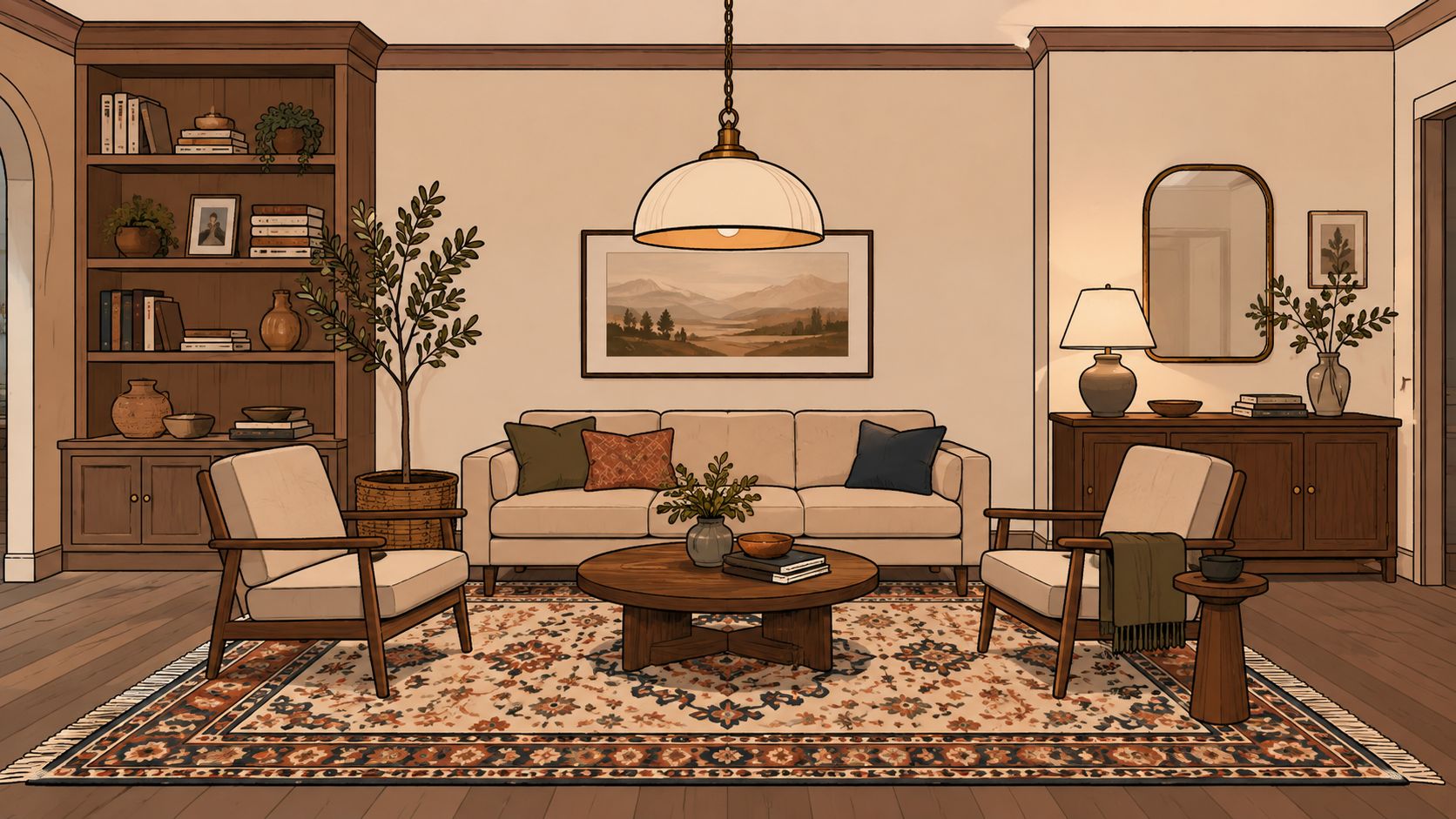
A rug is the room's visual foundation and a useful reference for scale. A small lamp on a long console can throw uneven light across the arrangement, while a pair of sconces flanking a fireplace gives the architecture a deliberate centre.
The Rug Market treats rugs as Art for Your Floor, and that principle matters to lighting. A hand-knotted rug shouldn't sit in a dark foreground while a ceiling fixture draws all attention upward. A low, controlled accent source can reveal its weave and pattern without turning the floor into a stage.
Correct common placement mistakes
A quick evening inspection often reveals the following problems:
- Lamp behind the chair: The reader's body blocks the useful light.
- Sconce judged while standing: The source lands too high for the people using the room.
- Accent light aimed straight at art: Reflections and glare flatten the image.
- One lamp on a long surface: The arrangement becomes visually heavy at one end.
- No low-level source: Movement through the room becomes awkward after the main lights are dimmed.
Artwork should generally be cross-lit from an angle of roughly 30 degrees to reduce reflections and give the surface depth. This is a placement guideline, not a substitute for testing the fixture in the actual room.
For homeowners planning a renovation or furniture rearrangement, Critelli's interior design space-planning service connects lighting placement to circulation, seating, and architectural balance.
Styling Light Around Furniture, Rugs and Architecture
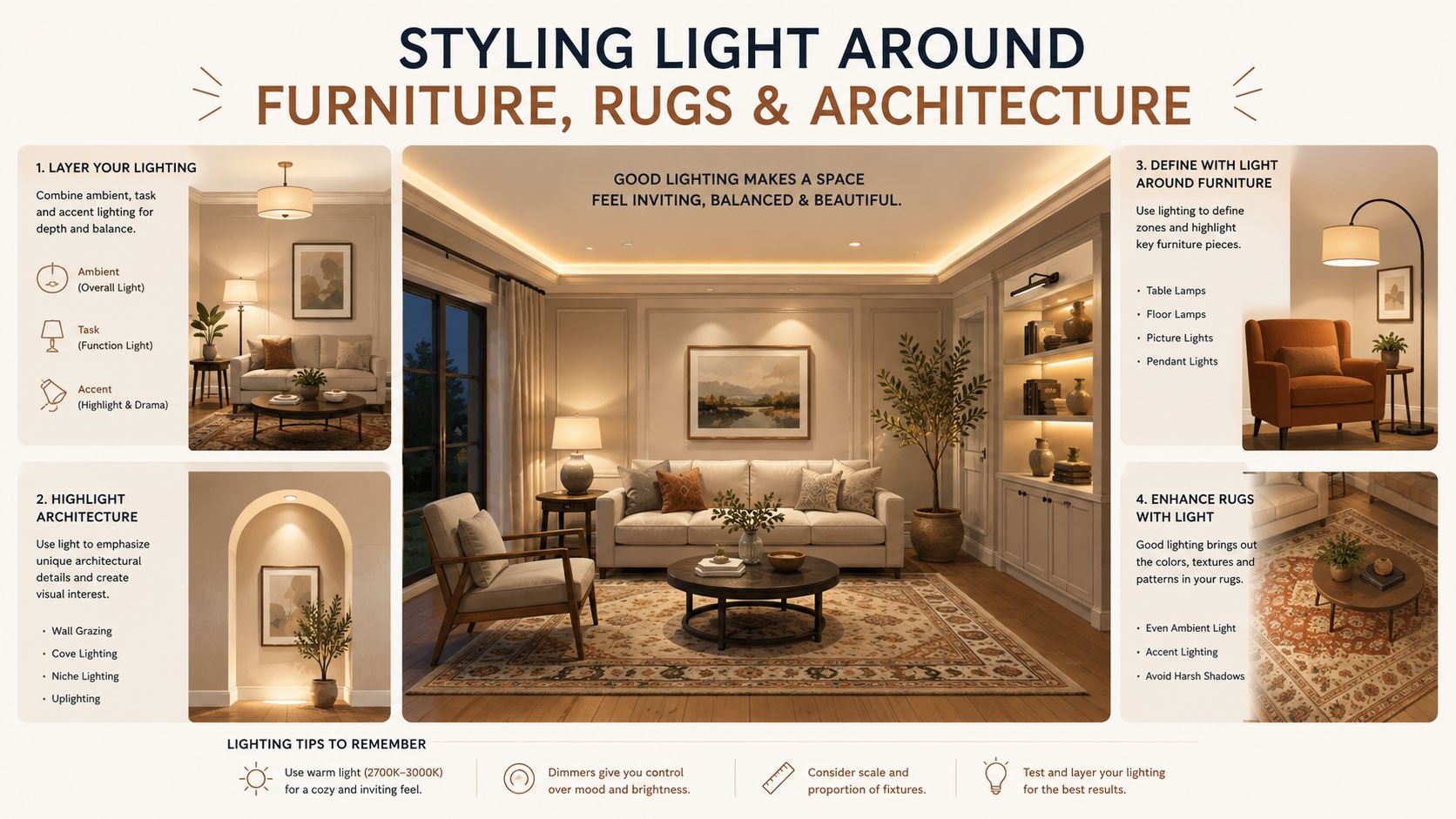
Lighting should be the final layer of a styled room, but it must be considered before the furniture arrives. A hand-knotted wool rug absorbs and softens light, so the ambient layer may need more breadth than it would in a room with a pale, reflective floor. A polished surface, glass table, or metallic trim may require a more carefully shielded source.
Warm light also changes the character of furniture. The patina of a Stickley oak frame responds beautifully to 2,700K light, while 4,000K can make the same finish appear flatter and cooler. A Stressless recliner presents a different requirement. Its occupant remains stationary for long reading sessions, so a dedicated sconce or adjustable floor lamp should be integrated into the chair's position rather than added as an afterthought.
Build around the strongest material
A bold leather chair needs a calm backdrop. A patterned rug needs enough directional light to show its detail without producing bright hotspots. A fireplace, coffered ceiling, or built-in bookcase deserves a source that traces its form instead of competing with it.
Designer's Insight: Pair a bold Hancock & Moore leather seating piece with a neutral hand-knotted wool rug, then use a warm, dimmable wash to balance the room's energy. The leather supplies richness, the rug establishes restraint, and the light keeps both materials inviting after dark.
Large-scale artwork can become the room's evening anchor when the light is controlled. Homeowners considering a statement piece may find large canvas art for a living room useful when determining how much wall-wash or cross-lighting the composition needs.
Treat the complete room as one composition
Critelli's Design Studio works from this broader premise. Furniture, rugs, lighting, and architecture are selected as a curated selection, with finishes tested against the room's natural light and intended use. That approach suits homeowners looking for luxury furniture Niagara, Interior design services St. Catharines, Custom furniture Southern Ontario, or Hand-knotted rugs Ontario, because the lighting plan can be resolved alongside the physical pieces.
A considered room doesn't need every surface illuminated. It needs a hierarchy. The sofa should feel welcoming, the rug should feel grounded, the artwork should have presence, and the architecture should remain legible.
The Critelli living-room rug-placement guide helps establish that foundation before final fixture placement. Once the rug and seating are correctly scaled, the lighting decisions become clearer and more restrained.
Budgeting and Living With the Plan
Mood lighting should be treated as a multi-year ownership decision, not a weekend collection of lamps. The budget needs to account for fixtures, quality dimmable LEDs, compatible controls, electrical work, drivers for low-voltage sources, and the installation details that keep wiring and power supplies concealed.
LEDs have made layered lighting more practical for Canadian homes. Natural Resources Canada reports that lighting represents 3.5% of energy used in the average Canadian home, while household lighting energy use fell 25%, from 4.7 GJ in 2000 to 3.6 GJ in 2019 (Natural Resources Canada lighting information). The same source records 82,609,788 LED bulbs in stock in 2019, equal to 5.48 LED bulbs per household, and notes that a typical Canadian house has 26 light bulbs with approximately $200 in annual lighting electricity use.
A Canadian living-room lighting guide estimates that LED setups can use 60% to 80% less energy than incandescent equivalents and may save roughly $40 to $60 annually for six light sources (Canadian lighting design guidance). Those figures make efficiency part of the design conversation, especially during long winter evenings when the living room carries more of the household's daily activity.
Maintain the atmosphere
A simple maintenance rhythm protects the plan:
- Dust seasonally: Clean shades, diffusers, sconces, and concealed ledges before dust dulls the light.
- Replace matched bulbs together: Keep colour and output consistent across a layer rather than mixing old and new sources.
- Review scenes after winter: Natural-light patterns become clear after the first season, making it easier to refine brightness and timing.
- Protect the architecture: Keep wiring, drivers, and control equipment accessible but visually discreet.
For a homeowner who values timeless craftsmanship, the final measure is ease. The room should feel natural to use, support everyday comfort, and remain adaptable as furniture and artwork evolve. Critelli's white-glove service extends that care from showroom selection through delivery, placement, and the final arrangement in the home, serving the Greater Niagara, Hamilton, and Toronto markets.
Critelli Furniture brings together artisanal furniture, lighting, hand-knotted rugs, and bespoke design guidance for a complete living-room concept, supported by a family-run legacy dating to 1914 and white-glove delivery. Visit Critelli Furniture to experience the craftsmanship in person at the King Street Showroom, or book a complimentary design consultation and create a lighting plan built around the room's materials, architecture, and daily life.