

Contemporary Lighting Ceiling: A 2026 Designer Guide

A newly painted room can still feel unfinished. The sofa is in place, the rug has been chosen, the walls have the right colour, and yet the space doesn't settle. In most homes, the missing piece isn't more furniture. It's the ceiling light that gives the room its rhythm, comfort, and focus.
That's why contemporary ceiling lighting deserves more care than a last-minute fixture swap. A well-chosen ceiling light does more than brighten a room. It shapes scale, softens architecture, supports daily routines, and helps every other element feel intentional. In a design-forward home, lighting is part of the complete room concept, not an afterthought.
Table of Contents
- Beyond Illumination The Art of Contemporary Ceiling Lighting
- Understanding the Styles of Modern Ceiling Fixtures
- Choosing the Right Light for Your Room and Ceiling
- Demystifying Lumens Colour Temperature and Controls
- Creating a Cohesive Lighting Plan
- Bringing Your Vision to Life with Expert Guidance
- Ensuring Timeless Quality from Installation to Maintenance
Beyond Illumination The Art of Contemporary Ceiling Lighting
A homeowner often stands in the centre of a room and asks the same question. Why does this space still feel flat? The answer is usually overhead. Without the right ceiling fixture, even heirloom quality furnishings and beautiful millwork can seem disconnected.
In a family-run firm that has served Southern Ontario homes since 1914, that pattern has repeated across generations. The lesson hasn't changed. Ceiling lighting is the element that gives the room its final sense of purpose. It can quiet a busy ceiling line, add artisanal character above a dining table, or bring calm to a bedroom that otherwise feels too stark.
Contemporary ceiling lighting should be treated like the jewellery of the room, but jewellery still has to fit the person wearing it.
That's where many homeowners get stuck. They see sculptural forms online, save a dozen images, and then discover that the fixture they admired doesn't suit their ceiling height, furniture scale, or the way the room is used. Inspiration is useful, but it isn't the same as specification. For readers exploring broader architectural ideas, this guide to contemporary ceiling designs in Naples offers helpful context on how ceiling treatments and lighting often need to work together.
A contemporary lighting ceiling plan also has to speak to the room below it. In a dining room, for example, the fixture should relate to the table, the chairs, and the atmosphere expected at different times of day. That's why many homeowners begin their research with a more room-specific reference such as this contemporary dining room lighting collection, then build outward into a larger whole-home strategy.
What contemporary really means
Contemporary doesn't only mean minimal. It can mean low-profile, architectural, sculptural, softly diffused, or subtly technical.
In practice, most contemporary ceiling lighting shares a few qualities:
- Clean geometry that feels disciplined rather than ornate
- Thoughtful materials such as metal, glass, linen, or woven textures
- Controlled light distribution that supports comfort, not glare
- A relationship to the room's architecture so the fixture feels placed, not dropped in
The most successful rooms don't chase novelty. They use timeless craftsmanship and proportion so the lighting still feels right years from now.
Understanding the Styles of Modern Ceiling Fixtures
Some confusion comes from language. Homeowners often use one term for every overhead fixture, when each category solves a different design problem. Once the vocabulary is clear, choosing a contemporary lighting ceiling scheme becomes much easier.
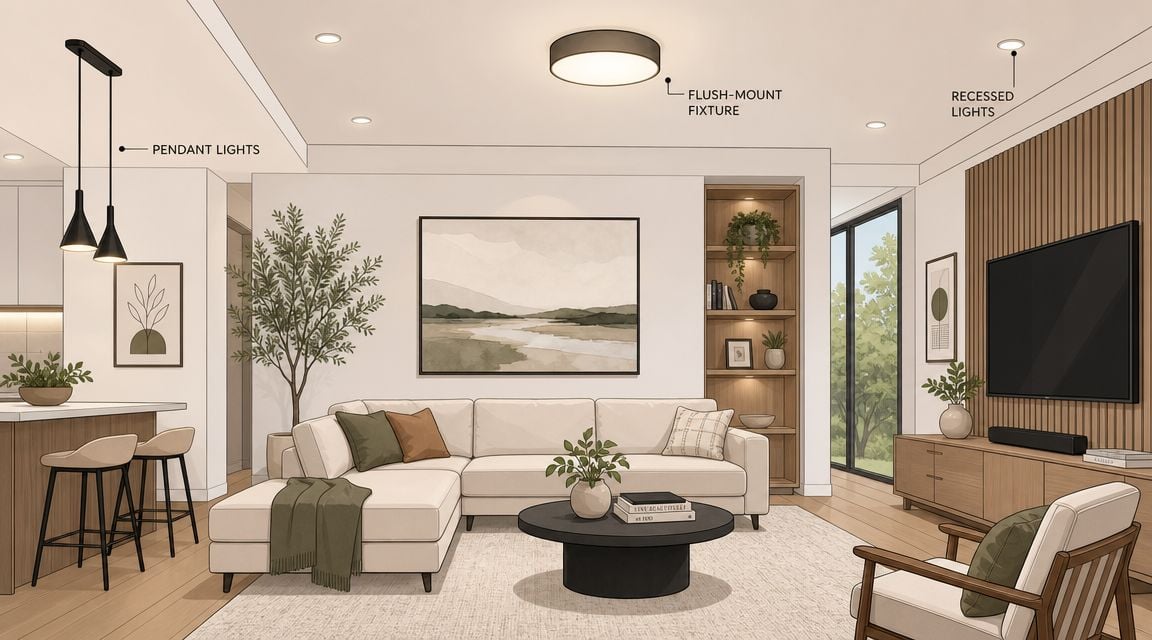
Pendants
Pendants are suspended fixtures that bring light lower into the room. They're often used above islands, breakfast tables, bedside tables, and entry moments where a focused pool of light feels welcome.
Their strength is presence. A pendant can anchor a zone without making the room feel crowded. In a kitchen, a row of pendants gives a long island structure. In a bedroom, a pendant frees up surface space on the nightstand and adds a more bespoke mood than a table lamp.
For readers considering decorative suspended forms, this modern pendant lighting selection shows how contemporary pendants can range from restrained to sculptural.
Chandeliers
A chandelier is often misunderstood as formal by default. In contemporary interiors, it's usually a central composition of arms, shades, or diffused light elements that gives a room ceremony without heaviness.
A modern chandelier works well when a room needs a focal point. Dining rooms, double-height entries, and large living spaces often benefit from one statement piece that gathers the furnishings below it into a single visual story.
Flush and Semi-Flush Mounts
These are the practical heroes of many homes. Flush mounts sit close to the ceiling. Semi-flush fixtures drop slightly lower and usually create a softer, more decorative spread of light.
They're especially useful when a homeowner wants the ceiling to remain visually open. Hallways, bedrooms, smaller dining areas, and homes with lower ceilings often feel far more balanced with this category than with a dramatic hanging fixture.
Practical rule: If a room feels compressed already, the fixture should reduce visual weight, not add to it.
Recessed Lighting
Recessed lights are built into the ceiling plane, so the ceiling looks cleaner and quieter. They don't compete with furnishings or architectural detail, which makes them valuable in design-led interiors where restraint matters.
Their best use is layered support. Recessed lighting can wash a room with even ambient light, highlight artwork, or strengthen dark corners that a single central fixture can't reach. On its own, though, recessed lighting can feel flat. It usually performs best as one part of a larger plan.
Track Lighting
Track lighting has evolved well beyond its old utilitarian image. In contemporary settings, it can be slim, architectural, and surprisingly elegant.
This category is useful when flexibility matters. A track system allows individual heads to be aimed toward art, shelving, a work surface, or a reading chair. It's often the right answer in rooms with changing layouts or homes where owners want to highlight collections.
Integrated LED Panels
Integrated LED ceiling fixtures and panels are increasingly common in contemporary homes because they keep profiles slim and light distribution even. They suit spaces that need quiet performance rather than decorative flourish.
This style often appeals to homeowners who prefer a clean ceiling line. In corridors, dressing areas, utility spaces, or minimalist living environments, integrated designs can feel crisp and organised without drawing attention to themselves.
A good ceiling plan rarely relies on just one type. A room often needs one fixture for identity and another for support.
Choosing the Right Light for Your Room and Ceiling
Selection becomes simpler when two questions guide the process. What does the room need to do, and how much physical space does the ceiling give the fixture?
Start with the room's job
A living room asks for flexibility. It hosts conversation, reading, television, and quiet evenings. A central fixture can establish mood, but that room usually benefits from support lighting around the perimeter or near seating.
A dining room is different. The ceiling fixture often becomes the visual centrepiece because people gather around a single table. The light should flatter faces, give the table presence, and feel inviting rather than clinical. In bedrooms, the tone usually shifts again. Softness and low glare matter more than spectacle.
Kitchens are the most demanding. They need clear task lighting, but they also need visual order. In many homes, a suspended fixture over an island can be paired with simpler ambient lighting elsewhere. Homeowners who want a suspended focal point in a smaller zone often start with forms like a corded pendant light, then decide how much supporting ceiling light the rest of the room requires.
Then look up at ceiling height
For Southern Ontario homes, fixture geometry matters. A contemporary ceiling-light specification should begin with ceiling height and room scale. Flush-mount fixtures are the safest default for lower ceilings because they sit directly against the ceiling plane, while semi-flush mounts hang only a few inches below, creating a softer, more decorative distribution of light. Fixture selection isn't just aesthetic. Mounting depth and light distribution work together to determine both glare control and spatial comfort according to Lumens' flush and semi-flush guide.
Many homeowners make expensive mistakes. They choose a fixture by diameter or finish, but ignore depth. A handsome fixture can still feel oppressive if it hangs too low in a compact room. On the other hand, a room with generous height can feel underdressed if the fixture is too small or too shallow.
Rooms with lower ceilings usually need the ceiling itself to stay visually quiet.
Contemporary Lighting Recommendations by Space
| Room Type | Ideal for Low Ceilings (<9') | Ideal for Standard/High Ceilings (9'+) |
|---|---|---|
| Living Room | Flush mount with diffused light, discreet recessed support | Semi-flush, chandelier, or large pendant with layered support |
| Dining Room | Low-profile semi-flush centred over table | Statement chandelier or pendant composition |
| Kitchen | Recessed ambient lighting and slim flush ceiling fixture | Pendants over island with supporting ambient layer |
| Bedroom | Flush mount with soft diffusion | Semi-flush or suspended bedside pendants plus ambient ceiling light |
| Hallway | Flush or recessed fixtures | Semi-flush fixtures spaced for rhythm and continuity |
Designer's Insight
A strong ceiling fixture becomes more convincing when the floor answers it. Designers often pair a bold overhead form with a hand-knotted rug from the Rug Market, treating it as Art for your Floor and the foundation of the complete room concept. When the ceiling and floor speak to each other, the space feels composed rather than decorated.
That's especially true in open-plan homes across Niagara, Hamilton, and the wider Toronto market, where one fixture is often visible from several adjoining spaces.
Demystifying Lumens Colour Temperature and Controls
Technical terms often make homeowners hesitate, but the ideas themselves are straightforward. Most lighting decisions come down to brightness, the colour of the light, and how easily that light can change through the day.
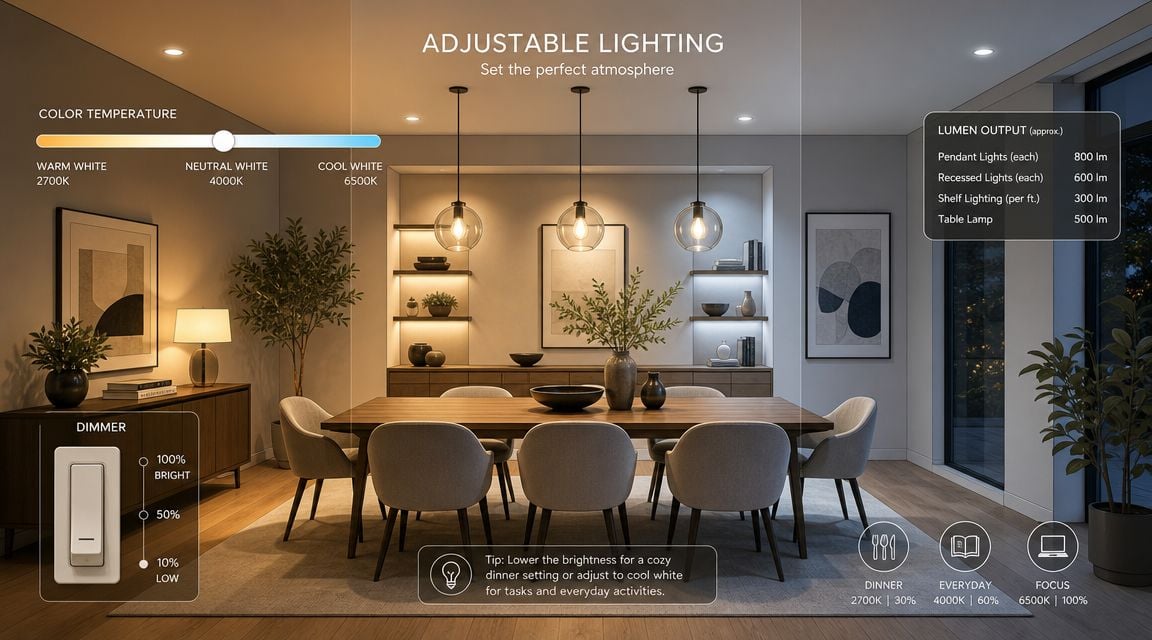
Lumens mean brightness
Lumens describe how much light a fixture gives off. The higher the lumens, the brighter the light appears. Homeowners sometimes confuse this with style, but brightness and appearance are separate questions.
A beautiful fixture can still be wrong if it leaves a room dim or overly stark. In practical terms, a bedroom usually wants gentler overall brightness than a kitchen work zone. A dining room often needs flexibility. It should be bright enough for clearing and serving, yet soft enough for a relaxed meal later in the evening.
Colour temperature shapes mood
Colour temperature is often measured in Kelvin, but homeowners don't need to memorise technical scales to make a good choice. The useful question is simpler. Does the light feel warm, neutral, or cool?
Warm light usually feels calm and residential. Neutral light can feel cleaner and more versatile. Cooler light is often better reserved for task-heavy areas where crisp visibility matters. The wrong colour temperature is one of the quickest ways to make a refined room feel uncomfortable.
Another useful specification is CRI, or colour rendering. That tells a homeowner how faithfully colours appear under the light. If fabrics, wood tones, artwork, and skin look dull, the room will never feel as rich as it should, no matter how expensive the furnishings are.
Controls make one room do more
The most advanced contemporary ceilings do more than turn on and off. For Southern Ontario homes, a premium approach often combines recessed ambient layers with tunable smart controls. Smart ceiling lighting allows brightness and colour temperature to be adjusted through apps or voice, enabling one room to shift from bright task lighting to a warm evening ambiance without changing fixtures, as described in this overview of ceiling-light types and smart controls.
That's why dimming matters so much. A room used from morning to night needs different light at different hours. A family breakfast, a work call, and an evening dinner all ask for a different atmosphere.
For homeowners planning renovations or new builds, broader smart-home coordination can affect lighting choices early. This article on the future of smart homes in new construction is helpful for understanding how lighting controls often fit into a wider home system.
A simple checklist keeps technical decisions grounded:
- Choose brightness by activity so the fixture supports real use, not only appearance
- Choose colour by mood so the room feels welcoming at the hours it's used most
- Choose dimming and controls early so switches, drivers, and fixtures work together
- Choose good diffusion so brightness doesn't become glare
Creating a Cohesive Lighting Plan
A beautiful fixture can still leave a room unfinished if it's expected to do every job on its own. The rooms that feel calm, luxurious, and fully resolved almost always use layered light.

The three layers every room needs
The first layer is ambient light. This is the general illumination that lets the room function comfortably. It often comes from a ceiling fixture, recessed lighting, or a blend of both.
The second is task light. This supports an activity such as reading, cooking, dressing, or working at a desk. It's more focused and should land where the activity happens.
The third is accent light. This is the most emotional layer. It highlights art, shelving, architectural detail, or the texture of a wall. Accent light is often what gives a room depth in the evening.
A room feels flat when every surface receives the same kind of light from the same direction.
Wall lighting often plays an important supporting role here. In bedrooms, corridors, and living spaces, thoughtfully placed wall-mount lighting fixtures can relieve pressure on the ceiling plan and add a softer, more intimate layer to the room.
Scale and placement matter
A dining fixture should belong to the table below it. If it's too small, it looks apologetic. If it's too large, it dominates the room and distracts from conversation.
In living rooms, the central ceiling fixture should acknowledge the seating arrangement, not float without relation to it. Track or accent lighting can then direct attention toward artwork, a fireplace surround, or shelving. Bedrooms benefit from restraint. The ceiling should support the room's sense of rest, not compete with the bed as the main visual focus.
A cohesive plan usually follows a few clear principles:
- Repeat materials thoughtfully so metal finishes and shades relate to nearby furnishings
- Let one element lead so the room has a focal point instead of several competing ones
- Balance ceiling and floor so lighting, furniture, and rugs feel part of one curated selection
- Protect comfort by avoiding harsh source visibility over seating and dining areas
Design-forward interiors separate themselves from trend-led rooms. They aren't crowded with fixtures. They're edited.
Bringing Your Vision to Life with Expert Guidance
Many homeowners can choose a lovely fixture. Fewer can see how that fixture will relate to the sofa scale, rug pattern, sightlines from the entry, and the way daylight moves through the room. That's where professional guidance becomes less about taste and more about integration.

Why a designer sees what a fixture list can't
A designer doesn't only select products. A designer organises relationships. The ceiling fixture has to speak to upholstery, wood finishes, circulation paths, and the emotional pace of the room. In a complete room concept, lighting isn't separate from furniture. It helps define how every object is perceived.
That's particularly valuable when a home includes multiple adjoining spaces. An open dining area might need one pendant language, while the nearby living room needs another. They shouldn't match exactly, but they should still feel related. Curated selection is important here. The room should feel assembled with intent, not purchased in fragments.
For homeowners evaluating practical installation questions before a project begins, this Al-Air Corporation lighting installation guide offers a useful overview of why planning fixture support, wiring, and placement early can prevent avoidable complications later.
A complete room concept feels resolved
A professional consultation can also keep decorative choices from becoming isolated decisions. A bedroom pendant, for example, isn't only about overhead light. It affects bedside table scale, art placement, and the visual weight around the bed. For homeowners considering suspended options in more private spaces, a bedroom pendant lights guide can be a practical starting point.
One relevant local resource is Critelli Furniture, which offers complimentary design consultation as part of a broader room-planning process in Southern Ontario. In homes across St. Catharines, the Greater Niagara region, Hamilton, and Toronto, that kind of collaboration can help clients coordinate lighting with furnishings from brands such as Stickley and Stressless, as well as with bespoke rugs and textiles.
The most memorable rooms rarely come from one excellent purchase. They come from a sequence of well-related decisions.
That's the difference between buying a fixture and shaping a home with timeless craftsmanship.
Ensuring Timeless Quality from Installation to Maintenance
A ceiling fixture may look effortless once installed, but proper performance depends on careful execution. This is especially true for suspended forms, heavier statement pieces, and layered systems that include dimming or smart controls.
Protecting the investment
Professional installation matters because alignment, support, and control compatibility affect both safety and appearance. A pendant hung slightly off-centre can disturb the whole room. A dimmer that doesn't suit the fixture can create frustration from the start.
For many homeowners, the final experience matters just as much as the selection itself. White-glove service helps ensure a smooth transition from showroom to home, with careful handling, placement, and a finished result that feels considered from the beginning.
Simple care that preserves finish and function
Maintenance doesn't need to be complicated, but it should be consistent.
- Dust gently and often so finishes remain clear and diffusers don't dull the light
- Use a soft cloth rather than abrasive cleaners on metal, glass, or painted surfaces
- Check controls promptly if dimming or smart functions become inconsistent
- Review bulbs or integrated components early when light quality changes noticeably
A good contemporary lighting ceiling plan should age gracefully. The goal isn't just style for this season. It's heirloom quality, enduring comfort, and a home that continues to feel beautifully resolved.
For homeowners ready to refine a room or shape a full home plan, Critelli Furniture offers a thoughtful path from inspiration to installation. Experience the craftsmanship in person at our King Street Showroom, book your complimentary design consultation today, or visit the Rug Market to find your room's foundation.