

Wall Mount Lighting Fixtures: A Designer’s Guide


A room can be beautifully furnished and still feel unfinished. The sofa is well scaled. The casegoods have presence. The rug anchors the seating area. Yet in the evening, the space falls flat because the light is doing only one job.
That's where wall mount lighting fixtures earn their place. They're often the detail that turns a furnished room into a composed interior. In practice, they behave like jewellery for the architecture, but their role is more serious than ornament. They shape mood, support function, and direct attention toward the materials that deserve it, whether that's quarter-sawn oak, polished metal, hand-knotted wool, or the subtle grain of plaster.
For homes across Southern Ontario, especially in heritage properties and carefully renovated newer builds, wall lighting also has to do something most style guides ignore. It must satisfy placement logic, scale, and local code. Good wall lighting isn't just attractive. It has to be right.
The Unseen Layer of Timeless Design
A common design problem appears after the larger pieces are already in place. The living room has a beautiful credenza, a well-made sofa, and artwork with genuine character, but the room still feels visually top-heavy by day and oddly hollow by night. Overhead lighting fills the room, but it doesn't create atmosphere. Table lamps help, though they can't always solve dead zones along the perimeter.
Wall mount lighting fixtures solve that missing middle layer.
Why the room still feels incomplete
Ceiling fixtures provide general illumination. Table and floor lamps create pockets of comfort. Wall lights connect those two levels. They soften transitions, draw the eye outward, and make the room feel architecturally intentional. In a hall, they create rhythm. Beside a fireplace, they frame. In a bedroom, they replace clutter on the nightstand. In a dining room, they add ceremony without overwhelming the furniture below.
This is why layered lighting matters more than many homeowners expect. A room rarely fails because one object is wrong. It fails because the relationships between objects, surfaces, and light haven't been resolved.
Practical rule: If a room feels finished during the day but unconvincing at night, the missing element is often wall-level light rather than another piece of furniture.
A complete room concept
The strongest interiors aren't assembled one product at a time. They're considered as a whole. That's true whether the room leans traditional, transitional, or understatedly modern. Wall sconces, picture lights, and reading lights all belong to the same conversation as upholstery, rugs, and casegoods. They influence what the eye reads first and what recedes.
That's also why heritage firms tend to approach lighting with unusual seriousness. A family-run design tradition dating back to 1914 understands that timeless craftsmanship isn't only about what sits on the floor. It's about the envelope around it, and light is part of that envelope.
For a closer look at how layered illumination changes the character of a room, the guidance on putting your living room in the best light is useful. It speaks to a principle designers return to constantly. Lighting should support the complete room concept, not operate as an afterthought.
Where wall fixtures do their best work
Some placements consistently outperform others:
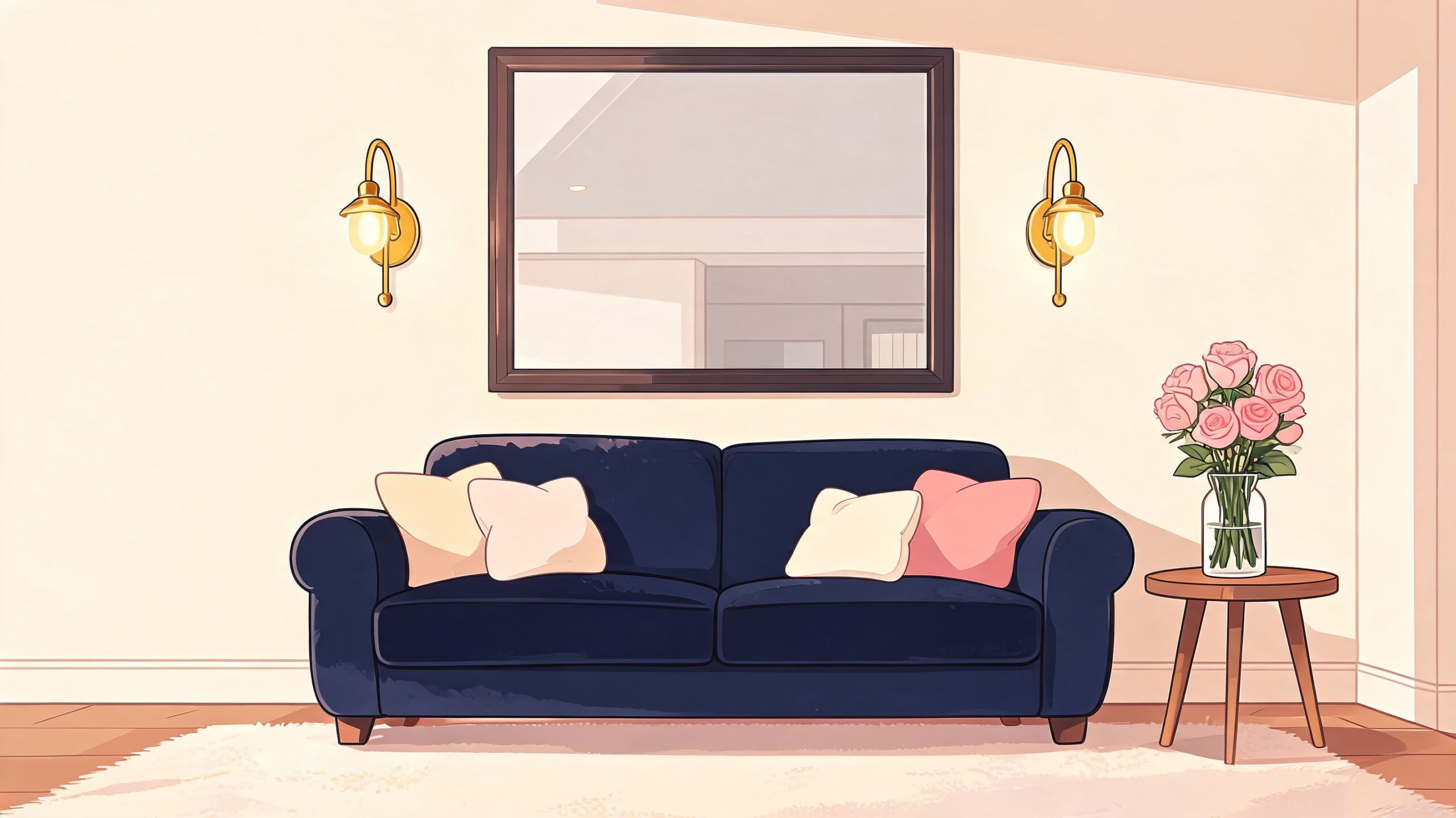
- Framing moments: A pair of sconces can give a fireplace wall the balance that artwork alone can't provide.
- Supporting circulation: Hallways and stairs often need more grace and clarity than a single ceiling light delivers.
- Freeing surfaces: Wall-mounted bedside lights keep the tabletop available for books, flowers, and the objects that make a bedroom personal.
- Adding intimacy: In dining spaces and sitting rooms, wall fixtures reduce the visual harshness of overhead-only light.
The best result is quiet. You don't walk in and think about the sconce first. You notice that the room feels settled.
A Typology of Wall-Mounted Fixtures
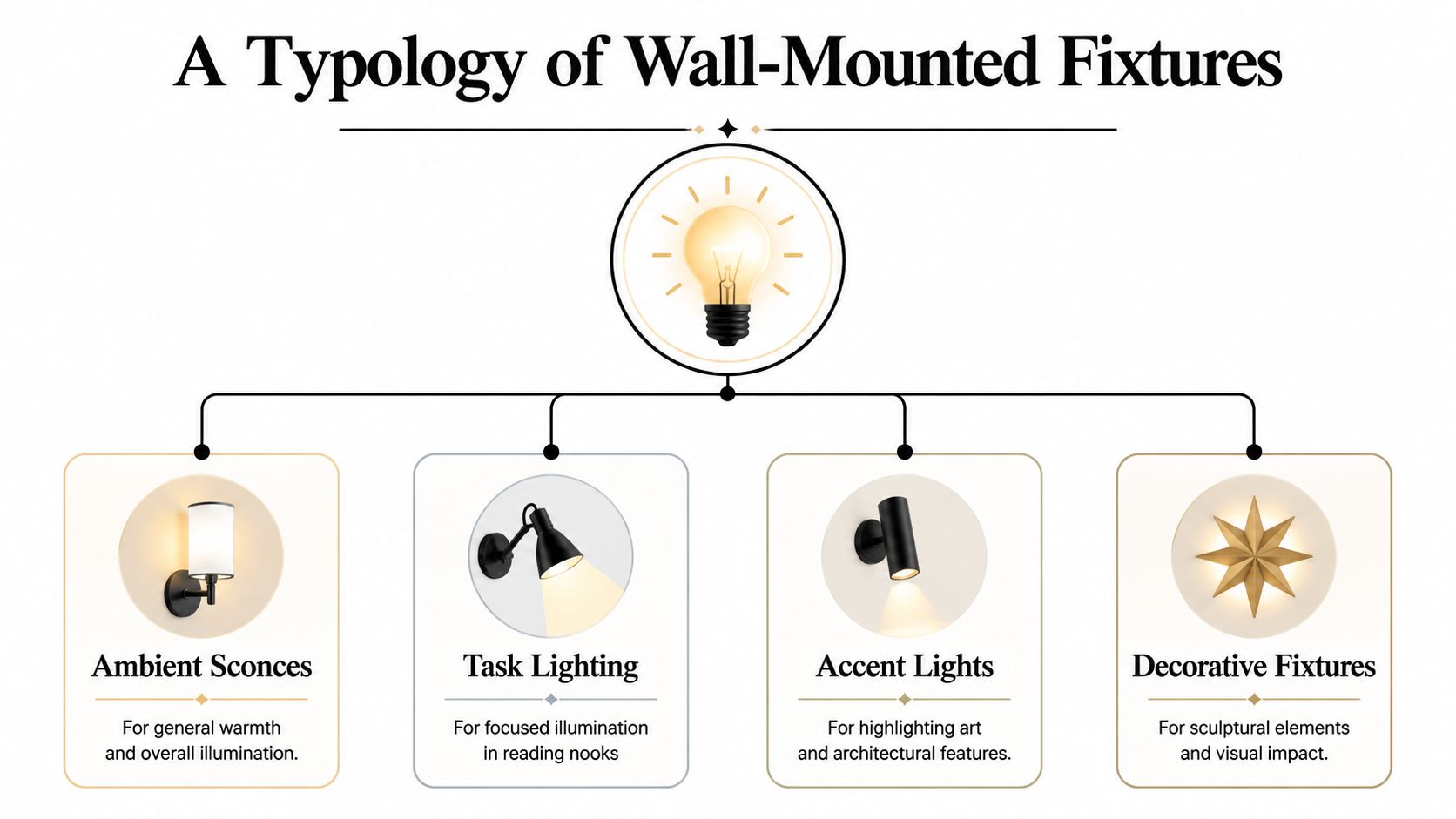
Not all wall mount lighting fixtures do the same job, and choosing well starts with knowing the type before judging the finish. A fixture may be beautiful in isolation and still be wrong for the room because it's casting the wrong kind of light.
Thinking about these fixtures is easy when you follow this approach. Some wall lights wash. Some direct. Some highlight. Some merely punctuate.
Ambient sconces
These are the workhorses of decorative wall lighting. They provide a gentle field of illumination and often make a room feel larger because they pull brightness away from the ceiling plane.
Up-light sconces send light toward the ceiling and flatter rooms with handsome mouldings or textured finishes. Down-light sconces produce more visible drama on the wall beneath. Combination sconces do both, and they're often the best choice in formal rooms where symmetry matters.
Ambient sconces work especially well in spaces that already have a central fixture but need visual depth. If you've been comparing wall lighting with ceiling-centred options, this look at pendant lighting for living rooms helps clarify when suspended light should lead and when wall lighting should support.
Task lighting
Task-oriented wall fixtures are more exacting. They're chosen for what people need to do under them, not just how they look from across the room.
Common examples include:
- Swing-arm lamps: Ideal beside reading chairs or beds because the light can move with the user.
- Dedicated bedside reading lights: Better than a decorative sconce when someone wants focused illumination without disturbing a partner.
- Vanity wall lights: These should light the face evenly rather than creating deep shadows.
A task light fails when it's too decorative to function or too clinical to belong in the room. The sweet spot is controlled beam, easy reach, and a form that still feels intentional.
A good reading light should disappear when you're not using it and feel indispensable when you are.
Accent and picture lighting
Accent wall fixtures direct attention. Their purpose is selective emphasis. Picture lights are the clearest example, but the category also includes narrow-beam fixtures used to highlight millwork, sculpture, or a textured wall finish.
Restraint matters in this context. Accent lighting is persuasive. Too much of it makes a room theatrical. A single painting over a sideboard can benefit from a discreet picture light. An entire room of highlighted objects starts to feel like a showroom.
Decorative fixtures
Some wall lights are chosen primarily for silhouette and material. They may still provide useful light, but their first contribution is sculptural. Think of forged metal forms, alabaster shades, ribbed glass, or custom shades with refined trim.
These fixtures are excellent when the wall itself needs punctuation. In a powder room, vestibule, or narrow hall, a decorative sconce can act almost like a small piece of wall art. It doesn't have to shout. It does need a reason to be there.
The test is simple. Ask whether the fixture improves the room when switched off. If the answer is no, it probably isn't the right decorative choice.
The Art of Placement Scale and Proportion
Placement decides whether a wall fixture looks integrated or accidental. Even a finely made sconce can appear awkward when it's hung too high, undersized for the furniture beneath it, or spaced without regard for the architecture.
In Southern Ontario homes, this isn't only aesthetic. Ontario Building Code Section 9.34 mandates that wall sconces in habitable rooms provide at least 100 lux of illuminance, and for hallways, a mounting height of 60 to 72 inches is recommended to meet egress lighting requirements, as noted in this guidance on wall light placement and sizing. Those measurements are useful because they align practical safety with visual balance.
Four placements that consistently work
Scale becomes easier when you relate the fixture to what it serves.
| Setting | What usually works best | What often goes wrong |
|---|---|---|
| Fireplace wall | A matched pair that frames the surround or artwork | Fixtures that are too small to hold the wall |
| Bedside | Mounted to support reading without crowding the headboard | Decorative sconces placed where they glare into the pillow line |
| Hallway | Repeated fixtures set at a consistent visual rhythm | Irregular spacing that makes the corridor feel choppy |
| Vanity area | Wall lighting that flatters the face and avoids sharp shadows | A single overhead source doing all the work |
A hallway is one place where consistency matters more than novelty. Repeating a modest fixture well usually looks better than alternating shapes or finishes for visual interest.
Scale should follow furniture and architecture
Designers often judge wall fixtures in relation to three anchors:
- The wall height: Taller walls can absorb more vertical presence.
- The furniture below: A broad sideboard, bed, or console needs a fixture with enough visual weight.
- The sightline: What looks balanced standing up may feel glaring once seated.
If you're pairing wall lights with other statement fixtures, a study of modern pendant lights can help you judge which element should dominate and which should support.
Designer's Insight: The direction of light changes how texture reads. A softly downward-cast sconce can bring out the dimensional surface of hand-knotted wool in a way broad overhead lighting can't. That's one reason rugs are often the foundation of a complete room concept. They don't just ground furniture. They reward thoughtful light.
Common placement errors
The mistakes repeat from house to house:
- Too high: The fixture floats and stops relating to the room's furnishings.
- Too low: The light source enters the direct line of sight and becomes irritating.
- Too small for the wall: It feels like an afterthought.
- Too ornate for a narrow space: The fixture projects too far and interrupts circulation.
Bathrooms need extra care because the mirror, hardware, and tile joints all create visual lines. Bedrooms ask for a different discipline. Comfort matters more than symmetry if one partner reads and the other doesn't.
The best installations feel inevitable. You notice the calm before you notice the fixture.
Choosing Your Specifications with Confidence
Good wall lighting has two layers of quality. The first is visible in the finish, the joinery of parts, the glass, the shape of the shade. The second is less glamorous, but it's what determines whether the fixture performs properly over time.
That hidden layer includes colour rendering, colour temperature, efficacy, and dimming behaviour. If those specifications are wrong, even heirloom-quality materials can look disappointing.
Start with light quality, not wattage
For interiors with fine woods, natural leathers, and layered textiles, CRI above 90 is the standard worth pursuing. High colour rendering allows walnut to look like walnut rather than a muddy brown, and it keeps paint, stone, and fabric from appearing dull.
Colour temperature matters just as much. In residential settings, warm to neutral light usually feels most settled. Very cool light can flatten the room and make artisanal materials seem sterile. The right tone should support evening comfort while still showing detail accurately.
A useful technical baseline comes from Canada's energy rules. LED wall fixtures must achieve at least 65 lumens per watt in Ontario, and fixtures below that threshold can generate 40% more heat, which raises the risk of wall damage and can also affect rebate eligibility, according to this overview of wall sconce efficiency considerations.
The specifications worth checking
When reviewing a cut sheet or showroom tag, focus on these points:
- CRI: If the fixture will illuminate artwork, wood grain, or textiles, a high CRI is worth insisting on.
- CCT: Match the tone of light to the mood of the room and the finishes already in it.
- Dimming compatibility: A fixture that won't dim smoothly rarely feels luxurious in use.
- Driver quality: Integrated LED fixtures need stable components, not just attractive housings.
- Shade material: Frosted glass, linen, alabaster, and metal all shape glare differently.
For kitchens and adjacent dining areas, the conversation around fixture specification often overlaps with the decisions people make for ceiling-mounted lighting. That's where the guidance on modern kitchen lighting becomes relevant. It helps clarify how decorative intent and technical performance should support one another rather than compete.
What works and what doesn't
Some combinations consistently disappoint. A beautiful brass sconce with poor dimming can flicker and cheapen the room. A fixture with low-quality LEDs can cast skin tones badly. An efficient fixture with harsh glare may save energy but never earn daily affection.
What works is simpler:
Choose the fixture that makes materials look honest. Oak should look warm. Leather should look rich. White walls should still have softness after sunset.
The technical side of wall mount lighting fixtures shouldn't feel intimidating. It should feel like craftsmanship translated into numbers. When the specifications are right, the room looks natural instead of lit.
Installation and Compliance in Southern Ontario
Wall lighting can look deceptively simple to install. A small backplate and a pair of screws don't suggest much complexity. In reality, the success of the fixture depends on what's behind the wall, how the junction box is supported, and whether the mounting method suits the fixture's weight and projection.
That matters even more with substantial artisanal pieces. Decorative metalwork, thick glass, carved stone, and oversized shades can create real load on the wall. In those cases, installation is not a styling footnote. It's part of the specification.
Plug-in versus hardwired
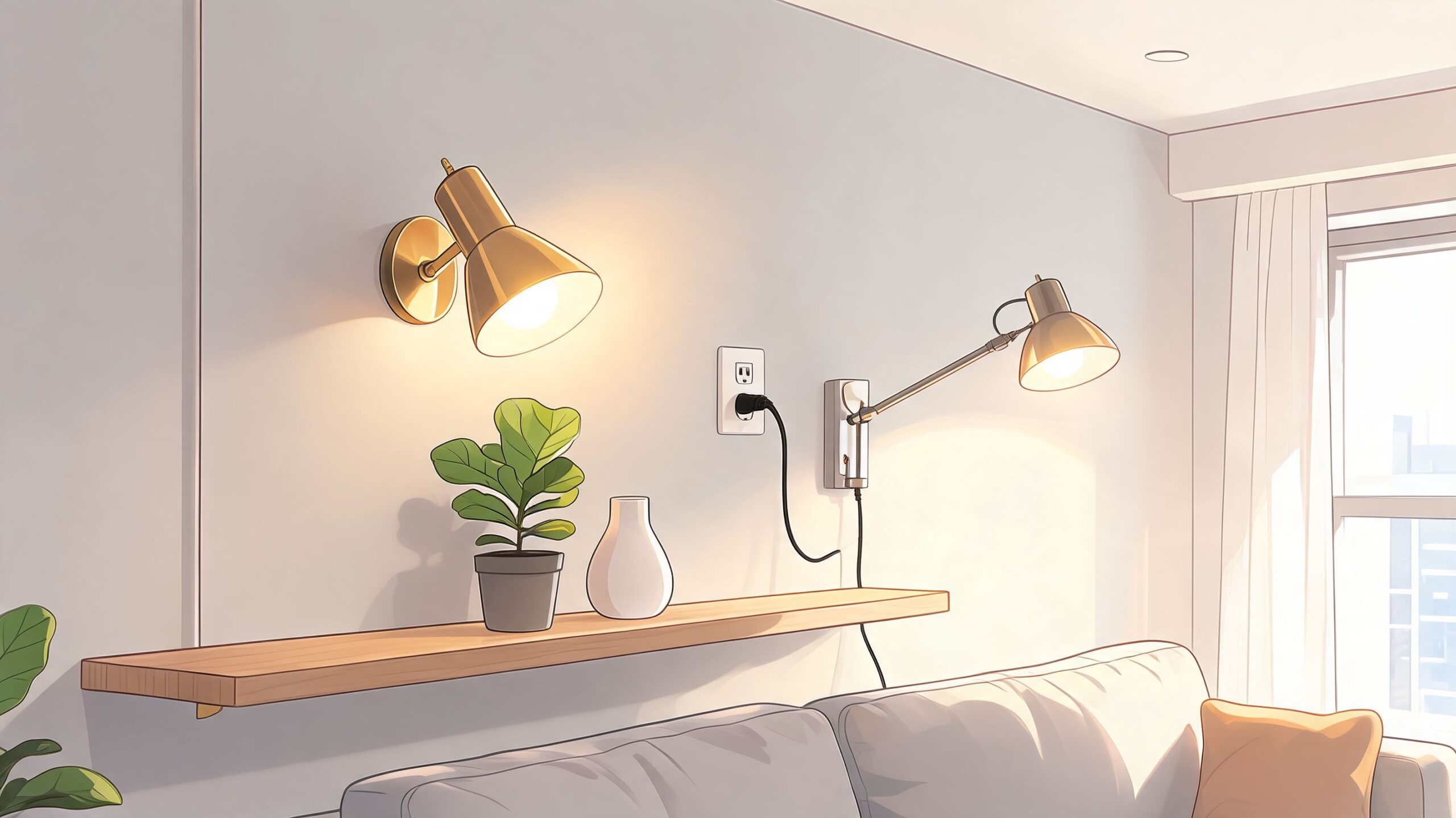
Plug-in wall lights have their uses. They can work in rentals, informal bedrooms, and reading corners where flexibility matters more than perfect concealment. But they rarely deliver the cleanest result in a refined room. The visible cord can interrupt millwork, interfere with furniture placement, and weaken the architectural finish.
Hardwired fixtures generally provide the stronger outcome because they look settled into the wall rather than added onto it. They also allow placement to be planned properly in relation to artwork, headboards, vanities, and circulation routes.
If you'd like a practical outside perspective on how professionals approach LED fitting work, this article on professional LED installation in Brisbane offers a useful process-oriented reference. The location differs, but the larger lesson holds. Good installation starts long before the fixture goes on the wall.
What Ontario code requires
In Southern Ontario, the mounting requirements for heavier fixtures are explicit. The Ontario Electrical Safety Code requires wall fixtures over 4.5 kg (10 lbs) to be mounted directly into wall studs with specific galvanized steel screws, as outlined in the Ontario electrical regulation framework. That requirement exists to prevent shear load failures that can happen when installers rely on drywall alone.
This is one of those details homeowners often don't hear until a problem appears. A fixture may feel solid on day one and still fail later if the support behind it is wrong.
Drywall isn't structure. When a wall light has real weight, the wall assembly has to carry it properly.
Why professional installation protects the design
A professional electrician or qualified installer does more than connect conductors. They confirm box placement, verify support, evaluate switch logic, and protect the finish around the fixture. That last point matters in homes with custom wallcoverings, limewash, plaster, tile, or painted millwork.
Professional installation is especially worthwhile when:
- The fixture is heavy: Support and fastening become critical.
- The wall finish is delicate: Stone, tile, and specialty paint need careful drilling and alignment.
- The placement is symmetrical: Even slight measurement errors become obvious.
- The project is part of a larger furnishing plan: Lighting must coordinate with art, furniture, and sightlines.
A white-glove mindset holds real value in this context. The goal isn't only to make the light turn on. It's to ensure the fixture looks composed, remains secure, and belongs to the house for decades.
Curating Your Home's Luminous Signature
The best wall mount lighting fixtures don't call attention to themselves in a vacuum. They belong to the home's larger language. A sleek, minimal sconce may be perfect beside low-profile upholstered pieces and crisp architectural lines. A more refined fixture with patinated metal or a fabric shade often suits traditional rooms, especially when the furniture carries visible craftsmanship and historical references.
That's why buying wall lighting by finish alone rarely works. Form, scale, beam direction, and material all need to answer the room that already exists. In a modern interior, the fixture might act as a clean vertical accent. In a layered, classic room, it may soften the transitions between casegoods, drapery, and art.
Style pairings that hold up over time
A few pairings consistently feel considered:
- Modern rooms: Cleaner profiles, restrained metalwork, and controlled light distribution.
- Classic interiors: Sconces with warmth, custom shades, and a sense of permanence.
- Bedrooms: Reading-driven function first, decorative character second.
- Hallways and entries: Repetition and rhythm matter more than novelty.
For dining spaces, balance becomes especially important because the wall lighting has to coexist with a central fixture and the reflective surfaces around the table. The ideas in this guide to contemporary dining room lighting are a helpful reference for judging that relationship.
Design and rebates can work together
Well-chosen lighting can be both beautiful and financially sensible. In 2025, over 42,000 Ontario households claimed lighting rebates, and careful planning can potentially save $200 to $400 per installation, particularly when wall fixtures are included in the broader strategy, according to this snapshot of Canadian smart lighting and rebate-related market activity.
That matters because incentives are most useful when they don't distort the design. The fixture still needs to suit the room. The smarter approach is to select the right light first, then confirm whether the specification aligns with available programmes.
For readers considering a bath project outside the living and bedroom context, this Southwest Michigan bathroom renovation lighting guide is a worthwhile companion read. It approaches vanity and bathroom layering from a renovation perspective, which can sharpen decisions about task lighting and wall placement.
Choose wall lighting the same way you'd choose a fine rug or a well-made chair. It should solve a practical need, improve the whole room, and still feel right years from now.
A luminous signature isn't created by adding more fixtures. It's created by choosing fewer, better ones, then placing them with conviction.
Experience a more complete vision of refined living with Critelli Furniture, serving the Greater Niagara, Hamilton, and Toronto markets with a heritage of family-run expertise since 1914. Explore a curated selection of heirloom quality furnishings, discover the Design Studio's bespoke approach to the complete room concept, and visit the Rug Market for art for your floor. Experience the craftsmanship in person at our King Street Showroom, or book your complimentary design consultation today.