

Aniline vs Semi Aniline Leather: Which Suits Your Room

The usual advice is to choose aniline for luxury and semi-aniline for durability. That's too simple. In the aniline vs semi aniline leather decision, the better choice starts with the room: its sunlight, indoor humidity, daily traffic and the household's willingness to accept visible change. A beautiful hide in the wrong setting can become a maintenance concern, while a carefully specified protective finish can preserve natural character without making the furniture feel overly coated.
Why the Finish Matters More Than the Label
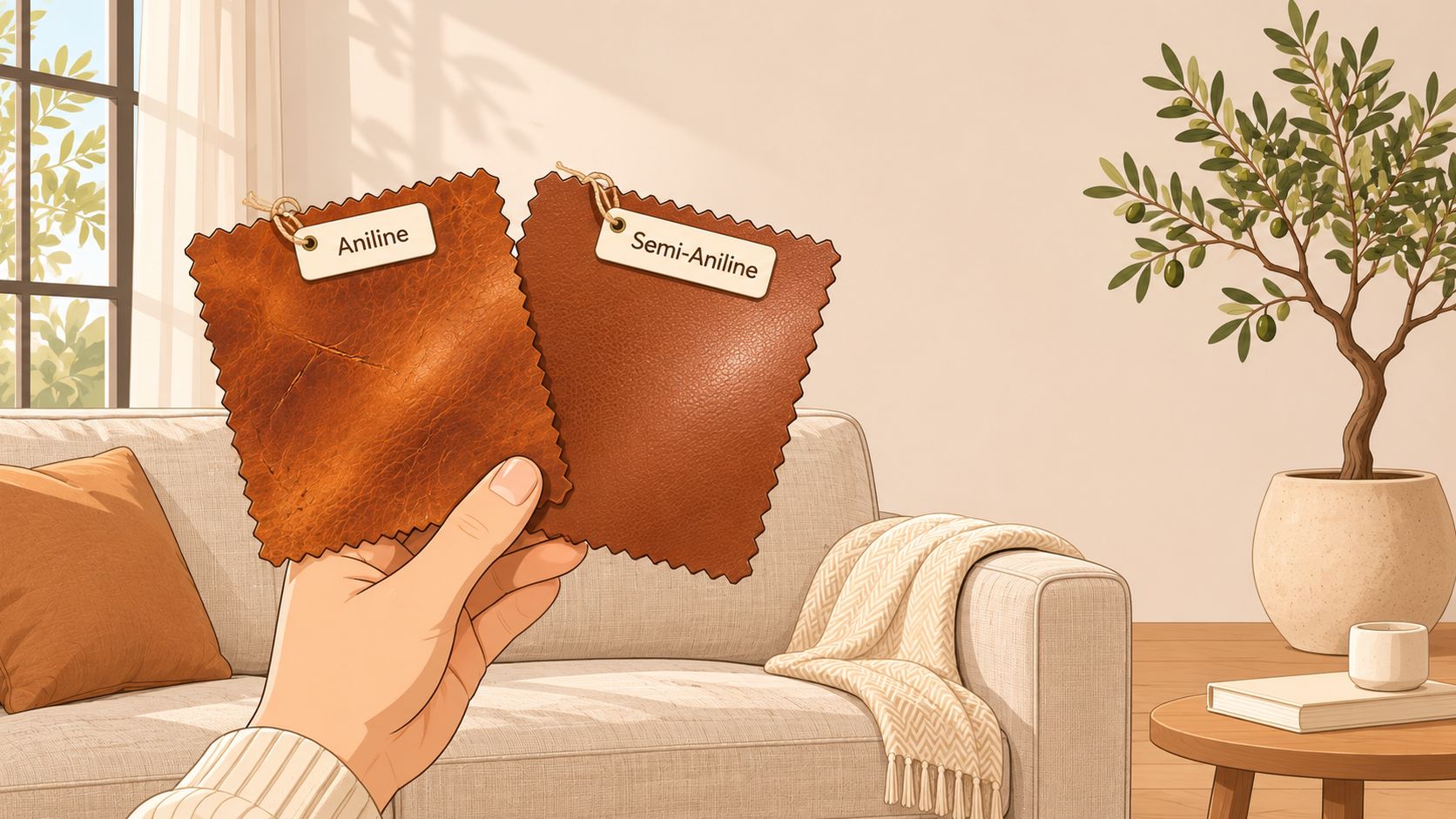
Aniline and semi-aniline are finishing terms: they describe what happened to a hide after tanning and colouring. Two cognac-coloured chairs can look nearly identical across a showroom floor. Place a drop of water on each. One surface may absorb it quickly and darken, while the other holds the droplet long enough for a clean blot. That simple test often reveals more than the label does.
Aniline leather receives transparent dye with little or no protective surface coating. Its grain, natural markings and tonal differences remain apparent. Semi-aniline retains much of that character and adds a light protective layer, often with pigment, for more even colour and greater everyday resistance.
The distinction deserves its own purchase check. Canada's historical tanning and leather industry report treats tanning, colouring and finishing as separate industrial processes. A leather description should therefore explain more than its colour or origin.
Family-run since 1914, Critelli Furniture serves St. Catharines, Greater Niagara, Hamilton and Toronto, treating seating as part of a complete room rather than an isolated purchase. That context matters here. A deep cognac aniline sofa can show dye transfer from new denim within its first weeks of use, and whether that trade-off suits a household depends on how the room lives day to day.
For households still deciding on the covering itself, the fabric-versus-leather sofa guide offers a useful starting point. Once leather is chosen, the meaningful questions concern appearance, wear, seasonal care and the room's real demands. Before committing, ask the supplier to demonstrate the water-spot behaviour of the exact hide on the floor, and confirm that any quoted result refers to the same finish you are ordering.
Aniline and Semi-Aniline Side by Side
Aniline vs semi-aniline leather at a glance
| Criterion | Aniline | Semi-Aniline |
|---|---|---|
| Surface protection | Little or none; transparent dye with minimal surface coating | Light pigmented or protective topcoat |
| Visible grain and natural marks | Fully visible, with differences between hides | Visible, slightly more uniform |
| Feel | Softest, most natural hand | Soft, with a subtle finish |
| Stain resistance | Low; absorbs spills readily | Moderate; resists light spills but isn't spill-proof |
| UV fading | High sensitivity to light | Generally better than aniline; still needs shading |
| Water vapour permeability | Generally higher; more open feel | Generally lower; protective film reduces transmission |
| Everyday abrasion | Shows wear and patina sooner | More forgiving under daily contact |
| Maintenance | Blot spills immediately; condition cautiously | Wipe promptly; condition only as specified |
| Best placement | Controlled, low-spill rooms | Family rooms, recliners and pet households; shading needed near windows |
The protective layer, not a simple ranking of hide quality, is the central difference. Semi-aniline isn't imitation leather, and aniline isn't automatically the better investment. Both can belong in finely made furniture when their finish suits the intended use.
These are typical category behaviours, not promises about every leather collection. A supplier's results for the exact hide and finish take precedence over the general pattern. Even two semi-aniline options can respond differently to moisture, rubbing and cleaning.
Grain and finish answer different questions
Full-grain and top-grain terminology concerns the hide's surface preparation. Aniline and semi-aniline terminology concerns its colouring and protection. Those descriptions should be read together, not substituted for one another.
The top-grain-versus-full-grain guide helps separate these decisions. A premium purchase needs both a clear material description and a clear finish specification.
The key differentiator: Aniline shows the hide. Semi-aniline protects it while still showing the hide.
Appearance, resistance and care also deserve separate judgements. A supple showroom sample establishes tactile appeal, but it doesn't establish how that leather will respond to dark denim, a bright window or repeated cleaning. Room matching requires all of those considerations, not just the softest swatch.
How Each Finish Looks and Feels in a Real Room
Stand across the room from the same sofa upholstered in each finish, and the difference is easy to read. Aniline shows depth rather than uniformity: pores, fine creases and natural marks stay visible, neighbouring cushions carry subtle shifts in tone, and the surface gains patina with use. In a bright, south-facing room that variation reads as character; in a dim den it can look uneven.
Semi-aniline presents a steadier colour across cushions, arms and adjoining pieces. In a formal sitting room, or any scheme where the sofa must sit precisely against painted cabinetry, a patterned rug or a chosen wall colour, that even tone is the finish I would specify.
Judge the whole piece, not just the swatch
A small cutting can make pronounced grain look restrained, and it hides the tonal range that appears once full hides are upholstered across three seat cushions. Ask for a larger sample and, where the showroom has one, compare it against a finished piece in the same leather.
- Check daylight: View the sample in a north-facing position and beside the window where the seating will sit; Southern Ontario's low winter sun reaches deeper into a room than summer light does.
- Compare adjoining materials: Place it against the rug, wood finish and principal fabric, rather than evaluating it alone.
- Discuss matching: Establish how much cushion-to-cushion variation is acceptable before ordering.
- Feel the surface: Compare suppleness and drag with a relaxed hand, without scratching or stretching the sample.
The thin protective film on semi-aniline slightly mutes the warm, untreated hand of aniline, and comfort figures from finishing trials run on exotic leathers such as python don't carry over to upholstery cowhide. Beyond colour and texture, ask for the documentation on the exact leather: its finish classification and whatever lightfastness and rub-test data the tannery publishes. A soft hand and a long service life are measured in different ways.
How Each Finish Holds Up to Stains, Wear and Sun
Semi-aniline generally offers more everyday resistance, but its protective layer isn't a waterproof shield. Coating chemistry and application affect how successfully it resists stains, abrasion and colour transfer. A lightly protected leather still needs prompt attention when something spills.
Aniline leaves less margin for delay. Coffee, skin oils and moisture can alter the surface, while repeated rubbing may make contact areas visibly different from sheltered areas. Some gradual change contributes to patina, but a spill ring or transferred dye shouldn't be mistaken for desirable ageing.
A family sofa beside a sunny window
Consider a family-room sofa used for television, visiting guests and weekend meals. Dark denim rubs against the cushions, hands repeatedly touch the arms, and afternoon sunlight reaches the same seats.
That combination points towards semi-aniline with effective shading, not aniline chosen solely for softness. The Canadian Conservation Institute's leather-care guidance identifies aniline dyes as highly sensitive to light and ultraviolet radiation. South- and west-facing glazing therefore deserves particular attention.
Shading remains necessary with semi-aniline. A protective coating can improve practical performance without making the dye beneath it immune to exposure. Moving a chair outside the direct sun path may be more useful than choosing a darker colour and hoping fading won't show.
Control contact, not just spills
Fine grit trapped in seams and cushion joints creates abrasion as people move. Both finishes benefit from gentle vacuuming with a clean, soft upholstery attachment, particularly where cushions meet the arms.
- Dark clothing: Treat colour transfer as a separate concern from ordinary dirt. Scrubbing can turn a removable deposit into finish damage.
- Pets: A protective layer offers useful tolerance, but it doesn't make leather claw-proof.
- Food and drink: Blot first. Avoid experimenting with household cleaners while the surface is wet.
- Uneven exposure: Check where sunlight falls through the day, not only where it falls during a showroom visit or morning consultation.
A quieter sitting room gives aniline a more forgiving setting. The owner can enjoy evolving grain and touch without asking the same surface to withstand constant meals, rubbing and direct sunlight.
Practical rule: Protection buys response time, not permission to ignore a spill.
For high-contact seating, measured supplier performance is more useful than an assurance that a leather is durable. The finish must suit the household's actual habits.
Caring for Each Finish Through Southern Ontario Seasons
Southern Ontario rooms change around the leather. Winter heating dries the air, while humid summers can make poorly ventilated spaces feel damp. The Canadian Conservation Institute's leather-care note recommends 45–55% relative humidity at 18–20°C, warns that humidity below 30% can cause moisture loss and embrittlement, and identifies increased mould risk above 65%. Treat those figures as a reference for controlling the room, not as a promise that any finish will perform well in every setting. Measure near the seating area, away from vents and direct sun, then adjust the environment before adding products to the hide.
Aniline care routine
- Lift grit weekly. Use a soft vacuum attachment without dragging a hard nozzle across the surface.
- Blot spills immediately. Use a clean, absorbent cloth within minutes rather than allowing liquid to sit. Don't rub outward.
- Clean with restraint. Where the maker permits damp wiping, use a barely damp cloth and an approved pH-neutral leather cleaner. Never saturate the hide.
- Condition sparingly. Test an approved product on a hidden area and allow it to dry before treating visible surfaces.
- Manage placement. Keep seating away from heating vents and direct sunlight.
Aniline shows its grain and pore structure, so polish and oils can change the look quickly. I would keep the routine plain and repeatable: dust, blot, clean only when needed, and condition only with a product the leather maker accepts for that finish.
Semi-aniline care routine
- Dust weekly, including seams and contact points where debris collects.
- Wipe spills promptly with a lightly dampened cloth if permitted, then dry gently.
- Use a leather-safe cleaner approved for the specific finish, not a general household spray.
- Follow the manufacturer's conditioning schedule. A coated surface doesn't automatically need frequent treatment.
- Maintain the same sun and vent precautions used for more open finishes.
Semi-aniline gives more tolerance at the surface, but the coating has limits. A finish that beads water for a moment can still stain if liquid sits long enough to work into seams, stitching or worn contact points. That distinction matters in family rooms, dining-adjacent seating and sunny sitting areas.
For uncertainty about household oils, the Grainmark Leather mineral oil guidance offers useful context before any improvised treatment. The exact leather manufacturer's approval should still govern product choice. The leather furniture care guide is another practical reference for building a maintenance routine around the selected finish.
Before using any cleaner, ask the supplier for the finish specification and a written spot-cleaning method for that exact leather. If they cannot say whether damp wiping, pH-neutral cleaner or conditioning is permitted, treat the surface as dry-clean only until they confirm it. That single question prevents more damage than an extra bottle of conditioner ever will.
Indoor Humidity Ranges for Leather Furniture
Measure conditions where the furniture lives. An outdoor forecast says nothing about the air beside a heating register, against a sunny window, or in a finished lower-level sitting room. A small digital hygrometer left near the seating gives a better picture of what the leather experiences than any weather report.
Canadian Conservation Institute guidance on incorrect relative humidity treats stability as the goal for leather rather than one perfect number. Persistent dryness pulls moisture out of the hide, while sustained humidity encourages mould in the sheltered space behind a sofa. Those extremes matter more than the finish choice. Semi-aniline's protective coating doesn't exempt it from a damp room, and aniline copes comfortably in the same stable, moderate conditions that suit semi-aniline.
Read the room before adjusting it
Set the hygrometer at seat height near the furniture, out of direct sun and out of the immediate airflow from a vent. Watch it through normal heating and cooling cycles rather than reacting to a single reading. In Southern Ontario, winter forced-air heating usually pushes readings toward the dry end, while summer humidity collects in poorly ventilated rooms, especially on lower levels.
If readings stay low, humidify the room rather than adding more conditioner to the leather. If they stay high, improve air movement, leave breathing room between upholstery and damp walls, and check behind furniture for early mould. A week of seat-height readings tells you more than the finish label does.
Matching the Finish to Your Furniture and Room
Choose by placement and behaviour, not reputation. High-contact sofas and recliners usually benefit from a protective finish. A lightly used chair can give more emphasis to visible grain, tactile character and gradual patina.
Stressless and Hancock & Moore offer seating in different leathers, so the finish must be confirmed for each selected model and covering. A familiar brand name doesn't establish the protection level of every option.

Recommended leather finish by room and use
| Room or Use | Recommended Finish | Why It Fits |
|---|---|---|
| Family room sofa with children or pets | Semi-aniline | Better stain and abrasion tolerance under daily contact |
| Daily-use recliner | Semi-aniline | Frequent flexing and contact favour a protective layer |
| Formal sitting room, low use | Aniline | Maximum grain, depth and natural patina |
| Sun-exposed window seating | Semi-aniline, with shading | Generally better light resistance; aniline fades more readily |
| Seating used with dark denim and frequent guests | Semi-aniline | Lower risk of colour transfer and visible staining |
| Lower-traffic reading chair | Aniline | Tactile naturalness takes priority when maintenance is manageable |
Build the complete room concept
Critelli Furniture offers recliners from Stressless, Flexsteel, Palliser, American Leather, Hancock & Moore and IMG, plus Power Lift Reclining Chairs from Ultra Comfort. The leather swivel-recliner guide helps connect covering choice with movement, scale and daily comfort.
A recliner needs enough clearance to operate, but its resting position also matters. A chair that swivels towards a window may receive more direct light than the floor plan initially suggests.
Designer's Insight: A bold Hancock & Moore leather paired with a neutral hand-knotted wool rug from the Rug Market can balance a room's energy. Select the finish with the room's light in mind, then use the rug to connect the seating with surrounding materials.
The Rug Market treats rugs as Art for your Floor, the foundation of interior design rather than a finishing accessory. For homeowners exploring hand-knotted rugs in Ontario, the useful comparison is the leather and rug together, with wood tones and daylight present.
Artisanal texture can complement either leather finish. Timeless craftsmanship doesn't require every surface to look rustic, nor does bespoke seating need perfectly identical grain.
The finish a household can maintain is usually the finish that stays beautiful longest.
Confirm the Finish Before You Buy
Put the exact leather reference and finish designation in the purchase record. A written specification gives you something concrete to compare with the sample, supplier's test results and care instructions before committing to aniline or semi-aniline.
A practical purchase checklist
- Request the test results. Ask for dry and wet rub fastness, finish adhesion, flex resistance, tear strength, elongation and blue-wool lightfastness results. Include water-spot resistance and Taber abrasion or an equivalent abrasion result, with the test method and rating scale.
- Confirm the finish in writing. Use the specification, invoice, swatch documentation or warranty. Ontario's archived upholstered-articles regulation addresses principal stuffing-material disclosure; that tag shouldn't be treated as proof of the leather's surface finish.
- Evaluate a substantial sample. Compare it under the room's daylight. Request permission for a water-spot check on a separate sample, never on a showroom piece without approval.
- Set the final position. Mark windows, heating vents, walking routes and recliner movement on the room plan before approving the configuration.
- Agree on care and protection. Establish approved cleaners, conditioning requirements and protection-plan terms before delivery.
Ask what each test measures. Confirm how its rating scale works and whether the result applies to your chosen colour and finish. For a Southern Ontario room, discuss sunlight exposure and seasonal indoor humidity alongside those results so the finish suits its intended position.
From specification to placement
Bring room photographs, window orientation and existing material samples to your consultation. These give comfort, finish and placement a shared context.
The custom leather upholstery guide supports that selection process. Critelli invites customers to a final presentation before their home is complete, where every leather, fabric and configuration is tuned to their style. For those seeking interior design services in St. Catharines, the Design Studio connects material decisions with the complete room concept.
Family-run since 1914, Critelli Furniture offers personalised design guidance and White Glove Delivery, including inspection, assembly, placement and packaging removal. Keep the product label, leather reference and care documentation at the handoff. They identify the delivered covering and its care requirements.
Experience the craftsmanship in person at our King Street Showroom. Book your complimentary design consultation today. Visit the Rug Market to find your room's foundation.