

Sectionals in Canada: How to Choose the Right One


A couple furnishing a St. Catharines condo finds a sectional that looks perfect online. The colour works, the chaise faces the windows, and the room measurements seem generous. Then someone checks the hallway corner, and the favourite suddenly looks much less practical.
That's the right moment to pause. The best sectionals in Canada aren't necessarily the largest or the most customisable. They're the ones that can reach their intended position, support the people using them, and adapt when the household changes. Start with those decisions; upholstery and styling become much easier afterwards.
Sectional Layouts and Typical Sizes at a Glance
For that condo couple, comparing configurations is more useful than comparing photographs. A sectional's shape determines how much floor remains available for walking, tables and everyday activities.
Common sectional layouts and typical footprints
| Layout | Typical length | Typical depth | Best room fit |
|---|---|---|---|
| Three-seat sectional with one chaise | Combined seat widths plus arms, confirmed on model sheet | Main seat depth plus the projecting chaise | Family rooms with a wall of 3 m or more |
| L-shaped sectional with corner unit | 270–330 cm as an initial planning allowance | Measure both complete legs of the L | Open-plan spaces where the corner is the main seating area |
| U-shaped or double-chaise sectional | Combined centre section and both returns | Deepest return sets the overall depth | Large rooms, media walls and entertaining |
| Modular sectional with separable pieces | Sum of modules in the selected arrangement | Deepest module in the selected arrangement | Condos, narrow halls and homes that may move |
| Sleeper sectional | Exact sofa-and-chaise configuration | Confirm closed depth and fully opened bed projection | Family rooms that also host guests |
| Reclining sectional | Combined selected seats, arms and corner components | 100–110 cm upright as an initial planning allowance | Households that want motion in every seat |
These are approximate planning references, not ordering dimensions. Brand, arm style and cushion construction change the footprint; the numerical allowances above aren't national size standards. Modular pieces have no single footprint because their arrangement determines the overall dimensions.
Statistics Canada's upholstered household furniture classification includes sofas, sofa beds, chairs and recliners. A sectional is a seating configuration within that broader category, not a separate industry classification with a standardised size.
Match the shape to the activity
A chaise suits someone who regularly stretches out, but it doesn't necessarily provide another comfortable upright seat. A corner unit supports conversation, although the inside corner may be less useful for watching a screen. A U-shaped arrangement makes sense only when its returns don't block the room's natural routes.
Facing terminology can also cause mistakes. The order should include a labelled drawing showing the chaise position, rather than relying on a verbal description of left or right.
A simple matching method keeps the decision grounded:
- Measure the available wall or open floor. Include nearby furniture rather than treating the room as empty.
- Sketch the layout with painter's tape. Mark arms, chaise projections and corner sections.
- Test the circulation. As an initial planning exercise, allow about 75–90 cm around the seating, then increase clearance wherever household mobility or a main passage requires more.
Confirm every footprint against the exact model sheet before ordering.
How to Measure the Full Route Into Your Home
Room dimensions answer only the final part of the delivery question. A sectional must first pass through entrances, doors, lifts and turns, sometimes while tilted. A custom purchase can be particularly difficult to reverse after delivery, so access deserves attention before fabric selection.
A tape measure, a floor sketch and photographs of the awkward corners make a useful starting kit. The route should be recorded in the same order the delivery team will follow.
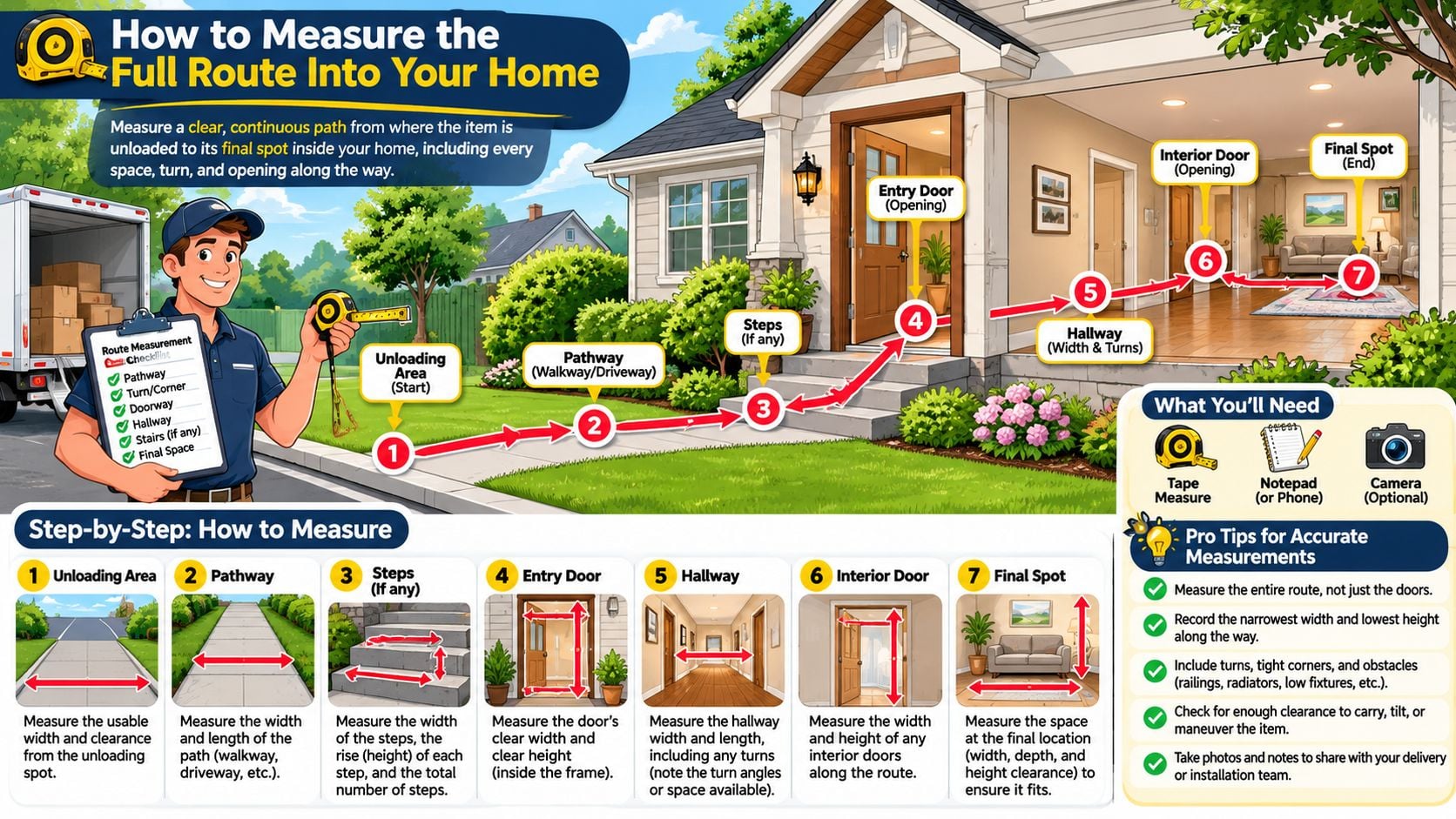
Record the route from pavement to placement
Measure the building entrance. Record the clear opening through lobby doors, along with ramps, steps and overhead obstructions. The useful dimension is the space available with the door open, not the width of its frame.
Check the elevator and booking rules. Measure the cab width, depth, interior height and door opening. In a Toronto condo, a suitable freight elevator still won't solve a missed loading reservation or an inaccessible loading bay.
Map hallways, turns and stair landings. Record the space before and after each corner, including ceiling height where a frame might need tilting. A Hamilton walk-up may offer adequate stair width but insufficient turning room at the landing.
Inspect the room entrance. Include door swing, handles, baseboards, radiators and projecting window trim. In an older Niagara home, those details can make the clear route narrower than the doorway initially suggests.
Tape out the final footprint. Mark the chaise, moving footrests and fully opened sleeper mechanism where relevant. Open nearby cupboards and walk through the room with the outline in place.
Confirm the delivered components. Obtain dimensions for each rigid frame and establish which backs, legs or modules detach. A sectional that separates into substantial sections isn't automatically equivalent to a system of compact individual seats.
For additional illustrations of doorway clearance and turning problems, TLC Moving & Storage's tips for tight Boston apartment moves provide a useful companion to the measurement sketch. The geometry matters more than the city.
Resolve delivery conditions before placing the order
Winter access needs its own conversation. Snowbanks, icy steps and salted walks affect the route, while building move-in windows can restrict when the delivery team may work.
Photographs help explain an obstruction, but they don't replace measurements. The delivery assessment should use the largest non-removable component, including protective packaging where applicable.
Practical rule: A smaller modular sectional can provide more usable seating than a larger fixed sofa that cannot reach its intended position.
The objective isn't just getting furniture indoors. It's getting the chosen arrangement into the position where it functions properly.
Choosing Upholstery That Holds Up to Canadian Households
A swatch that looks perfect in the showroom can fail within a year in a busy family room. Colour says nothing about repeated friction, oily marks, snagging or the cleaning routine a household can realistically maintain. Match the covering to the traffic first, then fall in love with a shade.
Children climbing onto a chaise, pets settling along cushion seams and adults claiming the same favourite seat every evening create far heavier demands than occasional entertaining. Judge every candidate fabric against that reality, not against the quiet afternoon you hope to have.
Two abrasion tests come up constantly in fabric specifications. Wyzenbeek measures back-and-forth friction in double rubs; Martindale reports cycles, and the results aren't directly interchangeable. For a hard-working family room, ask for at least 15,000 Wyzenbeek double rubs on the exact fabric under consideration, and push higher for the seats that take the most abuse.
Compare the covering, not just the category
Upholstery types by durability, care and household fit
| Upholstery | Abrasion benchmark | Care demands | Best for |
|---|---|---|---|
| Tightly woven polyester or performance blend | Request the family-grade Wyzenbeek benchmark above or higher | Spot clean only as permitted by the cleaning code | Families with children or pets |
| Microfibre | Confirm a published rating that meets the family-grade benchmark | Vacuum and use approved spot-cleaning methods | Busy households seeking an easy-care option |
| Top-grain leather | Assess hide quality and finish, not a fabric double-rub comparison | Use approved care products; condition if specified and protect from direct sun | Long-term, heirloom-quality pieces |
| Linen or cotton blend | Request the exact fabric's published test result | Plan for staining exposure and professional cleaning where specified | Low-traffic living rooms |
| Wool or bouclé | Assess the exact weave and published test result | Gentle maintenance or professional cleaning according to the care instructions | Design-led rooms with lighter daily use |
Treat the benchmark as a selection requirement on every purchase. A category label never guarantees the specific fabric on the frame meets it, so when a salesperson says "performance fabric," ask for the test result on that exact covering. The label starts the conversation; the published rating ends it.
Wear concentrates at seat fronts, chaise edges and the cushions beside sectional connections. Strong abrasion scores help under intensive use, yet they say nothing about pilling, seam failure, fading or oil staining, which need their own questions.
Make the maintenance decision honestly
Performance fabrics, tightly woven polyester blends and protected leathers reduce day-to-day maintenance exposure. Texture still decides plenty. An open loop invites snagged claws, while a heavily textured surface traps crumbs more readily than a close weave.
Leather deserves the same scrutiny. A household wanting easy wipe-downs should ask about protected finishes rather than assume every top-grain hide behaves identically. The finish matters as much as the colour.
Before comparing finalists, obtain:
- Test method and rating. Keep Wyzenbeek and Martindale results separate.
- Cleaning code. Establish whether water-based cleaning, solvent cleaning or professional treatment is appropriate.
- Fibre composition. Evaluate the complete blend, not the most attractive fibre name.
- Warranty exclusions. Check staining, pet damage, fading and seam coverage individually.
Critelli Furniture's team can review swatches in person before a custom order is finalised. Its guide to the best fabrics for sofas helps narrow the shortlist before that visit.
The strongest choice is the covering whose care requirements fit the household without wishful thinking.
How to Test Comfort and Reconfiguration Before You Buy
Chaise side, colour and room size receive plenty of attention. Seat height, usable depth, firmness and arm height decide whether someone enjoys sitting there.
A deep, low sectional can be excellent for lounging and frustrating for upright conversation. The right comparison uses the household's normal sitting positions, not a brief showroom pose.
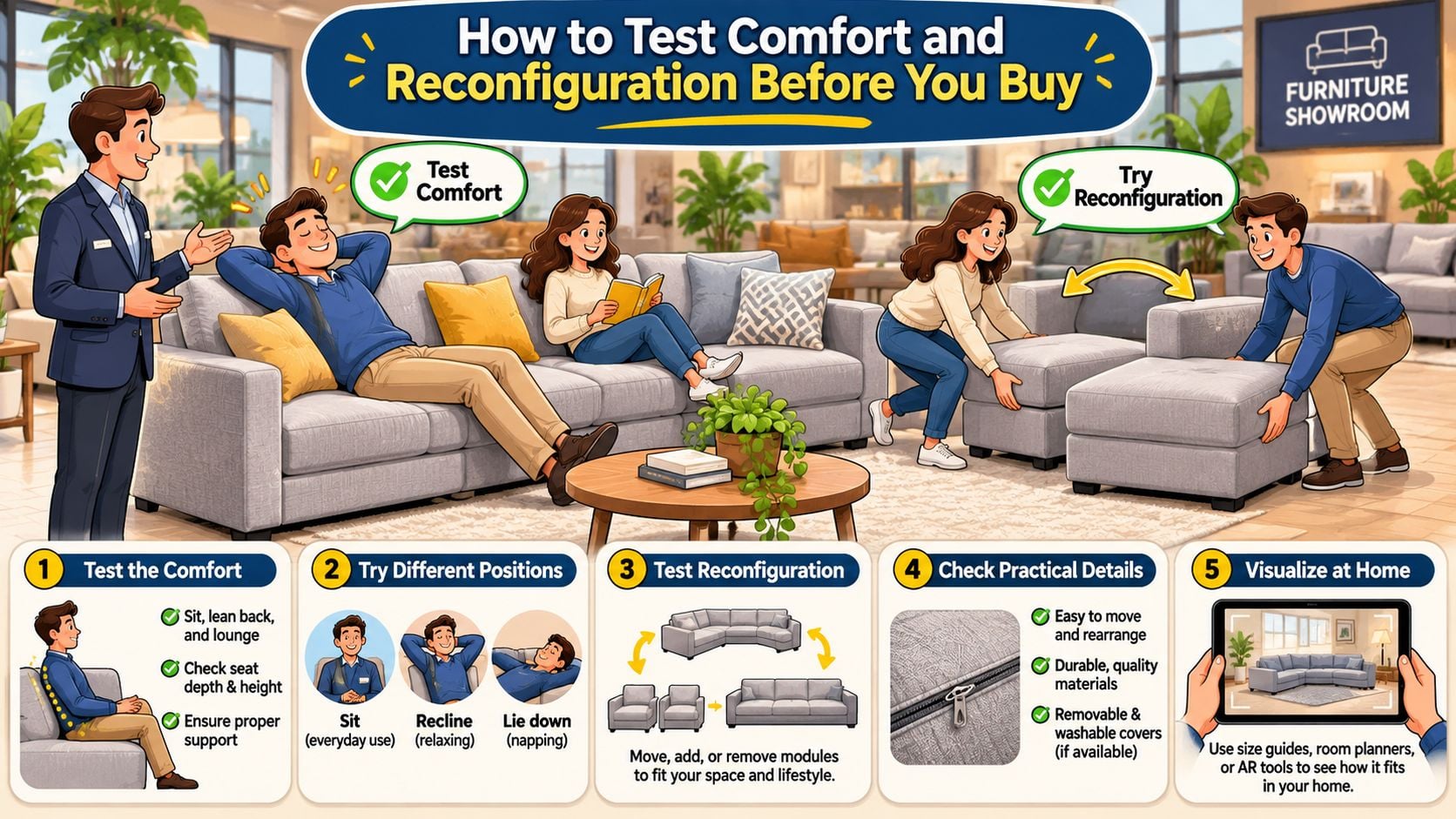
Carry out a proper comfort trial
- Settle into the seat. A deliberate trial of 10–15 minutes gives a better impression of support than a quick perch.
- Assess standing up. If safe and comfortable, try rising without pushing on the arms; anyone needing support should use their usual aid rather than force the test.
- Check foot support. Both feet should rest securely without the seat edge pressing behind the knees.
- Use the chaise naturally. Check whether watching television or speaking to someone requires an awkward twist.
- Operate the recliner completely. Verify moving clearances around walls, tables and the route past the footrest.
- Test another arrangement. Establish whether individual modules can move into useful positions after relocation.
Seat depth should be measured from the front of the cushion to the working face of the back cushion. Critelli Furniture's seat depth measurement guide helps distinguish usable sitting depth from overall furniture depth.
Plan for changing needs
Firmer cushions and a suitable seat height may serve someone better than a soft, low-profile design. Higher legs can assist cleaning access, but leg height alone doesn't establish whether the seat suits its user. Separate seats may also be preferable when household members need substantially different support.
Power reclining, including an appropriate option from a range such as Stressless, deserves comparison when controlled adjustment is useful. The person using it should operate the controls and assess the full movement themselves.
Accessibility Standards Canada's report records the start of public review of a national accessible programs and services standard in February 2025. It isn't a sectional-specific requirement, but it reinforces the importance of discussing mobility needs during furniture service.
More seats aren't better value if the household cannot use them comfortably.
Repairable components, accessible controls and useful alternative arrangements deserve more weight than maximum seating count.
Safety Labels, Warranties and Total Landed Cost
The label check is essential. Frame strength matters, but it isn't the whole safety assessment.
The Competition Bureau's federal upholstered-furniture labelling guidance covers upholstered domestic seating, including sectional items and their parts, and identifies UFAC as a voluntary flammability program. Modular construction doesn't place a product outside that framework, and voluntary program participation shouldn't be confused with a blanket government safety approval.
Check the exact configuration
The documentation should identify the model's Canadian label, covering and foam information. For a bespoke order, confirmation should reflect the selected fabric, cushioning and reclining hardware rather than merely the base collection.
A sectional may combine stationary seats, moving mechanisms and detachable components. The written specification should make clear which configuration has been evaluated under the applicable manufacturer or industry program.
The same precision belongs in the warranty. Frame, cushions, upholstery, motors and labour may have different terms; a broad warranty headline isn't enough.
Cost items to confirm before paying
| Cost item | Often left out of advertised price | Question to ask before paying |
|---|---|---|
| Delivery and freight | Yes, in many quotes | Is delivery to the intended floor included, and are there stair or elevator fees? |
| Custom fabric or leather upgrade | Yes | Does the quoted price include the upgrade for this exact configuration? |
| Assembly and packaging removal | Sometimes | Are placement, assembly and packaging removal included? |
| Return or adjustment terms | Sometimes | What time limit, charges and conditions apply? |
| Extended warranty | Optional | Which parts, fabrics and mechanisms are excluded? |
These are quote-checking prompts, not reasons to assume a particular charge applies. Every item should be either included, priced separately or expressly excluded before a deposit is paid.
Compare complete quotes
Critelli Furniture's White-Glove Delivery Service includes inspection, assembly, placement and packaging removal. That makes the transition from showroom to home a defined service rather than an unspecified doorstep delivery.
National price movements don't determine the final invoice. Statistics Canada reported that upholstered-furniture prices fell 0.9% in 2025, while wooden furniture rose 2.6% and other furniture, including mattresses, rose 1.6%.
A sectional's total landed cost can move differently because fabric, leather, customisation, freight and delivery change separately. Compare identical specifications and service levels, including applicable taxes, rather than comparing an advertised starting price with a fully configured quotation.
Written return terms matter especially for custom work. The buyer should know whether an adjustment is possible and who pays for transport before accepting the order.
Designing the Room Around Your Sectional
A sectional earns its footprint by anchoring a complete room concept. Its height, visual weight and orientation shape the space as much as its measurements, so the pieces around it deserve the same planning the seating received. By this stage the chaise side and configuration should already be settled by the access route and the comfort trial; what remains is how the piece sits visually.
The Critelli Design Studio approach connects space planning with bespoke fabric and leather selection. An in-home consultation adds what a showroom visit cannot: the actual conditions the sectional will live with every day.
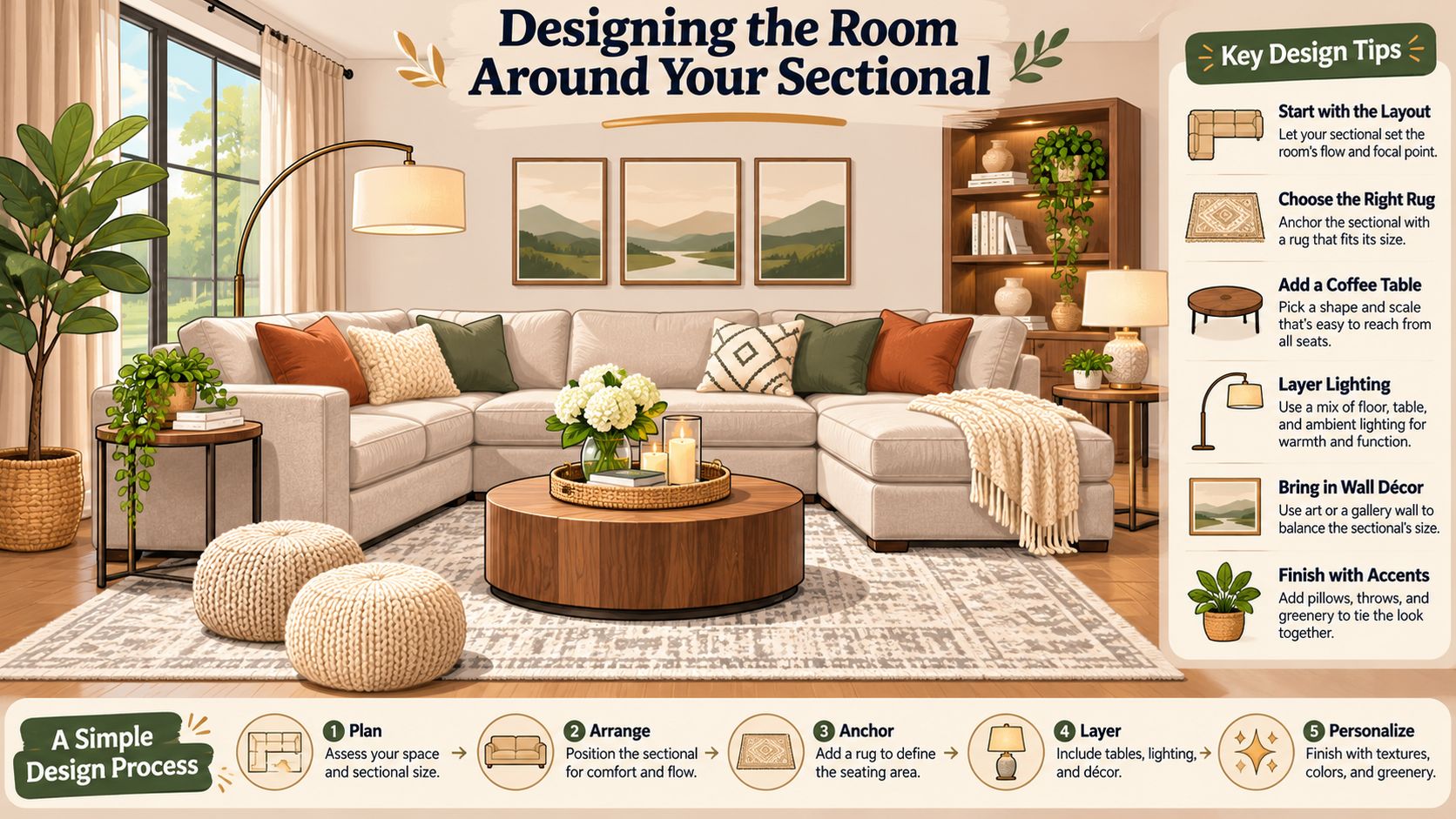
Begin with the room's foundation
A rug is art for your floor. It establishes colour, texture and scale before smaller decorative decisions compete for attention.
Critelli's Rug Market sources hand-knotted, artisanal rugs from across the globe, treating each one as the foundation on which a room's palette and character are built. Starting there is a more deliberate move than choosing a rug merely to fill the space beneath a table.
A neutral wool rug can give bold leather room to stand out without making the entire interior feel forceful. A patterned rug can instead supply the palette, with upholstery taking a quieter supporting role.
Designer's Insight: Pairing a bold Hancock & Moore leather with a neutral hand-knotted wool rug balances the room's energy while allowing the material and craftsmanship to remain visible.
Connect the seating to its surroundings
Take a Southern Ontario condo with an open living-and-dining area. The rug defines the conversation zone, while the sectional's back establishes a boundary without introducing another wall. The arrangement still needs a landing spot for lighting, drinks and everyday storage, and a large chaise shouldn't push every other piece onto the remaining strip of floor. A modular sectional that lets the chaise switch sides gives the same footprint a second layout.
Critelli Furniture's rug placement guidance for sectionals helps connect rug position with seating geometry. For rooms with exposed timber flooring, Savera Wood Floor Refinishing's guidance on decorating with hardwood floors adds useful context for coordinating wood tones and furnishings.
A design-forward room doesn't require every surface to match. It needs a deliberate relationship between warm and cool tones, smooth and textured materials, and substantial and lighter-looking forms.
The same Design Studio process is available to homeowners across Greater Niagara, Hamilton and Toronto. Done well, the room reads as a single composition, with each piece working rather than competing for attention.
Book Your Design Consultation Before You Order
Critelli Furniture has served Southern Ontario since 1914, a family-run business now past its first century. That continuity matters when a purchase depends on judgement, service and a relationship that outlasts delivery day. Judge the sectional the same way: by how it is built, how it sits and whether it suits your household.
Arrive with a useful starting point
A consultation becomes far more productive when you bring a floor plan, route measurements, photographs and notes from your comfort trial. Critelli Furniture's complimentary interior design consultation gives those decisions a proper review, from doorway clearance and stairwell turns to fabric, configuration and how the piece might be rearranged later.
- King Street showroom. Critelli Furniture is at 126 King Street, St. Catharines, Ontario, L2R 3J1, with free parking and telephone 905.684.8108.
- Contemporary destination. Critelli Modern is at 169 St. Paul Street, St. Catharines, reachable at 905.682.7600.
- Design support. Professional space planning, custom-order guidance and in-home consultations turn your measurements into a workable plan.
Whether the search began with luxury furniture in Niagara, interior design in St. Catharines or a hand-knotted rug for an Ontario home, the useful next step is an unhurried conversation about the actual rooms.
Experience the craftsmanship in person at the King Street showroom. Book your complimentary design consultation today, and visit the Rug Market to find your room's foundation.
Critelli Furniture pairs personalised space planning, custom-order guidance and white-glove delivery so a sectional works from the first measurement through final placement. Visit Critelli Furniture with room photographs and a floor sketch to begin a considered selection for the whole room.