
Best Ergonomic Office Chairs Canada: 2026 Buyer’s Guide

A great many Canadian home offices begin with a compromise. A handsome dining chair is pulled into service. A spare bedroom gains a desk but not proper support. A stylish room comes together, yet the chair at its centre feels temporary, technical, or wrong for the way the space is used each day.
That tension is familiar across Southern Ontario, from city homes in Toronto to quieter studies in Hamilton and the Greater Niagara region. The room needs to work hard, but it also needs to belong to the home. For design-conscious homeowners, the search for ergonomic office chairs in Canada isn't only about avoiding discomfort. It's about finding a chair with lasting support, measured fit, and enough visual integrity to sit confidently among well-made furnishings.
A family-run furnishings firm founded in 1914 understands that distinction well. A chair chosen for daily work shouldn't look like an afterthought beside custom millwork, a custom-made desk, or a hand-knotted rug. It should feel considered. It should support the body properly, and it should also contribute to a complete room concept that will still feel relevant years from now.
Table of Contents
- The Modern Home Office Deserves More Than an Afterthought
- What Makes an Office Chair Truly Ergonomic
- A Bespoke Approach to Seating
- Understanding Value from Entry-Level to Heirloom Quality
- Designing Your Home Office Around Your Chair
- Purchasing and Delivery in Southern Ontario
- Preserving Timeless Craftsmanship
The Modern Home Office Deserves More Than an Afterthought
A professional may spend months refining a home office. The wall colour is considered. Lighting is corrected. The desk is chosen with care. Then the chair arrives as a rushed online purchase, or worse, a dining chair remains in place far longer than intended.
When a temporary chair becomes a daily problem

That decision tends to show itself quickly. The shoulders lift because the arms have nowhere to rest. The lower back tires by mid-afternoon. The room looks composed, but the person working in it keeps shifting, perching, and leaving the desk more fatigued than the work alone should cause.
Canadian workplace sources cited by OfficeSeating.ca's ergonomic chair FAQ report a 25% increase in productivity from ergonomic solutions and a 64% decrease in musculoskeletal disorders after workplace ergonomic interventions. Even allowing for the commercial nature of the page, the point is useful. A proper chair changes more than comfort. It can alter how a workday feels and how consistently a person can perform.
Practical rule: If a chair forces constant fidgeting, the body is already telling the buyer that the fit is off.
For remote professionals trying to support better movement habits through the day, posture and activity often go hand in hand. Thoughtful routines, standing breaks, and strategies to increase activity during remote jobs can complement a better seating setup, but they don't replace the need for a chair that fits properly.
Why this purchase deserves design-level attention
An ergonomic chair shouldn't be treated as a medical appliance dropped into an otherwise refined room. In a well-resolved office, it becomes part of the architecture of daily life. It sits beside the desk, faces the doorway, catches the light, and often remains visible from adjacent rooms. Its scale, silhouette, and material matter.
That's why discerning buyers often do better when they choose the chair and desk together, rather than separately. A desk with visual warmth and refined detailing, such as the Olisa Rope Desk, creates a more coherent starting point for the full office arrangement.
For a multi-generational design firm serving Southern Ontario homes since 1914, this isn't a new lesson. The best rooms aren't assembled by category. They're curated as a whole. An office chair should support the body with precision, but it should also hold its own as a piece of furniture with presence, proportion, and timeless craftsmanship.
What Makes an Office Chair Truly Ergonomic
The word “ergonomic” gets used loosely. In practice, it has a much narrower meaning. A chair is ergonomic when it can be adjusted to suit the person using it and the work being done in it.
Fit comes before features
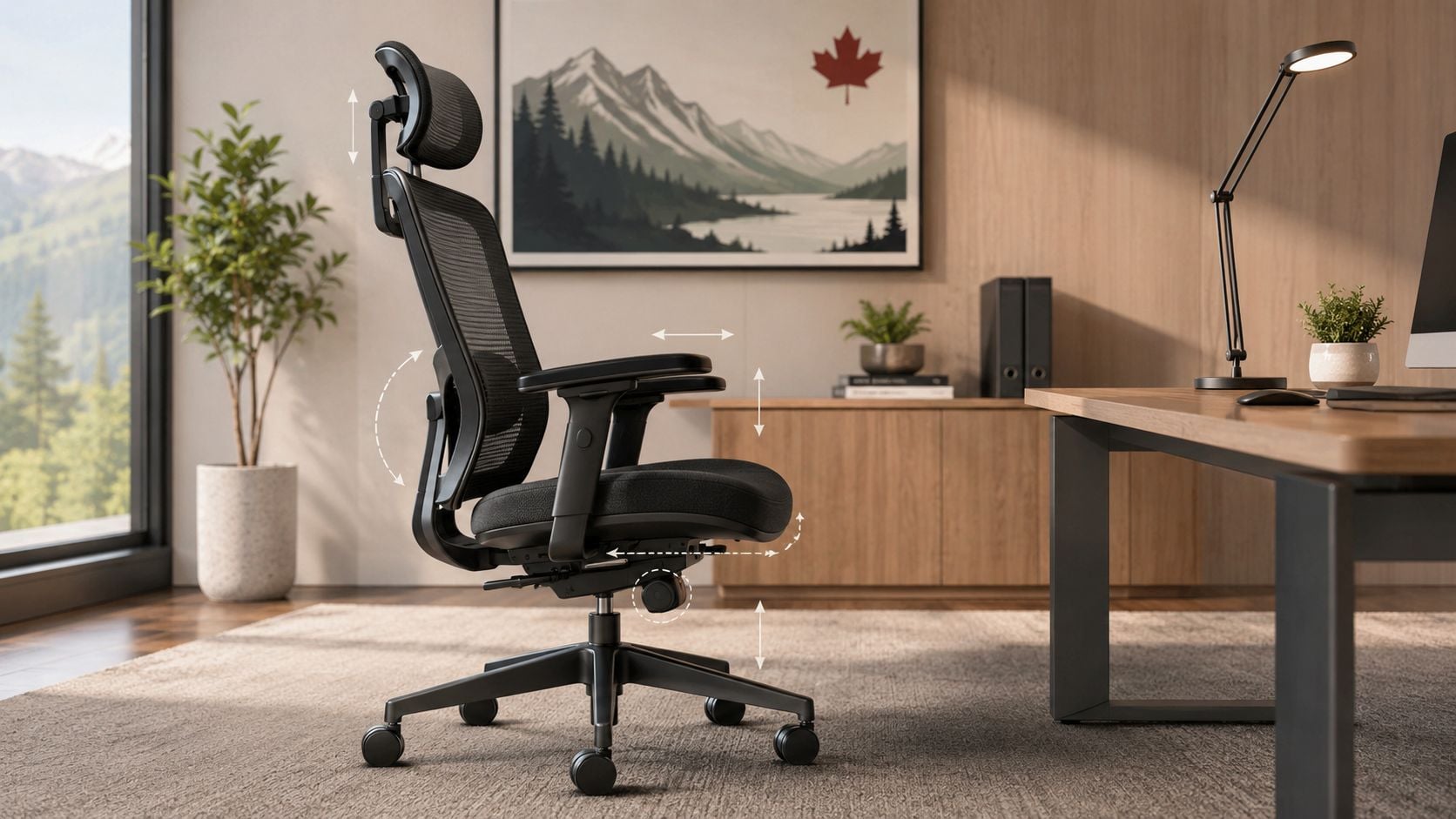
The clearest Canadian benchmark comes from the Canadian Centre for Occupational Health and Safety guidance on office chairs. CCOHS states that the optimal seat height is about one-quarter of the user's body height, that seat height should be adjustable, and that selection should be based on the worker's body dimensions because one chair doesn't fit everyone.
That principle matters more than any single feature list. A chair can have lumbar support, a polished base, and a sleek profile, yet still fail if the user can't plant the feet comfortably or reach the armrests without lifting the shoulders.
The most persuasive ergonomic feature is adjustability that the user will actually use from a seated position.
A well-chosen desk also helps those adjustments perform properly. A writing desk with clean lines and practical scale, such as the Electra Writing Desk with 2 Drawers, often pairs well with a more adjustable task chair because it keeps the working surface visually light and physically accessible.
The adjustments that matter in daily use
Several functions deserve close attention during a trial sit.
- Seat height adjustment matters first. If the seat is too high, pressure builds under the thighs. If it's too low, the hips and knees may fall into an awkward relationship with the desk.
- Back support should meet the curve of the lower back where support is needed, not where the chair happens to place it.
- Armrest adjustment helps the upper body settle. Properly positioned armrests can reduce the habit of reaching upward or inward with the shoulders.
- Chair controls should be easy to reach and simple enough to encourage regular use. If a mechanism is confusing, many users stop adjusting it altogether.
Buyers often focus heavily on whether a chair looks soft or firm. That's understandable, but it isn't the central question. The better question is whether the chair allows neutral working posture without strain.
A good ergonomic chair feels less dramatic than many expect. It doesn't force the body into stiffness. It supports the body so subtly that concentration can return to the task at hand.
A Bespoke Approach to Seating
An heirloom-quality chair still has to fit the person sitting in it. That's why the most reliable buying process begins with a personal fit profile rather than a list of brand claims or fashionable features.
Build a personal fit profile
Canadian ergonomic standards compiled by EWI Works in its chair standards overview specify that the seat pan width should be at least 48.8 cm (19.2 in.) and that the torso-to-thigh angle should be no less than 90° to reduce spinal loading and pressure. Those two measurements remind buyers that comfort has physical dimensions. It isn't guesswork.
A practical self-assessment can be done in a few minutes:
- Measure seated lower-leg height. Sit with feet flat and measure from floor to the underside of the thigh behind the knee. This helps identify whether a chair's seat-height range is likely to work.
- Measure buttock-to-knee length. Sit back in a firm chair and measure from the back of the body to the back of the knee. This gives a useful reference for seat depth.
- Notice shoulder position at the desk. If the shoulders rise while typing, the current armrest or desk relationship is probably wrong.
- Observe clothing bulk. In Canadian homes, heavier knitwear and winter layers can change how far back a person sits and how the backrest meets the spine.
Buyers often ask whether lumbar support is enough. It isn't. Seat depth, width, angle, and arm position often decide whether lumbar support can do its job at all.
For clients who also want a chair that can move between office and living areas, a piece such as the Harper Swivel Chair can be useful to study from a design standpoint. It shows how a swivel form can feel residential rather than overtly corporate, even though a dedicated task chair will usually offer more precise ergonomic adjustment.
Match the chair to the workday
The right fit profile also depends on behaviour, not only anatomy.
A person doing concentrated desk work for long stretches usually benefits from more exact adjustment and a backrest that encourages stable, upright support. Someone whose day includes frequent calls, reading, and movement around the room may prefer a chair that transitions more easily between tasking and relaxed perching.
A useful way to think about this is to define the chair's primary role:
- Focused task chair for long keyboard sessions
- Hybrid office chair for mixed computer work and calls
- Design-led occasional work chair for shorter sessions in a study or library
Winter climate adds another layer. Thick sweaters, structured jackets, and denser fabrics can subtly change posture and contact points. A chair that feels excellent in a summer fitting can feel narrower or more forward in colder months. That's one reason bespoke selection matters so much in the Canadian context.
The best buyers don't ask, “What's the best chair?” They ask, “What chair fits this body, this desk, this wardrobe, and this work pattern?” That question produces better results every time.
Understanding Value from Entry-Level to Heirloom Quality
Price alone doesn't explain value in ergonomic office chairs in Canada. Two chairs may look similar in a photograph and perform very differently over time because of differences in mechanism quality, upholstery, adjustability, and how gracefully they age in a home.
What changes as quality rises
At the accessible end of the market, a chair may solve immediate problems. It can offer basic support, a cleaner working posture, and a reasonable starting point. What it often lacks is refinement. Controls may feel coarse, foam may compress more quickly, and materials may read as office equipment rather than furniture.
Performance-tier chairs generally improve the mechanics. Adjustments are smoother, body contact points are better considered, and the chair tends to adapt to more users and more working styles. This is often the tier where serious home offices begin to feel resolved.
Heirloom-quality seating adds another dimension. The gain isn't only functional. It appears in stitch quality, tailoring, material depth, quieter movement, and a silhouette that belongs in a finely furnished room. These are the chairs that don't need to be hidden when the workday ends.
A chair becomes expensive in the wrong way when it has to be replaced long before the room around it.
Ergonomic Chair Tiers at a Glance
| Tier | Typical Price Range (CAD) | Key Features | Materials & Longevity |
|---|---|---|---|
| Functional | Varies | Basic seat-height adjustment, simple back support, standard mobility | Practical materials, suitable for shorter-term or lighter-duty use |
| Performance | Varies | More refined adjustability, stronger task support, better body fit options | Improved upholstery and mechanisms, built for sustained daily use |
| Heirloom quality | Varies | Design-forward engineering, tailored comfort, room-worthy aesthetics | Premium materials, timeless craftsmanship, intended for long service life |
The “right” tier depends on how often the chair will be used, how visible it is within the home, and whether the buyer wants a temporary fix or a long-term furnishing. In a dedicated study with custom shelving, a fine rug, and a desk selected with care, a disposable chair usually looks out of place long before it physically fails.
That's why many design-minded households treat the office chair as they would a dining chair or lounge chair. They assess comfort, yes, but also joinery, finish, line, and whether the piece will still look appropriate as the room evolves.
Designing Your Home Office Around Your Chair
A high-performance chair doesn't have to interrupt the room. In the best offices, it becomes the visual anchor that helps every other decision feel more intentional.
Let the chair anchor the room
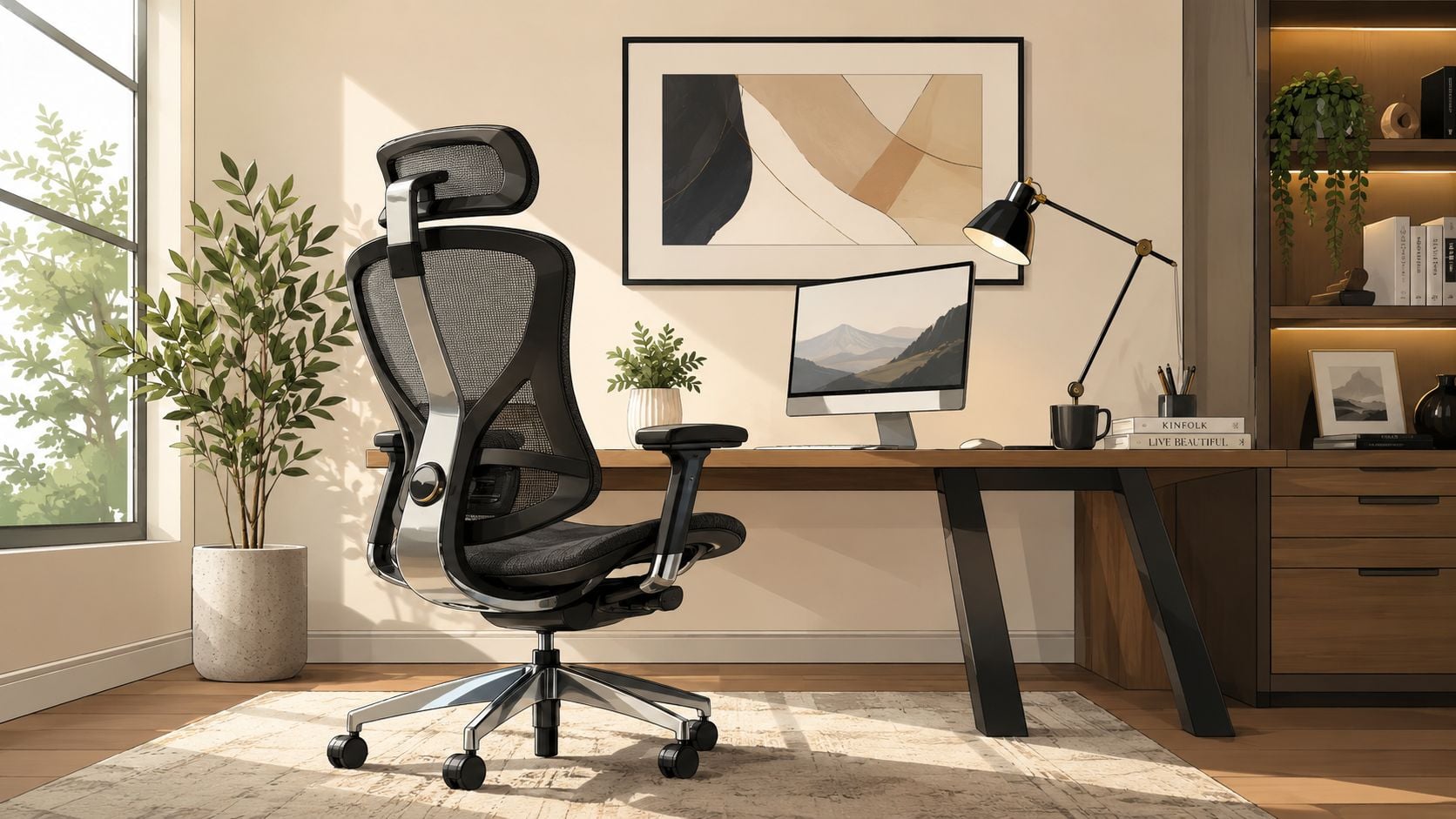
Many home offices fail aesthetically because every piece is chosen in isolation. The desk comes from one visual language, the chair from another, and the storage from a third. The result is workable, but never settled.
A stronger approach begins with proportion and sightlines. If the chair is the largest moving object in the room, it will command attention. That means its profile should relate to the desk, the shelving, and the rug underfoot. Buyers planning a new office often find it helpful to sketch furniture placement before ordering. Simple home office layout tips can help clarify circulation, chair clearance, and how the workspace will feel from the doorway.
Storage matters as well. An open piece such as the Olisa Rope Etagere can soften the technical nature of an office by introducing texture, display, and vertical rhythm around the chair and desk.
Materials, colour, and visual balance
Material choice changes the entire mood of the room. Mesh tends to feel lighter and more architectural. Upholstered seating reads warmer and more residential. Leather can bridge the office and library beautifully when the rest of the room supports that depth and formality.
A few pairing principles work especially well:
- Warm wood with tailored upholstery gives a study a grounded, collected feel.
- Sculptural modern desks with lighter chair frames keep a compact office from feeling heavy.
- Deeper chair colours can provide welcome visual weight in rooms with pale walls and generous daylight.
Designer's Insight
A bold ergonomic chair often looks most sophisticated when the rest of the room is edited rather than busy. A neutral hand-knotted wool rug can act as Art for your Floor, steadying the composition and allowing the chair's form to read as intentional rather than dominant.
Applying a design studio mindset proves valuable. The chair isn't a standalone object. It participates in a complete room concept that includes scale, palette, floor covering, storage, task lighting, and what the room says when no one is working in it. Buyers who approach the office this way usually end up with a space that feels both organised and personal.
Purchasing and Delivery in Southern Ontario
Buying a premium chair online can seem efficient until the practical complications appear. Shipping terms are often difficult to parse. Returns can become cumbersome. A chair that looked appropriately scaled on a screen may feel entirely different in a real room.
Why local fit matters
One of the most overlooked Canadian concerns is physical fit in real conditions. As noted in Simplova's discussion of ergonomic office chair fit, guidance tied to Health Canada emphasises seat height, backrest support, armrest position, and a footrest when needed, and it highlights a point many online guides miss. Chairs need to accommodate Canadian body types and even winter clothing, which makes in-person testing especially valuable.
That's a practical reason to sit in several chairs before committing. Buyers can feel whether the backrest meets the body properly, whether the armrests interfere with the desk, and whether the seat still feels right when wearing heavier seasonal clothing.
A smoother path from showroom to home

For homeowners in St. Catharines, across Greater Niagara, and into the Hamilton and Toronto markets, local purchasing also simplifies the last mile. It's easier to coordinate delivery windows, inspect workmanship, and ensure the chair enters the room without damage or assembly confusion.
This is where white-glove service matters. Rather than leaving a large carton at the door, a properly managed delivery includes careful handling, placement, and packaging removal so the office is ready to use. For buyers exploring options across categories, the broader furniture collection at Critelli Furniture also helps place the chair within a larger furnishing plan instead of treating it as an isolated transaction.
A refined purchase should feel smooth from showroom to home. That expectation isn't indulgent. It's appropriate when the chair is meant to support daily life and remain part of the household for years.
Preserving Timeless Craftsmanship
A well-made ergonomic chair rewards basic care. The goal isn't elaborate maintenance. It's consistency.
A simple care routine
Use a soft cloth for regular dusting, especially around adjustment controls and the base where debris can collect. Upholstered surfaces should be cleaned according to their material, with leather conditioned appropriately and performance fabrics treated gently rather than aggressively scrubbed.
A few seasonal checks help preserve both comfort and appearance:
- Inspect moving parts for looseness, unusual resistance, or noise.
- Clean casters so hair and dust don't affect smooth movement.
- Review adjustments every few months, especially if the user's desk setup has changed.
- Protect finishes by keeping the chair clear of direct, prolonged sun where possible.
A chair chosen for heirloom quality should age with dignity. Good care protects the mechanism, the tailoring, and the beauty that made it worth selecting in the first place.
For homeowners seeking ergonomic office chairs in Canada that combine measured support with timeless craftsmanship, Critelli Furniture offers a setting where the chair can be considered as part of a complete room concept. Experience the craftsmanship in person at the King Street Showroom, book your complimentary design consultation today, or visit the Rug Market to find your room's foundation.