
Wall Sconce for Living Room: Designer Lighting Ideas


A living room can be beautifully furnished and still feel unfinished. The sofa is right, the rug has presence, the tables are well chosen, yet the room falls flat in the evening because the lighting is doing too little or doing the wrong thing. That's usually the moment homeowners start looking for a wall sconce for living room use, not as a decorative extra, but as the missing layer that makes the room feel composed.
In Southern Ontario homes, that decision rarely stands alone. A sconce has to work with ceiling height, fireplace details, furniture placement, and the way the room is used on a winter evening. In a family-run design practice with roots going back to 1914, that's never treated as a minor detail. Lighting belongs to the whole composition. It should support comfort, flatter materials, and help the room feel settled rather than staged.
Table of Contents
- The Art of Layered Illumination
- Curating Your Selection
- The Blueprint for Precision Placement
- Illumination and Intelligent Control
- The Complete Room Concept
- Ensuring Timeless Craftsmanship
The Art of Layered Illumination
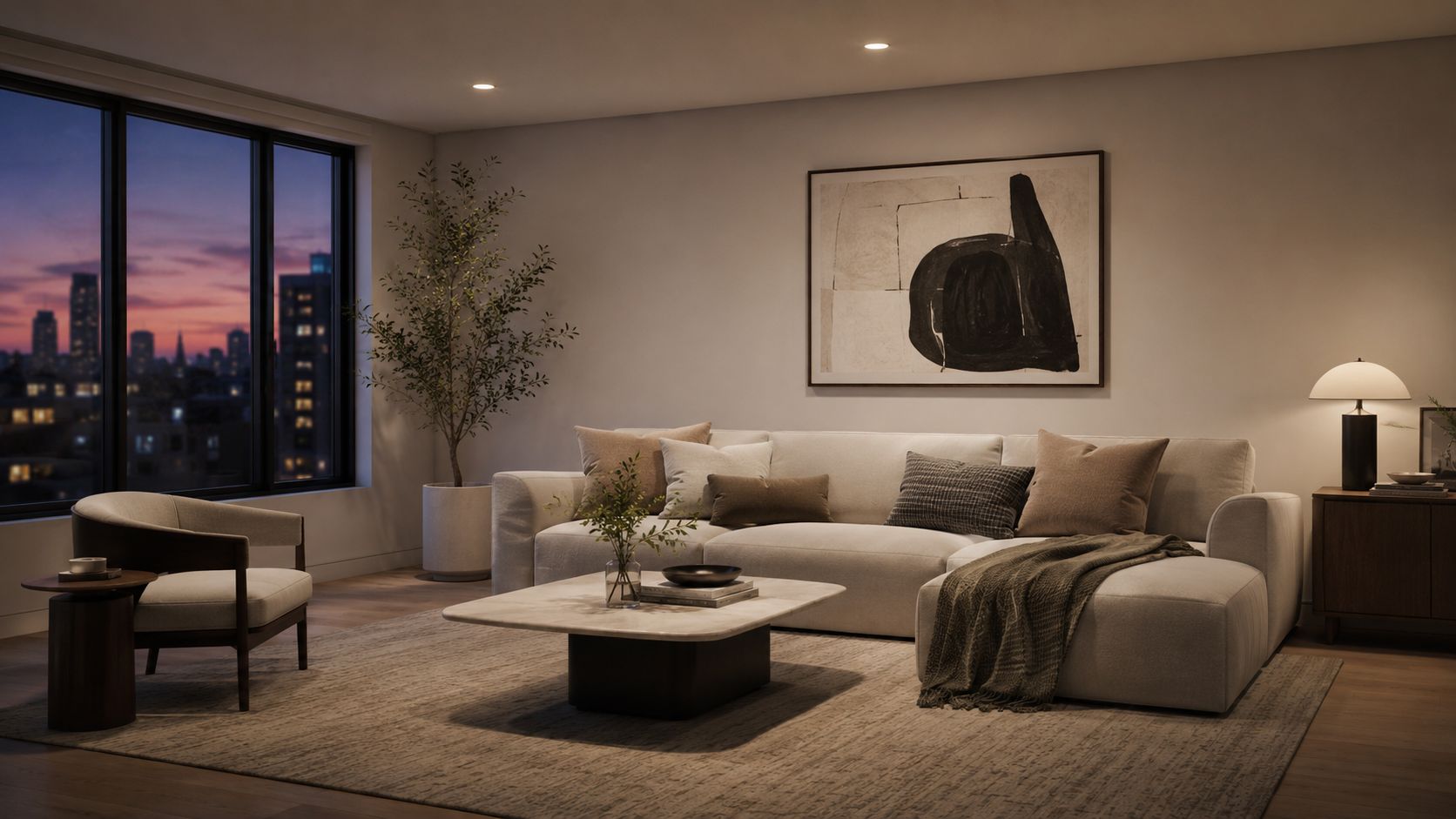
At 7 p.m. in January, a Southern Ontario living room has to work hard. Daylight is gone early, family gathers in one space, and a single ceiling fixture flattens everything you paid attention to. The sofa looks dull, the rug loses pattern, and the room feels smaller than it is.
A well-designed living room needs light in layers. A wall sconce for living room planning brings illumination down from the ceiling and out toward the walls, where it can shape the room properly. That shift matters in open-plan homes across Niagara, Hamilton, and the GTA, where one living room often handles conversation, reading, television, and quiet evening use in the same space.
Why overhead light isn't enough
A central fixture provides coverage. It does not provide atmosphere, depth, or balance.
Light from above alone leaves too much of the room visually unresolved after sunset. Upholstery reads flatter. Casegoods lose their grain and profile. Art disappears into shadow unless you are standing directly under the fixture. If you want a room to feel composed at night, you need light at eye level and below it, not only overhead.
That is why sconces belong in the room plan from the start, not as an afterthought once the sofa is in place. They should answer to the seating layout, the wall architecture, and the size of the rug beneath the conversation area. A proper lighting plan supports the same goal as good furniture planning. It gives the room order, comfort, and permanence. Critelli's perspective on putting a living room in its best light reflects that whole-room approach well.
Fine rooms earn their character at night.
Where sconces change the mood
Sconces are at their best where the room needs softness and definition at the same time. On a long wall, they create rhythm. Beside a fireplace, they add formality and focus. Near a seating group, they make the arrangement feel deliberate instead of loosely assembled.
They also correct a common design mistake. Homeowners often choose handsome furniture and a strong rug, then rely on one pot light pattern or a single pendant to do all the work. The result is a room with good ingredients and poor evening presence. Sconces tie those elements together by lighting the vertical surfaces around them, which makes the furniture grouping feel grounded and the room feel finished.
If you are trying to keep visual continuity between adjoining spaces, study the character of the fixtures, not just their finish. The same principle applies across the home, and innovative kitchen lighting designs can offer a useful point of comparison for maintaining a consistent lighting language from one zone to the next.
In heritage-minded interiors, this matters even more. Many Southern Ontario homes have good proportions but limited architectural detail on the walls themselves. Sconces add that missing layer. They bring ceremony to plain drywall, strengthen symmetry where you have it, and give a living room the settled, heirloom quality that never comes from overhead lighting alone.
Curating Your Selection
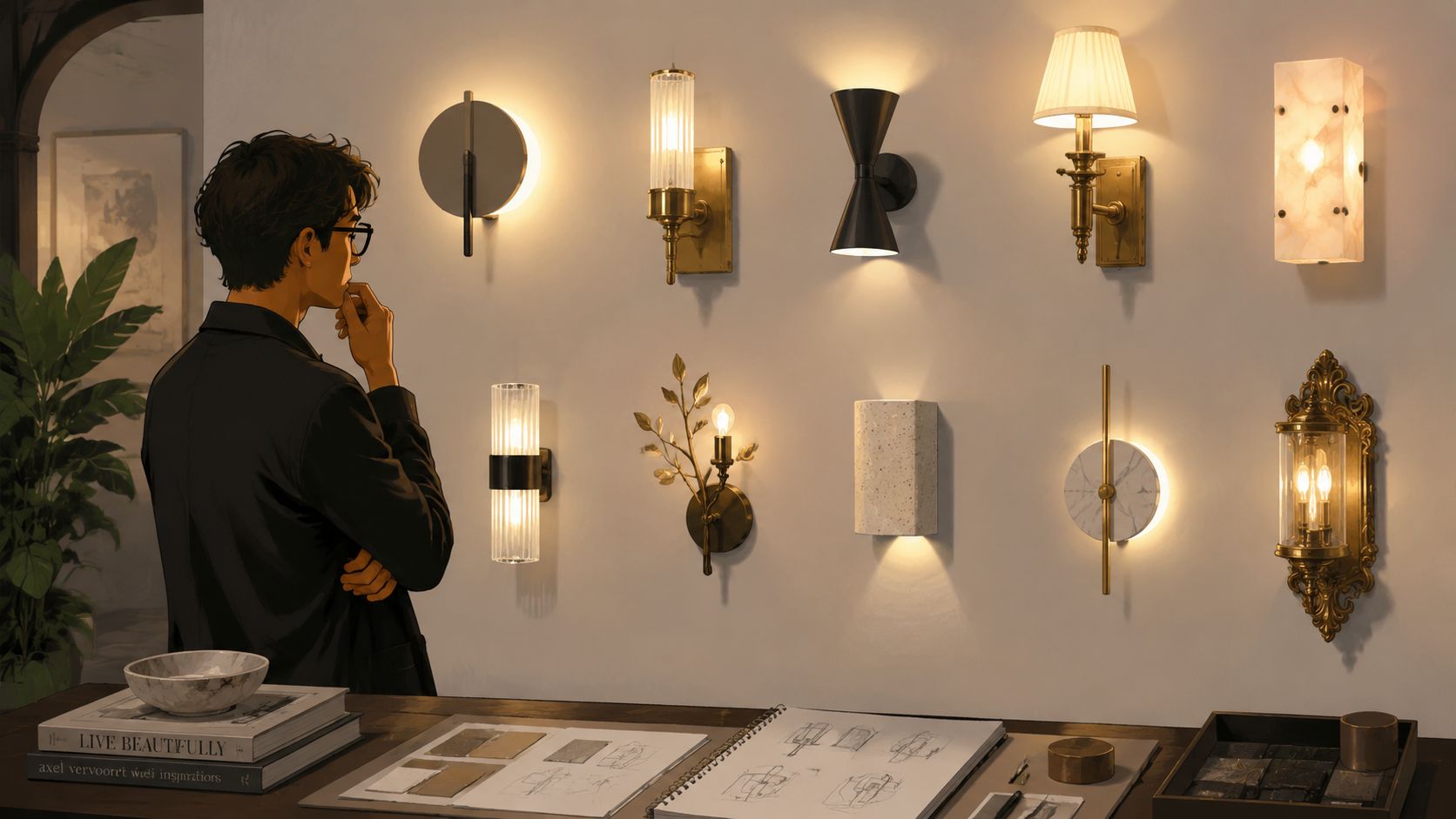
Choosing a wall sconce for living room use should feel less like shopping for hardware and more like selecting art. The fixture is visible at eye level. It contributes line, finish, silhouette, and mood. If it's wrong, the whole wall feels unresolved.
Choose the style before the finish
Most homeowners reverse the order. They start by asking whether they want brass, black, or bronze. That's too late in the process. The first question is stylistic character.
A classic room usually benefits from a sconce with gentler curves, a well-proportioned backplate, or a more traditional shade profile. A transitional room can handle cleaner geometry with a softened finish. A contemporary room usually wants a stricter silhouette and less ornament. The finish matters, but the form decides whether the fixture belongs.
A useful reference point for fixture types is this wall light collection, which shows how different sconce profiles shift the tone of a room even before finish and bulb selection enter the conversation.
Get the scale right
Scale is where most mistakes happen. A fixture that's too small looks apologetic. One that's too large overwhelms the wall and competes with furnishings.
A reliable rule is to choose a wall sconce whose height is about 1/4 to 1/3 of the wall height, which works out to roughly 15 to 20 inches for a standard 8-foot ceiling, according to this sizing guidance for modern wall sconces. That proportion gives the fixture enough presence without making the wall feel top-heavy.
Practical rule: If the sconce looks substantial on a sample board but timid on the actual wall, it's too small for the room.
This is also where visual weight matters more than dimensions alone. A slender metal arm with an airy shade reads lighter than a solid sculptural fixture of the same height. A compact room with delicate architecture usually needs restraint. A larger living room with a deep sofa, broad mantel, or strong millwork needs a fixture that can hold its own.
Think in visual weight, not trend
The right sconce should support the room's permanent elements. It should echo, not interrupt.
A few direct recommendations help:
- For rooms with traditional wood furniture: choose finishes and forms that respect craftsmanship. Patinated metals and fitted shades tend to age better than novelty shapes.
- For rooms with low visual contrast: use the sconce to add definition. A darker finish can sharpen a pale wall and stop the room from drifting into sameness.
- For compact spaces: slimmer profiles are usually the wiser choice. They keep the wall elegant and avoid crowding beside seating or case pieces.
- For statement walls: don't let the fixture fight the artwork, stone, or moulding. It should frame the composition, not dominate it.
A design-forward home doesn't need trend pieces on every wall. It needs fixtures that look settled. That is the difference between a room that feels current for a season and one built around heirloom quality decisions.
The Blueprint for Precision Placement

You sit on the sofa, the rug is down, the coffee table is centred, and the sconces still feel wrong. That usually comes down to placement, not fixture choice. A well-made sconce can look amateur the moment it ignores the furniture line, the mantel height, or the way the room is used.
Start with seated experience. In a living room, the fixture should relate to the people in the room and the furnishings beneath it. Mounting too high leaves the light stranded in empty wall space. Mounting too low pushes brightness into the eyes and makes the wall feel crowded.
A reliable rule is simple. Keep the sconce near eye level when seated, then adjust for the architecture around it. If there is a sofa, console, fireplace, or panel moulding below, the fixture should feel tied to that composition. It should never float as if it were added after the room was finished.
Place sconces in relation to the room plan
Good placement starts on the floor plan before it reaches the wall. The sconce has to make sense beside the seating group, the rug boundary, and the focal point. If the furniture arrangement is weak, the lighting will look weak too. Homeowners refining both at once should review this guide to arranging living room furniture so the sconces support circulation, sightlines, and the main conversation area.
That matters in Southern Ontario homes, especially older properties with mixed ceiling heights, original trim, deeper mantel shelves, and rooms that were never wired for layered lighting. Placement has to respect what the house already gives you.
Use spacing and clearance with discipline
Multiple sconces should read as part of one measured composition. Leave enough distance between fixtures for the wall to breathe and for the light to spread evenly. Crowding them creates visual noise. Spacing them too far apart makes each one feel isolated.
Clearance matters just as much. Keep sconces away from door casings and window trim so the wall does not feel pinched. When you are framing a fireplace, artwork, or built-in, give the feature enough room to remain the star. The fixture should support the focal point, not press against it. General placement guidance in this room-by-room sconce guide reflects the same principle.
The wall is only one part of the decision. The full room composition decides the final height and spacing.
Designers Insight
Designer's Insight
Tape the fixture outline on the wall before wiring is finalized. Then sit down, stand up, and view it from the entry, the sofa, and the adjoining room. If it only looks right from one angle, it is not placed correctly.
Do that before the electrician arrives for final installation. It is one of the easiest ways to avoid expensive corrections. For hardwired fixtures, proper planning and clean execution matter, and homeowners comparing installation approaches may find expert electrical lighting solutions useful as a general reference.
Illumination and Intelligent Control
A living room can have the right sofa, the right rug, and well-placed sconces, then still feel flat at night. Control is usually the reason. If the fixture cannot dim properly, if the bulb throws the wrong colour, or if the switching is awkward, the whole room loses its composure.
Hardwired or plug-in
Choose hardwired sconces for a principal living room whenever the room is meant to feel permanent. They read as part of the architecture, they keep the wall clean, and they support a furniture plan that has been carefully resolved. In a formal room with a properly scaled rug, anchored seating, and balanced casegoods, exposed cords usually weaken the effect.
Plug-in sconces still earn their place. They suit older Southern Ontario homes with plaster walls, finished millwork, or renovation limits that do not justify opening the wall. Use them in secondary seating areas, reading corners, or rooms that are still evolving. Hide the cord with intention. If you can see it first, the installation is unfinished.
The right choice depends on the room's long-term plan, not just the fixture.
Choose light that serves the full room
A living room needs more than one mood. Afternoon reading, evening conversation, television, and entertaining all ask for different light levels. Sconces should support that shift easily.
Put every sconce on a dimmer. No exceptions in a well-designed living room.
Colour temperature matters just as much. Warm light flatters wood finishes, upholstery, and natural fibres. Cooler light makes many living rooms feel sharp and unsettled, especially in the evening. If the room includes artwork, install lamps that render colour faithfully so textiles, paint, and curated living room wall art keep their depth after sunset.
Sconces also need to agree with the rest of the lighting plan. If the ceiling fixture is doing one thing and the wall lighting another, the room feels disjointed. Homeowners refining that broader scheme can review living room pendant lighting ideas that support a layered lighting plan before finalizing lamping and controls.
| Specification | Recommended Range | Why It Matters |
|---|---|---|
| Installation type | Hardwired for settled room plans, plug-in for flexible or low-disruption updates | This affects how architectural the fixture feels and how much wall work is needed |
| Lamp choice | LED-compatible, dimmable, warm-toned | This keeps the room comfortable and flattering at night |
| Control | Dimmer-capable, ideally zoned with other light sources | This lets the room shift from active use to evening ambience |
| Light role | Ambient or accent, supported by floor lamps, table lamps, or overhead lighting | Sconces should complete the scheme, not carry the room alone |
Handle these decisions before you order the fixture. Good design is visible in the silhouette and finish. Great design shows up at dusk, when the room settles in and every surface, from the sofa to the rug, feels connected.
The Complete Room Concept
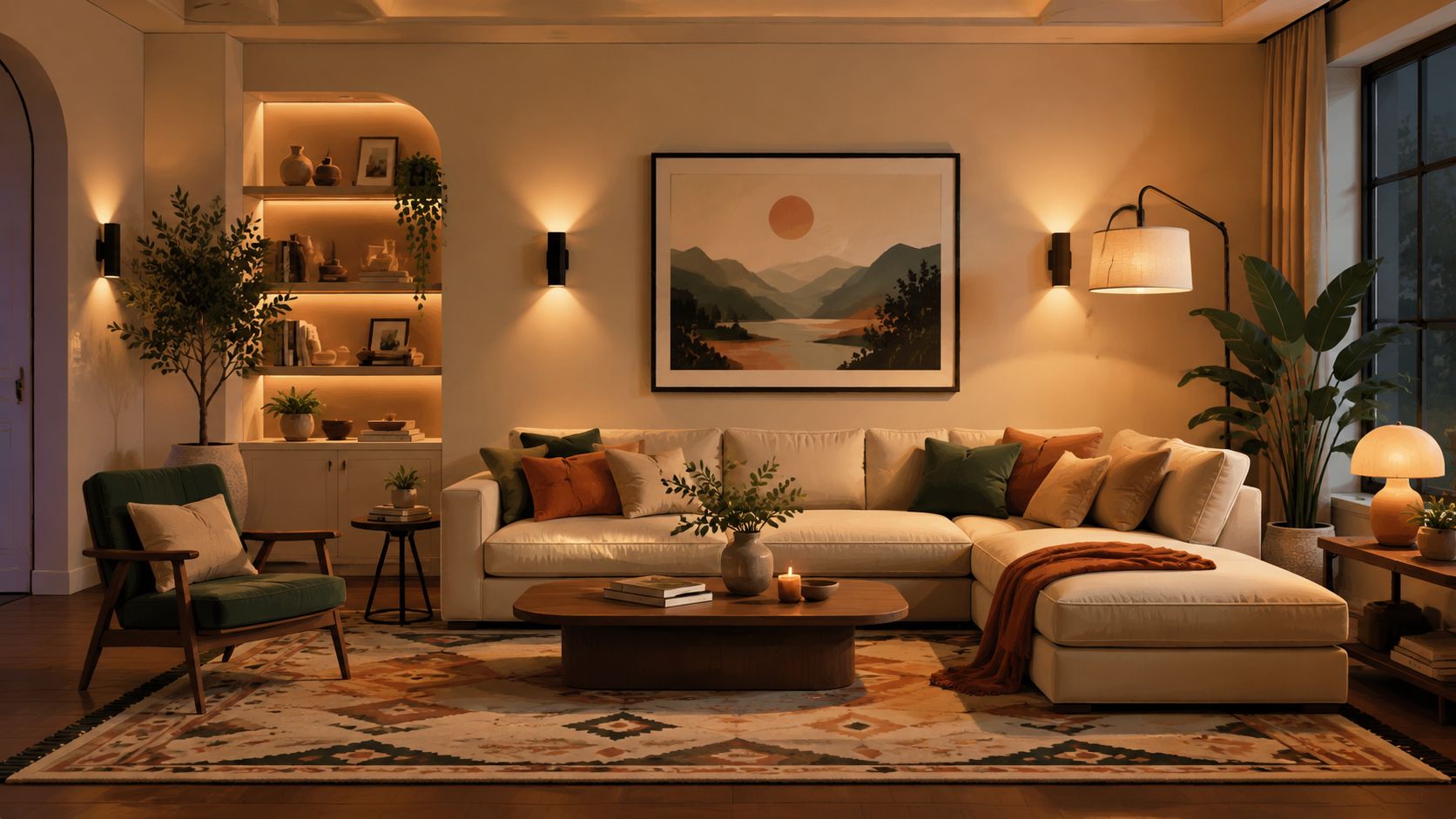
Lighting should never be the last item added to a room. It should answer to the furniture plan from the start. That's where many living rooms go wrong. The homeowner selects a sofa, adds occasional tables, chooses a rug, then tries to fill empty wall space with a fixture. The result is decorative, not integrated.
Lighting should answer to the furniture
A proper complete room concept starts with how the room lives. A Stickley piece, for example, has visual gravity and timeless craftsmanship. It asks for lighting with similar discipline. A fussy or overly slight sconce beside it usually looks uncertain. An artisanal fixture with honest materiality and a controlled silhouette feels more appropriate.
The same principle applies across Custom furniture Southern Ontario projects and interior design services St. Catharines clients seek out. The fixture should support the architecture of the furnishings, not compete with them. In rooms that already include pendant lighting or layered overhead fixtures, living room pendant lighting ideas can help establish a more cohesive language across the full lighting plan.
A strong room has hierarchy. Furniture leads, rugs ground, lighting refines.
For visual finishing, artwork often becomes the bridge between furniture and sconces. Homeowners comparing styles may find inspiration in curated living room wall art, especially when the goal is to create a wall composition rather than place isolated objects.
The rug is the room's foundation
The rug should be treated as Art for your Floor, not an afterthought. A hand-knotted rug anchors colour, pattern, and mood. Wall sconces help reveal that value by grazing light across nearby surfaces and giving the room more evening depth.
That matters in Hand-knotted rugs Ontario interiors, where texture is often one of the room's greatest strengths. Good sconce placement can catch the edge of a wool pile, warm up a border, or make a quiet neutral rug feel richer after dark. The effect isn't theatrical. It's cultivated.
This is also why lifestyle displays matter more than isolated product shots. A homeowner choosing Luxury furniture Niagara or planning a whole-home update in the Greater Niagara region needs to see the room as a total composition. The sconce, sofa, occasional chair, rug, art, and table lamps should read as one curated selection. That is how a room earns permanence.
Ensuring Timeless Craftsmanship
A well-made sconce should be treated like any other lasting interior investment. Keep finishes free of dust, handle shades carefully, and avoid neglecting the small maintenance that preserves the fixture's appearance over time. Good materials reward attention.
Quality also means resisting disposable decisions. A living room doesn't need more novelty. It needs pieces that still feel right years later, after the paint has changed, the art has shifted, and the room has evolved. That applies to lighting as much as upholstery or case goods.
For homeowners refining the broader character of their interiors, transitional style furniture inspiration can help align lighting choices with a room that balances tradition and modernity.
A thoughtful sconce does more than brighten a wall. It supports comfort, sharpens composition, and gives the room a finished evening life. That is the standard worth pursuing in any home intended to age with grace.
For those refining a living room with a more complete design lens, Critelli Furniture offers a natural next step. Book your complimentary design consultation today, experience the craftsmanship in person at our King Street Showroom, and visit the Rug Market to find your room's foundation.