
Accent Chair Black


The sofa is in place, the rug feels right, and yet one corner still looks unfinished, too empty for conversation and too prominent to ignore. That's the moment an accent chair black in finish stops being a colour choice and becomes a compositional decision, one that can settle the whole room when it's chosen for proportion, material, and daily use rather than drama alone.
Why a Black Accent Chair Changes a Room
A pale living room can look complete on a plan and still feel unanchored in person. Light upholstery, light walls, and a light rug drift without a point of visual weight. A black accent chair supplies that weight, giving the eye a place to land and making surrounding neutrals look intentional rather than washed out.
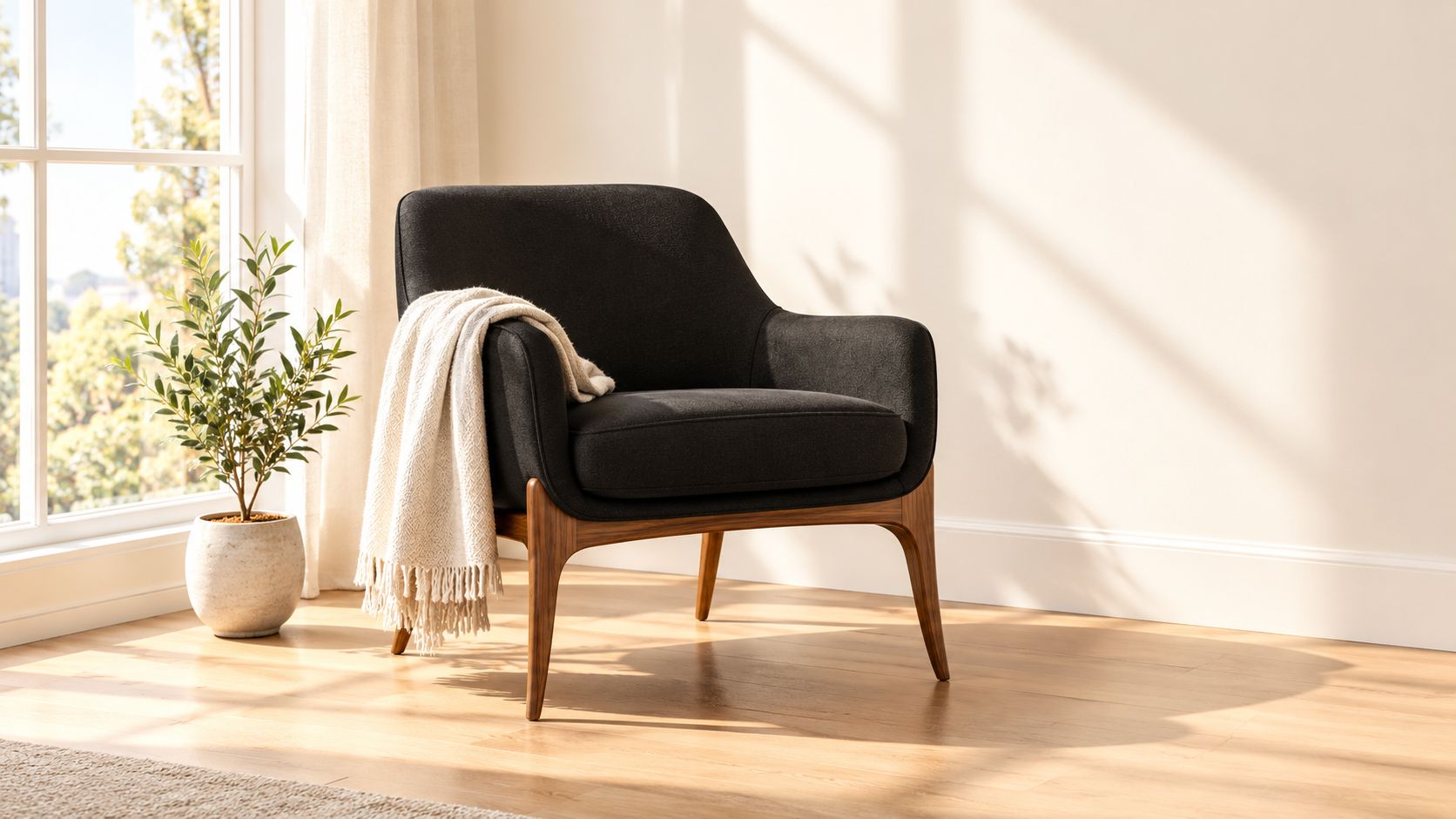
Black isn't a single effect. In a south-facing room in the Greater Niagara, Hamilton, and Toronto markets, a matte black frame beside linen can read crisp and calm. In a lower-light sitting room, the same silhouette upholstered in deep velvet turns intimate. Proportion, finish, and distance from windows decide the result far more than the tired warning that dark furniture always shrinks a space.
A finish with regional roots
Ontario's connection to black seating predates current trends. The Canadian Museum of History record for a Rustic Windsor Armchair found east of London, Ontario dates the piece to the first half of the 1800s, at about 70 cm high by 65 cm wide and 36.5 cm deep, with an original black finish later partly covered by green paint. A chair surviving roughly 120 to 170 years before its 1971 discovery makes a useful point. Black painted wood belongs to Southwestern Ontario furniture history, and timeless craftsmanship outlasts fashion cycles.
That history matters for Southern Ontario shoppers weighing luxury furniture Niagara options. The chair shouldn't be bought as a disposable contrast piece. It should be selected as part of a complete room concept, with silhouette, scale, upholstery, frame construction, customization, and delivery assessed together. Get those decisions right and black becomes punctuation, not a visual interruption.
Designer's Insight: Place the darkest piece where the room needs balance, not automatically in the emptiest corner. A black chair opposite a fireplace, dark bookcase, or window mullions often completes a visual triangle.
See Beyond the Colour
Black doesn't shrink a room by itself. Bulk does. A low, wide chair with closed sides occupies more visual space than a taller chair on exposed legs, even when both share the same footprint. Open space beneath the seat lets flooring and rug pattern continue through the piece, so the arrangement feels wider and less congested.
Sheen changes the reading
Matte fabric absorbs light and softens edges. Leather, polished wood, and lacquer return highlights, sharpening the outline and making black look closer to charcoal in bright conditions. Bouclé, velvet, and woven textiles add shadow within the surface, which keeps a large black form from reading as a flat block. The finish should therefore be tested at different times of day, not judged under showroom lighting alone.
Contrast also needs calibration. Against white walls, a black chair becomes graphic and demands a similarly confident rug or artwork nearby. Against warm grey, taupe, or walnut, the transition is quieter and the chair acts as depth rather than a focal point. An in-home colour consultation for testing finishes in actual light helps homeowners see those shifts before committing fabric or leather.
- Low contrast pairing: Black with walnut, bronze, and warm neutrals creates a layered, traditional mood.
- High contrast pairing: Black with pale oak, white walls, and clear glass creates a contemporary, architectural mood.
- Texture-led pairing: Black velvet or nubby weaves beside smooth leather keeps a monochrome palette from feeling flat.
Move around the chair before judging it. A profile that looks heavy from the doorway may look perfectly balanced from the sofa, where it will actually be seen most often.
The reliable strategy isn't a list of colours that supposedly always suit black. It's a balance of reflected light, texture, and visual mass, checked beside the intended rug, lamp, and side table. When those elements share related undertones, black integrates. When they don't, even an expensive chair can look stranded.
Compare Black Chair Silhouettes
Silhouette determines what black does in a room before upholstery enters the discussion. A wingback in black commands a corner and suits reading beside a fireplace. A slipper chair in the same colour offers flexible extra seating without blocking sightlines. Shape should follow the room's job, then personal preference can refine the details.
Curved barrel forms soften rectilinear sofas and encourage conversation, since the sitter turns naturally toward others. Architectural lounge chairs with exposed frames sharpen a soft scheme and pair well with custom rugs. Dining-height accent chairs bridge living and dining zones in open plans, while swivel or recliner-oriented forms prioritise movement and longer sitting, provided the base and mechanism suit the floor and user.
Black Accent Chair Silhouette Comparison
| Silhouette | Visual Character | Spatial Effect | Best Room Role |
|---|---|---|---|
| Wingback | Formal, enveloping | Adds height and authority | Reading corner, traditional sitting room |
| Barrel | Curved, sociable | Softens straight lines | Conversation grouping |
| Slipper | Low, armless, light | Preserves sightlines | Bedroom, flexible occasional seating |
| Lounge with arms | Relaxed, substantial | Anchors a seating group | Extended reading, media room |
| Dining accent | Upright, tailored | Links open-plan zones | Host seating, desk or table use |
| Swivel lounge | Contemporary, mobile | Turns between focal points | Rooms with fireplace and television |
For a softer room, choose an upholstered form with rounded arms and a cushioned back. The black surface will read as depth rather than outline. For a graphic interior, choose a slender exposed frame, such as the direction explored in a modern lounge chair selection for clean-lined seating, where the shadow lines become part of the design.
Practical rule: If the sofa is broad and low, avoid a broad and low black chair beside it. Contrast in height or openness keeps the grouping from sinking visually.
Generous upholstery creates a cocooning effect, but it isn't automatically more comfortable. A sculptural open frame can support posture well, while a deep plush seat can make shorter sitters perch. Silhouette is only the first filter. Scale, seat depth, and arm strength decide whether the chair earns daily use or becomes admired from a distance.
Match Scale and Comfort to the Space
Start with the floor, not a photograph. Tape the chair's footprint where it will sit, then walk the normal routes around it with a drink, a book, and another person passing. Check door swings, radiator clearance, and the view from the sofa. A chair that fits mathematically can still block the room's rhythm.
Compare visual mass next. A black chair beside a pale sofa carries more perceived weight than its dimensions suggest, so a slightly narrower profile may balance better than an exact match. The rug edge matters too. Front legs on the rug usually connect the chair to the group, while a chair floating entirely outside the rug can look exiled. Professional residential space planning for seating groups and circulation is useful in open plans where several focal points compete.
Test the body, not only the room
Ontario accessibility guidance offers a practical screening range, not a medical prescription. The Ottawa accessibility design standards for seating dimensions specify finished seat height of 450 to 500 mm, seat depth of 330 to 510 mm, back support at least 320 mm above the seat, and an armrest 220 to 300 mm above the seat. Measure the compressed cushion, since foam changes the effective height once occupied.
Those numbers have direct consequences. A seat that's too low increases knee and hip flexion and makes standing harder. A seat that's too deep presses behind the knees and prevents contact with the backrest. For mixed users, a mid-range height near 450 to 480 mm, moderate depth, firm support, and arms strong enough for push-off are safer choices than a dramatic low sling.
Long-term usability deserves the same candour. Statistics Canada reported that 25.7% of people aged 65 or older in the referenced Ontario data had a home adaptation need or related consideration, in its analysis of home adaptations among older Canadians. Dark upholstery can also be harder to locate in a dim room at night. Lighting, floor grip, stability under lateral force, and cleanability belong in the fit test alongside beauty.
Evaluate Upholstery and Frame Quality
Heirloom quality should be verifiable, not merely printed on a tag. Ask what's inside the black surface. Is the colour a pigment in leather, a textile dye, paint on wood, or a lacquer over composite panel? Each wears differently. Leather develops highlights at contact points, tightly woven fabric hides lint less readily than textured weaves, and painted wood can chip at edges where vacuums and shoes strike.
Fabric generally softens black and offers broader texture choice, but pale pet hair and dust show quickly. Leather wipes clean more readily and reflects more light, though scratches and sheen variation become part of its character. Detailed guidance on upholstery materials and their care requirements helps narrow that choice before samples are ordered. For an existing chair that remains structurally sound, an affordable chair cover refresh can also test a darker direction before a permanent investment.
Ask about what cannot be seen
Composite components such as MDF, particleboard, and hardwood plywood can emit formaldehyde from adhesive resins. Health Canada's residential guideline, summarised in its formaldehyde guidance for Canadian homes, sets a long-term target of 50 µg/m³ over an 8-hour average and a short-term limit of 123 µg/m³ over one hour, while measured Canadian-home concentrations commonly average 10 to 40 µg/m³ over a day. The black colour doesn't determine emissions. Adhesive chemistry, sealing, and ventilation do.
That distinction matters in tightly sealed homes. A 2025 study of a 110-unit residential building in downtown Toronto found volatile organic compounds at median concentrations about 22% higher in exhaust air than in incoming air, indicating the building acted as a net indoor source, according to the Toronto residential building VOC study. Furniture and building materials were identified among continuous contributors. Premium appearance doesn't prove healthier construction.
- Frame disclosure: Request whether panels are solid wood, composite, or metal, and ask for emissions documentation.
- Surface sealing: Prefer fully sealed or laminated composite surfaces where composite materials are used.
- Finish disclosure: Ask about low-VOC finishes, foam, textile composition, and care products.
- After delivery: Ventilate the room while new materials off-gas and avoid immediate placement beside sleeping areas.
Designer's Insight: Pair a black leather or dark woven chair with a lighter hand-knotted wool rug and warm wood nearby. The chair keeps its authority without pulling the whole seating group into shadow.
Sound construction combines disclosed materials, stable joinery, resilient cushioning, and a finish suited to the household. Anything less is styling dressed as quality.
Style Black Seating in Real Rooms
In a traditional sitting room, a black wingback beside a warm neutral rug and brass reading lamp reads established rather than stark. The dark upholstery echoes picture frames or a piano finish, while cream textiles keep the corner inviting. Pattern should stay controlled nearby, since black already provides the strongest outline in the group.
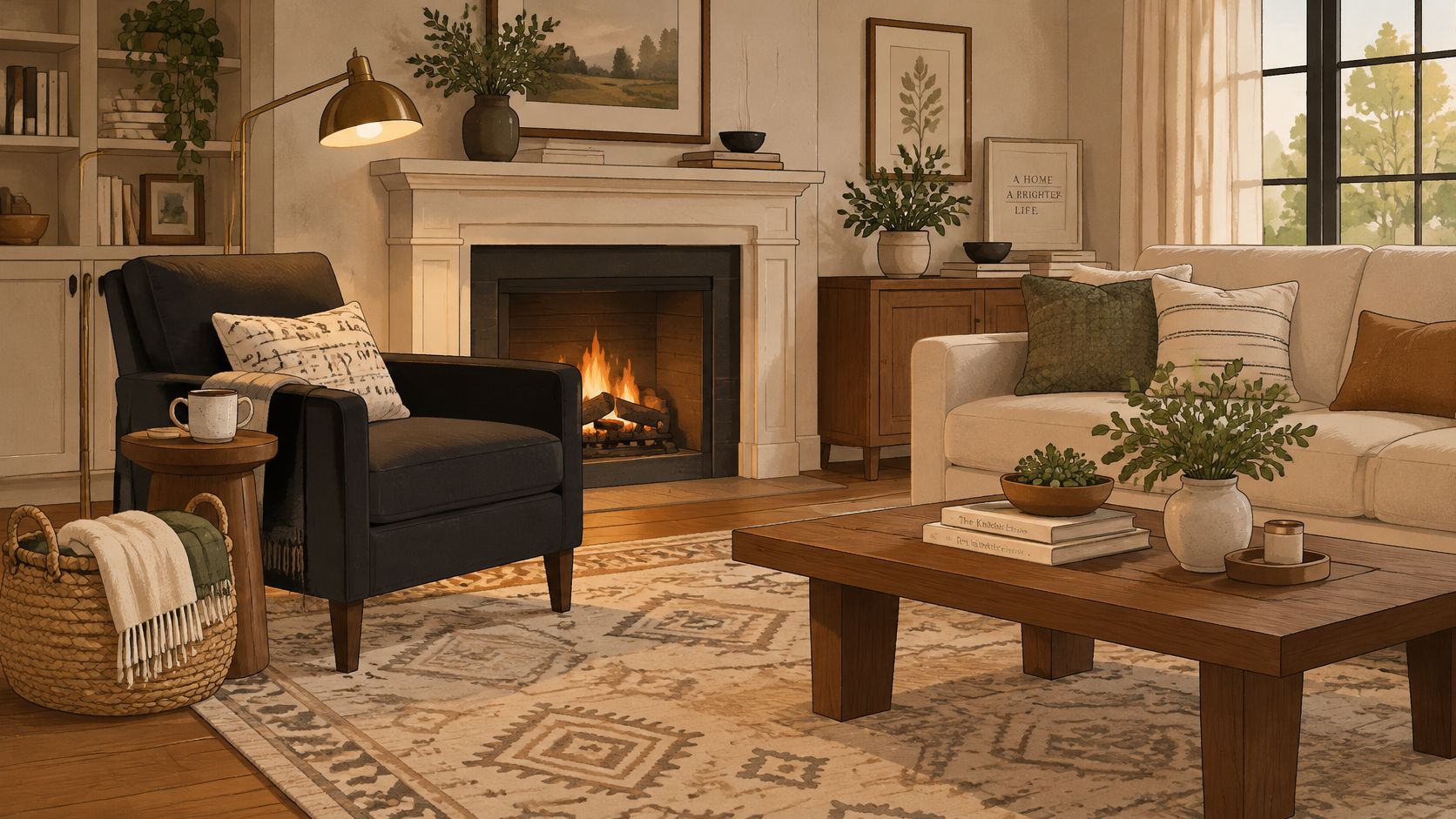
A contemporary room handles black differently. Pale walls, a low light sofa, and a slender black lounge chair create deliberate contrast, especially when one other dark element repeats the note. That repetition might be a floor lamp stem, cabinet hardware, or a thin rug border. Without it, the chair becomes the only full stop in an otherwise quiet sentence. An interior colour scheme guide can help homeowners test whether surrounding undertones lean warm or cool before paint and upholstery are locked together.
Transitional interiors often benefit most from black because it bridges periods. Beside walnut case goods, a black barrel chair sharpens traditional wood without forcing a fully modern scheme. Beside a lighter upholstered sofa, the same chair creates conversational balance and gives guests a visually distinct seat. Further placement ideas appear in five ways to use an accent chair in a room plan, but the principle remains personal. The chair must answer the architecture in front of it.
Start with the floor
Critelli's Rug Market, introduced in 2014 with hand-knotted silk and wool rugs from around the world, reflects a design sequence worth copying, as documented by the Greater Niagara Chamber of Commerce account of the Rug Market launch. Rugs are Art for Your Floor and the foundation on which colour relationships are built. A hand-knotted wool rug with a deep border can justify a black chair, while an all-pale rug makes that chair the hierarchy's peak. Hand-knotted rugs Ontario shoppers should choose pattern scale first, then let the chair either echo or interrupt it.
Customize, Consult, and Bring It Home
Black should always be judged in person. Screens flatten undertones, turning blue-black, brown-black, and true black into the same swatch. In a showroom, fabric, leather, and wood samples can be carried between daylight and shaded areas, placed against rug wool, and checked beside metal finishes. Dimensions, compressed seat height, frame materials, and care instructions should be documented before any order is placed.
Critelli Furniture brings a specific regional history to that process. Joseph and Thomas Critelli founded the family business in 1914, and it celebrated 110 years in operation in 2024, according to Greater Niagara Chamber of Commerce coverage of Critelli's 110 years. Present leadership under fourth-generation owner Joe Critelli and daughter Julia supports a curated selection model rather than a disposable purchase. Names in the wider showrooms, including Stickley, Stressless, and Magniflex, should still be assessed piece by piece for fit and construction.
Two downtown St. Catharines showrooms serve the region, at 126 King Street and 169 St. Paul Street, as described in the history of Critelli locations across Niagara. For interior design services St. Catharines clients, consultation can address space planning, bespoke fabrics, leathers, and finishes, and the relationship between a black chair and nearby custom furniture Southern Ontario pieces. Customization options vary by maker, so no chair should be assumed to accept every alteration.
An in-home consultation adds the missing evidence. Natural light, ceiling height, traffic routes, flooring, and existing furniture can be assessed as one composition across St. Catharines, the Niagara Peninsula, Hamilton, and Toronto. Homeowners planning a broader project may also value guidance on interior design that reflects your style when coordinating a single chair with renovations or adjacent rooms.
Confirm service details directly
White-glove delivery should mean a smooth transition from showroom to home, but specific mechanics should be confirmed directly before purchase. Available sources verify regional service and showroom support, not every operational detail. Ask what delivery includes for the selected piece and address, then record the answer with the order.
Experience the craftsmanship in person at the King Street Showroom. Book a complimentary design consultation today. Visit the Rug Market to find the room's foundation.
Make a Confident Final Selection
A confident choice follows a clear order. First confirm the chair's room role, focal point, conversation seat, reading chair, or flexible overflow. Then test silhouette against sightlines, tape the footprint, and sit long enough to judge compressed height, depth, back support, arm strength, and ease of standing. Appearance comes early in the process, but it shouldn't overrule those physical checks.
Materials come next. Verify upholstery composition, frame substrate, finish, cushion construction, emissions documentation, and cleaning method. Check the black sample beside the rug, floor, wall colour, and nearest lamp in daylight and evening light. Confirm customization limits, lead arrangements, and regional delivery details directly. Ontario demand gives context for treating the purchase seriously, since Statistics Canada reports Canadian households spent an average of $760 on furniture and Ontario households led the referenced comparison for furniture and linens, in its household spending dataset for furniture and furnishings.
The strongest black accent chair isn't the most dramatic object in the showroom. It's the chair that supports the sitter, clarifies the room's proportions, respects indoor-air questions, and still looks right on an ordinary Tuesday. View it in person, place it against real rug wool and real light, and let the complete room make the final argument.
For a black accent chair chosen as part of a complete, design-forward room, Critelli Furniture offers curated showrooms in downtown St. Catharines, a specialised Rug Market, and design consultation grounded in a family-run history dating to 1914. Experience the craftsmanship in person at the King Street Showroom, book a complimentary design consultation, or visit the Rug Market to find the room's foundation.