
Entryway Cabinets with Storage: A Design-Forward Guide


By the time most households think about the entryway, the clutter has already won. It shows up on a February evening in Southern Ontario, when the front door closes against the cold and there's suddenly a landing zone needed for boots, scarves, backpacks, keys, parcels, and the day's mail. If that zone hasn't been designed properly, the mess spills forward into the rest of the home.
That's why entryway cabinets with storage matter more than their modest footprint suggests. They don't hold things for the sake of it. They organise the first ten feet of daily life, conceal visual noise, and establish the material language for the rooms beyond. In a home that's meant to feel composed, the threshold can't be an afterthought.
Homes across the Greater Niagara, Hamilton, and Toronto markets also ask more of this space than many furniture catalogues admit. Winter gear is bulky. Hallways are often narrow. Older houses introduce baseboards, vents, radiators, and difficult door swings. Newer homes may be cleaner in plan, but they still need a practical drop zone that doesn't look temporary. The right cabinet solves that tension with quiet authority.
The First Thing Your Home Says
The entry is the one room every person uses, whether they notice it or not. It receives the house at its busiest moments. Groceries in hand, wet boots on the mat, a child looking for mittens before school, a guest arriving with no obvious place to set a bag. In each of those moments, the cabinet either helps the house behave well or exposes that nothing has been resolved.
A well-chosen entry cabinet does five jobs at once. It catches the daily deposit of shoes, coats, paper, and accessories. It hides what shouldn't stay in view. It preserves a clear walking path. It introduces a design-forward vocabulary through wood, finish, and hardware. It also saves a household from the constant little tidy-ups that make a home feel less settled than it ought to.
Four working forms
Most entryway cabinets with storage fall into four dependable archetypes:
- Bench cabinet for seating, boot removal, and lower concealed storage
- Console cabinet for slimmer foyers and lighter daily storage
- Locker cabinet for family-specific zones behind doors or in cubbies
- Hall tree for vertical storage that combines hooks, mirror, and a modest cabinet base
The mistake is choosing by finish first. Walnut versus painted cream is a later decision. The question is how the household moves.
A handsome cabinet that interrupts the front door or has nowhere sensible for wet boots isn't elegant. It's just expensive friction.
The threshold sets the tone
In older family practices, the entry has always been treated as a prelude, not an isolated moment. Its proportions, trim profile, wood tone, and storage discipline should speak clearly to the rooms ahead. A cabinet beside a haphazard runner and a weak light fixture creates confusion. A cohesive threshold feels intentional before a guest has taken off a coat.
Homeowners considering this balance often find it useful to look at how proportion and surface styling affect first impressions in pieces such as an entry table with proper scale and presence. The same principles apply to cabinetry, only with the added burden of daily utility.
Choosing the Right Cabinet Style for Your Entry
The most reliable way to choose among entryway cabinets with storage is to judge each type against footprint, storage capacity, and visual weight. Those three variables tell the truth quickly. A piece may look appealing online, but if it projects too far, stores the wrong things, or feels too heavy for the architecture, it won't last in the room.
A practical decision matrix
Small entries don't reward indecision. If the entry is under about 4 to 6 feet wide, Canadian design guidance often pushes households toward vertical storage and seasonal rotation rather than broad, deep pieces, especially where winter gear has to be managed in a narrow passage. Guidance focused on Southern Ontario homes also notes that dedicated per-person zones, boot trays, and practical winter storage often work better than one-size-fits-all cabinetry in tight spaces, as discussed in small entryway storage solutions for Toronto homes.
| Entryway Cabinet Style Comparison | Typical Depth | Best Entry Width | Primary Storage Strength | Visual Weight |
|---|---|---|---|---|
| Bench | Deeper profile, usually in the mudroom range | Wider entry stretches | Shoes, baskets, seating, lower drawers | Low and grounded |
| Console cabinet | Shallow to moderate | Narrow to medium foyers | Mail, keys, bags, small footwear storage | Light to moderate |
| Locker cabinet | Moderate to deep | Larger entries or dedicated mudroom walls | Family zones, coats, backpacks, seasonal items | Strong and architectural |
| Hall tree | Vertical rather than broad | Tall, narrow entries | Hooks, mirror, upper grab-and-go storage | Moderate, height-driven |
What each style does best
A bench cabinet earns its keep when people need to sit down and remove boots without balancing on one foot. It works well in family homes, but it needs breathing room around it.
A console cabinet is the safer answer for many foyers. It keeps projection under control and handles the small objects that otherwise drift through the house. For those comparing proportions before committing to a local piece or custom build, it can help to explore Luna Rectangular Cabinet as a visual reference for slim, rectilinear cabinet styling.
A locker cabinet suits active households best. Separate compartments reduce the familiar pile-up that happens when everyone shares one generic cupboard.
A hall tree is often underestimated. In a narrow vestibule, vertical organisation can outperform a deeper cabinet, especially when coats, hats, and mirrors need to be integrated into one disciplined composition.
For homeowners who want to compare cabinet profiles against other storage furniture categories before deciding, dining storage and sideboard examples can be surprisingly useful because they show how massing, leg style, and door configuration affect a room.
Sizing for Narrow Hallways and Daily Traffic
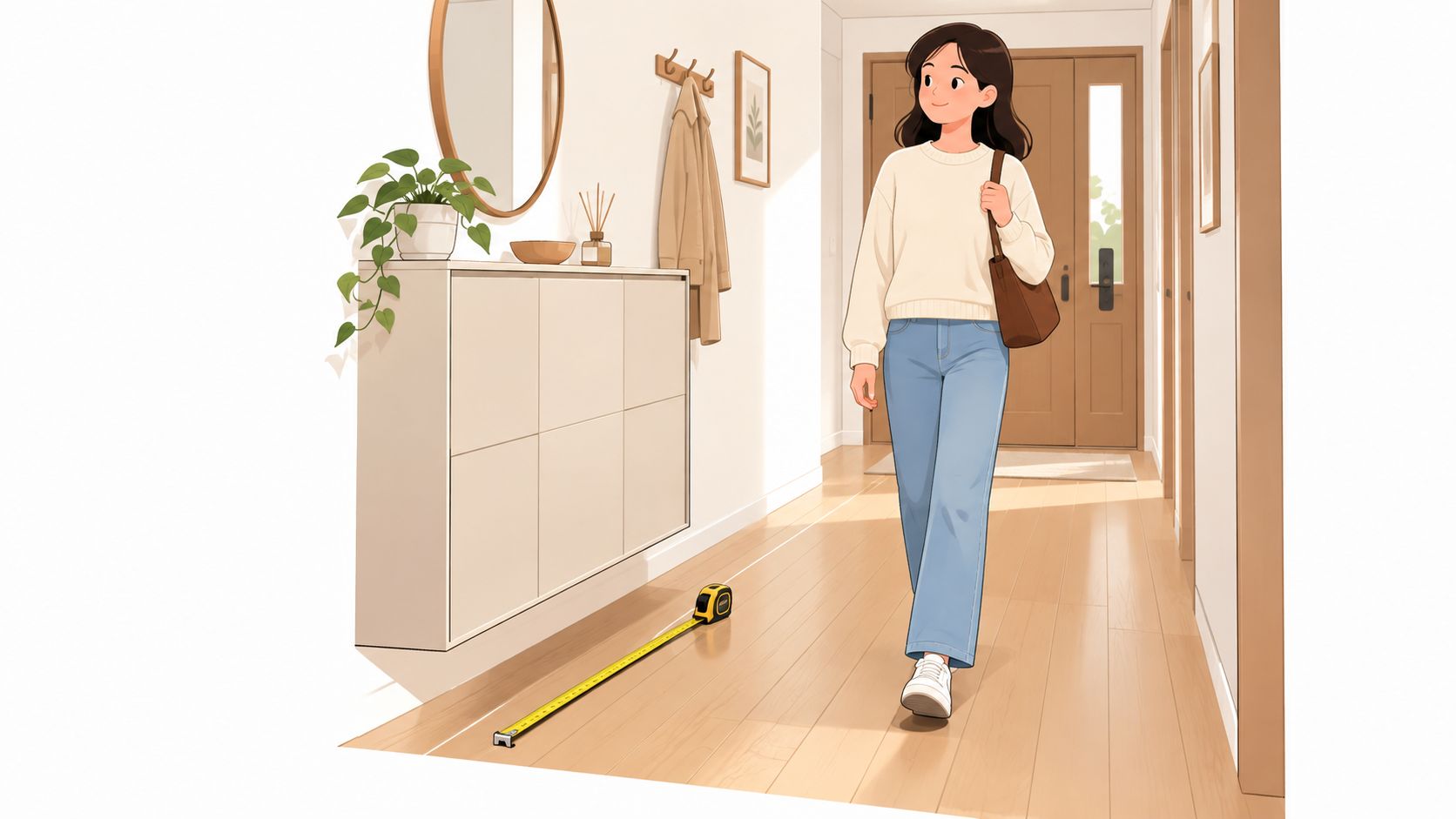
Measurements decide whether an entry feels gracious or irritated; many purchases go wrong here. A cabinet may fit on paper and still fail once the front door swings open, winter coats bulk out, and two people try to pass.
Start with clear passage
Ontario's building-code framework adopts the National Building Code of Canada 2020 with provincial amendments, and a commonly cited minimum unobstructed residential hallway width is 860 mm according to the Ontario regulatory framework. In practical terms, that means the cabinet can't reduce the walking path below that threshold.
Canadian accessible residential guidance is even more instructive for day-to-day comfort. It calls for interior paths of travel of at least 1200 mm, with short indentations allowed to 860 mm, and also identifies clear floor space of at least 900 mm by 1500 mm at key accessible areas in accessible-ready housing guidance. For entry cabinetry, that supports one clear conclusion. Shallow pieces are often the wiser technical choice.
Practical rule: measure the hallway first, then subtract cabinet projection, door swing, and body space for a person carrying bags or wearing a winter coat.
Five measurements worth taking
A tape measure should answer these questions before any showroom visit:
Clear path
Measure wall to wall, then determine what remains once the cabinet projects into the corridor.Door arc
Mark the full swing of the front door and any closet door nearby. Many cabinets fail at the hinge line.Vent and trim conflicts
Baseboard returns, cold-air returns, and radiators often claim more wall depth than expected in Southern Ontario homes.Ceiling height
Tall lockers can feel architectural under lower ceilings, but only if their top line is proportioned carefully.Sightline
Stand at the front door and look through the house. The cabinet should support that view, not block it.
Homes that need every inch to work often benefit from careful space planning before a piece is chosen. That's where small-space interior design thinking becomes practical rather than decorative.
Materials and Finishes That Age Beautifully
An entry cabinet lives a harder life than most furniture. Wet mittens land on it. Zippers scrape it. Boot soles kick its base. Salt and slush travel indoors all winter. Materials should be selected for how they age under that pressure, not for how they look under bright showroom lighting for five minutes.
Wood, veneer, and painted construction
Solid hardwood remains the benchmark for heirloom quality when the design and budget support it. White oak wears with composure and often deepens in warmth over time. Walnut tends to patinate gently and reads especially handsome in homes that want an established, refined mood. Maple offers a quieter grain and suits painted or lighter natural finishes.
Engineered hardwood and premium MDF with hardwood veneer also have a proper place. In painted cabinetry, stable substrates can produce a cleaner surface and reduce the visual interruption of grain telegraphing through the finish. The quality comes from the build method, edge treatment, and finishing system, not the material label.
| Entryway Cabinet Material Comparison | Durability | Aging Behavior | Best For |
|---|---|---|---|
| Solid white oak | High | Develops deeper warmth with use | Family homes, traditional and transitional entries |
| Solid walnut | High | Patinates softly, richens in tone | Design-led foyers, darker tailored schemes |
| Maple | High | Holds a crisp profile, good under paint or light stain | Clean-lined cabinetry, quieter grain preferences |
| Hardwood veneer on quality core | Moderate to high | Ages well when edges and finish are carefully done | Slim custom pieces, controlled budgets |
| Premium painted MDF components | Moderate to high in the right application | Shows contact wear in high-touch zones but can be refinished | Painted doors, panel-front cabinetry |
Finishes that work in real homes
Conversion varnish and other cabinet-grade finishes usually outperform softer decorative finishes in an entry. Hand-rubbed oil can be beautiful, but it asks for a homeowner who accepts and understands maintenance. Painted finishes can be timeless craftsmanship at its best when the colour, substrate, and touch-up strategy are chosen intelligently.
Southern Ontario buyers who want a finish matched to existing trim, flooring, or adjoining millwork often end up in custom or semi-custom territory. Independent mudroom design guidance points to practical dimensions such as about 18 inches bench height, 16 to 20 inches depth, and 12 to 18 inches of width per household member for functioning systems, noted in mudroom cabinet planning guidance. Those measurements are useful because they connect material choices to actual use, not just appearance.
For homeowners who want to compare woods and construction methods directly, solid wood furniture examples help clarify what hand-finished surfaces and substantial joinery look like in person.
Storage Features and Hardware That Actually Work
Good storage isn't about adding more compartments. It's about assigning each routine a proper place and giving that place hardware that won't feel tired after years of use.
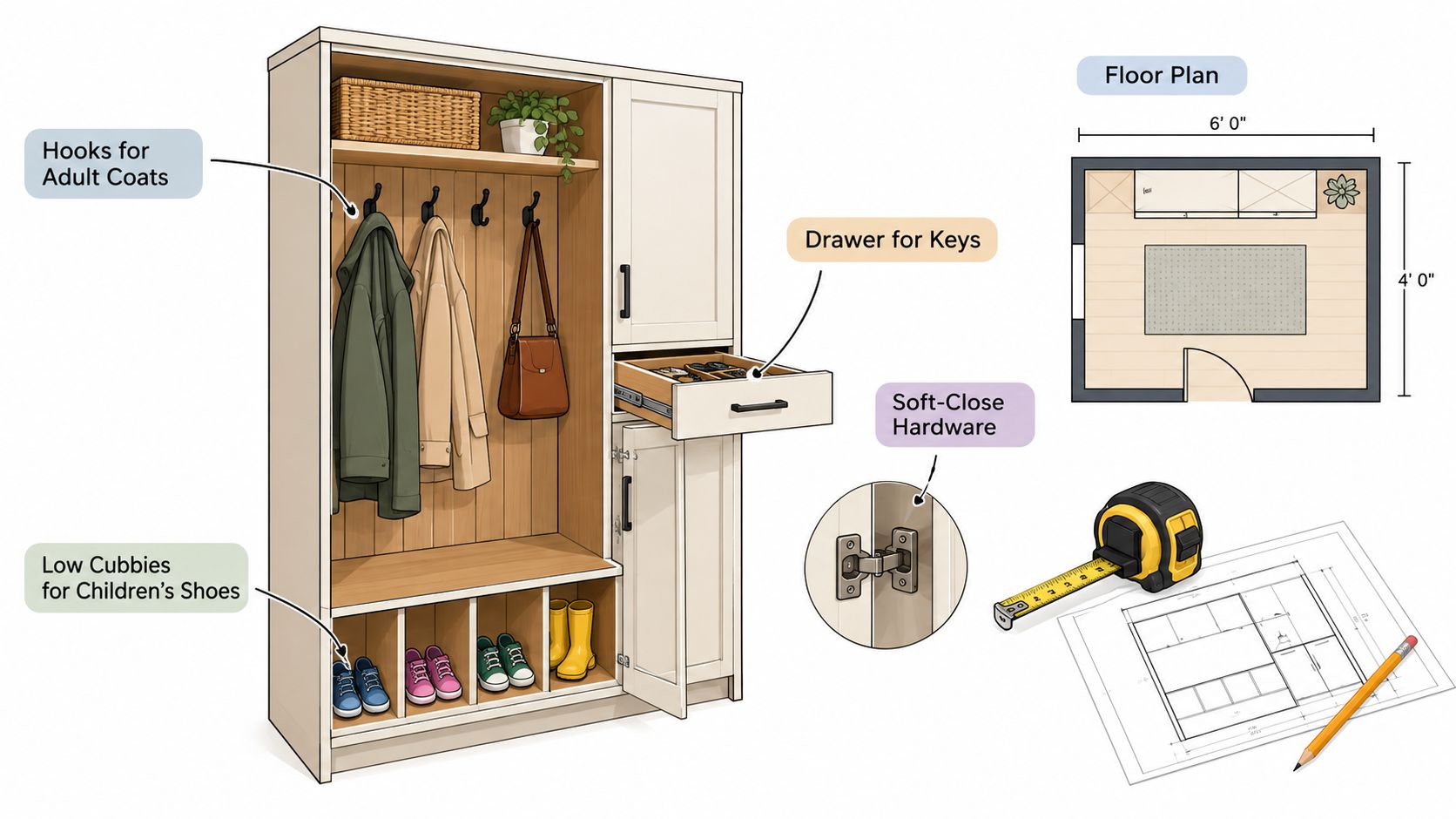
Build the cabinet around behaviour
The most successful entryway cabinets with storage separate the contents by task.
- Adult zone holds everyday coats, bags, keys, sunglasses, and often one drawer for wallet-sized essentials.
- Children's zone needs easier reach, less formality, and tolerance for backpacks that won't be placed neatly.
- Shoe zone should recognise the difference between dry shoes and wet winter boots.
- Paper zone keeps mail from migrating to the kitchen counter.
- Pet zone works best when leads, waste bags, and towels are grouped near the exit.
One large cavity rarely handles all of that gracefully. Division matters.
Hardware that earns the investment
A cabinet should open properly with one hand while someone's balancing groceries with the other. That's the standard.
Look for soft-close European hinges, full-extension drawer slides, sturdy hooks fixed into reliable backing, and pulls made from substantial materials rather than hollow decorative hardware. Adjustable shelves are useful, but they shouldn't be the only organising strategy. A better interior usually includes a mix of fixed and flexible components.
Designer's Insight
A wet-gear household needs at least one zone that can be cleaned quickly. Removable boot trays and wipeable cabinet interiors are often more valuable than one extra decorative shelf.
Door style changes how a hall feels
A slab front reads quieter and often makes a narrow entry feel less visually crowded. Shaker doors bring shadow lines and character, which can be welcome in older homes with trim detail. Inset and beaded profiles look refined, but they ask for careful proportion so the face doesn't become too busy in a tight corridor.
One practical option some homeowners consider is a modular storage system configured for an entry wall. Critelli Furniture offers shelving and storage planning that can be adapted to organised drop-zone use, particularly when standard sizes don't answer the room cleanly.
Styling the Entry as a Complete Room Concept
A cabinet alone won't finish an entry. The threshold becomes persuasive when every surrounding element supports it. A design studio approach changes the result. The entry stops behaving like a leftover wall and starts reading as a complete room concept.
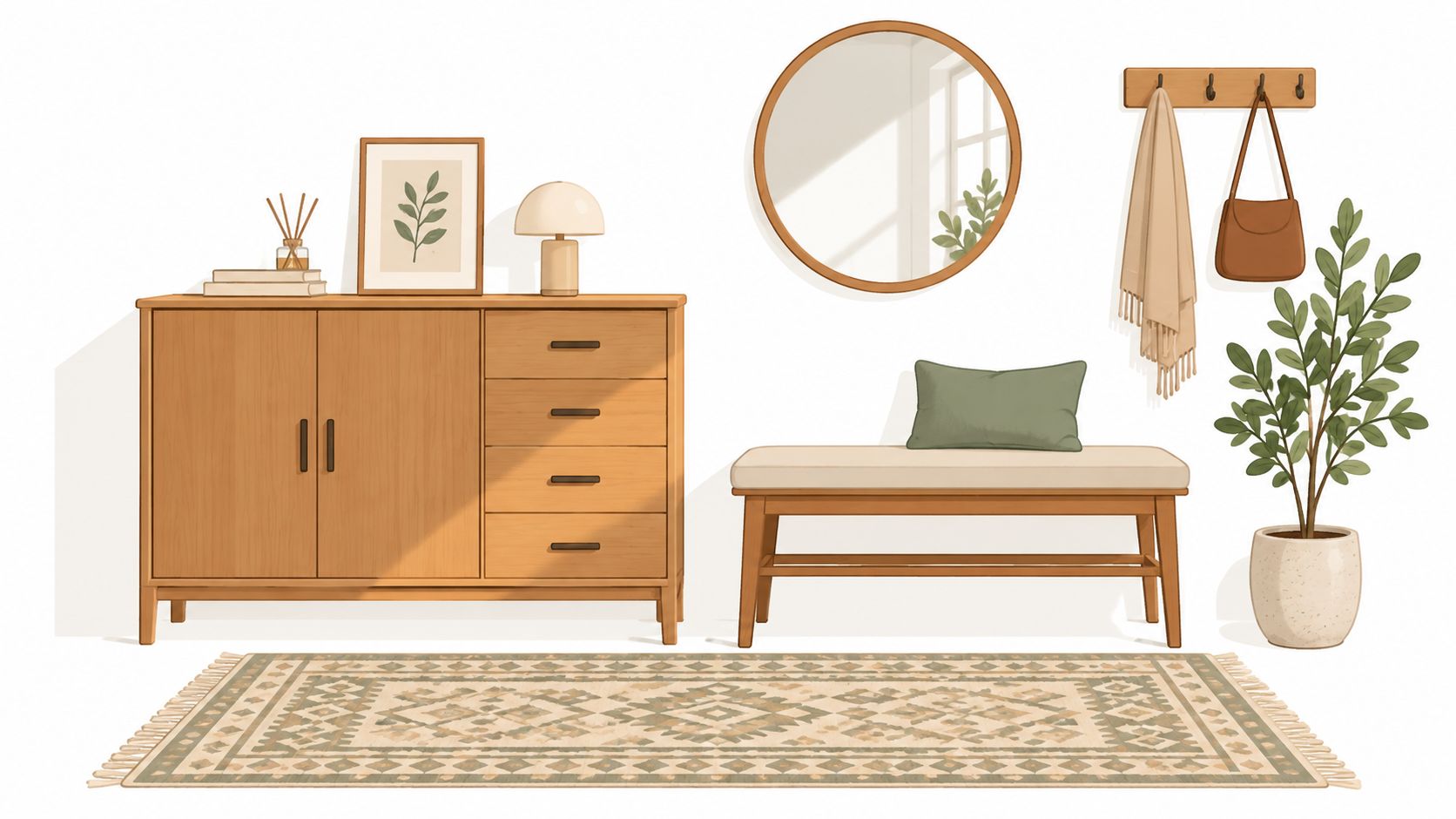
Start from the floor up
The rug is rarely an accessory here. It is the foundation. In a high-traffic entrance, the right textile softens sound, catches debris, and gives the cabinet visual context. The Rug Market's long-held philosophy of Art for your Floor is especially apt in an entry because the rug often carries the first layer of pattern, colour, and texture guests encounter.
Canadian market research places the floor coverings category, including area rugs, at roughly CAD 2 to 2.5 billion at retail, and estimates area rug sets at 6 to 8 percent of the overall Canadian area rug market by revenue in 2026, according to Canadian area rug market analysis. That matters less as a sales statistic than as a sign that homeowners increasingly treat rugs as a category worth choosing deliberately.
Compose the vignette
A complete entry usually benefits from these supporting layers:
- Mirror placement that reflects light without duplicating visual clutter
- Lighting at more than one height so the area doesn't collapse into a dim corner
- Wall treatment continuity with nearby trim, wainscoting, or paint tones
- A secondary decorative note such as a vessel, lamp, or framed piece that humanises the cabinet
Some homeowners like to shop wall art online when refining the final layer of the vignette, especially once cabinet finish and rug colours are already established. The art should complete the composition, not compete with the storage piece.
In the best entries, nothing feels added at the last minute. The cabinet, rug, mirror, and light all appear to have arrived together.
That's the value of reviewing samples side by side in a showroom setting. A rug swatch against a cabinet finish board under controlled lighting often settles decisions that remain murky on a phone screen.
From Design Studio to White-Glove Delivery
The most successful entry projects don't begin with a cart checkout. They begin with accurate measurements, honest discussion about household habits, and a review of how the threshold relates to the adjacent rooms.
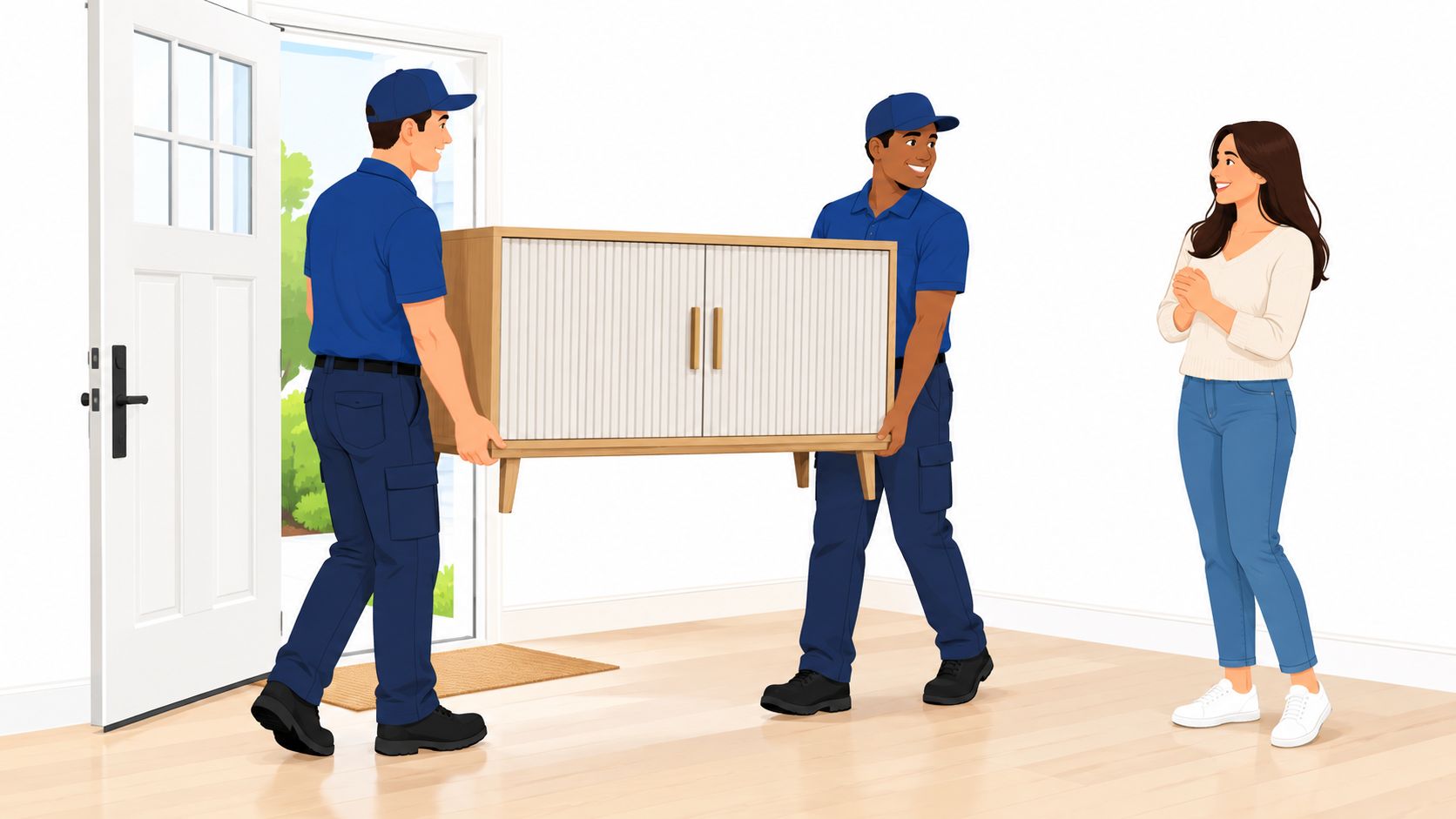
How a well-run project unfolds
In a proper design consultation, the cabinet is considered as part of the full sequence of arrival. Measurements are checked. The front door swing is reviewed. Floor conditions, trim details, and adjoining sightlines are noted. If the home sits in St. Catharines, Niagara-on-the-Lake, Ancaster, Burlington, or farther toward Toronto, the design logic remains the same. The entry must earn its footprint.
For non-standard conditions, custom millwork often becomes the sensible path. Angled walls, shallow niches, awkward heating elements, and unusual ceiling lines are difficult to solve with ready-made furniture alone. If an existing piece is being reconsidered instead of replaced, homeowners sometimes review resources such as the Arsh Art Cabinet Refinishing guide to understand what refinishing can and can't accomplish before committing to new work.
Why delivery matters as much as selection
White-glove delivery in Canada refers to a premium final-mile service that may include inside delivery, room-of-choice placement, unpacking, assembly support, packaging removal, proof-of-delivery documentation, and even scheduled windows as narrow as two hours, as outlined in Canadian white-glove delivery guidance. For an entry cabinet, that level of service matters because these pieces often need precise levelling, careful wall placement, and immediate inspection once unwrapped.
A handoff from showroom to home is part of the cabinet's value. Floors should be protected. Hardware should be checked. Doors should align. Packaging should leave with the delivery team, not remain stacked in the foyer.
For homeowners who want that process defined clearly, white-glove furniture delivery details show what careful in-home placement and final setup should include.
An Entryway That Rewards You Every Day
An entry cabinet is one of the few furniture purchases that proves its value every single day. It reduces the scramble of mornings, gives wet boots and seasonal gear a proper landing place, protects surrounding floors from winter salt and slush, and makes the first impression of the home feel considered rather than improvised.
The right decision is rarely about ornament. It comes down to four disciplined choices. The cabinet style must suit the architecture and the household rhythm. The footprint must preserve movement. The materials and hardware must tolerate years of use. The styling must belong to the broader interior rather than sitting apart from it.
That's why the threshold deserves more respect than it often receives. In a design-forward home, the entry is the opening statement. It introduces the palette, the level of order, and the standard of craftsmanship that follows through the rest of the house.
For homeowners who want a precise answer rather than a guess, a complimentary consultation is the sensible next step. A family-run practice with roots reaching back to 1914 brings a different sort of calm to these choices. It doesn't rush the measurements, the finish selection, or the final placement. It treats the cabinet, the rug, and the room around them as one connected decision.
Critelli Furniture offers a century-shaped perspective on entry design, from bespoke storage planning and custom furniture in Southern Ontario to hand-knotted rugs Ontario homeowners use as the room's foundation. For those seeking luxury furniture Niagara clients can live with beautifully, and interior design services St. Catharines homeowners can rely on, visit Critelli Furniture to book your complimentary design consultation, experience the craftsmanship in person at the King Street Showroom, or visit the Rug Market to find your room's foundation.