
Tables with Drawers: A Complete Buying Guide


Keys land on the kitchen counter, mail spreads across the dining table, and reading glasses disappear beside the sofa. The room isn't short of furniture. It's short of a place for small, everyday things to go, out of sight but within reach.
That's the quiet work of tables with drawers. The top holds what the moment needs, and the drawers keep the rest from turning a welcoming room into a holding area.
Why a Table with Drawers Earns Its Place
A Southern Ontario hallway tells the story quickly. Coats come off, gloves need a home, a dog lead tangles with the post, and the nearest flat surface absorbs it all. A console with concealed storage changes that pattern. The surface stays calm for a lamp and a small tray, while drawers take the chargers, keys, and spare batteries that make an entry look unsettled.
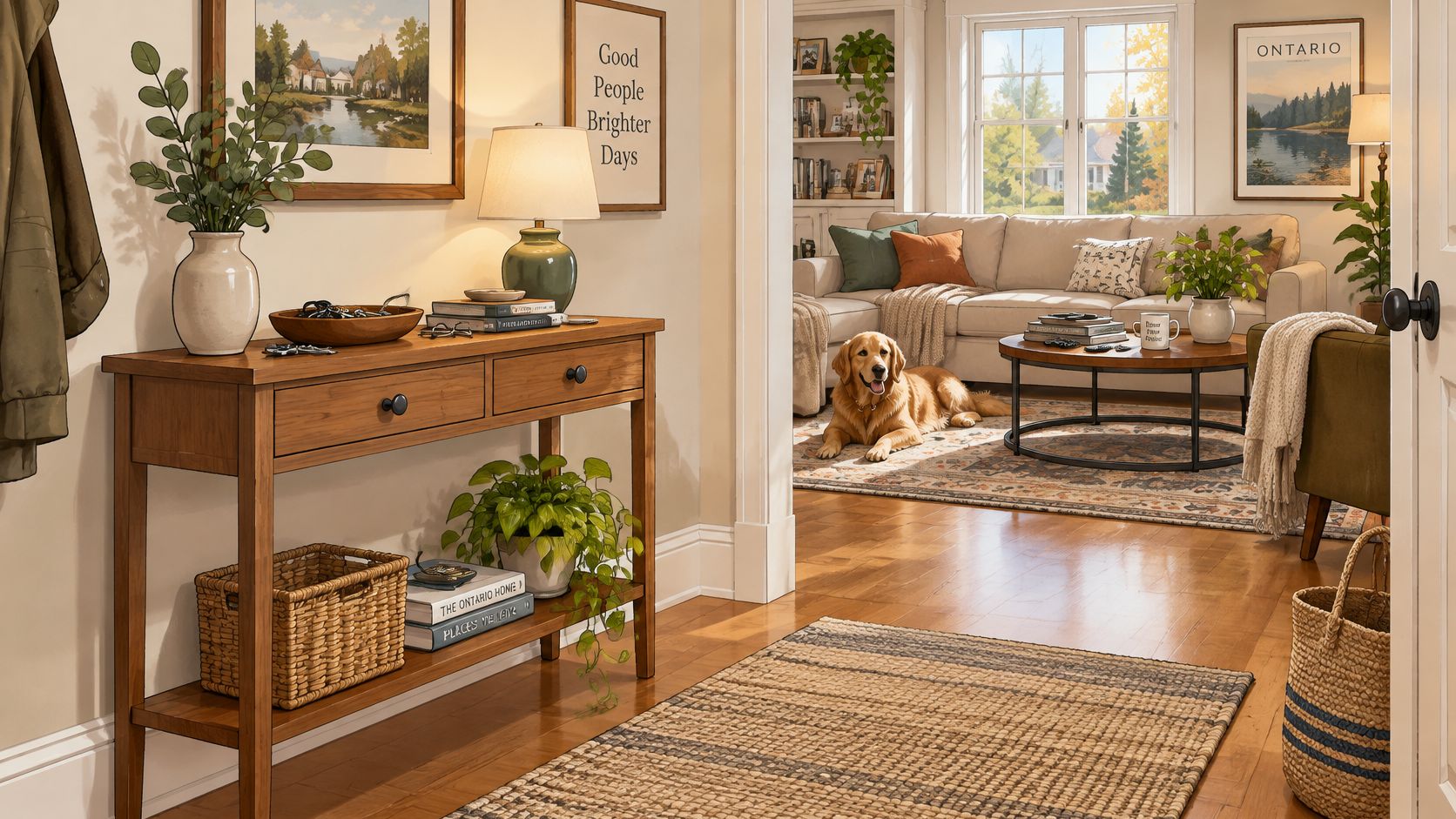
The definition is simple. A table with drawers is a work surface plus organised storage. The top does the visible task. The drawers prevent that task from becoming clutter.
One Daily Job Comes First
Readers often get stuck choosing a finish before naming the job. The better order is the reverse. Match the table to one daily job before falling for a finish.
Four jobs cover most homes. A console catches arrivals in a hallway or behind a sofa. A side table serves a seat with light, a book, and a place for a cup. A nightstand clears the bedside without forcing a reach in the dark. A coffee or work table stores what the room uses every day, from remotes to sewing tools.
For households weighing pieces that can shift rooms over time, guidance on choosing multi-functional furniture for modern homes helps test whether one well made piece can do the work of two.
A Niagara Example of Staying Power
Niagara has a long memory for this kind of furniture. The Canadian Museum of History's Harbinson Collection identifies a three-drawer work table made around 1840 in Vineland, in Ontario's Niagara Region, from walnut and white pine. It remained in the Moyer family through successive generations.
Its construction explains why. A two-board top rests on dovetailed cleats, which allow seasonal wood movement and help prevent warping. A stretcher base adds stability, and the three drawers supported organised household work beneath a broad surface for preparation or sewing.
The museum identifies the Niagara Region as one of the relatively few areas in Canada where groups of cabinetmakers developed distinctive regional designs over roughly sixty years. That is heirloom quality in practical form, not decoration for its own sake.
A drawer earns its place when it is opened daily without a second thought, and the top stays clear because the storage underneath is doing its job.
From that starting point, the path is clear. Choose the type and size for the room, judge materials by repair and indoor air, measure for safe clearance, style the piece within a complete room, then care for it well enough to keep it.
Types and Sizes for Each Room
Start with the lookup table, not with a finish sample. Pick one row that matches the room's job, then test that row against the actual wall, seat, or bed at home. Colour and hardware come after the footprint is right.
Tables with drawers by type and typical size
| Type | Width | Height | Drawer layout | Room job |
|---|---|---|---|---|
| Console or sofa table | 90 to 150 cm | 75 to 85 cm | One to three shallow drawers | Entry, or behind a sofa |
| Side or end table | 45 to 60 cm | 55 to 70 cm | One drawer, sometimes a shelf below | Beside a seat |
| Nightstand | 50 to 70 cm | Top within about 5 cm of mattress top | Two or three stacked drawers | Bedroom |
| Coffee table | About two-thirds of sofa length | 40 to 50 cm | One or two drawers, or a lift top | Living room centre |
| Work or hobby table | 120 to 150 cm | 73 to 76 cm | Drawer bank on one or both sides | Office, sewing or hobby |
How to Read the Dimensions
Three measurements confuse buyers most often, so it helps to name them plainly. Width is the face visible from the front. Depth is how far the piece comes into the walkway. Height must relate to the seat, mattress, or standing surface beside it, not to a catalogue photo.
A table can look modest online and still crowd a hall. Depth is usually the culprit. A few extra centimetres of depth matter more in a passage than a few extra centimetres of width along a wall.
Console and Sofa Tables
A console stays shallow for a reason. At about 30 to 45 cm deep and 75 to 85 cm high, it leaves passage in a hallway or behind a sofa while still offering a useful landing strip.
One to three shallow drawers suit mail, gloves, sunglasses, and chargers. Shallow is a virtue here. The contents sit in a single layer, so the drawer doesn't become a small, dark cupboard that nobody wants to search.
Behind a sofa, the same piece can hold a lamp and keep remotes out of the seat cushions. The top should sit near the sofa back height, so objects don't appear to float above the upholstery line.
Side Tables and Nightstands
A side or end table usually runs 45 to 60 cm wide, set near sofa arm height. A single drawer is often enough, because the top still needs room for a lamp base, a book, and a drink on a coaster. If the drawer is too deep, the table becomes storage that happens to have a lamp on it, and the proportions suffer.
A nightstand works differently. It runs about 50 to 70 cm wide and 35 to 50 cm deep, with the top within about 5 cm of the mattress top. That alignment lets a hand find the drawer pull in the dark without reaching up or down.
Two or three stacked drawers beat one deep bin at the bedside. The top drawer takes glasses, medication, and a charging cord. Lower drawers take books or spare linen, kept separate from the small items needed at 2 a.m. Households comparing bedside proportions can review a curated selection of contemporary night tables to see how drawer count changes the silhouette.
Coffee Tables and Work Tables
A coffee table should measure about two-thirds the sofa length and stand 40 to 50 cm high, close to seat height. One or two drawers, or a lift top, store remotes and coasters without turning the centre of the room into a chest.
A cavernous coffee table drawer creates its own problem. Board games, blankets, and magazines pile in together, and the weight makes the slide work harder every day. A shallower drawer with dividers stays usable.
A work or hobby table sits at desk height, 73 to 76 cm, with a drawer bank on one or both sides. Knee space matters as much as storage. A drawer bank on both sides suits sewing or paperwork done from a fixed chair. A single bank leaves more legroom for a chair that moves.
Practical rule: A deeper case stores more on paper, but items at the back are harder to reach and the piece steals circulation space. Usable storage beats maximum storage.
The right row is the one that fits the room's traffic and the body's reach. Once a row is chosen, measuring the wall and the walkway decides whether that row survives contact with the house.
How to Measure for Scale and Stability
A tape measure and ten quiet minutes prevent most returns. The routine below checks the closed case, the open drawer, and the path people walk. Each step has a reason, and skipping the drawer extension step is the most common mistake.
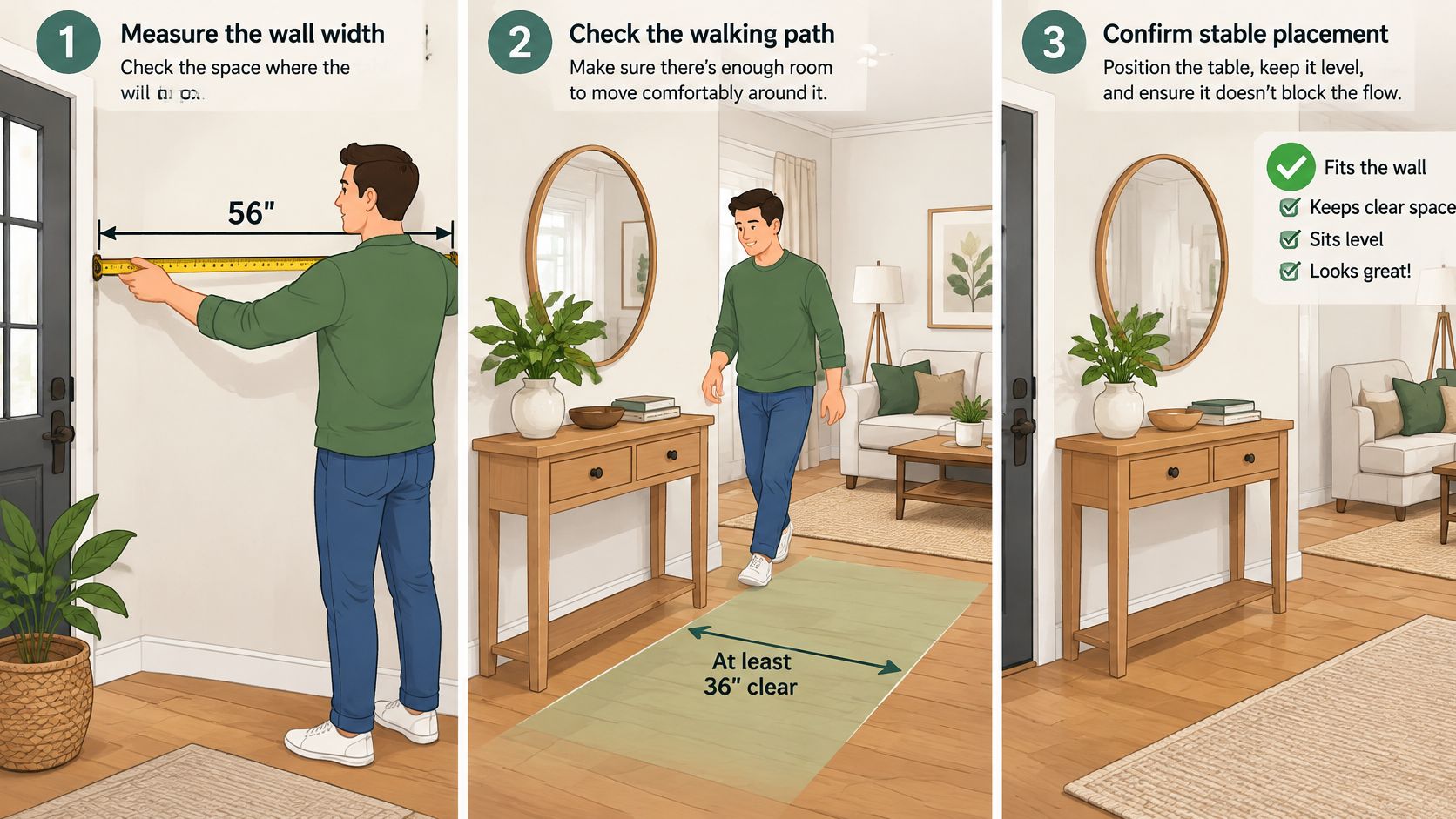
A Six Step Measuring Routine
- Measure the wall or the gap first. Note the full width available, then subtract baseboards, outlets, and heating vents. A table that covers a vent traps heat and dust, and a cord pinched behind a case wears quickly.
- Protect the walking path. Subtract the table depth from the route and keep at least 75 to 90 cm of clear passage on a main route. Shoulders, laundry baskets, and grocery bags need that room, not just a person walking carefully.
- Check a console behind a sofa as one unit. Add the sofa depth to the console depth, then confirm a path remains behind or beside the pairing. Keep the tabletop near the sofa back height so lamps read as part of the seating group.
- Measure a nightstand against the mattress. Measure from the floor to the mattress top, including bedding that stays on the bed. Choose a table close to that line, and leave room on top for a lamp base and a cord that doesn't drape across the drawer front.
- Set a coffee table by the seat, not the room's centre. Measure sofa length and seat height. Keep about 40 to 45 cm between the table and the seat so knees pass, and keep the top close to seat height, within about 5 cm of the seat cushion. A top far above the cushion feels like a desk. A top far below it forces a stoop for every cup.
- Open every drawer on the plan. Mark the extended drawer depth on the floor with painter's tape. Check that doors, chairs, drawer pulls, and heating vents still clear the open drawer, not just the closed case.
Households that want a refresher on tape technique before starting can follow a step by step guide on how to measure furniture and bring the finished numbers to the showroom.
Stability Is About the Open Drawer
A closed table can feel rock solid in a store and still be the wrong specification for a home with children. The risk appears when drawers open.
Health Canada's guidance on furniture tip-overs reports that furniture can become unstable when multiple drawers are open simultaneously because the drawers shift the centre of gravity forward. In plain terms, several loaded, extended drawers move weight beyond the footprint that is meant to support it. The tipping margin shrinks, and a child pulling or climbing adds force in the worst direction.
That mechanism leads to specific buying questions, not general worry.
- Base footprint: A wide, floor-contacting base is steadier than narrow legs or casters, especially on a taller case with stacked drawers.
- Drawer interlock: On a tall piece, an interlock that permits only one drawer to open at a time keeps the centre of gravity closer to the case.
- Restrained slides: Slides with positive stops prevent a drawer from travelling so far that its weight hangs unsupported.
- Wall anchoring: An anti-tip strap or angle brace anchored to a wall stud, or to an appropriately rated drywall anchor, holds the case if the forward load wins.
The Test That Matters
Static load capacity, the weight a top can hold while everything sits still, is only half the question. The fuller test is forward moment under the worst credible use. Several loaded drawers extended, plus a child pulling on the top drawer, describes a real afternoon in many homes.
Daily habits support the hardware. Drawers stay closed when not in use. Tempting items don't sit on top of an unsecured piece, because a favourite toy placed high invites climbing.
If an extended drawer blocks the only path through the room, the answer isn't to squeeze past it for years. Choose a shallower type and keep the passage.
Scale and stability aren't separate checks. A piece that fits the wall, clears the walkway, and stays steady with its drawers open is the piece that will feel right long after delivery day.
Materials, Finishes and the Value of Keeping It
The eye reads the top first. Value lives underneath it, in the drawer box, the slide, and the finish that has to survive cups, keys, and daily wiping. Judging those three parts before comparing price changes the whole conversation.
Drawer-table materials and what to verify
| Material | Look and repair | Care | What to verify |
|---|---|---|---|
| Solid walnut, oak or maple | Visible grain; scratches can be blended | Follow the specified oil, wax or varnish; avoid soaking | Species, joinery and whether the drawer box is solid too |
| Teak | Warm, oily, suited to indoor-outdoor pieces | Wipe; do not add a film finish without advice | Solid construction rather than a teak veneer over a core |
| Painted or lacquered hardwood | Crisp colour, design-forward | Soft cloth; no ammonia or abrasive pads | Whether paint hides an MDF or particleboard core |
| Hardwood plywood case | Stable panels, quieter grain | Keep edges sealed | Certification at the 0.05 ppm hardwood-plywood limit |
| MDF or particleboard drawer box | Smooth, economical | Do not soak; chipped edges swell | MDF 0.11 ppm, thin MDF 0.13 ppm, particleboard 0.09 ppm |
What the Materials Actually Do
Solid walnut, white oak, and maple take repair well. A scratch can often be blended into the surrounding finish because the grain runs through the piece, and the grain itself is the design. That's timeless craftsmanship with a practical payoff.
Teak behaves differently. It carries its own oils, which suit indoor and outdoor use, including a piece carved from solid teak root. It shouldn't be casually coated with a film finish, because the natural oil can fight adhesion.
Painted or lacquered hardwood gives crisp, design-forward colour for a room that needs a quieter silhouette. A chipped edge tells the truth about what's underneath, so it's worth asking whether the core is hardwood, MDF, or particleboard before purchase.
Hardwood plywood suits cases because layered panels stay dimensionally stable. MDF and particleboard make smooth, economical drawer boxes, but they swell if soaked and their edges don't forgive repeated knocks.
For readers comparing construction across a room, not just one table, a broader look at solid wood furniture shows how species and joinery choices repeat across cases, tables, and seating frames.
Emissions Documentation Worth Asking For
Engineered panels raise an indoor air question that a showroom label may not answer. Health Canada's guidance document on the Formaldehyde Emissions from Composite Wood Products Regulations cites maximum test limits of 0.05 parts per million for hardwood plywood, 0.09 ppm for particleboard, 0.11 ppm for MDF, 0.13 ppm for thin MDF, and 0.05 ppm for laminated products.
The regulations require regulated panels and laminated products to meet emission limits, with testing and third-party certification before compliant products can be imported or sold. Composite wood can emit formaldehyde continuously into indoor air, particularly in enclosed rooms with limited ventilation.
The practical request is straightforward. Ask for documentation identifying the panel type, certification, and applicable emissions class. A vague claim of low VOC doesn't carry the same weight. Solid wood or certified low-emitting panels, sealed edges, and low-emission adhesives reduce exposure potential.
Slides, Care, and the Cost per Year Test
Specify full-extension, soft-close slides with positive stops and replaceable metal guides. Full extension lets the back of the drawer be reached. A replaceable guide means a worn slide is a repair, not a reason to discard the table.
Care follows the finish. Dust along the grain so grit isn't dragged across it. Wipe spills at once and use coasters. Feed oil or wax only on the maker's schedule, and wipe lacquer with a damp cloth rather than polish. Vacuum drawer boxes, clear grit from slides, and tighten pulls before a loose screw enlarges its hole.
Price needs context. Statistics Canada's report on outfitting the home shows Canadian wooden-furniture prices increased 2.6% in 2025, while other furniture categories increased 1.6% and upholstered furniture decreased 0.9%.
That divergence makes cost per year of use a fairer test than ticket price. A repairable solid wood drawer with replaceable hardware can outlast a deeper disposable box by many years. A shallow drawer opened daily is worth more than a deep one that's avoided because nothing can be found in it.
Two questions settle the value argument. Can the piece be repaired rather than replaced? Can it move from entry to bedroom over a decade as the household changes? A table that answers yes to both is rarely the expensive choice.
Styling Tables with Drawers in a Finished Room
A table with drawers shouldn't be styled as a lonely object. It is one move in a complete room concept, where light, seating height, rug placement, and artwork all affect whether the piece looks settled or stranded.
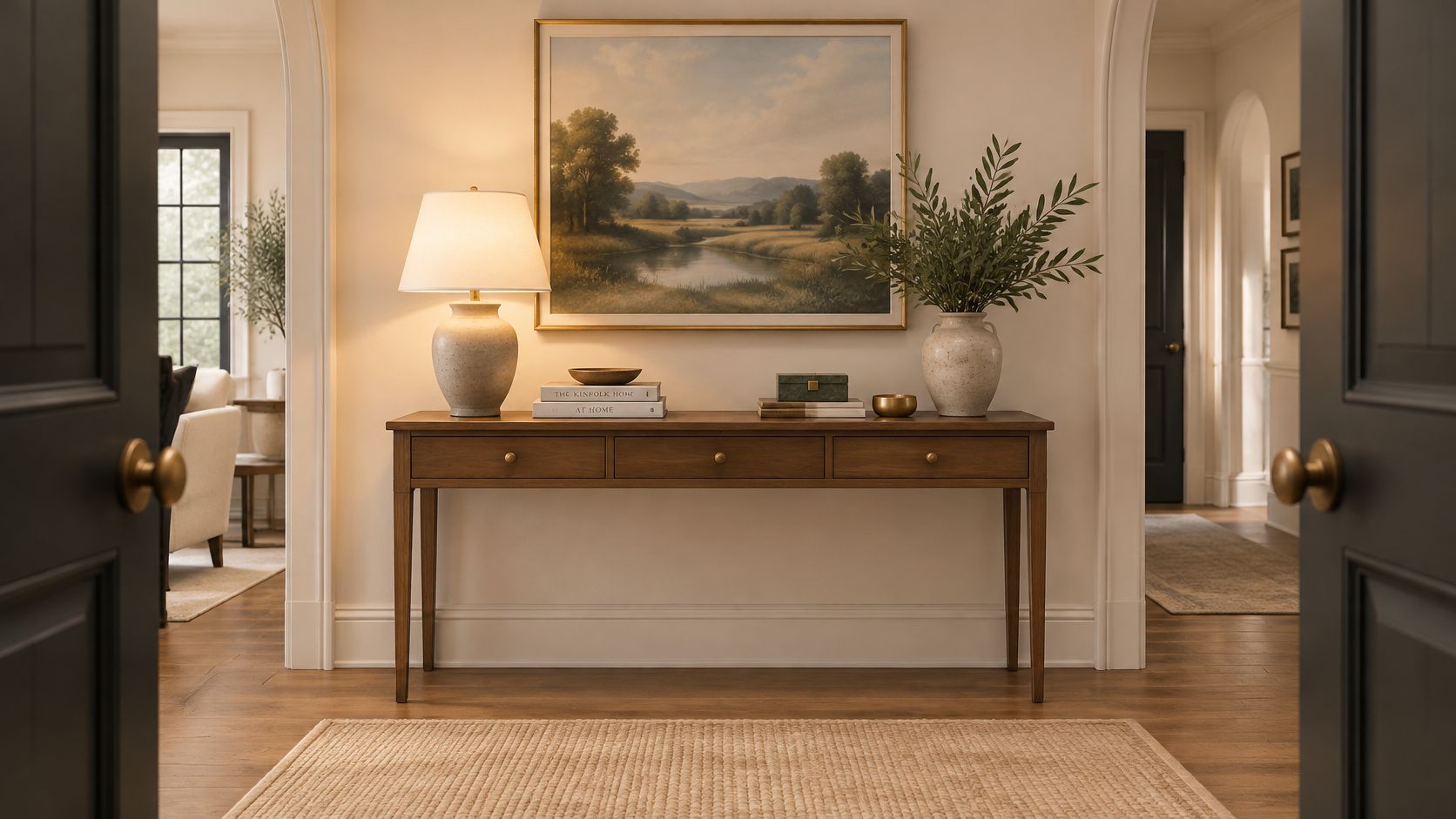
Entry and Living Room Placement
In an entry, place the console on the axis of the door so the first surface met on arrival is useful. Hang art so its centre sits near eye level above the tabletop, rather than floating too high with a gap that disconnects it from the furniture below.
A mirror serves the same wall differently. It checks a coat on the way out and pulls daylight deeper into a hall. Either choice works when the bottom edge relates to the tabletop instead of hovering.
Beside a sofa, align the lamp shade roughly with a seated person's eye line. Light falls on the book, not into the eyes. If the chair beside the table is already detailed, with tufting or a bold pattern, keep the drawer front visually quiet. One detailed element per grouping is usually enough.
For a coffee table, keep the top partly clear on purpose. One tray, one book stack, one object is a reliable edit. The drawers do the storage work, so the surface doesn't need to perform as shelving.
Bedroom Balance
In a bedroom, repeat the nightstand on both sides only when both sides of the bed offer the same reach and floor space. Symmetry forced into an asymmetrical room looks strained.
A single deeper chest on the wider side, paired with a smaller table on the narrower side, can balance an uneven plan. The lamps can still match, which holds the composition together while the storage differs.
Designer's Insight: Our designers suggest pairing a bold Hancock & Moore leather chair with a neutral hand-knotted wool rug so the table's wood grain can sit between them and balance the room's energy.
The Rug Sets the Foundation
A rug is art for your floor and the foundation of the room's palette. Choosing it before locking a wood finish prevents the common problem of a table stain that fights every textile in the room.
Placement follows one clean rule. The table legs sit either all on the rug or all off it. Two legs on and two off tilts a coffee table and makes a console look accidental. Shoppers exploring hand-knotted rugs in Ontario will find that a wool rug's colour can set the direction for upholstery and wood tone at once.
Style Families as a Lens
Style names help most as a lens, not a catalogue. Relaxed Comfort, New Traditional, Contemporary, Casual Traditional, and Uptown Style each suggest how much detail a drawer front should carry and how quiet the hardware should be.
A Stickley case reads as timeless craftsmanship beside quieter upholstery cloth. A Stressless chair wants a side table whose height meets the arm, not a low cocktail height that forces a reach down for a cup. A Magniflex mattress on a higher foundation changes the nightstand height the room needs, which is why furniture decisions connect.
Lifestyle imagery makes the point better than a product cut out on white. A finished room in a St. Catharines or Greater Niagara home, with window light falling across the tabletop, shows scale and shadow the way daily life will.
One final edit keeps the styling honest. Remove one object from the top for every drawer you're willing to use. If the drawers stay empty and the top stays crowded, the wrong table, or the wrong habits, came home.
See the Piece and Plan the Room
Measurements taken at home turn a showroom visit into a decision. Bring the wall width, the walkway clearance, the mattress or seat height, and the taped outline of an open drawer. Those four numbers narrow a large floor quickly and kindly.
A Family Business with Local Roots
The Greater Niagara Chamber of Commerce profile of Critelli Furniture reports that Joseph and his son Thomas Critelli founded the business in 1914 at the corner of Ormond Street and Albert Street in Thorold. The company expanded into downtown St. Catharines in 1939 and established a permanent location there in 1961.
In 2024, the family-run business marked 110 years in operation, with fourth-generation owner Joe Critelli and his daughter Julia, a fifth-generation family member, involved in leadership. That continuity matters for furniture meant to be repaired and kept.
From Showroom to Finished Room
Experience the craftsmanship in person at our King Street Showroom, serving homeowners across Greater Niagara, Hamilton, and Toronto who are searching for luxury furniture in Niagara with interior design services in St. Catharines. Opening a drawer in person tests the slide, the box joinery, and the finish in ways a photograph can't.
Book your complimentary design consultation today through the free interior design consultation page, so space planning, bespoke fabrics and finishes, and in-home advice can place the table inside a complete room. Critelli Furniture offers In-Home Design, Custom Order, Style Guides, Design Advice, and Meet Your Designers as design services.
Custom orders can change wood, finish, and configuration when a stock depth would block a door, reflecting custom furniture in Southern Ontario suited to a real floor plan. Visit the Rug Market to find your room's foundation, treating a hand-knotted rug as art for your floor before the wood colour is locked.
White-glove delivery then inspects, assembles, places, and removes packaging, so the piece moves from showroom to home without a gap. Critelli Furniture offers White Glove Delivery.
The decision line is short. If the drawer, slide, finish, and clearance all check out, order the piece that can be kept.
Bring the measurements, the room's daily job, and a willingness to open every drawer in person, and Critelli Furniture can match a table to the house it will serve for years. Experience the craftsmanship in person at our King Street Showroom, or book your complimentary design consultation today to plan the piece as part of a finished room, finished with white-glove delivery to Greater Niagara, Hamilton, and Toronto.