
Side Tables for Living Room Canada: A Buyer’s Guide

The lamp is still on the floor beside the sofa, and the reason is almost always the same: the table was bought for how it looked in a photograph, not for the height of the arm it serves. A mug ends up on the armrest, a phone charges on a stack of books, and a piece of furniture that should be invisible becomes a daily annoyance.
Choosing side tables for living room Canada households is mostly a measurement exercise with a design decision layered on top. The table has to work at arm's length, ten times a day, for whoever sits there now and whoever sits there in five years. It has to clear a recliner's footrest, survive a wet glass in February and road salt on the base in March, and sit properly on the rug rather than half off its edge.
What follows is the sequence a designer works through: heights that match the seating, placement that keeps the piece stable, materials judged on repairability, forms that adapt when the household does, and a rug that sets the composition every table in the room answers to.
Side Table Height and Size Chart for Living Rooms
Start with the arm, not the tabletop. Treat the 25 mm offset as a designer's rule of thumb rather than a code: close enough that a cup, lamp switch and remote land where the hand already rests, with allowance for cushions that compress once someone sits down. A table can be beautiful and still fail if every reach ends above or below the wrist.
Critelli Furniture's design team works in that order from its St. Catharines showroom: seat, arm, walkway and rug edge first, finish second, with In-Home Design and Custom Order support when the proportions are unusual. That matters in households that change. A soft sofa today may become a firmer chair, a recliner or a lift chair later, and the right size leaves room for that shift.
For accessible layouts, the Accessible Canada standards and technical guides database specifies table surfaces at 730 to 860 mm, places frequently used objects roughly 460 to 1,100 mm above the finished floor, cites CMHC's comfortable seated storage reach of 400 to 1,200 mm, and calls for 760 by 1,200 mm of clear floor in front of furniture used by wheelchair or scooter users. A conventional sofa-side table often sits below the accessible table range, but the reach envelope is still the honest test when grip, balance or mobility changes.
Print the chart below and carry it to the sofa.
| Seating or need | Height or reach to match | Width or diameter | Placement note |
|---|---|---|---|
| Sofa, arm 600 to 650 mm | 575 to 650 mm | 450 to 600 mm wide | Top within about 25 mm of the arm so a lamp, cup and remote are in reach |
| Armchair or recliner, arm 650 to 700 mm | 630 to 700 mm | 400 to 500 mm diameter | Keep the base clear of the footrest |
| Accessible design where required | 730 to 860 mm | 400 to 500 mm diameter | 760 by 1,200 mm clear floor in front for a wheelchair or scooter |
| Everyday objects from a seated position | 460 to 1,100 mm above the floor for used objects | A 400 mm tray or narrow top | Comfortable storage reach is 400 to 1,200 mm |
| Narrow condo walkway | Match the arm within about 25 mm | Narrower than the measured gap | Leave circulation so clothing and mobility aids do not catch |
Measuring Your Own Room in Three Steps
- Arm height. Run a tape from the finished floor to the top of the sofa or chair arm at the end where the table will sit. Cushions compress, so measure with someone seated if the seat is soft.
- Seated reach. From the cushion edge, measure forward and sideways to where a hand naturally falls. That arc sets the tabletop depth; anything deeper becomes a surface people stretch across.
- Walkway and rug edge. Measure the clear floor the table has to live in, then subtract its widest dimension and keep the remainder as circulation. Note where the rug edge falls, because a table half on pile and half on bare floor reads unsettled in the room.
A good fit is unremarkable in the best way. A lamp, a drink and a remote sit within reach without leaning, the footrest travels past without contact, and the table belongs to the same composition as the seating and rug rather than floating at the edge of it. Measure again when the seating changes; the right height for one chair is not automatically right for the next one.
Placement Rules That Keep Tables Stable and Clear
Start with the arrangement that causes the most trouble: a slim pedestal table squeezed between a recliner and a walkway, carrying a heavy ceramic lamp. The footprint is small, the load sits high, and the path past it is narrow. Any knock from a hip, a pet or a footrest lever now acts on a tall centre of gravity.
Health Canada names the mechanism plainly in its furniture and television tip-over guidance: top-heavy geometry, uneven flooring, heavy objects placed high, and climbing or pulling. A low side table is far less hazardous than a tall storage unit, but the same physics arrive once a narrow pedestal, a glass top and a substantial lamp are combined.
Run five checks before the table is considered settled.
- Confirm the base sits flat. Rock it gently on hardwood and on tile. Older Southern Ontario houses rarely have dead-level floors, and a table that rocks will eventually be leaned on in a way that shifts it.
- Keep the heaviest object lowest. Move dense decor to a lower shelf, or choose a broader tray table where the load spreads over a wider footprint.
- Route lamp cords away from trouble. Run the cord behind the table and away from the side where children and pets pass, so a pull cannot drag the lamp toward the edge.
- Leave circulation at the ends. Projecting legs catch clothing, handbags and mobility aids. Test the gap by walking past with your hands full.
- Anchor where it makes sense. For tables with drawers or tall shelves, Health Canada advises securing the piece to a wall stud or using heavy-duty anchors designed for the furniture type. The same guidance warns that legs and casters can raise the risk.
A wide drum table or a tray table with a low centre of gravity solves most of this by geometry alone. The piece looks quieter, and it stays put.
Stability check: a table beside a sectional is correctly placed when it sits within reach of the arm and clear of the path the seat's front edge travels when it reclines.
The vertical composition matters as much as the floor plan. A lamp shade, the tabletop and the bottom edge of the frame above the sofa read as one column, and frames hung too high break that relationship. For the wall above the seating, this guide to art placement advice for Denver homeowners explains the height ratios clearly, and the logic transfers to any room. Once the table and the art agree, the wider traffic pattern is the last thing to verify, and the principles in this guide to arranging furniture in a living room cover the distances between seats.
Finish with a walk-around test: circle the table, sit down, reach for the lamp, extend the footrest, and stand up again. A piece that survives all four without moving is placed.
Materials Compared for Daily Use and Canadian Seasons
A side table is often the piece a household keeps longest. It outlives two sofas and a rug, so the useful question isn't which finish photographs best. It's whether the surface can be repaired, refinished and passed on.
Repairability has moved from niche preference to mainstream purchase logic. A 2025 submission to a City of Toronto committee reported that nearly one-third of Canadians buy used items monthly and that 73% of those buyers do so to save money (Toronto committee communication file). Buyers who already think in second lives respond well to furniture built for one.
Canadian conditions test every material. Forced-air heating dries interior air through the winter, wet glasses leave rings on any finish that isn't protected, and salt tracked in on boots reaches metal bases and lower stretchers. Judge a table by how it behaves in February, not in a showroom in June.
| Material | Strengths | Watch for | Best fit |
|---|---|---|---|
| Solid hardwood (oak, walnut, maple) | Repairable and refinishable, long life | Seasonal movement in dry, heated homes | Traditional and transitional rooms meant to be passed down |
| Veneer over hardwood or board | Stable, lighter and more affordable | Chips at edges, cannot be sanded deeply | Design-forward rooms with steady humidity |
| Stone (marble, travertine) | Resists heat and moisture, striking surface | Heavy, can stain without sealing, cold to touch | Statement tables that stay in one place |
| Metal (steel, brass) | Slim, strong profile, long lifespan | Scratches, needs wiping after salted boots | Modern rooms and narrow spaces |
| Engineered board or laminate | Lowest cost, wide range of finishes | Swells after water rings, poor repairability | Light use and short-term rooms |
What Each Material Does in a Canadian Room
Solid hardwood is the only option on this list that a refinisher can restore. Oak, walnut and maple take a sanding and a new coat decades later, which is why a well-made piece in this group is worth paying for once. Expect small seasonal gaps in drawer fronts and joints through the heating season; they close again in summer humidity. Care guidance from the solid wood furniture side of the showroom comes down to stable humidity, a coaster and a wax or oil routine rather than a hard film finish.
Veneer earns its place when the substrate is stable and the edges are protected. It's lighter, more affordable and available in figured woods that solid stock can't supply at the same price. The limit is depth: a chip at a corner cannot be sanded out the way a solid top can, so buy with touch-up markers and keep the table away from door swings.
Stone resists a hot mug and a wet glass without complaint, and it will outlast every textile in the room. It also weighs enough that moving it becomes a two-person job, and unsealed marble will take a ring from a lemonade. Metal keeps a slim profile in a tight walkway and needs nothing more than a wipe after a winter's worth of salted boots. Engineered board does the job for a first apartment, and it is the one material on the list that will not survive a spill that sits overnight.
Five Questions to Ask Before You Buy
- Are touch-up kits supplied? A finish that can be spot-repaired saves a piece from a single clumsy evening.
- Can the finish be refinished? Ask what sits under the lacquer or the oil, and who can renew it locally.
- Are replacement parts available? Hinges, glides and drawer pulls fail first; confirm they can be reordered.
- How is the piece packaged? Good packaging predicts how the corners arrive, and whether you'll be disposing of a crate.
- What are the end-of-life or resale options? A durable design with documented materials has a second buyer.
Match the material to the household. A family with young children and a busy walkway does best with solid wood or a low metal frame and a forgiving finish. A downsizing couple in a condo gains more from a stone top that never needs refinishing. A renter moving every few years should choose light veneer or metal over a heavy solid piece that's punishing to carry.
Table Types Matched to Your Household
Say a couple buys a condo near the lake with a sectional, a narrow hallway and a reading chair that has already moved twice in a year. The first side table they bought was perfectly proportioned for the wall it started against. It has been in the wrong place ever since.
Household composition changes, and it's worth planning for. Statistics Canada publishes annual data on private households by household size through 2025 (Statistics Canada household size table), a reminder that the number of people reaching for the table is a planning variable rather than a backdrop. Side tables for living room Canada condos and century homes rarely need the same piece, and that's the point.
Nesting tables tuck into one footprint and expand when guests arrive, which suits a sectional with two open corners. C-shaped and cantilevered tables slide over a sofa arm and leave the floor clear, the practical answer when the walkway is measured in centimetres. Lift-top tables raise the surface to laptop or dinner height for one, useful in an open plan where the sofa doubles as a desk. Wheeled or lightweight tables follow the furniture when the layout changes, which matters in a rental where nothing stays put.
| Household situation | Recommended type | Why it works |
|---|---|---|
| Small condo with narrow walkway | C-shaped or cantilevered table | Slides over the sofa arm and frees floor space |
| Reading chair with no side surface | Lift-top or drum table | Holds a book, a cup and a lamp at one height |
| Sectional with two open corners | Matched pair of nesting tables | Expands for guests and tucks away when not needed |
| Layout changes often or renting | Wheeled or lightweight table | Moves with the furniture without marking floors |
| Mobility or reduced-reach needs | Stable drum table with a 730 to 860 mm top | Wide base and rounded edges for independent use |
Critelli Furniture's living-room floor includes end and nesting tables built for exactly these arrangements, from nesting side tables that collapse into one footprint to broader drums that hold a lamp without moving.
The contrarian view: the perfectly proportioned designer table is not always the most useful one. A visually quieter, movable piece that adapts when the sofa moves will outlive a fixed statement table chosen for a wall that no longer exists.
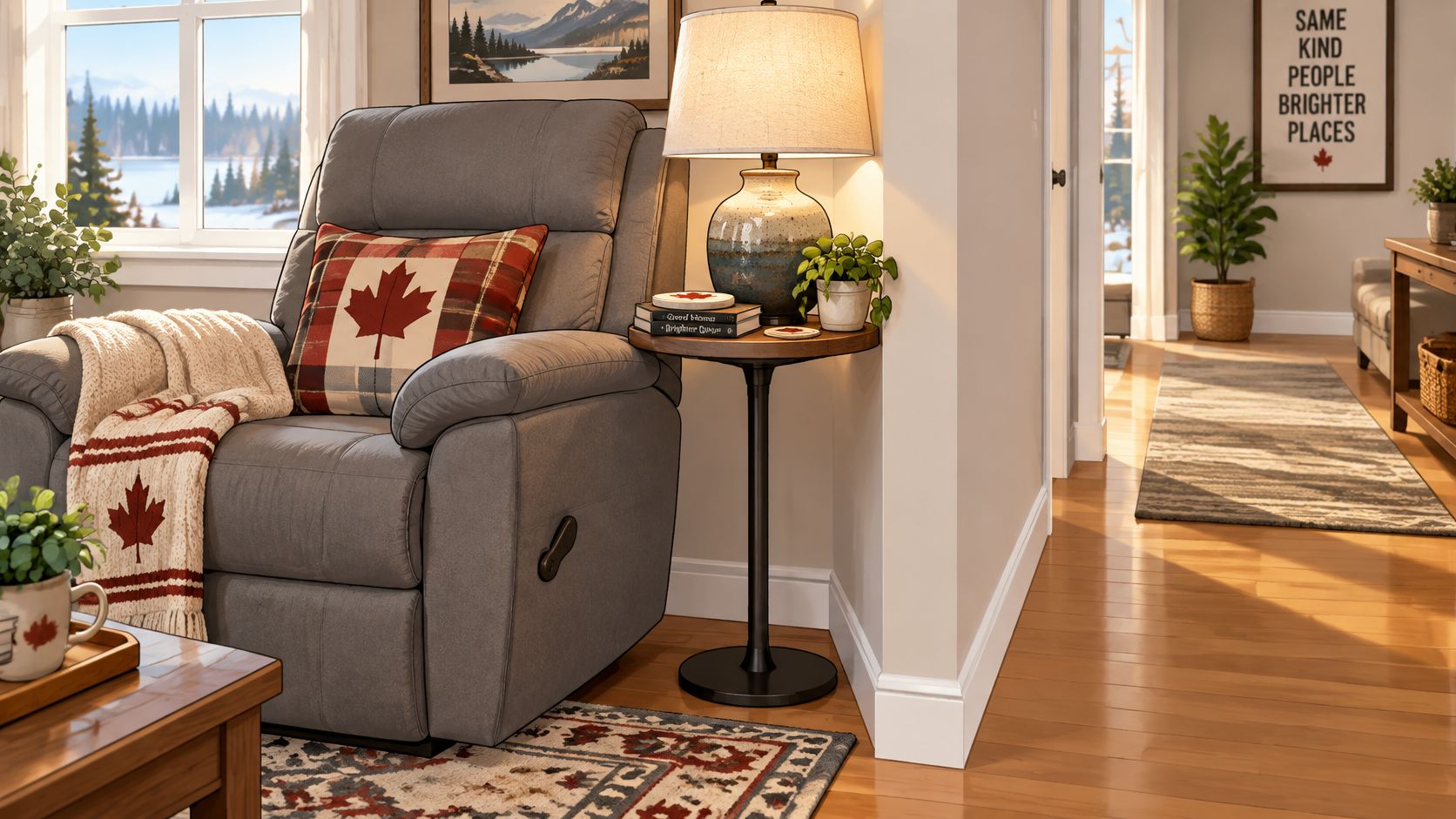
A styled room shows the target. The table sits at arm height, the lamp anchors it, and nothing crowds the path around the sectional.

Three Questions Before You Choose
Ask how often the table will move, because a piece that relocates monthly needs to be light. Ask who reaches it most, since the shortest seated reach in the household sets the usable top. Ask what sits on it every day, because a permanent lamp, a glass of water and a stack of books is a load case, not a styling choice.
Mixed households usually need two answers. Choose the primary table for the heaviest daily use, then add a small folding or tray piece for the occasional need: a second guest, a bowl of snacks, a laptop for an hour.
Building the Room Around Your Rug
The rug comes first. Critelli's Rug Market treats rugs as "Art for Your Floor," the foundation on which a room's colour palette and character are built, with hand-knotted artisanal pieces sourced from across the globe alongside contemporary statement designs and traditional heirloom styles (Critelli Furniture showrooms). A side table selected after the rug responds to something real. One selected before it competes with everything.
The principle is simple: the table answers the rug. Its pattern, weave, colour temperature and degree of formality set the brief, and the table either echoes that brief or deliberately counters it.
Four Pairings That Work
A bold patterned rug wants a quiet solid-colour table, in warm wood or neutral stone, so the eye settles on the floor rather than fighting across two busy surfaces. A hand-knotted wool rug with soft texture pairs beautifully with a metal or leather-wrapped base, where the hardness of the material contrasts the softness underfoot.
A traditional heirloom rug suits a classic pedestal or turned table in a matching wood species, and the pairing reads as inherited rather than assembled. A contemporary statement rug carries a sculptural drum or a stone top, where the table's form does the talking and its colour stays quiet.
Colour temperature does the quiet work. Warm rugs with rust, camel or olive grounds suit warm woods like walnut and oak. Cool grey and blue grounds sit more comfortably with brushed metal, pale stone and ebonized finishes.
Scale decides placement. A side table should sit fully on the rug or fully off its edge, never straddling the boundary, so the seating group reads as one composition rather than a collection of objects. The clearance rules that govern that placement are set out in this guide to rug placement in a living room.
Designer's Insight: pair a bold Hancock & Moore leather accent with a neutral hand-knotted wool rug to balance the room's energy. The leather carries the colour, the rug carries the texture, and the side table stays quiet enough to let both work.
A cream sofa, a teal chair and a patterned rug show how the balance looks when the table plays a supporting role.
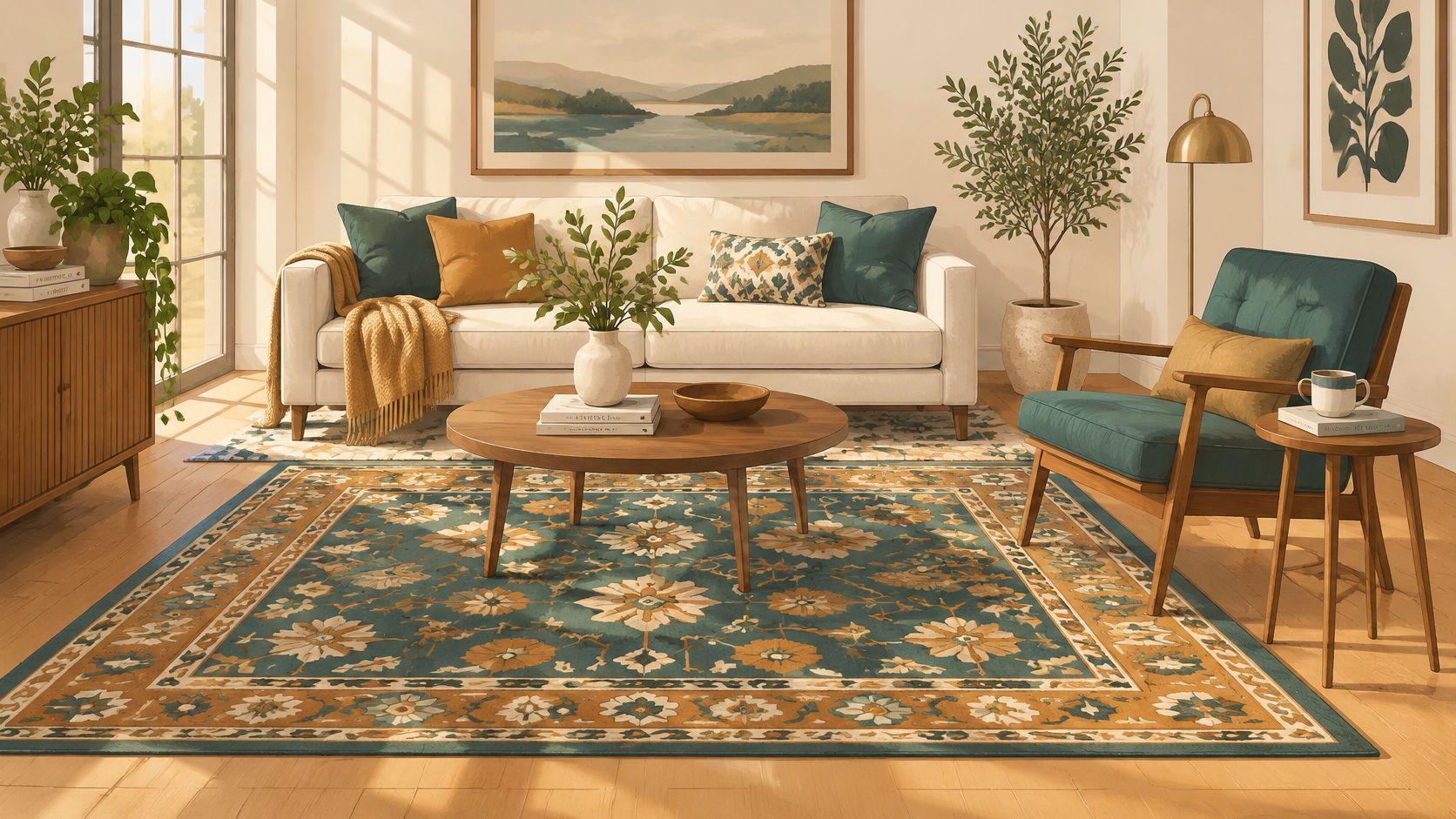
Texture extends beyond the floor. Layered throws in cashmere or wool change how a room reads in winter, and this Cashmere Boutique home decor guide covers how to layer them without crowding a seating group. Before deciding, do the test that settles most arguments: carry a rug sample to the table candidate in the showroom and stand them side by side in daylight. Colour temperature that looks correct online often shifts under window light.
From Showroom to Finished Room
A table chosen beside the actual sofa and rug arrives with its decisions already made. The height was checked against a real arm, the finish against a real rug, the footprint against a real walkway, so the piece lands inside a plan instead of a guess.
Delivery then runs as a sequence rather than a drop-off. Critelli Furniture's white-glove service covers the Greater Niagara, Hamilton and Toronto markets, and the team handles four defined tasks: inspection, assembly where required, precise placement in the room, and removal of all packaging.
The Handover, Step by Step
- Inspection before it leaves. The piece is checked over before it travels, so a chip or a loose fitting is caught in the showroom rather than in your hallway.
- Assembly where required. Bases, stretchers and hardware are fitted by the delivery team, which removes the risk of a leg that was never fully tightened.
- Placement in the chosen room. The table goes where the measurements said it should, checked against arm height and walkway rather than left wherever the doorway allowed.
- Packaging removed. Cartons, foam and wrap leave with the team, so the room is showroom-ready when they go.
Each step removes a job the homeowner would otherwise handle alone: the tightening, the lifting, the cardboard leaning in a corner for weeks. That is the difference between a delivery and a finished room.
Critelli Furniture has been family-run since 1914, and the shop's approach to delivery rests on a simple rule: measure before anything moves. Precise placement only works when the destination was decided in advance, so the tape on the floor matters as much as the van at the curb.
That planning buys adaptability. A table set with clear walkway room today still works when the seating is rearranged, when a recliner or lift chair joins the group, or when a wider path is needed for a mobility aid later. Placement that respects the room's composition outlives any single arrangement of it.
Before delivery: mark the planned footprint with painter's tape, then walk the path from the hallway to the sofa. If the tape crowds the walkway or sits too far from the arm, the fix costs nothing at that stage and a great deal afterwards.
Book a Complimentary Design Consultation
Three actions cover everything this guide has asked you to measure.
See the candidates in person at the King Street showroom, 126 King Street in St. Catharines, with free parking on site; call 905-684-8108 to arrange a visit. Book a complimentary design consultation through the In-Home Design service, and a designer will measure arm height, seated reach and the walkway in your own living room, then try table options beside the actual sofa. Finish at the Rug Market, where a hand-knotted, contemporary or heirloom rug can sit next to the table candidate so colour temperature, scale and formality are decided as one composition.
Households change, so tell the designer what is coming. A lift chair, a walker, a sectional that may rotate next year: a consultation that plans for mobility and layout shifts will point you toward a C-table or a nesting pair now, saving a second purchase later. Financing is available when the order grows beyond a single table, and white-glove delivery covers the Greater Niagara, Hamilton and Toronto markets.
A side table that matches the sofa but fights the walkway will be moved within a month; the one that fits the arm, the footrest and the rug will stay for decades. Critelli Furniture has furnished Southern Ontario homes for over a century, with living-room seating, end and nesting tables, hand-knotted rugs and a design team that measures before recommending. Visit Critelli Furniture to see the collection at 126 King Street in St. Catharines and book a consultation that starts with a tape measure.