

Dining Room Lighting Contemporary: Elevate With

A dining room can be beautifully furnished and still feel unsettled. The table is the right size, the chairs are comfortable, the rug is handsome, yet the room falls flat at dinner because the light is too harsh, too dim, or in the wrong place.
That problem shows up often in Southern Ontario homes. A lofty condo in Toronto asks for a different lighting approach than a brick heritage house in St. Catharines. Older homes across the region often come with lower ceilings and less predictable daylight, and many pre-1980s homes have 8 to 9 foot ceilings with limited window orientations, conditions that become more noticeable during Niagara’s 40% shorter winter daylight hours, as noted in this discussion of low-ceiling dining room lighting considerations.
A well-composed lighting plan doesn’t decorate around those realities. It responds to them. In a complete room concept, lighting is not the finishing touch. It’s one of the elements that determines how every other piece is perceived, from wood grain and upholstery to artwork and the character of hand-knotted rugs.
Illuminating Your Vision for Contemporary Dining
Contemporary dining rooms succeed when the lighting feels intentional. That doesn’t mean cold, sparse, or overly architectural. It means the fixture belongs to the room, the scale is disciplined, and the atmosphere can shift gracefully from breakfast to evening entertaining.
In heritage neighbourhoods throughout Niagara, many dining rooms were never designed for today’s fixture sizes. Ceiling heights can be modest, trim details can be prominent, and natural light may come from only one direction. In those spaces, a generic showroom choice often feels too bulky or visually noisy. The better move is a fixture with a cleaner profile and stronger proportion.
Why contemporary lighting works in regional homes
Contemporary style is especially useful because it edits rather than overwhelms. A slim pendant, a restrained chandelier, or a crisp linear suspension can sit comfortably in a room with original millwork, plaster details, or older window placement. It adds freshness without erasing the house’s history.
That balance matters if you’re deciding where your room sits stylistically. If you're weighing classic detailing against cleaner lines, this guide to contemporary vs traditional design styles is a helpful way to clarify the overall direction before choosing a fixture.
A dining room rarely feels “off” because of one dramatic mistake. More often, the proportions are slightly wrong, the bulb tone is too cool, or the fixture ignores how the room actually receives daylight.
Start with the room, not the fixture
The strongest dining room lighting contemporary schemes begin with three observations:
- Look at the ceiling line: If the room has a lower ceiling, avoid anything with excessive vertical layering or dense ornament.
- Read the daylight pattern: North-facing rooms often need warmth and softness by late afternoon, especially in winter.
- Consider what the room does daily: A formal room used only on holidays can tolerate a more sculptural statement. A room used for homework, family meals, and hosting needs better range.
Design-forward rooms gain their polish through the lighting. The light doesn’t merely brighten the table. It supports the architecture, flatters the materials, and gives the room the sense of permanence that heirloom quality interiors always have.
Understanding Contemporary Lighting Styles
Contemporary lighting changes with the current design conversation. Modern lighting refers more specifically to a historical design language, often tied to mid-century silhouettes. Traditional lighting leans into ornament, familiar candle forms, and more formal detailing. Contemporary sits between those worlds with more freedom.
That freedom is what makes it so useful. It can be sculptural without being busy, minimal without feeling severe, and warm without relying on old-fashioned motifs.
Contemporary versus modern versus traditional
A quick distinction helps when you’re shopping or speaking with a designer.
| Style | What it tends to look like | Best use in a dining room |
|---|---|---|
| Contemporary | Clean lines, updated forms, mixed materials, restrained drama | Homes that blend current taste with timeless craftsmanship |
| Modern | More specific iconic shapes, often mid-century influenced | Rooms with strong architectural clarity and simpler furnishings |
| Traditional | Decorative arms, classic chandeliers, formal symmetry | Interiors built around historic detailing or richer ornament |
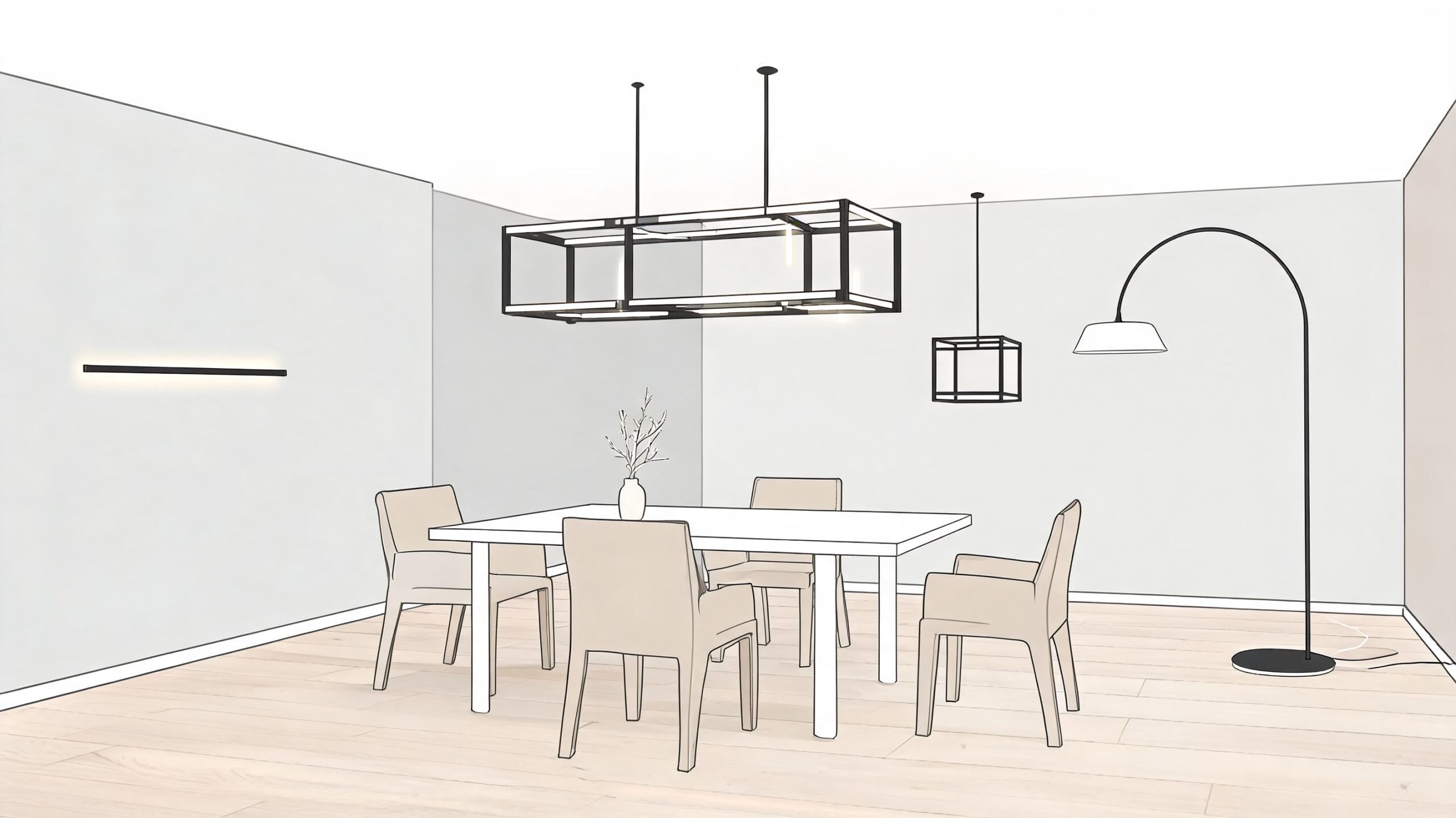
Contemporary fixtures often borrow from both ends. You might see a chandelier with a classic central structure, but rendered in matte black metal and opal glass. Or a pendant that uses natural wood, smoked glass, or brushed brass in a quieter, more architectural way.
Hallmarks worth looking for
The easiest way to identify a strong contemporary piece is to study its discipline. It usually has one idea and executes it well.
Look for:
- Clean geometry: Circles, rectangles, cylinders, and linear bars read as current because they don’t overcomplicate the silhouette.
- Material contrast: Metal paired with glass, stone, or wood adds depth without excess.
- Edited finishes: Matte black, soft brass, bronze, and muted metallics tend to integrate more elegantly than high-shine finishes.
- Visual lightness: Especially in smaller rooms, open-framed or slim-profile fixtures feel more refined than dense, heavy forms.
A good place to build visual vocabulary is a collection of modern pendant lights, where the distinctions between sculptural, linear, globe, and architectural forms become easier to read.
Practical rule: If a fixture is the first thing you notice and the only thing you continue to notice, it may be too dominant for the room.
The forms that work best now
Current dining rooms often favour a few fixture families.
A linear suspension works beautifully over a rectangular table because it follows the table’s shape and distributes light more evenly. A soft geometric chandelier suits round and oval tables where you want the fixture to gather the room rather than direct it. A cluster pendant can be compelling in rooms that need a little movement or asymmetry.
The key is that contemporary style should still feel settled. Design-forward isn’t the same as attention-seeking. The best pieces feel bespoke because their shape, finish, and visual weight all respond to the room around them.
Selecting and Placing Your Dining Room Fixture
Lighting can either make a dining room harmonious or cause it to fall flat. A beautiful fixture in the wrong size or at the wrong height won’t read as intentional. It will feel awkward.
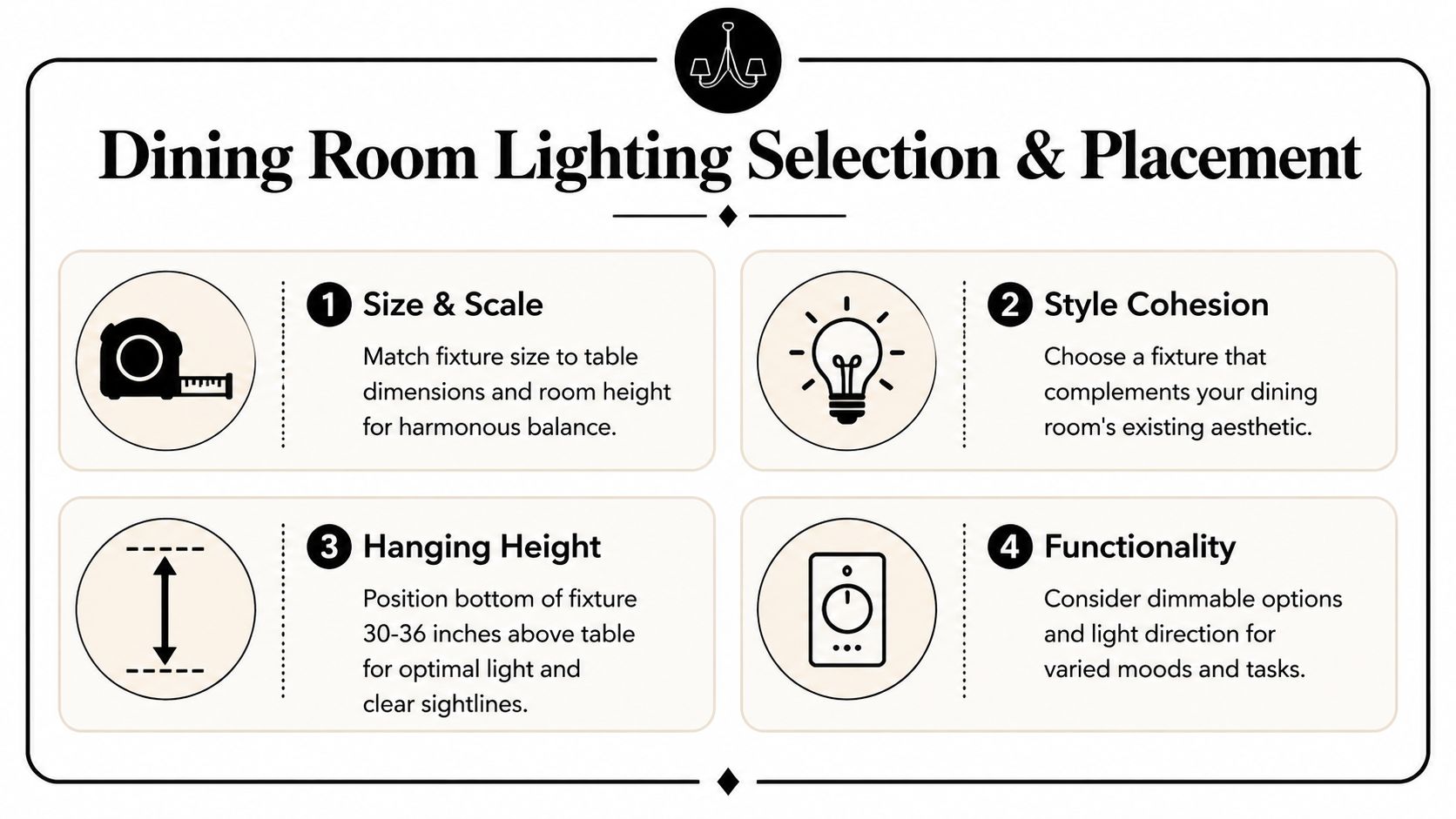
In Southern Ontario, one guideline remains especially reliable. The two-thirds rule is widely used in contemporary dining rooms, meaning the fixture’s width should be about two-thirds of the table’s width, as outlined in this guide to dining room light sizing rules. The same source also notes the strong preference for warm white LEDs in the 2,700 to 3,000K range with CRI above 80, and reports that this shift appears in 65% of renovated homes.
Get the width right
A fixture should relate first to the table, then to the room. People often reverse that and buy according to ceiling area alone, which is how dining lights end up floating like an afterthought.
Use these rules of thumb:
- For rectangular tables: Linear fixtures usually feel more resolved than a single small centred pendant.
- For round tables: Round chandeliers, globe clusters, or circular frames often create better visual harmony.
- For narrow rooms: Open designs help preserve breathing room and prevent the fixture from feeling compressed.
If you’d like to compare silhouettes, a gallery of dining room lighting pendants makes it easier to judge visual weight, not just dimensions.
Set the hanging height with discipline
Placement matters as much as selection. In most dining rooms, the bottom of the fixture should sit about 30 to 36 inches above the tabletop. That height keeps the light intimate while preserving sightlines across the table.
Too high, and the room loses focus. Too low, and guests feel as if they’re dining under an obstacle.
A few practical adjustments help:
| Condition | Better approach |
|---|---|
| Lower ceiling | Choose a shallower fixture and stay strict about visual clearance |
| Long rectangular table | Use a linear fixture or multiple pendants with careful spacing |
| Heavy fixture material | Hang slightly higher within the recommended range if the form feels dense |
| Open-concept room | Keep the fixture low enough to define the dining zone |
The light should gather people around the table, not interrupt the conversation above it.
Match the shape to the table
This sounds obvious, but it’s often applied too rigidly. You don’t need a perfect shape match. You need a relationship that feels composed.
A rectangular wood table with substantial presence often benefits from a linear fixture with some structure, such as a bar form, elongated lantern shape, or balanced series of globes. A round pedestal table can take a chandelier with a softer outline or a central sculptural form. Oval tables are more forgiving and can suit either a linear fixture or a rounded piece, depending on the room’s architecture.
Respect the room’s character
Contemporary design works best when it acknowledges what’s already there. In a heritage home with detailed trim, plaster medallions, or older door casings, a severe industrial fixture may feel abrupt. A cleaner chandelier with warmth in its finish will usually integrate more gracefully.
In a newer condo, the opposite may be true. A room with very simple architecture often needs a fixture with more presence, otherwise the space can feel underdressed.
Common mistakes are surprisingly consistent:
- Oversizing for drama: Statement lighting can be excellent, but oversized pieces often shrink the room visually.
- Ignoring chair height and seated views: What looks striking while standing may feel intrusive when you sit.
- Choosing style over light quality: A beautiful silhouette with poor light distribution won’t serve the room.
- Forgetting the table surface: Glass, polished stone, and glossy finishes reflect light differently than wood, so glare should be considered.
A simple decision sequence
If a client is uncertain, the order of decisions should stay straightforward.
- Measure the table first
- Study the ceiling height and room width
- Choose the fixture family
- Select the finish
- Confirm bulb tone and dimming
- Hang and test it in evening conditions
That last step matters more than many people expect. Dining rooms live differently at 7 p.m. than they do at noon. A fixture should be judged in the hours when you’ll use it.
Creating Layers of Light for a Complete Room Concept
At 4 p.m. in January, a St. Catharines dining room can already feel like evening. In a Niagara heritage home with deep window casings, mature trees outside, and higher plaster ceilings, the overhead fixture has to do more than look right above the table. It has to carry the room through short winter days, grey lake light, and the warmer glow people want once dinner begins.
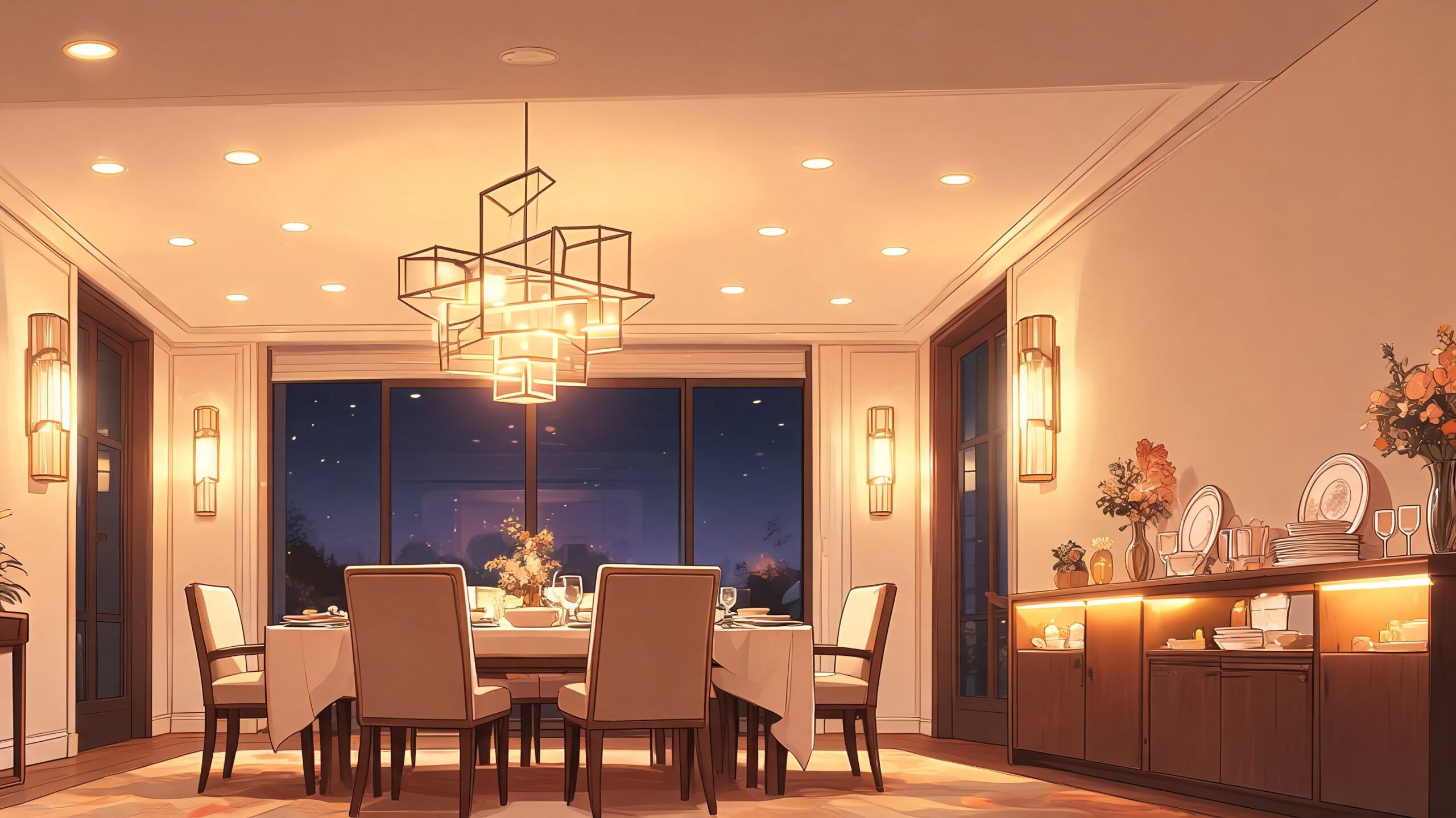
A single fixture over the table is necessary. It rarely finishes the room. The strongest schemes use ambient, task, and accent light together so the space feels settled at night and still reads clearly on a dim afternoon. Professional guidance recommends about 300 lux for task areas on a dining table, and according to this overview of dining room lighting ideas and dimmer use, 92% of Ontario households now use smart dimmers in dining spaces, up from 25% in 2010. That change reflects how people live. They want one room to serve a family meal, a holiday gathering, and a quiet coffee the next morning.
Ambient light sets the room’s tone
Ambient light gives the room its overall brightness and mood. In many dining rooms, the chandelier or pendant provides most of it, but in older Niagara houses that light often disperses unevenly because of ceiling height, darker millwork, or room proportions that are longer than they are wide.
The goal is balance. Too much overhead brightness flattens the architecture and leaves everyone feeling on display. Too little, and the corners disappear in a way that feels gloomy rather than intimate.
Task light supports how the room is used
Dining rooms are working rooms. Platters are served here. Homework lands here. Someone trims flowers on the table five minutes before guests arrive.
That is why directed light matters. Recessed ceiling lights on a separate circuit, a shaded lamp on a sideboard, or discreet wall lights near cabinetry can all support the table without competing with the main fixture. In heritage settings, I often prefer adding light at the perimeter instead of forcing the chandelier to solve every problem from the center of the ceiling.
Accent light adds depth and respects the architecture
Accent light gives the eye somewhere to travel. It can pick up artwork, a panelled wall, a cabinet interior, or the texture in limestone, brick, or old wood trim common in the region’s traditional homes. This layer matters even more in contemporary dining rooms set inside older architecture, because it helps the newer fixture feel connected to the room instead of suspended in isolation.
For homeowners refining more than one space, many of the same layered principles apply beyond the dining room. Our guide to putting your living room in the best light shows how supporting layers create cohesion across adjoining rooms. For a broader primer on how professionals design with layered lighting, Golden Lighting offers a useful overview.
Build scenes that match the hour
Good lighting plans are set up in scenes, not as one fixed brightness level. Southern Ontario light changes quickly across the day and across the seasons, so the dining room should respond just as gracefully.
A practical scheme usually includes:
- Daytime support: enough fill light to balance cloudy natural light without fighting it
- Everyday dining: warm, moderate light centered on the table, with softer perimeter glow
- Entertaining: stronger overall illumination with artwork, a buffet, or shelving gently lit
- Evening intimacy: lower levels, reduced glare, and enough contrast to keep the room atmospheric
Where many schemes fall short
The most common mistake is relying on one bright chandelier and calling the room done. Even an excellent fixture can feel harsh after dark if nothing else supports it.
The second problem is overusing recessed lights. They can help, particularly in older rooms with uneven daylight, but too many downlights pull attention away from the table and wash out the character of the architecture. A complete room concept should make the dining table feel anchored, the furnishings look considered, and the room hold its character from noon to night.
Mastering Bulbs, Controls, and Smart Technology
A fixture gives the room form. The bulb and control system determine whether that form performs beautifully. Here, dining room lighting contemporary decisions become practical, because the wrong lamping can make even an excellent fixture feel clinical.
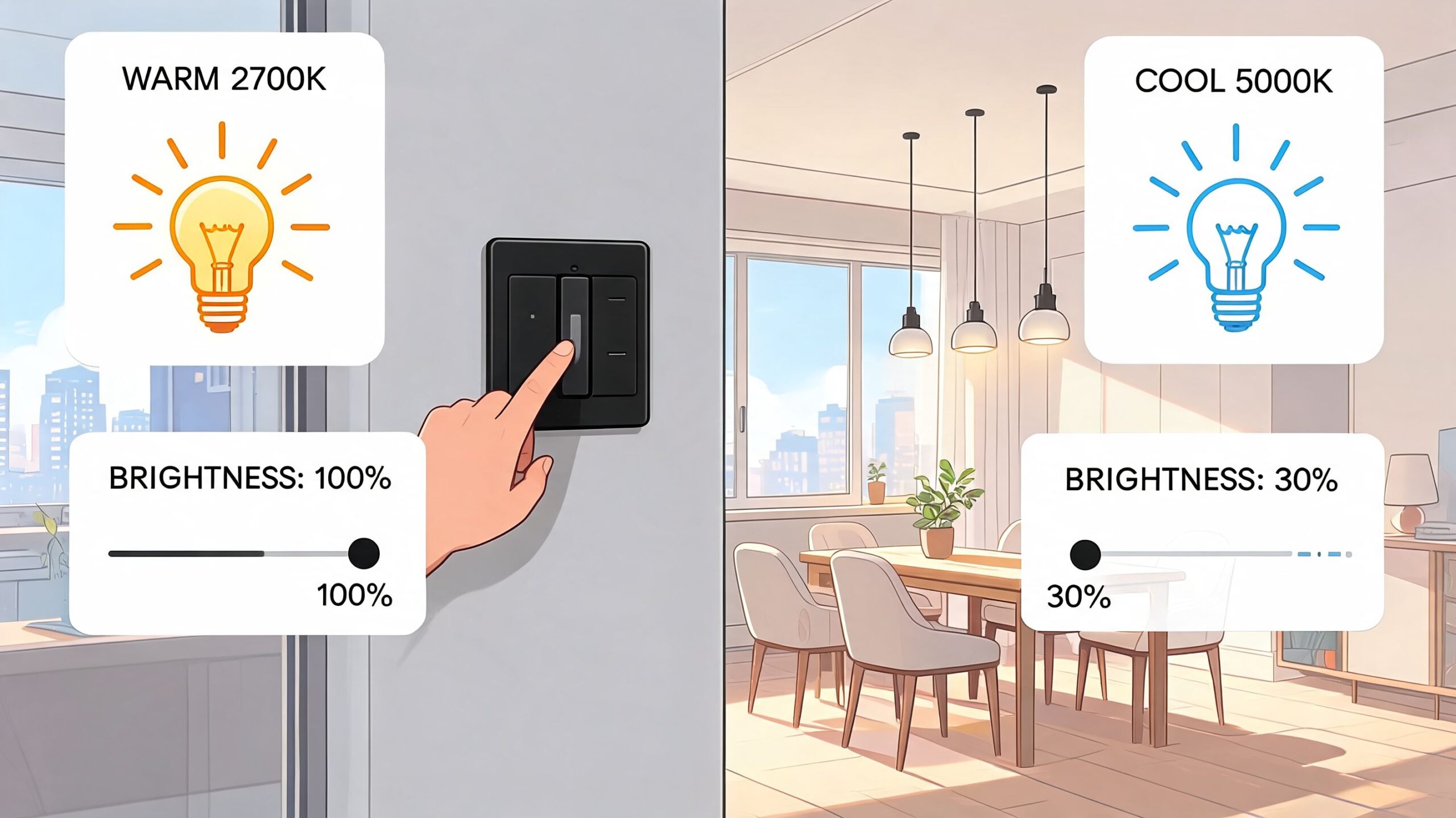
The most useful starting point is colour temperature. In dining rooms, the warm range tends to be the most flattering. Tunable systems can be appealing, but a warmer tone is still often preferred for the room by evening.
Kelvin and why warmth matters
Kelvin tells you whether the light will appear warmer or cooler. For dining, a warmer tone is usually more forgiving on faces, food, wood finishes, and textiles.
A cooler white might seem crisp in a store or online image, but in a home dining room it often feels too sharp after dark. Warmth creates invitation. It softens hard edges and supports the kind of atmosphere people desire when they sit down to stay awhile.
CRI and the look of materials
CRI, or Colour Rendering Index, matters because it affects how accurately colours appear under artificial light. In practical terms, that means your walnut table, artwork, upholstery, greenery, and dinner itself all look more convincing under a better light source.
If you’ve ever noticed a room that looked fine in daylight but slightly lifeless at night, poor colour rendering is often part of the issue. Contemporary interiors with natural materials depend on this more than people realise.
Good dining light should flatter oak, brass, linen, skin tone, and food at the same time.
Dimmers are not optional
A dining room without dimming is missing one of the simplest tools in interior design. The same fixture should serve a bright lunch, a quiet midweek dinner, and an evening with guests. Without control, it can only do one of those well.
Dimming also helps bridge Southern Ontario’s shifting daylight conditions. Rooms in Niagara and St. Catharines can feel dramatically different from summer to winter, and controls let the room adapt instead of forcing one fixed setting year-round.
Smart systems and energy management
Smart controls are no longer just a novelty. They’re increasingly useful because they combine convenience with cost awareness. According to this overview of smart dining room lighting options, rising Ontario Time-of-Use hydro pricing has increased interest in Matter-compatible systems, and these systems can reduce dining room energy bills by 20 to 30% when programmed for off-peak use and tunable settings.
That matters in everyday practice. A homeowner can set an early evening scene that uses less intensity, shifts to a warm tone, and avoids waste without sacrificing atmosphere.
A few features are worth prioritising:
- Scene setting: Save preferred brightness levels for dinner, entertaining, or daytime use.
- Compatibility: Matter-enabled systems simplify integration with broader smart home platforms.
- Tunable warmth: Helpful when a room receives little natural light in winter.
- Reliable wall control: App control is useful, but a handsome wall dimmer still matters in daily life.
What works and what doesn’t
The strongest systems are often the quietest. A well-made LED with warm output and excellent dimming performance will usually outperform a more complicated setup that offers endless novelty but poor light quality.
What tends not to age well is lighting chosen for gimmick rather than atmosphere. Dining rooms benefit from restraint. Smart technology should disappear into the experience, not announce itself every time someone sits down.
Coordinating Lighting with Furniture and Decor
Lighting should never be chosen as an isolated object. It belongs to a conversation with the table, the chair silhouettes, the rug, the wall treatment, and the finishes that repeat through the room.
Many otherwise attractive dining rooms frequently lose their composure concerning their lighting. The fixture may be fashionable, but it doesn’t echo anything else in the space. It feels imported rather than integrated.
Start with the dominant visual weight
Every room has one element that carries the most weight. In a dining room, that is often the table. A substantial wood table with visible grain and heirloom quality presence can handle a fixture with structure and material depth. A lighter table with slim legs often prefers a fixture that feels airy and edited.
The same logic applies to chairs. Upholstered dining chairs with curved backs can soften a geometric pendant. More angular chairs may benefit from a fixture with some roundness to keep the room from becoming too rigid.
Let the rug anchor the choice
A hand-knotted rug is often the room’s quiet organiser. Pattern, tone, and texture all influence how a fixture should behave overhead. If the rug has movement, the light can be calmer. If the rug is restrained, the fixture can carry more personality.
That’s why many designers refer to rugs as Art for your Floor. They aren’t background. They establish the room’s visual tempo.
For a broader perspective on how art and interiors inform one another, these Colorado Art Services design insights offer a useful reminder that a room feels more convincing when each element supports a larger point of view.
Use finish as a unifying thread
Metal finish is one of the easiest ways to create cohesion without becoming too matched. If the room includes warm wood, bronze or aged brass often feels settled. If the space is cooler or more architectural, blackened metal or a muted metallic finish can sharpen the composition.
Avoid making every finish identical. That usually reads less curated and more formulaic. Repetition should be deliberate, not literal.
Designer’s Insight
Our designers suggest pairing a strong geometric fixture with a quieter hand-knotted wool rug when the dining chairs already carry pattern or visual texture. The contrast keeps the room sophisticated and prevents every surface from competing for attention.
A few pairings tend to work reliably:
- Sculptural chandelier with simple table: Good when the room needs a focal point.
- Linear pendant with rectilinear furniture: Useful when you want order and architectural clarity.
- Soft globe fixture with upholstery with clean lines: Helps balance cleaner-lined furniture.
- Textural rug with restrained lighting: Lets the floor provide richness while the fixture provides shape.
The best rooms feel curated because nothing is shouting. Each piece knows its role.
From Curation to Installation The Critelli Advantage
Choosing dining room lighting contemporary isn’t difficult because there are too few options. It’s difficult because every worthwhile option has consequences for proportion, mood, sightlines, finishes, and how the room lives through the seasons.
That’s why homeowners often benefit from a guided approach rather than a quick online decision. A complete room concept asks better questions. How does the light relate to the rug? Does the fixture support the architecture? Will it still feel right in February at six o’clock, not just on a bright afternoon?
For anyone planning a full-room update, professional support helps connect those decisions. This is especially true in homes across Niagara, Hamilton, and Toronto, where architecture varies so widely. Thoughtful installation matters too. Even a beautiful fixture can disappoint if it is hung poorly or paired with the wrong controls. For a general look at what professional installation involves, these lighting installation service notes are a useful reminder that the final result depends on execution as much as selection.
A heritage brand brings a different kind of reassurance to that process. Since 1914, a family-run business builds trust by understanding how people live with the pieces they choose. It isn’t only about sourcing a design-forward fixture or an heirloom quality table. It’s about composing the room so every element feels resolved, then carrying that experience through delivery and placement with the same care.
That’s where complimentary design services become valuable. They connect furniture, lighting direction, materials, scale, and finish into one bespoke plan. White-glove service completes the experience by making the transition from showroom to home feel organised, considered, and calm.
The end result is not just a well-lit dining room. It is a room with timeless craftsmanship, a clear point of view, and the ease that comes from getting the details right the first time.
Experience the craftsmanship in person at Critelli Furniture, where a century-old St. Catharines legacy, curated selection, Interior design services St. Catharines, and white-glove delivery come together for homeowners across the Greater Niagara, Hamilton, and Toronto markets. Book your complimentary design consultation today, or visit the Rug Market to find your room’s foundation.