
Elevate Your Home With a File Cabinet With Desk

A well-appointed home office often begins with a frustration. The printer is tucked into a corner, papers migrate across the desktop, and the filing cabinet feels like an afterthought brought in after the room was already finished. The space works, technically, but it doesn’t belong to the house.
A file cabinet with desk solves that problem when it’s chosen as furniture, not equipment. In a design-forward home, storage should support the room’s architecture, the way you work, and the tone of the rest of the interior. It should hold legal files, charging cords, and project folders without looking like it came from a back office.
That’s been part of our philosophy in St. Catharines for generations. Since 1914, our family has approached home furnishings as a long-term composition, where comfort, finish, proportion, and utility all matter together. A desk with integrated filing isn’t just a place to answer emails. It can become the anchor of a private study, a refined corner of a great room, or the quiet engine behind a beautifully organised household.
The Art of the Integrated Workspace
A client usually realises the difference between “office furniture” and a furnished office at the same moment. It happens when they stand in a room that already has handsome millwork, thoughtful lighting, and a rug with real presence, then try to place a generic desk and a separate metal cabinet into it. The proportions fight each other. The finishes don’t relate. The room loses its calm.
That’s why an integrated approach works so well. When the filing element is built into the desk, or paired with it in a deliberate way, the room reads as resolved. The practical pieces disappear into the design instead of interrupting it.
Many homeowners start by gathering inspiration from custom storage and millwork examples. If you’re weighing built-in versus freestanding solutions, these creative home office cabinet ideas are useful for understanding how cabinetry can shape both workflow and atmosphere. The same principle applies to a freestanding file cabinet with desk. It should feel intentional from every angle.
Why integrated pieces feel more at home
A single, cohesive workspace tends to do three things well:
- It quiets visual clutter by reducing the number of unrelated forms in the room.
- It improves daily rhythm because files, stationery, and technology stay within reach.
- It supports longevity since a furniture-grade piece can evolve with the room rather than needing replacement the moment your needs shift.
In our design conversations, the better question isn’t “Where can I fit a cabinet?” It’s “What kind of room am I trying to create?” A study with library character calls for a different solution than a compact workspace off the kitchen or a dual-purpose guest room.
A beautiful office doesn’t hide function. It composes it.
If you’re furnishing a room that needs to serve more than one purpose, our guide to multifunctional home office furniture offers a helpful framework for balancing storage, seating, and surface space without sacrificing elegance.
The strongest spaces don’t treat work as an intrusion into the home. They give it a proper place.
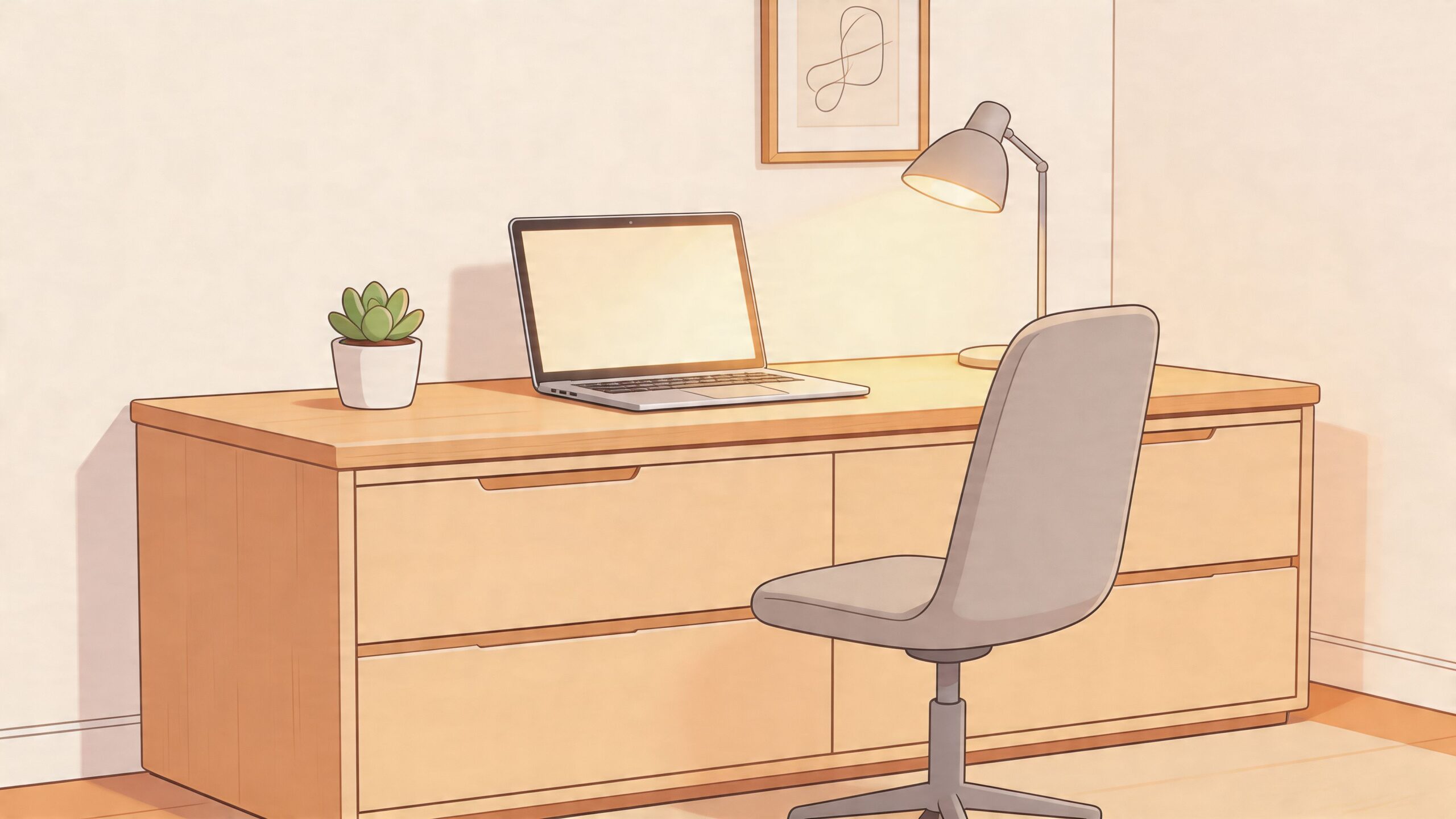
Beyond Utility Defining the Modern File Cabinet Desk
The modern file cabinet with desk has deeper roots than many people realise. It didn’t begin as a decorative object. It began as a serious answer to a serious problem: too much paper, too little space, and far too much time wasted retrieving documents.
The idea was always about efficiency
The vertical filing cabinet was patented in 1902 and proved to save 61% of office space over older systems, according to the history summarised by Workiro’s filing cabinet overview. In the same regional period, clerical jobs rose 25% from 1891 to 1901, which helped drive demand for compact, efficient filing. By the 1920s, over 40% of Niagara-area offices used these hybrid units, linking storage and work surface in a way that still feels familiar today.
That history matters because it explains why the best desk-file combinations still outperform makeshift arrangements. They were never random pairings. They were designed to keep work flowing.
Critelli was established in 1914, right in that broader era when office and household furnishings were becoming more specialised. In Southern Ontario, that legacy still resonates. Good furniture has always answered practical needs, but the enduring pieces also bring order and visual restraint.
What makes the modern version different
Today’s file cabinet with desk isn’t confined to one look. It can be mid-century in line, contemporary in profile, or understated traditional. What matters is integration.
A strong modern example will usually do the following:
- Unify storage and surface so drawers feel built into the composition, not bolted on.
- Support technology gracefully with space for cords, task lighting, and devices.
- Respect the room through better proportions, cleaner lines, and furniture-grade finishes.
Mass-market discussions often focus narrowly on utility, but a more useful lens is how the piece lives in a home. That’s where resources discussing a home office desk with storage can help frame the broad categories, even if the final decision for a refined interior comes down to better materials, scale, and detailing.
Practical rule: If the filing portion looks like a separate object trying to disguise itself as part of the desk, it probably won’t age well in the room.
The shift from office equipment to furniture
The best integrated desks now sit in a middle ground that didn’t always exist. They still perform like serious work pieces, but they’re styled to belong in principal bedrooms, family rooms, libraries, and open-plan living spaces. That’s a meaningful shift.
For clients building out a polished workspace, we often suggest starting with forms that already read as residential. A piece such as the contemporary desk and office collection shows how clean-lined desks can carry storage without taking on a commercial feel.
The modern file cabinet desk works because it solves an old problem in a more graceful way. That’s why it endures.
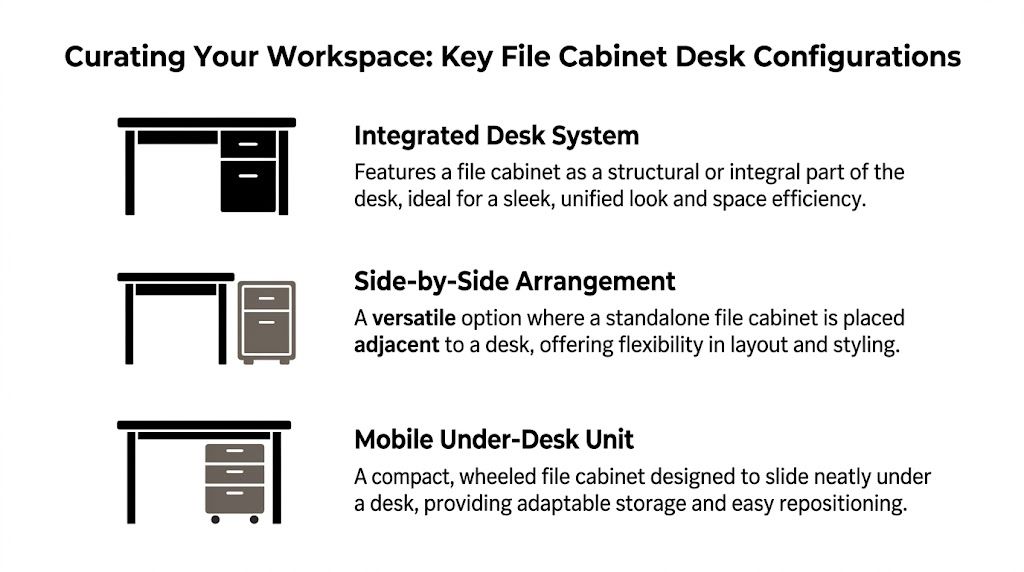
Curating Your Workspace Key Configurations Explored
Choosing the right file cabinet with desk begins with configuration. Most disappointments come from selecting the wrong format, not the wrong finish. A desk can be beautifully made and still fail the room if the footprint is too heavy, the storage is in the wrong place, or the layout forces awkward movement through the day.
The material spec matters just as much. Under Canadian benchmarks relevant to trade clients, premium desk configurations often use 1-inch thick thermally fused laminate, which resists moisture absorption by 70% compared to veneers and helps prevent the warping and drawer misalignment that affects 25% of lesser-quality units in Southern Ontario’s humidity, as outlined in Bush Business Furniture’s product specifications.
Pedestal desks
A pedestal desk remains the classic choice. The filing drawers sit beneath one or both sides of the work surface, giving the piece a grounded, architectural presence.
This format works well in a study, den, or any room where the desk should read as a permanent anchor. It’s often the best choice for clients who keep active paper files close at hand and prefer a more traditional work posture. The visual weight can be an asset in larger rooms, especially when paired with substantial seating and layered lighting.
Its limitation is flexibility. Once placed, it usually wants to stay put. In a smaller room, two full pedestals can also make the base feel closed in.
L-shaped desks with integrated storage
An L-shaped configuration suits the homeowner who manages multiple zones of work. One plane can hold the computer, lamp, and writing area, while the return handles filing, reference materials, or a printer.
This is often the most efficient layout for professionals who spread out. It can also define a workspace within an open-concept room without needing walls or screens. If the room has enough breadth, the shape creates a sense of command without looking oversized.
The caution here is footprint discipline. L-shaped desks need thoughtful placement so they don’t choke circulation or crowd windows. They reward proper planning and punish guesswork.
Mobile pedestal pairings
The mobile pedestal is the quiet overachiever. It tucks beneath or beside a desk, gives you filing where you need it, and can shift if the room changes.
This is a strong solution for multipurpose spaces and for clients who want a lighter visual profile. It also works well when a desk is chosen first for its form, then complemented with discreet storage. The trade-off is aesthetic cohesion. Unless the pedestal is carefully matched in finish, scale, and hardware, it can look temporary.
One option in this category is the Bolden Desk With File Cabinet, which combines desk surface and file storage in a furniture-forward form rather than a purely utilitarian one.
If your room has to function as both office and living space, the least bulky solution often looks the most sophisticated.
Desk configuration comparison
| Configuration Type | Best For | Storage Capacity | Footprint |
|---|---|---|---|
| Pedestal Desk | Dedicated studies and traditional offices | High, with filing built directly into the base | Moderate to large |
| L-Shaped Desk | Multi-tasking workflows and corner layouts | High, with room for files and equipment | Large |
| Mobile Under-Desk Unit | Flexible rooms and lighter visual layouts | Moderate, usually focused on active files | Compact |
What works and what doesn’t
Some practical patterns show up again and again:
- Works well when the filing side matches your dominant hand and daily routine.
- Works poorly when drawers open into a walkway or conflict with door swings.
- Works well when the desk’s material can tolerate seasonal humidity changes.
- Works poorly when veneer edges and low-grade substrates begin to swell or shift.
- Works well when the desk feels scaled to the room’s architecture, not just to a vacant wall.
Configuration is never just a floor-plan decision. It’s the point where workflow and design either support each other or start to compete.
Measuring for Timeless Placement and Workflow
A file cabinet with desk can look perfectly proportioned in a showroom and feel awkward at home within minutes. The issue usually isn’t style. It’s placement. People measure wall width, then forget about chair movement, drawer projection, radiator clearance, window trim, and the route they take through the room every day.
A useful baseline comes from integrated desk sizing. A standard 72W x 30D desk can provide up to 35 sq ft of effective workspace, according to the specifications discussed by Techni Mobili. In Niagara homes, where floor settling can affect stability, models with powder-coated steel legs tested to resist 300 lbs of lateral force offer added reassurance. The same source notes that integrated locking cabinets have been shown by WSIB Ontario to reduce unauthorised access incidents by 60% in home offices.
The measurements that matter first
Before choosing a desk, measure the room in layers, not just in one dimension.
- Start with the envelope. Note wall length, baseboards, window casings, floor vents, and outlets.
- Measure the operating zone. Account for drawer extension and the space your chair occupies when pulled back.
- Mark the walk path. You should be able to move through the room without sidestepping around open drawers.
- Check the sightlines. In a beautiful room, the desk shouldn’t block the best window or interrupt the room’s focal point.
Workflow is part of the floor plan
A well-placed desk lets you reach what you need without constant twisting. That sounds obvious, but it’s where many attractive offices fail. If your active file drawer is on the side you access least, or if the printer forces you to stand and pivot across the room every few minutes, the setup will wear on you.
Place the items you touch daily within one seated reach pattern. Everything else can live in secondary storage.
This matters even more when the room doubles as a library, guest room, or sitting room. The desk has to support work without taking over the room’s movement.
A quick placement checklist
Use this before a final decision:
- Chair clearance: Make sure your seating can move freely without striking a wall or cabinet.
- Drawer clearance: Open every file and utility drawer in your mind before the piece arrives.
- Door swing: Check nearby doors, including closet and French doors.
- Surface depth: Confirm your screen, lamp, and writing area can coexist comfortably.
- Floor stability: In older homes, favour sturdier leg and base construction where settling is a concern.
For clients who want to avoid expensive measuring mistakes, this room-planning guide on how to measure furniture is worth reviewing before you order.
Good measurement is what allows a desk to feel inevitable once it’s installed. Not squeezed in. Not compromised. Exactly right.
The Art of Material and Finish Selection
Materials decide whether a file cabinet with desk matures beautifully or starts looking tired long before it should. In premium interiors, the desk doesn’t live in isolation. It sits near upholstered seating, casegoods, art, lighting, and often a rug with real character. If the finish is flat, the hardware generic, or the grain pattern unconsidered, the piece will always feel slightly unresolved.
That’s one reason the market has shifted away from disposable office furniture. A 2025 Niagara Region Home Office Survey found that 68% of St. Catharines-area homeowners prioritise locally sourced, heirloom-quality storage, while custom wood office furniture has shown 42% higher resale value in Greater Niagara, as referenced in the source material connected to Best Buy’s under-desk filing category. The appetite for better furniture is real.

Hardwood, veneer, and high-performance surfaces
Solid hardwood and fine veneers still bring the most warmth to a residential office. They develop presence through texture, grain variation, and finish depth. For many homeowners, that’s what turns a desk from useful to memorable.
High-performance laminates have their place too, especially in contemporary rooms or demanding work environments. The better versions are stable, clean-lined, and easier to maintain. The important distinction isn’t wood versus laminate in the abstract. It’s whether the material matches the room and the demands of daily use.
Hardware changes the character
Drawer pulls, locks, and metal accents often get less attention than they deserve. Yet hardware is what your hand touches every day, and visually it can push a desk traditional, architectural, or softly contemporary.
Look for hardware that does one of two things well:
- It disappears elegantly, letting the cabinet fronts read as uninterrupted planes.
- It contributes intentional detail, adding contrast and rhythm without becoming decorative noise.
Finish should relate to the whole room
A desk finish doesn’t need to match every other wood tone in the room. It does need to converse with them. Walnut can sit beautifully with warm oak. Sycamore can brighten a darker corner. Painted finishes can sharpen a room that already has enough visual grain.
Designer’s Insight
Our designers often begin with the rug, not the desk. A hand-knotted wool rug acts as Art for your Floor and gives you a palette to work from. Rich walnut or cherry can sit beautifully over a quieter rug ground, while lighter woods benefit from a rug with stronger pattern and tonal depth.
That complete room thinking is what separates a furnished office from a collection of pieces. It also helps when selecting from long-lasting wood species and furniture-grade construction. If you’re comparing options, this guide to choosing the right hardwood for longevity and style offers a useful foundation.
What to avoid
Certain choices rarely age well in a refined interior:
- Busy faux wood patterns that repeat obviously across drawer fronts.
- Shiny, lightweight hardware that feels detached from the scale of the piece.
- Finishes chosen in isolation without considering flooring, drapery, or adjacent upholstery.
The best desks feel settled from the day they arrive. Materials are the reason.
Integrating Your Desk into a Cohesive Room Concept
A file cabinet with desk should anchor the room, not interrupt it. The strongest home offices treat the desk as one part of a complete composition that includes seating, lighting, textiles, storage, and negative space. When those elements are chosen together, the room feels calm even when the workday is not.
That design discipline has old roots. The commercial rollout of xerography in 1950 caused a 300% increase in paper volume in the Niagara region from 1950 to 1960, which drove demand for integrated desk-file solutions. By 1955, Critelli’s King Street showroom was stocking over 500 desk-file combinations annually, according to the historical material linked through Consentia’s filing history article. Storage had to become more advanced because the paperwork did.

Start with visual balance
A desk with integrated filing has more mass than a simple writing table. That means the rest of the room should answer it appropriately. If the desk has a strong wood presence, soften the setting with upholstery, drapery, and layered light. If the desk is visually light, perhaps on a slim metal base, add grounding elsewhere through a substantial chair or rug.
One common mistake is letting the office zone become all hard surfaces. The room quickly turns cold. A refined office needs absorption and texture.
Let the rug establish the room
Consequently, the Rug Market becomes indispensable. We often describe rugs as Art for your Floor because they do more than fill space. They establish colour relationships, absorb sound, and give the desk a defined setting within the room.
A hand-knotted rug can do several jobs at once:
- Frame the desk area so it feels purposeful inside a larger room.
- Introduce pattern and softness around angular cabinetry.
- Bridge finishes between wood tones, upholstery, and painted surfaces.
Build a room, not a workstation
A cohesive office often includes one or two pieces that have nothing to do with filing but everything to do with comfort. A reading chair, a side table, a floor lamp, or art placed at seated eye level can shift the mood from task-based to residential.
The office that gets used most is usually the one that still feels welcoming after business hours.
This is especially important in homes across Greater Niagara, Hamilton, and Toronto where a workspace may sit within a principal suite, a family room extension, or an upper landing. The desk has to carry responsibility without becoming visually dominant.
A room concept asks better questions than a product search ever will. How should the room feel at night? What do you see first from the hall? Does the desk belong to the architecture? Those are the questions that lead to durable design.
The Critelli Difference From Bespoke Design to White-Glove Delivery
A file cabinet with desk is easy to underestimate. It seems like a practical purchase until you realise how many decisions shape whether it feels ordinary or carefully considered. Configuration affects workflow. Measurement affects comfort. Material affects longevity. Finish affects whether the piece belongs to the room five years from now.
That’s where a heritage approach matters. In a family-run firm that has served Southern Ontario since 1914, furniture is never treated as an isolated object. It’s part of a complete room concept. The desk has to relate to the architecture, the rug, the lighting, and the way the household functions.
Why full-service guidance matters
The value of bespoke design isn’t novelty for its own sake. It’s precision. A customized desk solution can respond to room scale, storage habits, aesthetic preferences, and the practical realities of daily use. That’s especially important for clients furnishing homes across St. Catharines, Greater Niagara, Hamilton, and Toronto, where rooms vary widely in proportion and purpose.
White-glove service matters for the same reason. Fine furniture doesn’t end at the showroom floor. Delivery, placement, assembly, and final positioning all influence the result. A beautiful desk can lose its impact quickly if it arrives without proper planning or lands in the wrong spot by even a small margin.
What thoughtful service changes
- It reduces costly mistakes in scale, fit, and finish selection.
- It protects the design intent from showroom through installation.
- It makes custom and heirloom quality pieces easier to live with, not harder.
The right file cabinet with desk should feel composed from day one and remain useful for years. That’s the advantage of working with people who understand both furniture and rooms.
Experience the craftsmanship in person at our King Street Showroom.
Book your complimentary design consultation today.
Visit the Rug Market to find your room's foundation.
Frequently Asked Questions for the Discerning Homeowner
Will a rolling file cabinet fit comfortably with a Stressless chair
Often, yes, but the answer depends on seat footprint, swivel range, and desk clearance. The demand for under-desk cabinets shorter than 26 inches has grown alongside hybrid work, which rose 23% in Southern Ontario in early 2026, according to the product-linked source at UPLIFT Desk. That same source notes a 15% injury reduction from correctly integrated adjustable storage in home offices.
The practical test is simple. Measure the chair at its widest moving point, not just the seat width, then compare that to the clear opening beneath the desk and the cabinet’s parked position. Stressless seating deserves enough room to recline, swivel, and enter the desk comfortably.
Can desk height be customised for different users
In many cases, yes. That’s especially worthwhile in shared home offices or for homeowners outside standard ergonomic assumptions. Some clients need a lower writing posture, while others want more knee clearance or a better monitor relationship.
A custom or semi-custom approach is often the cleanest answer because it resolves the height issue without resorting to visible add-ons that compromise the design.
Is a lockable file cabinet necessary in a home office
For many households, yes. If you handle financial records, contracts, client drawings, or family documents, lockable filing adds order and discretion. It’s particularly valuable when the office sits near a family room, guest room, or shared circulation area.
How should I prepare for white-glove delivery in a multi-storey home
Clear the path from entry to final room, remove small décor items, and confirm whether the piece will travel by stair, lift, or a tight hallway turn. It also helps to decide the desk’s exact orientation before delivery day. Fine placement is part of the result, not an afterthought.
Should the desk match the rest of the room exactly
No. It should relate, not duplicate. Matching every wood tone and finish usually makes a room feel rigid. Better interiors use contrast carefully. The desk can stand apart while still belonging to the larger composition.
For a file cabinet with desk that feels considered rather than improvised, Critelli Furniture offers the kind of guidance that helps a room come together properly. If you’re furnishing a study, refining a guest room office, or building a bespoke workspace for a larger home in Southern Ontario, experience the craftsmanship in person at our King Street Showroom, or book your complimentary design consultation today.