CRITELLI'S SUMMER SALE | UP TO 70% OFF



Wooden Bed King Size A Buyer’s Guide to Heirloom Quality

You’re often standing in the same place when the search begins. At the foot of your current bed, looking at a room that should feel restorative but somehow doesn’t. The mattress may be fine. The bedding may even be lovely. Yet the room still lacks presence, calm, and that settled feeling that makes a bedroom read as a true retreat.
That’s usually because the bed isn’t just one item in the room. It’s the room’s anchor. It sets the scale, the mood, and the standard for everything around it.
For families across Southern Ontario, that decision has become more intentional over time. In the Niagara Region, approximately 68% of households now feature king or queen size beds, and wooden king size beds account for 42% of premium bed frame sales in the Greater Niagara and Hamilton markets according to regional market data cited here. That shift makes sense. As homes evolve, people want bedrooms that feel generous, grounded, and built to last.
A wooden bed king size does that in a way few other pieces can. It brings architecture into the room. It introduces texture, warmth, and weight. Above all, it offers the kind of permanence that helps a bedroom feel designed rather than merely furnished.
Investing in Your Sanctuary The Role of a King Size Bed
A primary bedroom should support rest, but it should also support daily life. It’s where you begin the morning, where you read at night, where you set down the day’s noise. When the bed is undersized, visually flimsy, or poorly made, the whole room feels unsettled.
A king bed changes that experience. It gives the room a centre of gravity. The larger footprint feels calm rather than crowded when it’s chosen well, and wood adds a tactile quality that upholstered or metal frames often can’t match. You notice it in the morning light across the grain, in the solidity of the headboard, and in the way the room starts to feel complete.
Why wood feels different
Wood has memory. It records craftsmanship in a visible way. Grain direction, joinery, finish, and edge detailing all remain legible year after year. That’s part of why a wooden bed king size often reads as more personal and more enduring than trend-driven alternatives.
For a family-run firm with roots in St. Catharines since 1914, that distinction matters. A bedroom isn’t assembled as a quick set. It’s curated as a lived space, one that should still feel right many years from now.
A bed frame is one of the few pieces of furniture you interact with every single day. It deserves the same thought you’d give a dining table or a well-made sofa.
The shift from purchase to investment
Clients often begin by asking about style. Panel bed or sleigh bed. Dark finish or natural oak. High headboard or lower profile. Those are useful questions, but they come after the most important one.
What role should this bed play in your home?
If the answer is “something for right now,” almost any frame will do. If the answer is “the piece that defines our bedroom for years,” then the conversation changes. You start looking at structure, scale, wood species, finish depth, and how the bed works within a complete room concept.
That’s where heritage matters. A century-old perspective tends to favour quieter virtues. Heirloom quality. Timeless craftsmanship. Proportion that doesn’t date itself. Materials that improve with age rather than merely survive it.
What a king bed should give back
A well-chosen wooden king bed should offer more than size. It should provide:
- Visual grounding so the room feels composed
- Material warmth through natural grain and finish
- Long-term usefulness that outlasts temporary design cycles
- Design flexibility that can support traditional, transitional, or modern interiors
That’s the difference between buying a bed and investing in your sanctuary. The first solves a need. The second shapes how your home feels.
The Art of Wood Selection Choosing Your Bed's Character
Choosing wood isn’t only about durability. It’s about personality. Each species carries a different visual rhythm, and that rhythm affects the entire bedroom. Some woods feel precise and architectural. Others feel relaxed, familiar, or very traditional.
A wooden bed king size becomes the room’s largest natural surface, so the species you choose will influence everything from wall colour to bedside lighting to the tone of your linens.
Here’s a quick visual guide to the four hardwoods many homeowners consider first.
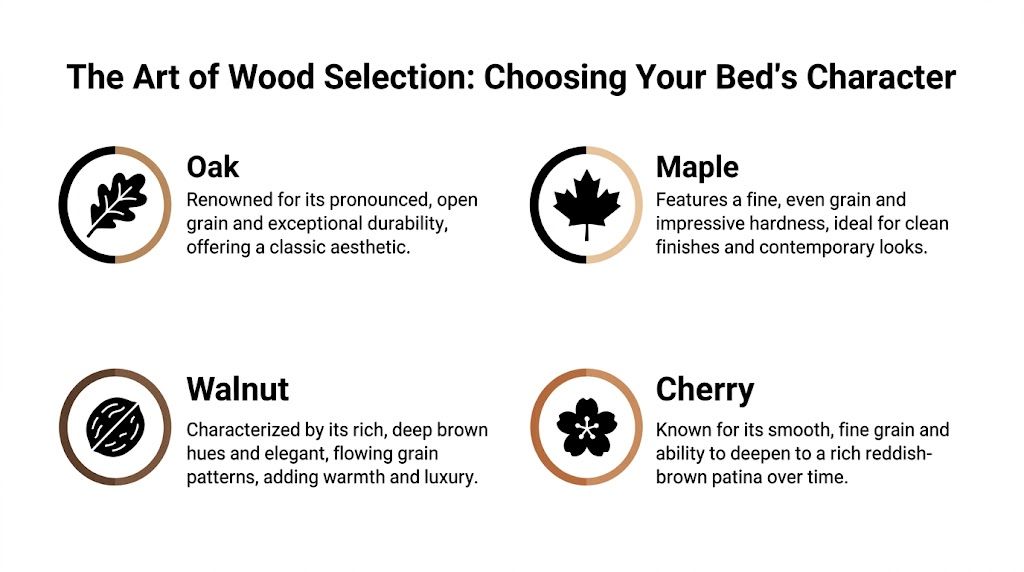
Reading the personality of each wood
Think of wood species the way you’d think about fabric in tailoring. The cut matters, but the character of the material matters just as much.
| Wood | Visual character | Best suited for |
|---|---|---|
| Oak | Pronounced grain, traditional presence | Classic and heritage interiors |
| Maple | Fine, even grain, cleaner appearance | Contemporary and transitional rooms |
| Walnut | Rich brown depth, elegant movement | Sophisticated, moodier bedrooms |
| Cherry | Smooth grain, warmer patina over time | Refined traditional spaces |
Oak often appeals to homeowners who want visible grain and a sense of permanence. It has confidence. It doesn’t disappear into the room, and it pairs beautifully with layered textiles and older architecture.
Maple is quieter. It suits a cleaner envelope and lets silhouette do more of the work. If you prefer a bed with crisp lines and restrained ornament, maple often gives you that design-forward look without losing warmth.
Walnut brings depth immediately. It can make a room feel more elegant and intimate, especially when balanced with lighter bedding and softer wall colours.
Cherry changes over time in a lovely way. For readers drawn to furniture that develops patina and history, cherry has a gracious, settled quality.
Why Southern Ontario climate matters
Not every wood behaves the same way in our region. Southern Ontario’s changing humidity asks a lot of bedroom furniture, especially in larger spans such as king bed side rails and headboards.
For that reason, material preparation matters as much as species. This overview of wood furniture and hardwood selection is useful if you want a deeper look at how different hardwoods perform over time.
One fact is especially important. For Southern Ontario’s variable climate, quartersawn hardwoods like hard rock maple with a Janka hardness of 1450 lbf are superior. They resist denting 40 to 60% better than softwoods and retain 92% of their structural integrity in mortise-tenon joints under cyclic humidity, according to this construction-focused reference.
That tells you two things at once. First, a beautiful bed still needs structural discipline. Second, wood choice isn’t just aesthetic. It’s practical.
Practical rule: In a climate with humid summers and dry winters, ask not only what the bed looks like, but how the wood was cut, dried, and joined.
Real wood versus look-alikes
Many shoppers are comparing solid hardwood to veneered, engineered, or faux alternatives in more than one category of the home. If you’re weighing how natural material changes the feel of a room, this short read on real wood offers a helpful parallel from another design category. The principle carries over. Authentic material has depth, variation, and warmth that imitation struggles to reproduce.
A simple way to decide
If you’re unsure where to land, start with the mood you want.
- Prefer a room that feels rooted and familiar? Oak is often the natural fit.
- Want a cleaner, lighter visual language? Maple usually supports that beautifully.
- Like a bedroom with richness and contrast? Walnut often delivers it.
- Love furniture that ages gracefully? Cherry rewards patience.
The wood you choose becomes the bed’s voice. Everything else in the room responds to it.
Understanding Timeless Craftsmanship and Joinery
It's easy to recognise a beautiful bed. Far fewer can recognise why one bed will last for decades while another begins to wobble, creak, or loosen after only a few moves.
The answer is usually hidden where you can’t immediately see it. In the joinery. In the rail construction. In the way one component locks into another.
By the early twentieth century, furniture making had already become part of St. Catharines’ identity. By 1925, local workshops produced 15,000 wooden beds annually, with king size variants making up 22% of production, according to historical documentation summarised here. That heritage matters because it reminds us that quality furniture was once judged by endurance first and decoration second.
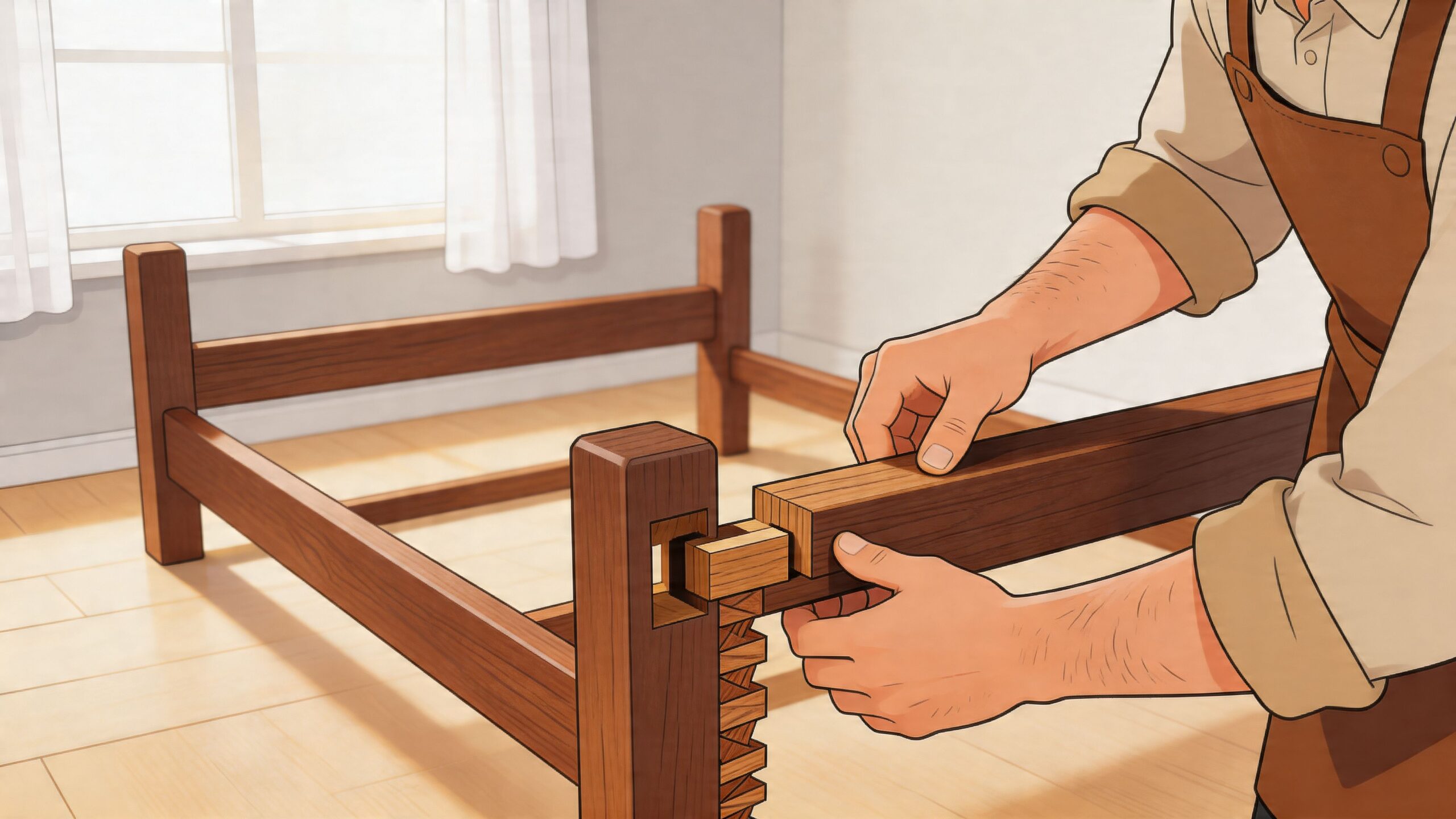
What strong joinery actually means
A strong bed frame doesn’t rely on fasteners alone. It uses shape against shape. One piece is cut to receive another, and the fit itself contributes to strength.
Mortise-and-tenon joinery is a classic example. One component forms a projecting tenon. The other is cut with a matching cavity, called the mortise. When properly made, that connection spreads force through the wood rather than asking a few screws to do all the work.
Dovetail joinery works on a similar principle. The interlocking shape resists pulling apart. It’s one reason well-made case goods and bed components can remain stable for years.
The difference you feel at home
There’s a practical reason this matters in a bedroom. A king bed has a wide span. Two people getting in and out, shifting during sleep, and sitting on the edge all create stress at the joints.
A bed built with better joinery usually feels:
- More stable when you lean against the headboard
- Quieter because the structure doesn’t shift as much
- More resilient if the bed is moved or reassembled
- More worth refinishing because the bones remain sound
Mass-market frames often lean heavily on bolts, corner blocks, glue, and thinner materials. That can work adequately for a time. It rarely creates heirloom quality.
Traditional joinery is like tailoring. You may not see every stitch at first glance, but you recognise the difference in how the piece holds its shape.
What to look for when you inspect a bed
You don’t need to be a cabinetmaker to spot signs of thoughtful construction. Look closely, ask questions, and trust what your hands tell you.
A short checklist helps:
- Check the rail connection. Does it feel precise and substantial, or light and mechanical?
- Inspect the inside faces. Quality often shows up where manufacturers assume no one will look.
- Ask about species and cut. Good makers can explain why they chose a material.
- Notice the finish over edges and corners. Poor construction often reveals itself at transition points.
If you enjoy learning how craftsmanship carries across a room, this guide to heirloom-quality solid hardwood end tables offers another useful lens. The principles of proportion, joinery, and material honesty are remarkably consistent across categories.
Why this still matters in design
A bedroom can be beautifully styled and still feel temporary if the main piece lacks integrity. The opposite is also true. A well-made wooden bed king size can enhance even a relatively restrained room because it brings authority with it.
That’s why names such as Stickley remain important in design conversations. Not because they follow fashion, but because they represent the discipline of making furniture that earns its place over time.
Designing Your Space with a King Bed
A king bed can make a bedroom feel luxurious, but only if the room supports it. When the proportions are off, even an exquisite frame starts to feel cumbersome. The bed should command the room, not crowd it.
That’s why good bedroom design starts with footprint before finish. You need to understand the actual size of the piece you’re bringing home, not just the mattress size printed on the label.

Start with the true dimensions
A standard king mattress is 76×80 inches, but a premium wooden frame adds 2 to 5 inches in width and length. For Southern Ontario homes, where master bedrooms often average 12×14 feet, that extra footprint matters. It also matters during delivery, because standard doorways are often 32 to 36 inches wide, as noted in this king mattress dimension guide.
That one detail clears up a common misunderstanding. People plan around mattress measurements, then feel surprised when the finished bed appears larger in the room. A wooden frame has rails, posts, headboard thickness, and often a more generous visual perimeter.
How to think like a designer
The easiest way to plan a king bed is to stop thinking of it as an isolated object. Instead, think in zones.
There is the bed zone itself. Then there’s the circulation zone around it. Then the companion zone made up of nightstands, lamps, window treatments, art, and the rug beneath.
A complete room concept asks whether those zones work together comfortably.
Here are three useful questions:
Can you move around the bed without turning sideways?
Easy movement affects how restful the room feels.Do your nightstands look proportional to the headboard?
Small tables beside a substantial king bed can make the room feel visually unbalanced.Does the bed leave room for softness?
Bedrooms need breathing room for drapery, rugs, and light.
Common layout mistakes
These are the problems we see most often in primary bedrooms:
- Underscaled bedside tables that look temporary beside a substantial frame
- A headboard that blocks window trim and makes the architecture feel compromised
- No rug plan beneath the bed, leaving the room visually top-heavy
- Ignoring entry clearance so delivery and placement become more difficult than expected
If you’re deciding how large your rug should be under a king bed, this guide on how to choose an area rug size is especially useful. It helps shift the room from furniture placement to full composition.
The room should feel as though the bed belongs there naturally. If every surrounding piece looks like an afterthought, the layout isn’t finished yet.
Designer’s Insight
Designer’s Insight
Headboard height should relate to the architecture around it. In rooms with lower ceilings or strong window lines, a quieter headboard often feels more elegant. In taller rooms, a more substantial headboard can create needed vertical balance.
The room should support the bed’s presence
A wooden bed king size is substantial by nature, and that’s part of its appeal. The key is pairing that scale with pieces that support it. Symmetry often helps. So do fuller bedside lamps, generous drapery panels, and a rug that extends the visual footprint rather than stopping abruptly.
Consequently, design services become valuable. A bed isn’t just placed. It’s integrated into the room’s architecture, circulation, and daily use.
Curating Your Style from Finish to Foundation
Style decisions are easier once you stop treating them as isolated choices. Headboard shape, wood tone, rug pattern, wall colour, and bedding texture all speak to one another. A bedroom feels bespoke when those decisions are made as a family rather than as strangers.
That’s why the bed’s finish matters so much. It isn’t merely surface treatment. It decides how the wood reads in the room and whether the piece feels formal, relaxed, refined, rustic, or subtly modern.
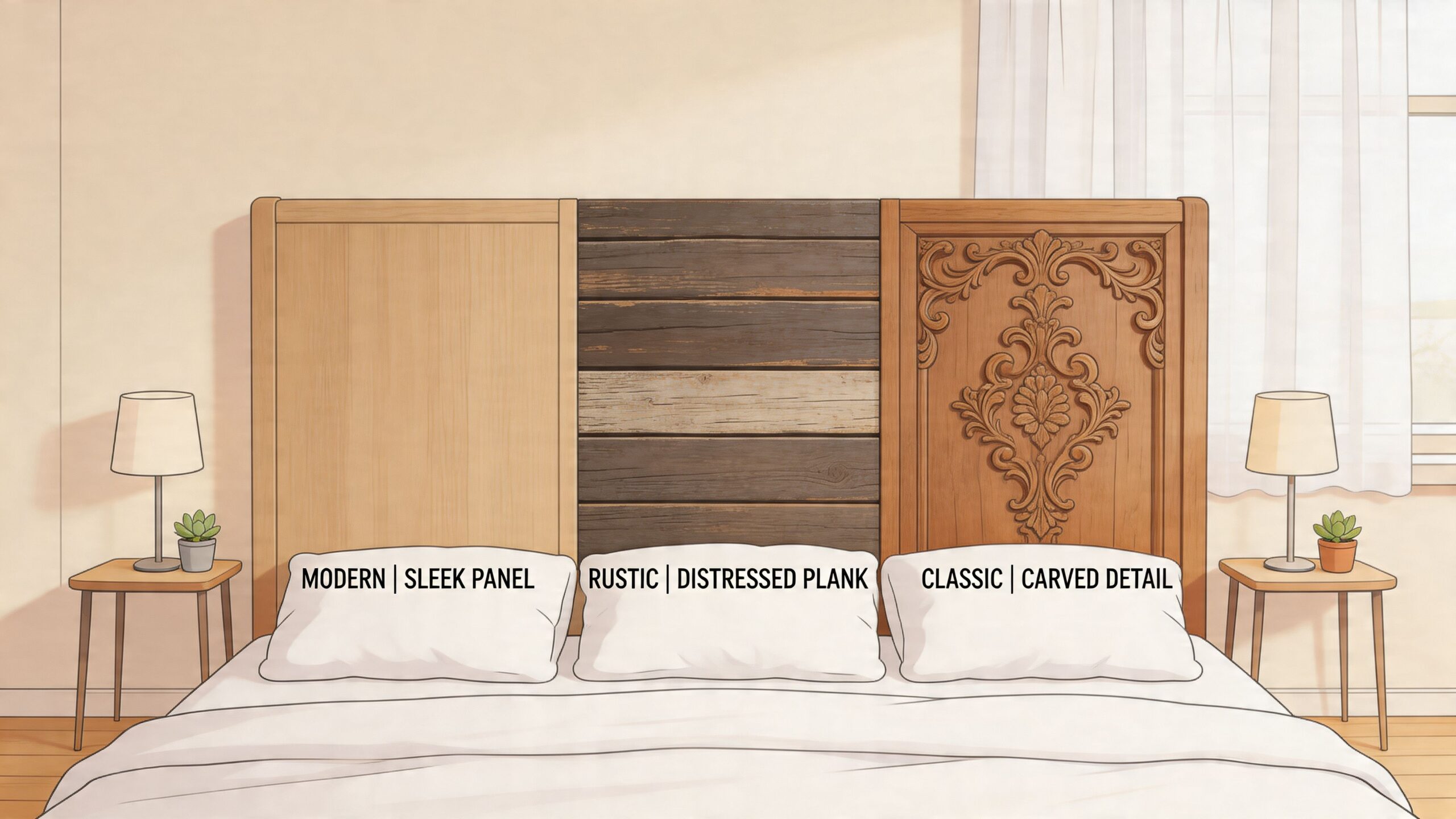
Choosing a style language
A few broad families tend to guide most decisions.
Traditional beds usually feature stronger silhouettes, panel detailing, mouldings, or carved elements. They pair well with richer stains, layered bedding, and rooms with architectural detail.
Modern designs often rely on cleaner lines and less ornament. They ask the wood to do more of the visual work through grain, finish, and proportion.
Rustic and farmhouse-inspired pieces sit somewhere else entirely. They favour texture, visible character, and an ease that feels less formal. If that’s your preference, this overview of rustic home styles offers helpful visual context for how the language extends through the rest of the room.
Finish changes everything
The same bed can read very differently depending on finish.
| Finish direction | What it tends to communicate |
|---|---|
| Natural or light stain | Airy, organic, contemporary |
| Medium walnut tone | Balanced, versatile, tailored |
| Deep espresso or darker stain | Formal, dramatic, grounded |
| Painted or opaque finish | Graphic, decorative, more styled |
A stain celebrates grain. It lets the material remain part of the story. Opaque finishes shift attention from the wood itself to the silhouette of the bed.
Neither approach is wrong. The right choice depends on whether you want the bed’s beauty to come from species and grain, or from shape and contrast.
The foundation under the bed
A room rarely feels finished until the floor is resolved. As a result, many otherwise beautiful bedrooms fall short. The bed may be strong, the bedding tasteful, and the lighting correct, but the room still drifts because there’s no visual anchor beneath it.
That’s why we often speak about rugs as Art for your Floor. A hand-knotted rug doesn’t merely soften the room. It sets the palette, controls the energy, and helps connect wood tones with textiles.
A rug should make the bed look intentional. Without that foundation, the room can feel as though the furniture is floating.
In design work across luxury furniture Niagara and Interior design services St. Catharines searches, this is one of the clearest dividing lines between a furnished bedroom and a composed one.
Sustainability belongs in the conversation
Material beauty and environmental responsibility don’t need to compete. In Ontario, 68% of consumers prefer sustainably sourced furniture, yet online listings often don’t explain sourcing clearly. Looking for FSC-certified local hardwoods and low-VOC finishes helps buyers make choices that align with both their homes and their values, according to this sustainability-focused reference.
That matters because finish affects more than colour. It affects indoor air quality, maintenance expectations, and how confidently you can live with the piece over time.
For homeowners interested in custom furniture Southern Ontario options, this is often where the most rewarding decisions happen. A thoughtful finish, a considered rug, and a bed silhouette that suits the architecture can turn one strong piece into a complete bedroom identity.
The Critelli Experience From Showroom to Sanctuary
Buying a bed online can feel efficient until the important questions start. How tall is the headboard in a real room? Does the walnut read warm or cool in evening light? Will the rail profile feel substantial or bulky? Is the finish quiet enough for the rest of the home?
Those are easier questions to answer in person. Material, scale, and craftsmanship ask to be seen at full size.
Why the showroom still matters
A premium bed is one of the few purchases where touch changes judgement immediately. You can run your hand across the grain, step back to assess proportion, and compare silhouettes without guessing from a screen.
For homeowners in the Greater Niagara, Hamilton, and Toronto markets, that kind of in-person evaluation often saves uncertainty later. It also supports a more complete room conversation. Not just the bed, but the nightstands, lighting, rug, mattress, and the room’s overall composition.
One relevant option in this category is the Outline Panel Bed in King size, which is offered in wood construction with a Cassel finish and a raised upholstered panel headboard. In practice, pieces like this help illustrate how wood and upholstery can work together in a bedroom that wants both structure and softness.
Design support changes the outcome
The strongest bedrooms are usually designed in relation to the whole house. Ceiling height, flooring tone, adjacent rooms, natural light, and personal routine all influence what will feel right.
That’s where a design consultation becomes practical rather than ornamental. It helps answer questions such as:
- Should the bed be the darkest piece in the room?
- Would a hand-knotted rug soften the architecture or sharpen it?
- Does the room need matching case goods, or would a more collected approach feel better?
- Would an upholstered insert in the headboard bring balance to all the wood in the space?
These are the kinds of decisions that shape long-term satisfaction.
White-glove matters more than people expect
The final stage is often the most overlooked. A large bed frame isn’t just delivered. It needs to arrive safely, move through the home carefully, be assembled properly, and be placed with intention.
That’s where professional furniture assembly services become part of the design experience, not just a logistical extra. White-glove delivery means the transition from showroom to home feels organised and calm. Packaging is removed. Components are assembled. Placement is handled with care.
A bedroom should feel finished the day the bed arrives, not halfway complete with hardware bags still on the floor.
The process matters because it protects both the piece and the mood you’re trying to create. When the experience is smooth, the room can immediately begin doing what it was meant to do. Support rest, beauty, and daily comfort.
Caring for Your Heirloom Investment
A well-made wooden bed doesn’t ask for complicated maintenance, but it does reward consistency. Small habits preserve finish, reduce wear, and help the bed age with grace.
The goal isn’t to keep the piece looking untouched. Good furniture should be lived with. The goal is to protect the qualities that made you choose it in the first place. The grain, the colour depth, the smoothness of the finish, and the quiet solidity of the structure.
The basic routine that works
Most care is simple.
- Dust with a soft dry cloth so fine particles don’t grind into the finish over time
- Wipe spills promptly because moisture left to sit can mark even a durable surface
- Avoid harsh cleaners that can dull or strip protective topcoats
- Use care when moving lamps or decor on nearby case goods so abrasion doesn’t spread through the room
If you’d like a more detailed approach to prevention, this guide on protecting wood furniture from scratches and stains is a helpful reference.
Protect the bed from the room itself
Sunlight and dry indoor heat can be harder on wood than daily use. If one side of the bed receives stronger direct light, you may notice subtle change over time. That isn’t always a flaw. Wood is a natural material, and variation is part of its appeal. Still, balance helps.
A few habits make a difference:
- Rotate accessories and bedding placement so exposure feels more even
- Use window treatments thoughtfully if strong afternoon sun reaches the headboard
- Maintain a steady indoor environment rather than letting the room swing from very dry to very humid
- Tighten hardware when needed so small shifts don’t become larger structural issues
What not to do
The most common damage usually comes from overcorrection. Too much polish. Too much water. A cleaner chosen for speed rather than suitability.
Keep it restrained. Clean gently. Follow the maker’s guidance for the finish you have. If the bed ever needs touch-up or service, it’s better to ask first than improvise with a product meant for another surface.
A wooden bed king size is built to stay with you. When cared for properly, it doesn’t just endure. It develops character, and that’s exactly what heirloom quality should do.
Experience the craftsmanship in person at Critelli Furniture. If you’re furnishing a bedroom in Southern Ontario and want a bed that feels considered within a complete room concept, book your complimentary design consultation today, or visit the Rug Market to find your room’s foundation.